“We were like brothers, me and Gerry. He was my blood, even though we weren't related. We were just boys.”
— Lipsha Morrissey reflecting on his relationship with Gerry Nanapush, highlighting their deep bond.

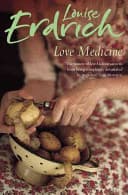
Louise Erdrich (1993)
Genre
Literary Fiction / Historical Fiction
Reading Time
700 min
Key Themes
See below
Sign in to track this book
Across generations, the Kashpaw and Lamartine families navigate love, betrayal, and the enduring spirit of their Ojibwe heritage on a North Dakota reservation.
The novel begins with the death of June Kashpaw, found frozen in a snowdrift after leaving a bar in Williston, North Dakota. Her estranged husband, Gordie Kashpaw, is one of the first to hear the news. June's death brings her extended family, mainly the Kashpaws and Lamartines, back to the reservation for her funeral. Her nephew, Lipsha Morrissey, a young man with a healing gift, is especially affected, feeling a deep sense of loss and responsibility. The family gathers, each member dealing with their own memories and complicated relationship with June. This sets the stage for the interwoven stories that follow and shows the deep connections and conflicts within the community.
This chapter goes into the past, focusing on Lulu Lamartine's childhood and her mother, Fleur Pillager. Lulu tells about her life in a government boarding school, describing the harsh assimilation policies and her longing for her family. She describes Fleur as a wild, untamable woman, deeply connected to the land and having mystical powers, especially after surviving multiple drownings. Fleur's history of love, loss, and resilience, including her relationships with Nanapush and Gerry Nanapush, is central to Lulu's identity and her understanding of her place in the world. This section emphasizes the lasting strength of the Pillager family line and the impact of historical trauma on later generations.
Lyman Lamartine tells the story of his beloved red convertible, a symbol of freedom and brotherhood shared with his older brother, Henry Junior. They bought the car together and took a memorable road trip. However, Henry's return from the Vietnam War greatly changes their relationship. Henry is deeply altered, suffering from severe PTSD, becoming withdrawn and haunted. Lyman tries desperately to reconnect with his brother, even intentionally damaging the convertible to give Henry a project. The chapter ends with a tragic scene where Henry, after a brief moment of clarity and joy while driving the repaired car, drowns himself in the river, leaving Lyman devastated and forever marked by the loss.
Marie Lazarre, a devout Catholic, tells about her early life and her intense, competitive relationship with Lulu Lamartine for Nector Kashpaw's affection. Marie, an orphan raised by nuns, is determined to marry Nector and build a respectable life. She describes her spiritual visions and her strong faith, often at odds with the reservation's more traditional beliefs. Her story details her eventual marriage to Nector, his political ambitions, and the challenges of raising their family, including Gordie. The chapter highlights the complexities of love, faith, and the struggle to maintain a sense of self and family amidst the changing culture of the reservation.
Lipsha Morrissey, now working at the senior care facility where Nector and Marie Kashpaw live, feels deep empathy for them, especially Marie, who is suffering from Nector's declining health and his renewed interest in Lulu Lamartine. Lipsha believes he can help rekindle their love with 'love medicine,' a traditional Chippewa remedy passed down from his grandmother, Nector's sister, Lulu's mother. He tries to prepare a powerful love medicine using a goose heart, but due to a mix-up, he accidentally feeds Nector a frozen turkey heart. The medicine fails, and Nector dies shortly after, leaving Lipsha guilty and questioning traditional remedies versus modern medicine.
Gordie Kashpaw, June's estranged husband, struggles with severe alcoholism and crushing guilt over June's death. He often hallucinates June, who appears to him, sometimes blaming, sometimes comforting. While drunk, he tragically runs over a deer, mistaking it for June. This event sends him into a deeper spiral of self-loathing and despair. His struggles show the destructive power of addiction and the deep impact of unresolved grief and guilt on a person's life. Marie, despite her own pain, tries to support him, showing the lasting, though strained, bonds within the family.
Albertine Johnson, Marie Lazarre and Nector Kashpaw's daughter, reflects on her family's complex history and the weight of their legacy. She tells about her mother's strong faith and her father's political aspirations, as well as Lulu Lamartine's constant influence. Albertine, a nurse living off the reservation, feels a sense of detachment yet also a strong pull towards her roots. She carefully observes her family's dynamics, especially the lasting rivalry between Marie and Lulu. This chapter provides an outsider-insider view, offering insight into the connected lives and the lasting power of family ties, even when strained by distance and different life choices.
After Nector's death, Lipsha Morrissey searches for his biological father, Gerry Nanapush, a charismatic Native American activist and legendary jailbreaker. Lipsha travels to Minneapolis, where he eventually finds Gerry, who is again on the run from the law. Their meeting is brief but important. Gerry, despite being an outlaw, offers Lipsha a sense of belonging and a connection to his heritage. Lipsha also learns more about his mother, June, and her own struggles. This encounter helps Lipsha accept his identity and his place within the larger family story, providing a key piece of his personal puzzle.
Lipsha returns to the reservation after meeting Gerry. He continues to deal with the meaning of his gifts and his family's history. The story ends with a moving scene where Lipsha, now more confident in his identity and abilities, encounters June's ghost by the river. He finally understands the circumstances of her death, not as a random tragedy but as an act of release or a journey. He comes to terms with her passing and his own role in the family, embracing his inherited 'love medicine' and his connection to the spiritual world. The ending suggests a hopeful future for Lipsha, based on tradition and self-acceptance.
Lulu Lamartine, now an elderly woman, reflects on her life, her many loves, and her lasting rivalry with Marie Lazarre. She tells about her passionate affair with Nector Kashpaw, her marriages, and her children. Lulu is a woman driven by desire and fierce independence, often clashing with social norms and the reservation's strict expectations. She openly discusses her relationships with Gerry Nanapush and her deep connection to the land and her heritage. Her story provides a different view from Marie's, showing the complexities of love, jealousy, and resilience among the women of the reservation.
Marie Lazarre, now an elderly and respected matriarch, reflects on her life, her strong Catholic faith, and her complex relationships with her family, especially Lulu Lamartine. Despite many hardships, including Nector's infidelities and the challenges of raising her children, Marie remains firm in her beliefs. She sees her life as a sign of God's grace and her own resilience. Her story provides a contrast to Lulu's, highlighting the different paths taken by the women of the reservation and their individual struggles to find meaning and purpose within their community and spiritual traditions.
This chapter gives June Kashpaw's perspective, offering insight into her final hours and why she left the bar in Williston. June is shown as a restless soul, always searching for belonging and purpose. She is haunted by past traumas, including the loss of her children and her difficult relationship with Gordie. Her decision to walk out into the snowstorm is not necessarily an act of despair, but perhaps a final, desperate attempt to find peace or to reconnect with something primal and free. Her journey symbolizes the larger themes of displacement and the search for identity within the Native American experience.
The Catalyst/Supporting
Her arc is revealed posthumously, as the family pieces together her life, ultimately understanding her search for peace and belonging.
The Protagonist
Lipsha evolves from a naive, guilt-ridden young man to one who embraces his heritage and spiritual gifts, finding a sense of belonging.
The Protagonist/Matriarch
Marie maintains her strong faith and matriarchal role, finding strength in her beliefs despite personal hardships and family conflicts.
The Protagonist/Patriarch
Nector's arc shows his decline from a powerful tribal leader to a frail old man, haunted by his past loves and decisions.
The Protagonist/Matriarch
Lulu remains fiercely independent and passionate throughout her life, embracing her desires and her heritage despite societal judgment.
The Supporting/Mentioned
Gerry remains a symbol of resistance and a connection to cultural identity, even as he lives a life on the run.
The Supporting
Gordie's arc is one of descent into addiction and grief, struggling to find redemption or peace after June's death.
The Supporting
Henry's arc is a tragic descent from a lively young man to one destroyed by war trauma, culminating in his suicide.
The Supporting
Lyman grapples with the traumatic loss of his brother, learning to live with grief and the enduring impact of their shared past.
The Supporting
Albertine navigates her identity between her professional life off the reservation and her deep-seated family connections.
The Mentioned/Ancestral
Fleur's influence is felt throughout the generations, her legendary status shaping the identities of her descendants.
Despite rivalries, betrayals, and distance, the Kashpaw and Lamartine families stay connected. June's death, for example, brings everyone back to the reservation, showing the deep ties that go beyond individual conflicts. Characters like Marie and Lulu, though rivals, are bound by shared history and a complex relationship. The novel shows how family provides both great struggle and strong support, forming the foundation of identity and survival within the Native American community.
“We were a family, like a bunch of trees, some with roots tangled, some with branches intertwined, but all of us reaching for the same sun.”
The characters in 'Love Medicine' constantly deal with the tension between their Ojibwe traditions and the modern, often Westernized, world. Lipsha's attempts at 'love medicine,' for example, contrast traditional healing with the realities of a nursing home. Marie Lazarre's strong Catholicism differs from the more fluid, spiritual beliefs of characters like Lulu or Fleur Pillager. This theme explores the challenges of keeping cultural identity, language, and spiritual practices in the face of assimilation, poverty, and outside pressures. It shows the resilience and adaptation of the Anishinaabe people.
“What got lost in the shuffle of the years, what got saved, was a mystery to me.”
The novel is full of different kinds of love—romantic, familial, and unrequited—and the deep grief that follows loss. June's death is the first event, but the stories show many heartbreaks: Lyman's devastation over Henry's war-induced trauma and suicide, Gordie's alcoholism after June's passing, and the lasting pain of Nector and Marie's complicated marriage. Love is often mixed with suffering, jealousy, and sacrifice, showing its messy, powerful, and often destructive nature. The characters' attempts to cope with loss, whether through traditional rituals, faith, or self-destruction, drive much of the story's emotion.
“There was no cure for what was in the blood.”
Many characters deal with their sense of self and their place in the world. Lipsha, especially, goes on a literal and figurative journey to find his parents and understand his inherited gifts. June's restless wandering symbolizes a deeper search for belonging that she never finds. Characters like Albertine, living off the reservation, constantly weigh their individual goals against the pull of their cultural roots. This theme explores how identity is shaped by family history, cultural heritage, personal choices, and the shared experience of being Native American in a society that often tries to erase or redefine them.
“You got to know where you come from to know where you're going.”
The novel directly shows the trauma passed down through generations of Native Americans, from historical injustices, assimilation policies (like boarding schools, which Lulu experienced), and the psychological scars of war (Henry Jr.'s PTSD). This trauma appears as alcoholism (Gordie), mental illness, and a widespread feeling of loss. However, alongside this pain, there is great resilience. Characters like Marie and Lulu, despite their hardships and heartbreaks, endure and adapt, finding strength in their spirit, their community, and their connection to the land. The stories highlight the strong spirit of the Ojibwe people.
“We are a tough people. We keep going.”
The story is told through the shifting perspectives of various family members.
The novel employs multiple first-person narrators, each taking a turn to recount events from their unique viewpoint. This allows for a multifaceted and often contradictory understanding of the same events and characters. For example, the rivalry between Marie and Lulu is illuminated through their individual, deeply personal accounts, revealing their differing motivations and perceptions. This technique builds a rich, complex tapestry of the family's history, emphasizing the subjective nature of truth and memory, and mirroring the oral storytelling traditions prevalent in many Native American cultures. It also allows the reader to piece together the larger narrative mosaic.
The story jumps back and forth in time, revealing events out of chronological order.
The plot does not follow a strict chronological order. Instead, it moves fluidly between different time periods, sometimes spanning decades within a single chapter. June's death, which opens the book, is a present event, but subsequent chapters delve into the past lives of characters like Fleur, Nector, and Marie, providing context for current relationships and conflicts. This non-linear structure reflects the nature of memory and oral tradition, where stories are recalled and re-told, often out of sequence, to illuminate present understandings. It allows for a deeper exploration of generational trauma and the long-lasting impact of past events on the present.
Objects and events carry deeper, often spiritual, meanings.
Various symbols are woven throughout the narrative, enriching its themes. The red convertible, for instance, symbolizes freedom, brotherhood, and ultimately, the shattered innocence and trauma of war for Lyman and Henry. The 'love medicine' Lipsha attempts to create represents the clash between traditional spiritual beliefs and modern skepticism, as well as the inherent power of intention. The geese and other animals often serve as spiritual guides or omens, connecting the characters to the natural world and their Ojibwe heritage. These symbols deepen the emotional and cultural resonance of the story.
The narrative mimics the style and flow of spoken stories.
The novel's structure and language often evoke the oral storytelling traditions of the Ojibwe people. Each narrator's voice feels distinct and authentic, as if they are directly sharing their personal history and perspectives. The non-linear progression, the emphasis on character relationships, and the way stories are passed down and reinterpreted across generations all contribute to this sense. This device not only grounds the narrative in cultural authenticity but also makes the reader feel like an intimate participant in the unfolding family saga, privy to shared histories and secrets.
“We were like brothers, me and Gerry. He was my blood, even though we weren't related. We were just boys.”
— Lipsha Morrissey reflecting on his relationship with Gerry Nanapush, highlighting their deep bond.
“The only thing that ever really went wrong was that sometimes, in the middle of all the good, a person would just up and die.”
— Lulu Lamartine contemplating the unpredictable nature of life and loss.
“I was just a kid then, and I didn't know anything about love, not real love. I just knew how to want things.”
— Marie Lazarre looking back on her youth and early experiences with desire.
“There are some wounds that never show on the outside. But they're the ones that hurt the most.”
— A general observation within the narrative about hidden emotional pain.
“We were supposed to be safe there. But there was no safe place, not really, not for us.”
— Marie Lazarre reflecting on the false sense of security and the pervasive dangers faced by her community.
“The dead speak to us. They tell us things. If we listen.”
— A recurring theme, often associated with Lipsha Morrissey's spiritual gifts and connection to ancestors.
“Love medicine. You got to learn it. It's not like the other kind. It's got no cure.”
— Lipsha Morrissey musing on the nature of love and its powerful, often unmanageable, effects.
“Sometimes you got to make a mistake to get to the right place.”
— A character's reflection on the role of error and learning in life's journey.
“History is not a line. It’s a circle.”
— A thematic statement emphasizing the cyclical nature of events and generational patterns within the families.
“We were always trying to get away, and always coming back.”
— A common sentiment among the characters, reflecting their complex relationship with their home and origins.
“The wind was a spirit. It talked to me. It told me things.”
— Lipsha Morrissey's connection to the natural world and his spiritual perceptions.
“There are things you can't outrun, no matter how fast you go.”
— A character's realization about the inescapable nature of one's past or destiny.
“It was the quiet things that always got you, the things you didn't see coming.”
— A reflection on the insidious nature of subtle dangers or emotional wounds.
Ready to see how well you understood this book? Take our interactive quiz with 10 questions.

Karen Louise Erdrich is an American author of novels, poetry, and children's books featuring Native American characters and settings. She is an enrolled member of the Turtle Mountain Band of Chippewa Indians, a federally recognized tribe of Ojibwe people.







