“For whom is the funhouse fun? Perhaps for the funhouse itself.”
— The narrator's reflection on the nature of the funhouse and its purpose.

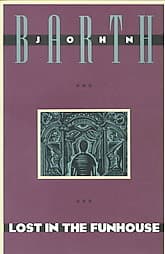
John Barth (1968)
Genre
Literary Fiction
Reading Time
240 min
Key Themes
See below
Sign in to track this book
John Barth's "Lost in the Funhouse" blurs the lines between author, story, and reader, inviting you to enjoy the experimental nature of fiction itself.
The collection opens with 'Frame-Tale,' a metafictional piece where the narrator directly addresses the reader about storytelling and the difficulty of beginning a tale. The narrator, presumably Barth, discusses the recursive structure of a frame-tale, where a story contains another story, which in turn contains another. He considers the infinite regress and self-reference in such structures, questioning the act of creating and consuming fiction. This piece sets the stage for the experimental and self-aware nature of the stories that follow, immediately establishing a dialogue between author, text, and reader about narrative conventions.
In 'Night-Sea Journey,' the narrator is a single sperm among millions, in a desperate race towards an unknown destination. This sperm, however, has a philosophical consciousness, questioning the meaning of its existence, the purpose of the journey, and the nature of the 'Goal' – the ovum. It considers the futility of individual effort within a vast, indifferent process and debates with a more optimistic companion. The journey is dangerous, with many brethren perishing, forcing the narrator to confront mortality and the overwhelming odds against success. This allegorical tale explores themes of identity, free will, and the search for meaning in a predetermined existence.
This story introduces Ambrose Mensch as a young boy in Ocean City, Maryland, during the early 20th century. Ambrose is sensitive and introspective, feeling alienated from his boisterous, conventional family, particularly his father, a successful hotelier. He grapples with his emerging sense of self, his intellectual curiosity, and his physical awkwardness. The narrative highlights his internal struggles with self-doubt and his desire for individuality, often contrasting his inner world with the external expectations placed upon him by his family and society. This piece lays the groundwork for Ambrose's recurring role as a character who embodies the author's anxieties about identity and storytelling.
'Autobiography: A Self-Recorded Fiction' features a narrative that speaks directly to the reader, detailing its own birth and development as a fictional construct. The story describes its awareness of being written, its dependence on its author, and its inherent artificiality. It expresses a desire for genuine existence and laments its predetermined plot and characterizations. The narrative struggles with its identity as a fabricated entity, questioning its purpose and the meaning of its own existence within fiction. This piece is a commentary on the nature of storytelling, the relationship between author and text, and the boundaries between reality and fiction.
The titular story follows a young Ambrose Mensch as he navigates a funhouse with his family and a girl named Magda. However, the narrator frequently breaks the fourth wall, directly addressing Ambrose as a character, discussing his motivations, his self-consciousness, and the mechanics of the story. Ambrose, aware of his fictionality, struggles with his identity and his predetermined path within the narrative. The funhouse itself becomes a metaphor for the labyrinthine nature of storytelling and the existential predicament of being a character in a fiction. He tries to impress Magda, but his self-awareness and the narrator's commentary constantly undermine his efforts, highlighting his awkwardness and the constructed nature of his experience.
'Petition' is a dialogue between Siamese twins, one male and one female, who are conjoined at the hip. They engage in a philosophical debate about their shared existence, their individual identities, and their conflicting desires. The male twin, who narrates, is more introspective and analytical, while the female twin is more pragmatic and sensual. They discuss how their physical bond affects their autonomy, sexuality, and the possibility of separation. Their conversation explores themes of duality, interdependence, and the struggle for selfhood within an inseparable union, using their unique condition as a metaphor for various forms of human connection and conflict.
In 'Life-Story,' an author tries to write his autobiography but finds himself constantly fictionalizing. He grapples with the inherent artificiality of memoir and the difficulty of presenting objective truth. The author, who resembles Barth, questions whether his life is merely a story he is telling, or if the act of telling it is shaping his reality. He becomes increasingly self-conscious of the narrative conventions he uses, leading to a metafictional exploration of the relationship between life and literature, and the impossibility of separating the two when one is a writer. The story highlights the paradox of trying to capture genuine experience through the artifice of language.
'Glossolalia' presents a series of fragmented monologues from various unnamed, disembodied voices, like a Greek chorus. Each voice speaks in a distinct, often idiosyncratic style, offering philosophical musings, personal anecdotes, and existential questions. The voices discuss themes of communication, meaning, belief, and the nature of language. The piece is characterized by its stream-of-consciousness style and its exploration of the limits and possibilities of expression. It creates a cacophony of perspectives that collectively explore the human condition, without settling on any single truth, reflecting the fragmented and subjective nature of reality.
'Menelaiad' is a complex, multi-layered story told from the perspective of Menelaus, the King of Sparta, after the Trojan War. He tries to recount his experiences, particularly his capture of Proteus and the prophecies he received, but the narrative is constantly interrupted and complicated by his own self-awareness of storytelling. The story features nested narratives, as Menelaus recounts what Proteus told him, what Helen told him, and so on, creating an infinitely regressing series of unreliable narrators. This piece is a display of narrative recursion, exploring themes of truth, memory, love, and the elusive nature of reality, all filtered through the lens of a weary, self-conscious storyteller.
The final story, 'Anonymiad,' is narrated by a forgotten poet who has been shipwrecked on a desolate island. To preserve his legacy and his sanity, he carves his life story, his poems, and his philosophical reflections onto various objects—coconuts, seashells, turtle shells—and casts them into the sea, hoping they will be discovered. He recounts his past life, his artistic struggles, and his present isolation, all while contemplating the futility and necessity of art. The narrative is a meditation on the impulse to create, the desire for recognition, and the enduring power of storytelling against oblivion. It is a final, melancholic reflection on the themes of authorship and the search for meaning.
The Protagonist/Authorial Voice
The narrator's arc is less about personal development and more about an evolving meta-fictional exploration, becoming increasingly self-aware and experimental in its narrative strategies.
The Recurring Protagonist
Ambrose's arc is one of perpetual self-consciousness, moving from childhood awkwardness to a deeper, more existential awareness of his role as a character, never fully resolving his identity crisis.
The Protagonist
The sperm's arc is primarily intellectual and existential, culminating in a reluctant acceptance of its role in the grand, unknowable process.
The Protagonist
Its arc is a journey from self-realization as a construct to a melancholic acceptance of its fictional fate.
The Protagonist
Menelaus's arc is a recursive one, perpetually trapped in the act of retelling, never reaching a definitive conclusion or understanding.
The Protagonists
Their arc is a continuous, unresolved debate, representing the ongoing tension between individual desire and shared existence.
The Protagonist
His arc is one of resignation to his fate but persistent, almost defiant, creation, finding meaning in the act of storytelling itself.
Barth's collection is a work of metafiction, where the stories constantly draw attention to their own artificiality as fictional constructs. Narrators often address the reader directly, discuss narrative conventions, and question the act of storytelling. This is clear in 'Frame-Tale,' which discusses recursive structures, and 'Autobiography: A Self-Recorded Fiction,' where the story itself is the protagonist, lamenting its predetermined plot. In 'Lost in the Funhouse,' the narrator comments on Ambrose's character development and his awareness of being a fictional entity. This theme challenges traditional notions of realism and immerses the reader in the mechanics of fiction.
“For whom is the funhouse fun? Perhaps for the builder. Perhaps for the victim.”
Many characters in the collection grapple with their identity, often in relation to their fictionality or unique circumstances. Ambrose Mensch, in 'Ambrose His Mark' and 'Lost in the Funhouse,' is self-conscious, struggling to define himself amidst family expectations and his awareness of being a character. The philosophical sperm in 'Night-Sea Journey' questions its individual purpose within a vast, collective endeavor. The conjoined twins in 'Petition' explore the boundaries of individual and shared identity. This theme highlights the constructed nature of self and the existential search for meaning in a world that often feels predetermined or artificial.
“I am a story, told or written. I am told by myself, but not written by myself. I am a fiction.”
Barth explores the idea that objective truth is unattainable, especially through narrative. Stories like 'Menelaiad' show this, with Menelaus's endlessly nested and unreliable accounts of the Trojan War, where each retelling further obscures the original event. The fragmented voices in 'Glossolalia' offer multiple, often contradictory perspectives, preventing any single truth from emerging. This theme suggests that reality itself is subjective and constructed through language, and that meaning is often provisional or elusive, residing more in the process of questioning and interpretation than in definitive answers.
“What is the truth? I tell you, no man knows the truth. Each man tells his story, and the stories contradict. What then?”
The collection explores the anxieties and challenges in the creative process. The various authorial narrators, or characters who are writers (like the narrator in 'Life-Story' or the 'Anonymiad'), grapple with writer's block, the limitations of language, the burden of originality, and the desire for legacy. 'Life-Story' blurs the lines between life and fiction, as the author struggles to write his autobiography without fictionalizing it. This theme highlights the paradoxical nature of art: its artificiality as a construct versus its potential to convey truths about the human condition, and the artist's struggle for authenticity and meaning.
“To be what I am, I must be more than I am. To be me, I must be my story. But my story must be more than me.”
Stories that self-consciously draw attention to their own status as fictional constructs.
Metafiction is the overarching plot device in 'Lost in the Funhouse.' It manifests through narrators who directly address the reader, discuss narrative conventions, and comment on the act of storytelling itself. This includes breaking the fourth wall, characters aware of their fictionality (Ambrose in 'Lost in the Funhouse'), and stories that are themselves the protagonists ('Autobiography: A Self-Recorded Fiction'). This device challenges traditional notions of realism, blurring the lines between author, text, and reader, and forcing an examination of the artificiality and construction of narrative.
Stories contained within other stories, creating layers of narrative.
Barth frequently employs nested narratives, or 'mise en abyme,' where a story contains another story, which in turn contains yet another. The most prominent example is 'Menelaiad,' where Menelaus recounts what Proteus told him, who in turn recounted other stories, leading to an infinite regress of unreliable accounts. 'Frame-Tale' explicitly discusses this structure. This device highlights the subjective and mediated nature of truth and memory, demonstrating how information is filtered and transformed through multiple tellings, making it impossible to reach an original, unadulterated truth.
Stories that convey a deeper symbolic meaning beyond their literal plot.
Many of Barth's stories function as allegories or parables, using specific scenarios to explore universal philosophical or existential questions. 'Night-Sea Journey,' with its philosophical sperm, is a clear allegory for human existence, the search for meaning, and the journey of life. The funhouse itself in 'Lost in the Funhouse' serves as an allegory for the labyrinthine nature of storytelling and the complexities of identity. These devices allow Barth to tackle profound themes in a playful and intellectually stimulating manner, inviting readers to interpret the symbolic layers of meaning.
A narrative technique that mimics the continuous, unedited flow of a character's thoughts.
While not every story uses it exclusively, elements of stream of consciousness are present, particularly in the internal monologues of characters like the sperm in 'Night-Sea Journey' or the author in 'Life-Story.' The fragmented, philosophical musings of the voices in 'Glossolalia' also exhibit this device, reflecting the raw, unfiltered workings of the mind. This technique allows Barth to delve deep into the psychological and philosophical states of his characters, presenting their anxieties, questions, and self-awareness in a direct and immediate manner, often without conventional narrative transitions.
“For whom is the funhouse fun? Perhaps for the funhouse itself.”
— The narrator's reflection on the nature of the funhouse and its purpose.
“The story you are about to read is a story about a story, which is to say, a story about itself.”
— The opening lines of 'Title', setting up its self-referential nature.
“To turn experience into language, language into print, print into a book, a book into a story, a story into a reader, a reader into a character, a character into a person, a person into a writer, a writer into God, God into the void, the void into everything.”
— A contemplation on the recursive nature of creation and storytelling within 'Life-Story'.
“Once upon a time there was a story that began, 'Once upon a time there was a story that began...' and so on.”
— From 'Title', demonstrating an infinite regress in narrative beginnings.
“Ambrose, you're a sensitive child. You feel things. That's why you're unhappy.”
— A mother's observation about her son Ambrose in 'Lost in the Funhouse'.
“The author, in the privacy of his study, is at this moment wondering how to continue this story.”
— A direct authorial intrusion in 'Life-Story', breaking the fourth wall.
“He wishes he had never been born. He wishes he were a character in a book, so he could be rewritten.”
— Ambrose's despair and longing for control over his own narrative in 'Lost in the Funhouse'.
“What does one do when faced with the fact that one's story is not one's own?”
— A question posed by the narrator/character in 'Life-Story' about agency.
“This is the story of a man who loved a woman who loved a man who loved a woman who loved a man...”
— The cyclical and repetitive nature of relationships described in 'Menelaiad'.
“The medium is the message, but the message is also the medium.”
— A rephrasing of McLuhan's idea within the context of self-referential art.
“To be perfectly frank, I am tired of stories that begin with 'Once upon a time.'”
— A meta-commentary on traditional narrative openings in 'Night-Sea Journey'.
“The end of the story is the beginning of the next story, and the beginning of the story is the end of the last story.”
— A reflection on the continuous and interconnected nature of narratives.
“What I want is to be free of all this, to be a simple, uncomplicated character in a simple, uncomplicated story.”
— A character's longing for simplicity and escape from meta-narrative complexities.
“The world is not a funhouse. It is a serious place, and we are serious people.”
— A contrasting statement to the central metaphor, perhaps ironically.
“He was a character, and he knew it, and that was his tragedy.”
— A character's self-awareness of their fictionality and its implications.
Ready to see how well you understood this book? Take our interactive quiz with 10 questions.

John Simmons Barth is an American writer who is best known for his postmodern and metafictional fiction. His most highly regarded and influential works were published in the 1960s, and include The Sot-Weed Factor, a satirical retelling of Maryland's colonial history, and Lost in the Funhouse, a self-referential and experimental collection of short stories. Though Barth's work has been controversial among critics and readers, he was co-recipient of the National Book Award in 1973 for his novel Chimera with John Williams for Augustus. Despite Barth's influence on postmodern literature in America, his influence and publicity have decreased since his novels were published.







