“It was a dark and stormy night.”
— The opening line of the novel, a deliberate cliché.


Martin Amis (1990)
Genre
Literary Fiction / Mystery
Reading Time
12-15 hours
Key Themes
See below
Sign in to track this book
In a London near collapse, the alluring Nicola Six, haunted by visions of her own death, sets two men against each other, forcing them to confront the murder she knows one of them will commit.
Samson Young, an American writer with writer's block and a mysterious illness, arrives in London in 1999, on his 35th birthday. He lives in Notting Hill, trying to write a novel about the end of the world, which he calls 'the Crisis'. He is immediately drawn into the lives of London's eccentric and morally ambiguous residents. Samson meets Nicola Six, who claims to know she will be murdered on her 35th birthday, which is soon. She has chosen two men as her potential killers: Guy Clinch, a wealthy, naive man, and Keith Talent, a working-class dart player and petty criminal. Samson, interested by Nicola's story and its narrative potential, decides to write about her and her chosen assassins, becoming an observer.
Nicola Six begins her manipulation of Guy Clinch, a man defined by his upper-class background, his careful nature, and his naiveté. Guy is married to Hope, who has become distant and neglectful, especially after their difficult daughter, Marmaduke, was born. Nicola targets Guy's repressed desires and his wish for connection, starting a series of encounters that slowly dismantle his conventional life. She appears in his life under different identities, seducing him with her charm and intellect, while also mocking his innocence. Her goal is to push him to an emotional and psychological extreme, making him a likely candidate for murder, or a tool in her larger plan.
At the same time, Nicola also begins to manipulate Keith Talent, a rough dart player from a working-class background, who spends his days in pubs, gambling, and committing small crimes. Keith is married to Kath Talent, who endures his infidelity and rudeness. Nicola enters Keith's world, often at the Black Cross pub, where he plays darts. She uses her allure to provoke his jealousy, possessiveness, and violent tendencies. Unlike Guy, Keith is already prone to aggression, and Nicola's interactions with him are designed to push him further into a state of volatile rage, making him another main suspect for her coming murder. She watches his reactions, documenting them for Samson, as she plans her own death.
The Black Cross pub is a central place for Nicola, Guy, and Keith's lives to meet. It is Keith's usual spot, where he plays darts and commits crimes. Nicola often visits, using it as a stage for her manipulations, watching both men as they interact, often unknowingly, with each other. Guy, at first uncomfortable in such a place, finds himself drawn there by Nicola. Samson Young, the narrator, also spends time at the pub, watching the interactions, taking notes, and sometimes getting involved in small ways. The pub becomes a small example of London's social classes, where class differences blur under the influence of desire, jealousy, and the coming 'Crisis'.
As Nicola's plans unfold, Samson Young becomes more involved in the story he is trying to write. He is not just an observer but a participant, constantly questioning Nicola's predictions and her control over events. He deals with the ethical questions of writing about a foreseen murder, and his own part in its potential occurrence. Samson's writer's block begins to lift as the story of Nicola's life and impending death gains a compelling force. He documents the details of her manipulations, his own feelings, and the increasing tension between Guy and Keith, all while thinking about fate, free will, and the author's role.
Throughout the story, the coming 'Crisis'—an unspecified global disaster that threatens to end the world—is a constant background. News reports and public worries about environmental collapse, nuclear war, and societal breakdown fill the characters' lives. This external threat mirrors the characters' internal problems and moral decay. Nicola's personal apocalypse, her foreseen murder, becomes a small story within the larger story of global doom. Samson often talks about the 'Crisis,' connecting his characters' individual problems to humanity's wider troubles, suggesting that the end is both literal and symbolic.
Nicola's manipulations become more extreme and psychologically damaging. She humiliates Guy Clinch repeatedly, showing his weaknesses and driving him to a nervous breakdown. She creates situations that make him feel powerless and foolish, often involving other characters like Guy's wife Hope, or Nicola's own mother. At the same time, she continues to fuel Keith Talent's jealousy and rage, hinting at sexual encounters with Guy and showing her independence. Her goal is to remove their inhibitions and show their darkest impulses, making both men capable of violence. Samson observes these increasing provocations with a mix of fascination and dread, realizing the story is getting out of his control.
A dart tournament at the Black Cross becomes a central point for the characters' interactions. Keith Talent, a skilled but volatile player, is competing, and his performance is linked to his self-worth and his criminal dealings. Guy Clinch is there, increasingly drawn into Nicola's world, and the tension between him and Keith is clear. Nicola uses the event to further her plans, arranging encounters and conversations that increase the animosity. The tournament's outcome, and the drunken aftermath, lead to more confrontations and a heightened sense of coming violence, pushing both Guy and Keith closer to the edge, and confirming their roles as potential murderers in Nicola's unfolding drama.
As Nicola Six's 35th birthday, the prophesied day of her murder, gets closer, Samson Young feels increasing despair. He understands that he is not just writing a story, but actively helping to create it, yet he feels unable to change the outcome. He becomes more convinced that Nicola's prediction will come true, and that one of his protagonists will kill her. His own illness, the 'writer's disease,' gets worse, mirroring the moral sickness he sees around him. He struggles with the weight of his authorship, the responsibility for the lives he is writing about, and the ethical problem of observing rather than preventing a murder.
On the night of her 35th birthday, Nicola Six is murdered. The story builds to this event, with both Guy Clinch and Keith Talent present and in extreme emotional distress. However, the killer is not who the reader, or even Samson, might expect. It is revealed that Nicola Six herself planned her own death, not by provoking Guy or Keith, but by hiring a hitman, Mark Asprey, to ensure the prophecy came true and provide a definite ending to her story. Furthermore, in a surprising twist, it is revealed that Samson Young is not just the narrator, but the actual killer, having taken on the persona of Mark Asprey, and that he is not Samson Young at all, but Mark Asprey, a previously established character and writer in the novel, who has been writing the entire story as a form of self-justification or artistic project. The entire story has been a carefully constructed literary device, with the author as the ultimate manipulator.
The Protagonist/Antagonist
Nicola's arc is less about internal change and more about the execution of her elaborate plan, culminating in her pre-ordained death and the revelation of her ultimate control.
The Narrator/Protagonist/Antagonist
Samson's arc is a journey from supposed objective observer to deeply involved participant, ending with the shattering revelation of his true identity and culpability, reframing the entire narrative.
The Supporting/Victim
Guy's arc is a descent from naive innocence to a state of profound psychological distress and humiliation, revealing the fragility of his privileged existence.
The Supporting/Victim
Keith's arc is a progression from existing aggression to a heightened state of violent rage and jealousy, orchestrated by Nicola's manipulations.
The Supporting
Hope's arc is static, serving primarily as a catalyst for Guy's vulnerability and a symbol of domestic malaise.
The Supporting
Kath's arc is largely static, serving to highlight Keith's destructive nature and the stoicism of those around him.
The Mentioned
Marmaduke's arc is static; she primarily serves as a symbolic and contextual element.
The Supporting/Antagonist
Asprey's arc is a narrative misdirection, culminating in the shocking revelation of his true identity and his central role as the orchestrator and executor of the plot.
The novel questions how much characters control their destinies versus being subject to fate. Nicola Six believes she is fated to be murdered and actively plans events to fulfill this, blurring the line between acceptance and action. Samson Young, as narrator, wonders if he is just documenting a predetermined event or actively shaping it. The twist at the end suggests that free will, in the story, is an illusion, replaced by the author's control.
““I’ve known all along that I’m going to be murdered. I’m going to be murdered on my thirty-fifth birthday. Which is next week.””
Amis uses *London Fields* to examine the author's role and the act of storytelling. Samson Young is a writer within the novel, struggling with his craft and observing his characters, but his narrative is revealed to be a manipulation. The final twist, where Samson is revealed to be Mark Asprey, the killer, and the true author, challenges the reader's view of narrative authority and truth. The novel suggests that authors, like Nicola, can be manipulative forces, shaping reality through their creations, and that the line between fiction and reality is permeable.
““I am the author. I am the voice. I am the one who gives you your own voice, and your own life.””
The novel is set against a coming global catastrophe, 'the Crisis,' which represents a broader moral and environmental decline. This external threat mirrors the characters' internal corruption and moral ambiguity. London is shown as a place of squalor, crime, and cynicism. The characters, from Nicola's manipulations to Keith's violence and Guy's weakness, show different forms of moral decay, suggesting a society near collapse, both literally and figuratively. The 'Crisis' is a constant reminder of humanity's destructive tendencies.
““The planet was getting ready to blow its stack. The animals were dying. The trees were dying. The air was dying. The seas were dying. And the people were dying too, but they were taking their time.””
Nicola Six is the ultimate femme fatale, using her sexuality, intelligence, and psychological skill to control the men in her life. She challenges traditional gender roles by actively planning her own death and manipulating her male 'killers.' The novel explores how both men and women use power, often through deception. Nicola's control over Guy Clinch and Keith Talent shows the weaknesses of patriarchal masculinity, demonstrating how men can become tools in a woman's complex game. This theme is central to understanding Nicola's character and the power dynamics of the plot.
““They were her men, all right. Her two men. Her two chosen murderers. And she would make them pay.””
The novel contrasts the lives of the upper-class Guy Clinch and the working-class Keith Talent, using their interactions with Nicola to expose the hypocrisies and biases of both social classes. Guy represents a decaying aristocracy, refined but weak, while Keith embodies a rougher, more violent lower class. Amis uses their different social backgrounds to comment on British society, showing the disparities in opportunity, education, and moral codes. The Black Cross pub is a place where these class divisions are both reinforced and temporarily blurred, offering a sharp critique of contemporary London.
““Guy Clinch, the innocent, the patrician, the fastidious. Keith Talent, the villain, the plebeian, the foul-mouthed. Two sides of the same debased coin.””
The narrator's identity and truthfulness are progressively undermined, culminating in a shocking revelation.
Samson Young presents himself as an objective, terminally ill American writer observing the events in London. However, his narration is riddled with self-doubt, philosophical musings, and a growing sense of complicity. The ultimate revelation that 'Samson Young' is actually Mark Asprey, Nicola Six's hired killer, and the true author of the entire narrative, completely recontextualizes everything the reader has been told. This device forces the reader to question the nature of truth, memory, and the author's control, making the entire book a meta-fictional exercise in narrative deception.
The novel constantly draws attention to its own status as a constructed work of fiction.
'London Fields' frequently breaks the fourth wall, with Samson Young directly addressing the reader about the challenges of writing, the nature of his characters, and the story's progression. The characters themselves are aware of being in a narrative, particularly Nicola Six, who actively 'writes' her own murder story. This self-awareness culminates in the final twist, where the entire novel is revealed to be a creation by Mark Asprey (Samson Young), blurring the lines between author, narrator, and character, and making the act of storytelling itself a central theme.
Nicola's premonition of her own murder drives the plot and creates an atmosphere of inevitability.
Nicola Six's unwavering belief that she will be murdered on her 35th birthday acts as the primary driver of the plot. This prophecy creates an intense sense of suspense and inevitability, as the reader watches Nicola deliberately orchestrate events to fulfill her own premonition. The foreshadowing is not subtle; it is explicitly stated from the beginning. This device explores themes of fate versus free will, as Nicola actively ensures the prophecy's fulfillment rather than passively awaiting it, making her both a victim and an architect of her own demise.
An impending global catastrophe that serves as a symbolic backdrop to the characters' personal dramas.
The 'Crisis' is an unspecified, looming global catastrophe—a blend of environmental disaster, nuclear threat, and societal breakdown—that permeates the atmosphere of the novel. It is constantly referenced in news reports and the characters' anxieties, though never fully detailed. This device functions as a powerful symbol, mirroring the moral decay and personal crises of the characters. It suggests that the individual pathologies of Nicola, Guy, and Keith are microcosms of a larger, global sickness, amplifying the novel's dark, apocalyptic tone and providing a sense of urgency to the characters' actions.
A central location that symbolizes London's social mixing, decay, and the convergence of disparate lives.
The Black Cross pub is more than just a setting; it's a potent symbol. It's the natural habitat for Keith Talent and his criminal associates, a place of gritty reality and moral ambiguity. Nicola uses it as a stage for her manipulations, drawing Guy Clinch into its seedy orbit. The pub represents a cross-section of London society, where class lines blur, and primal human desires—jealousy, lust, violence—are played out. It is a place of gathering, conspiracy, and impending doom, reflecting the novel's overarching themes of societal decay and the intertwining of fates.
“It was a dark and stormy night.”
— The opening line of the novel, a deliberate cliché.
“She was a murderess, a femme fatale, a black widow spider.”
— Describing Nicola Six, the central female character.
“The past is a foreign country; they do things differently there.”
— A famous line, though not original to Amis, used in the novel's context of memory and history.
“Every time she went out, she was looking for her murderer.”
— Nicola Six's macabre quest to find the man who will kill her.
“Love is a battlefield. And the battlefield is London Fields.”
— A metaphor for the setting and the romantic entanglements within it.
“He was a man whose life was a series of small, uninteresting crimes.”
— Describing Keith Talent, one of the potential murderers.
“The end of the world was approaching, and it was going to be a laugh.”
— Reflecting the darkly comedic and apocalyptic mood of the novel.
“Language is not a mirror, but a lamp.”
— A reflection on the nature of writing and its power.
“She had a face that could launch a thousand ships, and sink a thousand more.”
— Another hyperbolic description of Nicola Six's allure and danger.
“There are no innocent bystanders in London Fields.”
— Highlighting the pervasive moral ambiguity and involvement of all characters.
“The truth was a slippery customer, and he wasn't sure he wanted to catch it.”
— Reflecting the ambiguity and elusiveness of truth in the narrative.
“The novel was a kind of high-wire act, a tightrope walk over the abyss.”
— A meta-commentary on the perilous nature of the narrative itself.
“He felt like a character in a book, and the author was playing tricks on him.”
— Samson Young, the American writer, grappling with his role and the narrative's manipulation.
“It was the autumn of the century, and the world was holding its breath.”
— Setting the scene with a sense of impending doom and historical weight.
“To be human is to be a mess, a glorious, tragic, hilarious mess.”
— A broader philosophical statement on the human condition as depicted in the novel.
Ready to see how well you understood this book? Take our interactive quiz with 10 questions.
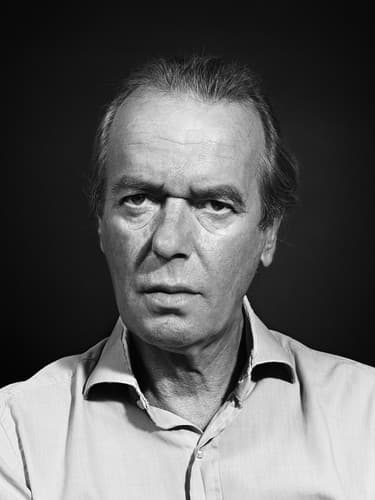
Sir Martin Louis Amis was an English novelist, essayist, memoirist, and screenwriter. He is best known for his novels Money (1984) and London Fields (1989). He received the James Tait Black Memorial Prize for his memoir Experience and was twice listed for the Booker Prize. Amis served as Professor of Creative Writing at the University of Manchester's Centre for New Writing from 2007 until 2011. In 2008, The Times named him one of the fifty greatest British writers since 1945.







