“I am a white man and never forget it, but I am also a Cheyenne, and that is something I will never forget either.”
— Jack Crabb reflecting on his dual identity after being raised by the Cheyenne.

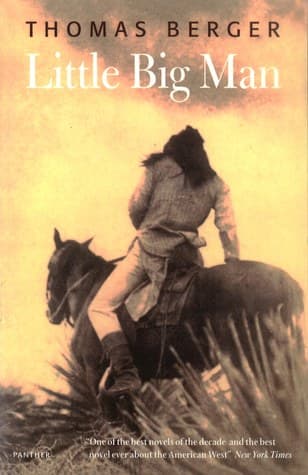
Thomas Berger (1964)
Genre
Historical Fiction
Reading Time
12-14 hours
Key Themes
See below
Sign in to track this book
Orphaned and raised among the Cheyenne, Jack Crabb navigates the brutal and often absurd American West as both an adopted "human being" and a white man, witnessing the demise of a culture he loves while clashing with legendary figures like Custer and Wild Bill.
The narrative begins with Jack Crabb, a 111-year-old man, telling his life story to a historian. Crabb starts by describing how, at age ten, he and his older sister, Caroline, were traveling west with their parents when their wagon train was attacked by Pawnee Indians. Their parents were killed, and the siblings were taken captive. Soon after, a Cheyenne war party attacked the Pawnee camp, rescuing (or re-capturing) Jack and Caroline. While Caroline quickly escapes back to white society, Jack is adopted by the Cheyenne holy man, Old Lodge Skins, who names him 'Little Big Man' due to his small stature but brave demeanor. Jack is raised among the Cheyenne, learning their language, customs, and way of life, becoming one of them.
Under Old Lodge Skins' guidance, Jack grows up as a Cheyenne. He learns to hunt, ride, and fight, embracing the tribe's communal lifestyle and spiritual beliefs. He experiences the joys of tribal life, including the hunt and ceremonies, but also sees the harsh realities of inter-tribal warfare and the encroaching presence of white settlers. He develops a deep respect for Old Lodge Skins and the Cheyenne people, considering them his true family. During this period, he marries his first wife, Sunshine, and tries to live a traditional life, often struggling with the cultural differences and his own 'whiteness' that occasionally surfaces, such as his dislike of eating dog meat.
After several years living as a Cheyenne, Jack's life takes another turn. During a skirmish with white soldiers, he is captured and forcibly returned to white society. This is a traumatic experience for him, as he struggles to re-adapt to the customs, language, and values of the 'white man.' He is placed with various white families, often feeling like a misfit. He meets a series of colorful and often morally ambiguous characters, including a minister and his wife, Mrs. Pendrake, who tries to 'civilize' him and, eventually, seduce him. Jack's experiences in white society are marked by a sense of alienation and a longing for his Cheyenne family.
Jack's attempts to integrate into white society lead him through a series of different and often comical professions. He tries being a store clerk, a mule skinner, a gambler, and even a con artist. During these adventures, he meets several figures of the American West. He works for Wild Bill Hickok, seeing his skill and eccentricities, and later meets Wyatt Earp. He observes the lawlessness and opportunism in frontier towns, often finding himself in difficult situations due to his naivety or his attempts to navigate the deceptive nature of white society. Despite his efforts, he never truly feels at home.
Driven by a strong yearning, Jack eventually makes his way back to his adopted Cheyenne family. He is joyfully reunited with Old Lodge Skins and Sunshine. However, their reunion is short-lived and interrupted by the escalating conflict between settlers and Native Americans. Jack is present during the Sand Creek Massacre, where Colonel Chivington's troops brutally attack a peaceful Cheyenne village, killing women, children, and the elderly. Sunshine is among the victims, a loss that deeply traumatizes Jack and strengthens his contempt for the savagery of white expansion.
Following the Sand Creek Massacre, Jack, consumed by grief and rage, vows to seek revenge against the white soldiers responsible, particularly focusing on General George Armstrong Custer. He tries to assassinate Custer several times, but his efforts are either thwarted by circumstance or his own moral hesitations. His bitterness against white society intensifies. Eventually, disillusioned with both white and Native American ways, and unable to find peace, Jack retreats to live as a hermit, shunning both worlds and living a solitary existence in the wilderness, further showing his 'between worlds' identity.
In a bizarre twist, Jack eventually finds himself serving as a scout for General George Armstrong Custer and the 7th Cavalry. Despite his previous attempts to kill Custer and his deep-seated animosity towards him, Jack's circumstances lead him to this position. He observes Custer's arrogance, vanity, and strategic blunders firsthand, often providing Custer with accurate assessments of the Native American forces that are largely ignored. This period allows Jack to gain an intimate understanding of Custer's character and the military mindset, while also giving him a unique view on the impending clash.
Jack is present at the Battle of Little Bighorn, often called 'Custer's Last Stand.' He tries to warn Custer of the overwhelming numbers of the combined Lakota and Cheyenne forces, but Custer dismisses his advice. Jack witnesses the battle unfold from multiple perspectives, moving between the white soldiers and his adopted Cheyenne kin. He sees the bravery and desperation on both sides. Ultimately, he witnesses the annihilation of Custer's command, a devastating victory for the Native Americans, but one that he understands will only hasten their ultimate defeat and the end of their way of life. He watches Old Lodge Skins accept his fate and prepare for death.
After the victory at Little Bighorn, Old Lodge Skins, recognizing the inevitable demise of the Cheyenne way of life, decides it is time to 'go to the other side.' He starts a spiritual journey to die with dignity, and Jack, his adopted son, accompanies him. This journey is a moment of shared understanding and farewell. Old Lodge Skins imparts his final wisdom to Jack, affirming their bond and the cyclical nature of life and death. Jack helps him find a peaceful place to die, and witnesses his adopted father's serene passing, a poignant end to a generation and a way of life.
In the concluding sections, Jack Crabb thinks about his long and complex life, marked by his unique position straddling two different cultures. He acknowledges the irony of his survival and the fact that he outlived almost everyone he knew. He grapples with the conflicting loyalties and identities he carried throughout his life – a white man raised as a Cheyenne, never fully belonging to either world but shaped by both. His narrative concludes with a sense of resignation, wisdom, and a touch of the same dry humor that characterized his entire story, leaving the historian and the reader to think about the true nature of his experiences and the myth of the American West.
The Protagonist
Jack transforms from a naive boy into a seasoned survivor, bearing witness to the destruction of the Cheyenne way of life and eventually finding a form of peace in his unique, dual identity.
The Supporting
He remains steadfast in his wisdom and traditional beliefs, guiding Jack and ultimately accepting his fate and the end of his world with serene dignity.
The Antagonist/Supporting
He remains consistently arrogant and self-assured, leading directly to his demise and the 'Last Stand' that cements his controversial legacy.
The Supporting
Her life is tragically cut short by the Sand Creek Massacre, symbolizing the devastating impact of white expansion on Native American families.
The Supporting
He maintains his iconic, stoic persona throughout his encounters with Jack, eventually meeting his fated end.
The Supporting
She remains a figure of hypocrisy and unfulfilled desire, serving as a memorable, if brief, impediment to Jack's integration into white society.
The Supporting
She quickly returns to white society and adapts to its harsh realities, contrasting sharply with Jack's continued struggle between worlds.
The Mentioned
He remains a static framing device, facilitating Jack's narrative without significant personal development.
The novel explores Jack Crabb's struggle with identity, as he is a white man raised by Cheyenne. He constantly feels like an outsider in both worlds, never fully belonging to either. This theme is clear in his attempts to adapt to white society after being captured, only to feel alienated, and his occasional 'whiteness' that surfaces even among the Cheyenne. His journey is a lifelong quest to reconcile these two conflicting aspects of himself, culminating in a unique, hybrid identity that allows him to critique both cultures. His name, 'Little Big Man,' itself symbolizes this dual nature.
“I am a white man and never forget it, but I was brought up by the Cheyenne Indians from the age of ten.”
Berger deconstructs the romanticized myths of the American West by presenting a gritty, often unheroic, and morally ambiguous reality. Through Jack Crabb's eyes, figures like Wild Bill Hickok and General Custer are stripped of their heroic facades, revealed as flawed, complex, or even foolish men. The narrative challenges the black-and-white portrayal of 'cowboys and Indians,' showing the brutality and hypocrisy of white expansion, the humanity of Native Americans, and the often mundane or absurd aspects of frontier life. The West is portrayed not as a land of opportunity for all, but a place of violence, displacement, and cultural collision.
“It was just like the white man to make a big thing out of a little thing.”
The conflict of the novel is the clash between white American culture and Native American (Cheyenne) culture. Jack Crabb is the ultimate bridge between these two worlds, experiencing firsthand the differences in values, spirituality, social structures, and worldview. The novel shows the destructive impact of white expansion on Native American ways of life, particularly through events like the Sand Creek Massacre. It also examines the difficulties and often futility of forced assimilation, as Jack struggles to adapt to white society while retaining his Cheyenne upbringing, and vice versa. The inability of the two cultures to coexist peacefully is a central tragedy.
“The white man was a strange animal, with a short memory for good things and a long one for bad.”
Jack Crabb's long life and his ability to survive countless perilous situations show the theme of survival. He adapts to different environments and social structures, from the communal life of the Cheyenne to the cutthroat world of white frontier towns. His survival is less about heroic strength and more about cunning, observation, and a certain resilient quality. He endures massacres, battles, and personal tragedies, always finding a way to persist, even if it means living a life of quiet anonymity. His adaptability is key to his long life, but it also shows his constant displacement.
“I was a survivor, that was my main talent.”
Jack Crabb's advanced age and selective memory shape the narrative.
Jack Crabb, at 111 years old, is an unreliable narrator. His extreme age, coupled with a tendency towards exaggeration, self-deprecation, and a highly subjective perspective, means that the reader must constantly question the absolute veracity of his tales. This device allows Berger to comment on the nature of history and memory, suggesting that 'truth' is often subjective and shaped by individual experience. It also adds humor and allows for a playful subversion of historical facts and legendary figures, making the reader active in discerning what might be 'true' within the fictional framework.
A series of episodic adventures as Jack wanders through the American West.
The novel employs a picaresque structure, following Jack Crabb, a 'picaro' (rogue/wanderer), through a series of loosely connected adventures. Jack moves from one situation to another, encountering a diverse cast of characters and experiencing various aspects of frontier life without a singular, overarching goal beyond survival. This episodic nature allows Berger to explore different facets of the American West and to introduce a wide array of historical figures and cultural critiques. It also emphasizes Jack's transient nature and his inability to settle permanently in either white or Native American society.
Humorous critique of historical figures, societal norms, and cultural assumptions.
Berger heavily uses satire and irony to critique the romanticized notions of the American West, the arrogance of white expansion, and the often absurd behaviors of both cultures. Jack Crabb's dry wit and detached observations highlight the hypocrisy of figures like Mrs. Pendrake and the vanity of Custer. The irony often stems from Jack's unique perspective as an 'insider-outsider,' allowing him to see the follies and contradictions of both white and Native American societies. This device adds a layer of dark humor to the often tragic events of the story, preventing it from becoming overly sentimental.
The historian's interview frames Jack Crabb's dictated memoirs.
The entire narrative is framed as Jack Crabb dictating his memoirs to an unnamed historian. The historian's interjections, often presented as footnotes, serve to ground Jack's fantastical tales in a semblance of historical inquiry, while also highlighting the historian's own limited understanding and occasional skepticism. This device allows for a meta-commentary on the writing of history itself and the challenges of accurately recording subjective experiences. It provides an external, 'objective' counterpoint to Jack's highly personal and often embellished narrative, drawing attention to the tension between lived experience and historical record.
“I am a white man and never forget it, but I am also a Cheyenne, and that is something I will never forget either.”
— Jack Crabb reflecting on his dual identity after being raised by the Cheyenne.
“The only good Indian is a dead Indian.”
— General Custer's infamous line, repeated in the novel to critique frontier racism.
“I seen things that would make your hair stand on end, and I done things I ain't particularly proud of.”
— Crabb recounting his wild life adventures to the historian interviewing him.
“Life is a series of surprises, and would not be worth taking or keeping if it were not.”
— Crabb philosophizing about his unpredictable existence.
“The Cheyenne way is to live with the earth, not against it.”
— Crabb explaining Cheyenne values contrasted with white settlers' expansion.
“I have been called a liar so many times I have come to believe it myself.”
— Crabb acknowledging the dubious nature of his own storytelling.
“There is no such thing as a hero; there are only men who do what they must.”
— Crabb debunking myths about figures like Custer and Wild Bill Hickok.
“The white man's god is a god of wrath, but the Cheyenne's gods are in everything around us.”
— Comparing spiritual beliefs during Crabb's time with the Cheyenne.
“I have outlived all my enemies and most of my friends, which is a kind of victory, I suppose.”
— Crabb in old age, reflecting on survival and loneliness.
“History is written by the winners, but I was there, and I tell you it wasn't like that.”
— Crabb challenging official accounts of events like the Battle of Little Bighorn.
“A man's life is what he makes of it, and I made mine a damn interesting one.”
— Crabb summarizing his picaresque journey through the American West.
“The West wasn't won with guns; it was stolen with paper and promises.”
— Crabb critiquing treaties and broken agreements with Native tribes.
“I have seen the end of an era, and it wasn't pretty.”
— Crabb witnessing the decline of the Cheyenne way of life.
“Sometimes the only way to stay sane is to laugh at the madness.”
— Crabb using humor to cope with the violence and absurdity he experiences.
Ready to see how well you understood this book? Take our interactive quiz with 10 questions.

Biography coming soon.







