“I aint got time to worry about it. I aint got time to not worry about it. I aint got time to do nothing but just be.”
— Lena Grove's stoicism and acceptance of her fate while pregnant.


William Faulkner (2022)
Genre
Literary Fiction
Reading Time
9-12 hours
Key Themes
See below
Sign in to track this book
In the hot American South, a pregnant woman looks for her lover, while a mysterious drifter's past reveals the deep prejudices and violence of a small Mississippi town.
Lena Grove, a young, pregnant woman from Alabama, starts her long trip to Jefferson, Mississippi, looking for Lucas Burch, the father of her child. She walks most of the way, getting rides from kind wagon drivers. Her simple past and why she left home show her hopeful and determined nature. She expects Lucas to marry her, even though he has disappeared. Her journey is slow and hard, showing her vulnerability and the kindness of strangers, like the Armstids who give her a ride and food after seeing her trouble.
Byron Bunch, a quiet and religious worker at the Jefferson planing mill, notices Lena Grove right away when she arrives. He learns she is looking for Lucas Burch, who is working at the mill under the name Joe Brown. Byron, a man of routine and strong morals, becomes more involved in Lena's situation. He secretly helps her with food and a place to stay. At the same time, he watches the mysterious Joe Christmas, another mill worker. Christmas lives in a cabin on Joanna Burden's property, and his strange behavior bothers Byron.
The story then shows Joe Christmas's complicated and troubled past. He grew up in an orphanage, bothered by rumors that he was part Black. His early life involved violence, rebellion, and a desperate search for who he was. He was adopted by the very religious McEachern, who beat him for perceived sins and tried to make him disciplined, but Joe resisted strongly. Joe later killed McEachern and lived a wandering life, moving through towns and having various relationships, always feeling lost because of his unclear race and a deep sense of not belonging.
Reverend Gail Hightower, a former minister in Jefferson, lives alone, shunned by the community after a scandal involving his wife's affair and death, and his own perceived failure. He is fixated on the past, especially his grandfather's heroic cavalry charge during the Civil War. Hightower avoids the present, spending his days at home, thinking about a romanticized past. Byron Bunch often visits Hightower, seeking advice and trying to get him to re-engage with the world, especially about Lena's situation and the tension building around Joe Christmas.
The main crime of the novel happens: Joanna Burden is found murdered, her throat cut. Her house is burning, and Joe Christmas, who had a long and difficult affair with her, is immediately suspected. The community, already wary of Christmas because of his dark skin and mysterious past, quickly forms a mob. Joe Brown (Lucas Burch), wanting reward money, points the finger at Christmas, fueling the town's prejudice and desire for quick justice. This event starts a desperate hunt for Christmas, leading to the tragic end.
After Joanna Burden's murder, Joe Christmas runs away. He first avoids capture, hiding in the woods and moving quietly, showing his long history of being without a home and running. During his escape, he thinks about who he is, his past, and what will happen to him. He eventually heads back toward Jefferson, drawn by an unclear urge, perhaps a subconscious desire to face his fate. His flight shows both defiance and acceptance, a last desperate try to escape his life, but ultimately a return to the place he tried to leave.
As the hunt for Joe Christmas gets more intense, Lena Grove goes into labor. Byron Bunch, dedicated to Lena, convinces the reluctant Reverend Hightower to let Lena stay in his house to give birth. Despite wanting to stay isolated, Hightower is pulled into the immediate crisis, helping Lena as she delivers a healthy baby boy. This moment shows a brief victory of life and hope amid the surrounding violence and despair. It forces Hightower, if only for a short time, to deal with the present and the needs of others, breaking his self-imposed detachment.
Joe Christmas is finally caught. While being taken away, he tries desperately to escape, running through the streets of Jefferson. He is chased by Percy Grimm, a young, fanatical National Guard officer who represents the town's prejudice and desire for extreme punishment. Grimm shoots Christmas multiple times, then castrates him with a butcher knife, a horrifying act of symbolic violence. This brutal lynching is the tragic end of Christmas's life, a violent conclusion that highlights themes of racial hatred, mob mentality, and the destructive results of societal prejudice.
After Joe Christmas's brutal death, Reverend Hightower is deeply affected. The violence and Lena's childbirth break through his long detachment. In a strong internal thought, Hightower reviews his past, his obsession with his grandfather, and his failures as a minister and husband. He admits his responsibility and the emptiness of his self-imposed exile. He has a vivid, almost dream-like vision of his grandfather's cavalry galloping, but this time, the vision is not of glory but of a repeating, meaningless cycle, showing his final reckoning with his past and the futility of escaping the present.
After Christmas's death, Lucas Burch (Joe Brown), fearing the consequences of his involvement and becoming a father, leaves Jefferson, abandoning Lena and their child. Byron Bunch, despite his disappointment, stays loyal to Lena. He continues to care for her and her baby. Lena, always hopeful and strong, decides to continue her journey, now with her infant and Byron by her side. They are last seen traveling in a wagon, heading west, a new, uncertain chapter beginning for them, with Lena's hope still intact.
The Protagonist
Lena remains largely unchanged, a symbol of life's continuity and an unyielding, if naive, optimism.
The Protagonist/Antagonist
Christmas's arc is one of escalating violence and self-destruction, culminating in his brutal lynching, a final, tragic expression of his lifelong alienation.
The Supporting
Byron is drawn out of his isolation by his love for Lena, forcing him to engage with the world and take responsibility for others, ultimately accepting a role as her protector.
The Supporting
Hightower is reluctantly pulled back into the present by Lena's childbirth and Christmas's death, leading to a shattering of his illusions and a final, painful confrontation with his past and failures.
The Supporting/Antagonist
Burch's arc is one of moral decline and cowardice, culminating in his betrayal of Christmas and his ultimate flight from responsibility.
The Supporting
Burden's arc is one of increasing psychological and spiritual torment, culminating in her violent death at Christmas's hands.
The Antagonist
Grimm's arc is one of escalating fanaticism and violence, culminating in his role as Christmas's executioner, solidifying his status as a symbol of societal brutality.
The Mentioned/Supporting
Hines's arc is one of unwavering, destructive fanaticism, a fixed point of prejudice that shapes Christmas's destiny.
The novel explores the destructive power of racial prejudice and the search for identity in a society obsessed with racial purity. Joe Christmas's unclear background and the constant talk about his race cause much of his inner pain and outer conflict. His perceived 'blackness' isolates him, making him an outsider even to himself. The town's quick assumption of his guilt in Joanna Burden's murder comes from racial bias, showing how race determines fate and identity in the American South. The violence against Christmas, especially his castration, is a symbolic act of racial terror.
“''It was as if he had been through a door, a gate, a wall, and come out on the other side. He was not on the other side, he was on both sides, he was not on either side, he was a man in the middle of a bridge, suspended.''”
Faulkner shows how the past, both personal and historical, always shapes the present. Reverend Hightower is stuck in his obsession with his Confederate grandfather's glory, unable to live in the present. Joe Christmas is haunted by his difficult childhood, his uncertain parents, and the racial prejudice that defines him. The South's collective past, especially slavery and the Civil War, affects the characters and community, influencing their biases and morals. Characters often struggle to escape or come to terms with their pasts, usually without success.
“''The past is not dead. It is not even past.''”
Many characters feel a deep sense of loneliness, from different causes. Joe Christmas is the ultimate outsider, isolated by his unclear race, his violent nature, and his inability to truly connect with others. Reverend Hightower lives in self-imposed isolation, an outcast in his own community. Joanna Burden, despite her intelligence, is also an outsider because of her family's history and her unconventional life. Even Byron Bunch, though he wants connection, is initially a withdrawn figure. Lena Grove, despite her optimism, is a wanderer, always on the edge, showing the widespread feeling of solitude in the novel.
“''He was a man of thirty-three. He was a man who had never known a home.''”
Religion is a powerful, often damaging, force in the novel, often appearing as hypocrisy and extremism. Doc Hines, Joe Christmas's grandfather, uses his fundamentalist beliefs to justify his racism and abandonment of Christmas. McEachern, Christmas's adoptive father, tries to force religion on him, creating anger instead of faith. Hightower, a former minister, has lost his faith and is an outcast. The community's 'Christian' values often clash with its violent prejudices, especially in the quick judgment and brutal lynching of Joe Christmas, revealing a deep moral emptiness beneath the appearance of piety.
“''It was as if the very sound of the hymn were a part of the iron which had been shaped and hammered into him.''”
The conflict between natural instincts and the rules of 'civilized' society is a repeated idea. Lena Grove, with her basic journey and connection to nature, represents a natural, enduring life force, often untouched by societal complexities. In contrast, Joe Christmas's struggle is often seen as an attempt to escape societal labels and expectations, leading him to a wild existence in the woods. The town of Jefferson, representing civilization, is shown to be capable of extreme brutality and prejudice, suggesting that 'civilization' can often be more destructive than any 'natural' impulse, especially when driven by fear and hatred.
“''She was like a still small font of water, not to be defiled, not to be sullied.''”
A narrative technique that mimics the unfiltered thoughts and feelings of characters.
Faulkner employs stream of consciousness to delve deeply into the psychological states of his characters, particularly Joe Christmas and Reverend Hightower. This technique allows the reader to experience their fragmented memories, internal monologues, and complex emotional landscapes. It creates a non-linear narrative, often jumping between past and present, reflecting the characters' burdened minds. This device is crucial for conveying the profound alienation and internal conflicts, especially Christmas's struggle with his identity and Hightower's obsessive recollections of his past, providing intimate access to their inner turmoil.
The story is told out of chronological order, jumping between different time periods and character perspectives.
The novel does not follow a straightforward chronological sequence. Instead, it frequently shifts in time, moving from Lena Grove's present journey to extensive flashbacks detailing Joe Christmas's traumatic childhood, adolescence, and early adulthood, and Reverend Hightower's past. This non-linear structure creates suspense, gradually revealing the complex motivations and backstories of the characters. It also mimics the fragmented nature of memory and the way the past constantly impinges on the present, reinforcing the theme of the burden of history and providing a richer, more complex understanding of the characters' fates.
The narrator knows and reveals the thoughts and feelings of all characters.
Faulkner utilizes a third-person omniscient narrator who has access to the inner lives of all major characters. This allows for a panoramic view of the events and the intricate psychological motivations behind them. The narrator can delve into Joe Christmas's tormented mind, Hightower's reclusive meditations, Lena Grove's simple optimism, and Byron Bunch's moral struggles. This device provides a comprehensive understanding of the complex interplay of individual lives and societal forces, offering insights into the deep-seated prejudices and moral ambiguities that drive the plot and shape the characters' destinies.
The use of objects, characters, or actions to represent abstract ideas or qualities.
Symbolism is pervasive in 'Light in August.' The 'light in August' itself can symbolize clarity, truth, or the brief, intense illumination before a storm, highlighting the novel's themes of revelation and impending tragedy. Lena Grove symbolizes life, fertility, and an enduring, almost primal, optimism. Joe Christmas's name is highly symbolic, reflecting the conflict between his perceived 'blackness' and 'whiteness,' and the tragic irony of his birth around Christmas and his Christ-like suffering. The road and the wagon symbolize journeys, both physical and spiritual, and the transient nature of life, particularly for those like Lena and Christmas.
“I aint got time to worry about it. I aint got time to not worry about it. I aint got time to do nothing but just be.”
— Lena Grove's stoicism and acceptance of her fate while pregnant.
“It's not when you are on the ground that you are hurt, you are hurt when you hit the ground.”
— Gail Hightower reflecting on his past and the impact of his wife's death.
“He had a name for it. It was like he was not only not a man, but not even a human being, not even a living creature. He was just a shape, a shadow, a presence.”
— Joe Christmas's internal struggle with his identity and sense of otherness.
“Because it’s not just a memory. It’s a part of me. It’s like it’s in my blood, in my bones.”
— Joe Christmas's enduring connection to his past and perceived heritage.
“A man is the sum of his misfortunes. One day you'd think that was the good luck, but it ain't. It's the bad luck.”
— Byron Bunch reflecting on life's hardships and ironies.
“The past is never dead. It's not even past.”
— A general theme running through the novel, particularly in Hightower's and Christmas's narratives.
“Man will go to any length to win a woman, except for the one length that would win her.”
— Byron Bunch's observations on the complexities of romantic pursuit.
“I reckon that God don't care about nothing but what a man does.”
— Mrs. Armstid's pragmatic view of divine justice and human actions.
“He was a man of peace, but he had a furious capacity for rage.”
— Description of Gail Hightower's internal contradictions.
“It was not a new thing. It was an old thing. It was a new face in an old story.”
— Reflecting on the cyclical nature of human events and suffering.
“A man's life is a long time. It's a long time to be wrong.”
— Hightower contemplating his life and past mistakes.
“He was like a man who had been dead a long time and then come back to life, but he hadn't come back to life in the way that people usually come back to life.”
— Describing Joe Christmas's detached and almost spectral existence.
“It was just a day, and then it was gone. And then it was another day, and then it was gone.”
— Lena Grove's simple perception of time and the passing of days.
“The only thing a man can do is to try and live his life as best he can, and if he can't do that, then he's no good to nobody.”
— Byron Bunch's practical philosophy on living.
Ready to see how well you understood this book? Take our interactive quiz with 10 questions.
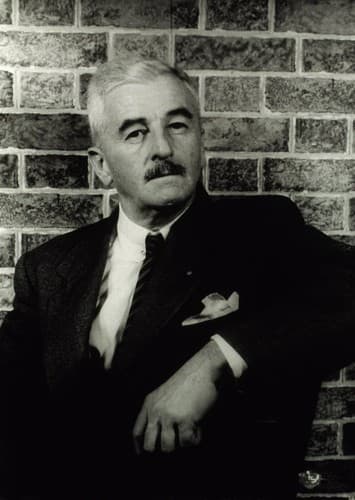
William Cuthbert Faulkner was an American writer known for his novels and short stories set in the fictional Yoknapatawpha County, based on Lafayette County, Mississippi, where Faulkner spent most of his life. A Nobel laureate, Faulkner is one of the most celebrated writers of American literature and often is considered the greatest writer of Southern literature.







