“I must say a word about Ojibwe. It is a beautiful language, musical and intricate.”
— Pi describes the language of his ancestors.

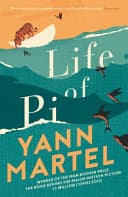
Yann Martel (2016)
Genre
Fantasy / Philosophy
Reading Time
700 min
Key Themes
See below
Sign in to track this book
Stranded in the vast Pacific, a young Indian boy forms an unlikely bond with a Bengal tiger, questioning belief and survival.
Piscine Molitor Patel, or Pi, tells about his childhood in Pondicherry, India, where his father owned a zoo. From a young age, Pi understood animal behavior, learning about their needs and dangers, especially from the Bengal tiger, Richard Parker. He also explored spirituality, practicing Hinduism, Christianity, and Islam at the same time, amusing and confusing his family and local religious leaders. Pi's father, a rationalist, tried to make him abandon his multi-faith devotion by showing him a tiger attacking a goat, demonstrating nature's brutal reality. This early exposure to both the beauty and savagery of animals, combined with his spiritual search, shaped Pi's view of the world.
Because of political unrest and changes in India, Pi's father decided to sell the zoo animals and move to Canada, seeking a better life. This decision was a big change, uprooting Pi from his only home. The family arranged passage on a Japanese cargo ship, the *Tsimtsum*, which would take them and their remaining zoo animals across the Pacific Ocean. Pi, though sad about the move, approached it with both fear and curiosity, not knowing the disaster that awaited them at sea. The journey preparations showed the family's hope for a fresh start.
In the middle of the Pacific Ocean, the *Tsimtsum* faced a violent storm and began to sink quickly. Pi, woken by the noise, went on deck and was thrown into a lifeboat by a crew member. From the lifeboat, he watched the ship disappear into the waves, taking his entire family – his mother, father, and brother Ravi – with it. The sudden, brutal event left Pi in shock and deep grief. He was completely alone, adrift in the vast ocean, his world shattered. This extreme trauma marked the start of his terrible ordeal, forcing him to face the raw reality of survival.
After the *Tsimtsum* sank, Pi found he was not alone in the lifeboat. To his horror, he shared the small boat with a zebra with a broken leg, a hyena, an orangutan named Orange Juice, and eventually, the powerful Bengal tiger, Richard Parker. The lifeboat quickly became like a wild place, with the animals acting on instinct. The hyena brutally killed the zebra, then attacked and killed Orange Juice, leaving Pi traumatized and fearing for his own life. This sequence of events created a dangerous environment on the lifeboat, showing the immediate threat Pi faced from his fellow survivors.
After the hyena's attack, Pi realized that Richard Parker, the Bengal tiger from his family's zoo, had been hiding under the tarpaulin covering part of the lifeboat. Richard Parker emerged and quickly killed the hyena, becoming the dominant predator. Pi now faced the terrifying reality of sharing a small lifeboat with a 450-pound tiger. He understood that his survival depended on his ability to manage and control Richard Parker. This realization changed Pi's focus from despair to a desperate will to survive, knowing he had to find a way to live with, or control, the tiger.
Using his knowledge of animal psychology from his father's zoo, Pi planned to show his dominance over Richard Parker. He used a whistle, the boat's rocking, and the tiger's seasickness to make his presence seem unpleasant. He also set a clear boundary on the lifeboat, marking his and the tiger's territory. Pi began to fish, providing food for Richard Parker, thus becoming the tiger's provider. This strategic training was essential for Pi's survival, turning the immediate threat into a manageable, though dangerous, companion. Their relationship became a delicate balance of fear and reliance.
Pi's days on the lifeboat were a constant fight for survival. He carefully collected rainwater, rationed his limited emergency supplies, and learned to fish and hunt turtles, providing food and water for both himself and Richard Parker. He developed clever methods, such as using a solar still for fresh water and a gaff for fishing. The constant threat of starvation, dehydration, and the unpredictable ocean pushed Pi to his physical and mental limits. He experienced deep despair, hallucinations, and spiritual comfort, relying on his cleverness and faith to endure the endless days and nights at sea.
Months into his ordeal, Pi met another castaway, a blind French sailor, whose boat drifted near his. In a desperate state, both men, unaware of each other's blindness, tried to board the other's vessel. The sailor, driven by hunger, tried to attack Pi, but Richard Parker killed him. Later, Pi and Richard Parker drifted to a strange, seemingly miraculous island made entirely of algae, full of meerkats and fresh water. At first, it seemed like rescue, but Pi soon discovered the island was carnivorous, dissolving living creatures at night. He quickly realized the danger and left, barely escaping its deadly embrace.
After 227 days at sea, the lifeboat washed ashore on a beach in Mexico. Pi was completely exhausted, emaciated, and barely alive. As the boat landed, Richard Parker leaped out and, without a look back, disappeared into the jungle. Pi was heartbroken and deeply disappointed by the tiger's sudden departure, having expected some form of acknowledgment or farewell after their shared experience. Locals found him and took him to a hospital, ending his incredible journey of survival. His sadness at Richard Parker's leaving showed the complex bond they had formed.
While recovering in a Mexican hospital, Pi was interviewed by two Japanese Ministry of Transport officials, Mr. Tomohiro Okamoto and Mr. Atsuro Chiba, investigating the *Tsimtsum*'s sinking. They doubted Pi's fantastic story involving the animals, especially Richard Parker. Pi recounted his story in detail, but the investigators found it unbelievable. They pressed him for a more 'believable' account, one that fit their logical and factual expectations. This interview set up the book's central philosophical question: the nature of truth and storytelling.
Because the investigators disbelieved him, Pi offered an alternative version of his survival story, without animals. In this version, the zebra was a Taiwanese sailor with a broken leg, the hyena was the ship's cook, Orange Juice was Pi's mother, and Richard Parker was Pi himself. The cook brutally murdered the sailor and then Pi's mother, before Pi, driven by instinct and revenge, killed the cook. This second story is a grim, human-focused allegory of the first, mirroring the animal interactions with human cruelty and survival. It is a much darker, more plausible, yet equally horrifying account of the events at sea.
After hearing both versions, the Japanese investigators had to decide which story they preferred. They admitted the second story, though horrific, was more factually plausible. However, they also agreed that the first story, with the animals, was 'the better story,' more imaginative and ultimately more comforting. Pi then asked them which story they would include in their report, and they chose the animal story. This moment highlights the novel's main idea about the power of storytelling and faith, suggesting that sometimes a more beautiful, less factual truth can offer greater meaning and comfort than a harsh reality.
The Protagonist
Pi transforms from a curious, multi-faith boy into a hardened survivor who confronts the darkest aspects of human (or animal) nature, ultimately becoming a testament to the power of faith and storytelling.
The Antagonist/Companion
Richard Parker remains largely unchanged as a wild animal, but his presence acts as a catalyst for Pi's transformation and survival.
The Supporting/Antagonist
The hyena's role is primarily to establish the immediate danger and brutality of the lifeboat's ecosystem before being dispatched by Richard Parker.
The Supporting
Orange Juice represents the fleeting presence of innocence and familial connection amidst the chaos, her death marking a further descent into the brutal reality of survival.
The Supporting
The zebra's role is to be the first victim, illustrating the immediate and violent struggle for survival among the animals.
The Supporting
Remains a static influence, representing the rational and scientific perspective that complements Pi's spiritual journey.
The Supporting
Remains a static influence, representing the spiritual and faithful perspective that guides Pi.
The Supporting
Initially skeptical and driven by facts, he eventually concedes the value of a compelling narrative over strict reality.
The Supporting
Starts as a junior investigator focused on facts, but gradually shows an appreciation for the imaginative aspects of Pi's story.
The novel explores how stories shape our understanding of reality and give meaning. Pi offers two versions of his survival, one with animals and one with humans, asking the Japanese investigators which they prefer. The 'animal story,' though less likely, is called 'the better story' because it offers more beauty, hope, and wonder. This theme suggests that factual truth is not always the most important truth, and that narratives can provide comfort, purpose, and a way to cope with extreme trauma. The book's structure, framed by Pi's adult narration, supports the idea that life itself is a story we tell ourselves and others.
“And so it goes with God.”
Pi's multi-faith spiritual journey (Hinduism, Christianity, Islam) is central. His strong belief in God, even during extreme suffering, gives him strength and purpose. The book suggests that faith, no matter its specific form, provides a way to understand the world and endure hardship. The idea of choosing a 'better story' at the end is like choosing faith over pure reason or despair. Pi's ability to see the divine in nature and to pray, even in the worst situations, shows the resilience that belief can provide. The novel champions the human need for something greater than themselves.
“I suppose in the end, the whole of life becomes an act of letting go, but what hurts the most is not taking a moment to say goodbye.”
At its heart, *Life of Pi* shows the human (and animal) will to survive. Pi's clever methods for collecting water, fishing, and training Richard Parker demonstrate his incredible resourcefulness and determination. The ocean's brutal realities – starvation, dehydration, and the constant threat from the tiger – push Pi to his limits, forcing him to face primal instincts. His mental and physical endurance, along with his ability to find a reason to continue, even amidst deep grief, highlights the powerful, innate drive to preserve life. The constant struggle against despair is a main part of this theme.
“To choose doubt as a philosophy of life is akin to choosing immobility as a means of transportation.”
The novel constantly questions what 'truth' means and how subjective our view of reality can be. Pi's two conflicting stories to the Japanese investigators make the reader consider whether a factual account is more 'true' than a metaphorical one that conveys deeper emotional or spiritual truths. The uncertainty about Richard Parker's existence challenges the reader to engage with the story on multiple levels, blurring the lines between fact and fiction, reality and imagination. The book suggests that our personal truths are often built from the stories we accept.
“If you stumble about believability, what are you living for?”
The relationship between Pi and Richard Parker, and the allegorical second story, explores the thin line between human and animal instincts. Pi's struggle to civilize Richard Parker mirrors his own fight to maintain his humanity in the face of extreme savagery and despair. The second story, where human characters take on the animals' roles, directly links the primal violence of the animal kingdom to the darkest aspects of human nature. The novel suggests that under extreme pressure, humans are capable of both deep cruelty and incredible resilience, blurring the differences we often make between ourselves and other creatures.
“I must say a word about fear. It is life's only true opponent. Only fear can defeat life.”
A story told within a story, with an unreliable narrator
The novel is framed by an unnamed author's encounters with the adult Pi, who then narrates his incredible survival story. This device establishes an immediate sense of mystery and positions Pi as an unreliable narrator, as the author explicitly states that Pi's story will 'make you believe in God.' This framing invites the reader to question the veracity of the tale from the outset and prepares them for the choice between two stories at the end, emphasizing the power of narrative over objective truth.
A story with a hidden meaning, often moral or political
The entire novel can be read as an allegory, particularly when Pi presents his second, human-centric version of events. In this allegorical interpretation, the animals on the lifeboat represent human survivors (the zebra as the injured sailor, the hyena as the cook, Orange Juice as Pi's mother, and Richard Parker as Pi himself). This device allows Martel to explore themes of human savagery, survival, and the primal instincts within us, without explicitly detailing horrific acts. It provides a layer of symbolic meaning that deepens the novel's philosophical questions about truth and storytelling.
The tiger as a multifaceted symbol of fear, survival, and God
Richard Parker is a powerful symbol throughout the novel. Initially, he symbolizes raw, untamed nature and the fear of the unknown. As Pi learns to coexist with him, the tiger becomes a symbol of Pi's own primal survival instincts, forcing him to be resourceful and vigilant. In the allegorical second story, Richard Parker symbolizes Pi's own dark, animalistic side that commits violence to survive. For many readers, and as Pi himself suggests, the tiger can also represent God – a force that is both terrifying and life-sustaining, demanding faith and offering a reason to live.
Hints or clues about future events in the story
Foreshadowing is used early in the novel, particularly in Pi's childhood recollections. His father's demonstration of a tiger's ferocity using a goat, and Pi's early knowledge of animal behavior and the dangers of the zoo, subtly prepare the reader for the extreme challenges he will face with Richard Parker. The discussion of his multi-faith journey also foreshadows the deep spiritual resilience he will need. These early details, seemingly innocuous, lay the groundwork for the incredible events to come, making the extraordinary feel somewhat inevitable.
“I must say a word about Ojibwe. It is a beautiful language, musical and intricate.”
— Pi describes the language of his ancestors.
“The world isn't just the way it is. It's how we understand it, no? And in understanding something, we change it, no?”
— Pi reflects on the nature of reality and perception.
“I was not a lion tamer. I was a lion keeper. A zookeeper. I was a man who looked after animals, who understood them, who loved them.”
— Pi distinguishes his role from a typical circus performer.
“To choose doubt as a philosophy of life is akin to choosing immobility as a means of transport.”
— Pi discusses the utility of faith versus doubt.
“I had to invent a story to live. I had to invent a story that would make sense of my suffering. I had to invent a story that would make me want to live.”
— Pi explains the necessity of his narrative.
“You must take life the way it comes at you and make the best of it.”
— Pi's father gives him advice about life.
“The matter of life and death is a matter of the mind.”
— Pi reflects on the psychological aspect of survival.
“Grief is a house that has been emptied of all its furniture.”
— Pi describes the feeling of profound loss.
“When you've lost all you can lose, you have nothing to lose.”
— Pi considers the freedom that comes with utter desolation.
“The shortest distance between two points is a straight line, but the shortest distance between two people is a story.”
— Pi reflects on the power of narrative to connect individuals.
“I suppose in the end, the whole of life becomes an act of letting go, but what always hurts the most is not taking a moment to say goodbye.”
— Pi muses on the nature of loss and farewells.
“If you stumble about in a forest of doubt, it's hard to find your way to God.”
— Pi emphasizes the difficulty of spiritual searching without belief.
“It was a life of great hardship, but also of great beauty.”
— Pi summarizes his ordeal at sea.
“The lower you are, the higher your mind will want to soar.”
— Pi considers the human spirit's ability to transcend suffering.
Ready to see how well you understood this book? Take our interactive quiz with 10 questions.

Yann Martel, is a Canadian author who wrote the Man Booker Prize–winning novel Life of Pi, an international bestseller published in more than 50 territories. It has sold more than 12 million copies worldwide and spent more than a year on the bestseller lists of the New York Times and The Globe and Mail, among many other best-selling lists. Life of Pi was adapted for a movie directed by Ang Lee, garnering four Oscars including Best Director and winning the Golden Globe Award for Best Original Score.







