“I guess I always felt even if the world came to an end, McDonald's would still be open.”
— Miranda's reflection on normalcy before the asteroid impact.

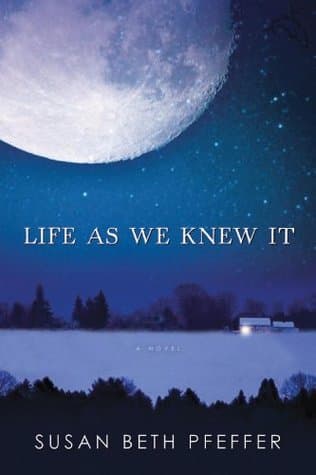
Susan Beth Pfeffer (2006)
Genre
Fantasy / Science Fiction / Young Adult
Reading Time
360 min
Key Themes
See below
Sign in to track this book
After a meteor shifts the moon, plunging the world into an Arctic winter, a teenage girl's journal records her family's fight to survive tsunamis, earthquakes, and an ash-choked sky.
Miranda Evans, sixteen, in Howell, Pennsylvania, starts her journal in May, writing about typical high school things: swim team, boys, grades, and a crush on a new student, Dan. Her family includes her mother, Laura; her older brother, Matt, who is going to college; and her younger brother, Jonny, who likes baseball. Life is normal; her parents are divorced, and her father lives in New York City with his new wife, Lisa, and their baby, Gabriel. News reports about a meteor, 'Shattered Moon,' hitting the moon are at first seen as a distant threat, barely noticed in her daily life. The family talks about it casually, but no one really understands the possible disaster.
On May 29th, the meteor hits the moon. Miranda is at her friend Sammi's house and sees the moon visibly shift. Immediately after, there is chaos: huge earthquakes shake the area, power goes out, and news reports are broken and scary. The moon is closer, its orbit changed, causing extreme tides. Miranda's family quickly understands how serious the situation is. Their first goal is to get food, water, and fuel. Matt, the most responsible, takes charge, while their mother tries to keep things normal. The world outside their town is a mess, with communication down and the government seemingly unable to cope.
In the weeks after the impact, life becomes a constant search for supplies. Gasoline is hard to find, so Matt bikes long distances for things. Food becomes valuable, leading to rationing and creative meal planning. The local grocery store is looted, and the community starts to fall apart. Miranda sees the desperation firsthand, as people get more aggressive looking for food and water. Her mother starts a garden, seeing the need to grow their own food. Jonny's baseball season is cancelled, showing how much of their old lives is gone. The family's focus is entirely on survival, with every choice about saving and getting supplies.
As summer goes on, a new problem appears: volcanic eruptions worldwide, caused by the changed moon, send huge amounts of ash into the air. The sky darkens, blocking the sun and making temperatures drop. What should be summer feels like an endless, gray winter. Miranda and her family must stay inside, their windows sealed against the toxic ash. Their small sunroom, with a wood-burning stove, becomes their safe place. The lack of sunlight ruins their garden and puts them in constant twilight. The world outside becomes empty and silent, and their isolation grows as communication with the outside stops.
The family’s elderly neighbor, Mrs. Nesbitt, who often shared garden produce and company, dies from sickness and the harsh conditions. Her death reminds them how vulnerable they are and how uncaring the world is. Miranda, Matt, and their mother carry her body to her backyard for burial, a hard task. This event affects Miranda deeply, making her face death and the fragility of life in their new world. It also shows the importance of community, even as their connections to others decrease. The family realizes they are alone, relying only on each other for survival and emotional support.
The ash-filled winter is very cold, and the family's food runs out fast. They rely on dwindling canned goods and a small amount of stored produce. Jonny gets weaker from lack of food, and Miranda's mother decides to send him to a local school turned shelter, hoping he will get more regular food and medical care. This separation is painful but necessary. Miranda struggles with hunger and the emotional toll, writing about her declining physical and mental state in her journal. The family's life becomes a daily fight against starvation and hopelessness.
One day, looking for food, Miranda meets a boy named Brandon, also looking for food. He shows her an abandoned house full of canned goods. This discovery helps a lot, giving a temporary boost to their low supplies. The meeting, though short, reminds Miranda that kindness still exists. Later, a local man named Peter, a mailman from before the impact, starts delivering mail again, though not often. He brings news from Jonny and others, providing an important, if irregular, link to the outside world and a fragile sense of connection and hope.
As spring nears, the ash starts to clear a little, and the sun appears sometimes. Jonny, having recovered somewhat at the shelter, comes home. His return brings great relief and joy, though he is still weak. The family keeps rationing, but the idea of planting a new garden gives them a new purpose. They find a small bag of potatoes and carefully plant them, seeing the importance of continued effort. Green shoots coming from the barren earth represent a fragile hope for recovery and a return to some form of normal, even if it is a new, harder normal.
The journal entries end with Miranda thinking about their survival. They have gone through great hardship, losing loved ones and their old life. However, they have also found strength, resilience, and a strong family bond. The sun sometimes shines through the thinning ash, and their garden looks promising. They have learned to value every small victory, every bit of food, and every moment of warmth. Miranda realizes that while the world is very different, life goes on, and they, as a family, are ready to face it together, holding onto hope for a future, no matter how uncertain. Her final entries express a quiet optimism, showing the human spirit's ability to adapt and last.
The Protagonist
Miranda transforms from a self-absorbed teenager into a resilient survivor, finding strength and purpose in the face of unimaginable hardship.
The Supporting
Laura evolves from a concerned parent to a fierce, resourceful survivor, her primary focus being the protection and sustenance of her children.
The Supporting
Matt quickly matures into the family's primary protector and provider, bearing the heavy burden of responsibility.
The Supporting
Jonny's journey from a carefree child to a frail survivor emphasizes the devastating impact of the disaster, eventually becoming a symbol of enduring hope.
The Supporting
Mrs. Nesbitt represents the vulnerability of the elderly in the new world, her death serving as a sobering lesson for the surviving family.
The Supporting
Horton remains a constant, comforting presence, symbolizing the persistence of life amidst despair.
The Supporting
Peter represents the enduring human spirit and the importance of connection, providing a lifeline of information and hope.
The Mentioned
Dan serves as a symbol of Miranda's lost innocence and the abrupt end of her normal teenage life.
The Mentioned
Sammi represents the friendships and social connections lost to the catastrophe, highlighting Miranda's growing isolation.
The main theme is the human desire to survive during catastrophe. The Evans family's journey from a comfortable life to a desperate search for food, water, and warmth shows this. Miranda's journal details their resourcefulness—planting gardens, rationing food, finding other heat sources, and making hard choices like sending Jonny to a shelter. Their ability to adapt, bear suffering, and find small wins, like a bag of potatoes or a sunbeam, shows their resilience.
“We are still alive. We have food. We have water. We have each other. That has to be enough.”
The book explores different kinds of loss: the loss of life (Mrs. Nesbitt, maybe others), the loss of a familiar world, the loss of innocence for the children, and the loss of basic comforts and safety. Miranda grieves for her old life, her friends, her future, and simple pleasures like hot showers or fresh food. Constant hunger and the bleak environment reflect the emotional emptiness. The family's sadness is often unsaid, shown in their quiet struggles and the constant longing for what used to be, making them face how fragile existence is.
“I miss the sun. I miss hot water. I miss chocolate. I miss knowing that tomorrow would be pretty much like today.”
When the world is broken, family bonds become most important. The Evans family relies completely on each other for physical and emotional survival. Matt acts as a provider, Laura as the emotional support, and Miranda records their shared struggle. The choice to send Jonny away, and his eventual return, highlights the strength of their family love. While the wider community largely falls apart, isolated acts of kindness (Mrs. Nesbitt, Peter) offer glimpses of lasting human connection, contrasting with the widespread fear and self-interest.
“We are a unit. We have to be. There is no one else.”
The novel shows how quickly modern civilization can fall apart when its main systems—power grids, communication, food supply chains, government—are disrupted. The immediate chaos after the moon's shift, the looting, the breakdown of order, and the fast return to a fight for basic needs all show how thin societal order truly is. The book is a warning, showing how dependent humanity is on complex systems and how vulnerable it becomes without them.
“All the things we took for granted. Electricity. Water. Food in the stores. Everything is gone.”
Miranda's journal entries move between moments of deep despair and fragile hope. Constant hunger, cold, and uncertainty often push her to almost give up. However, small victories—finding food, Jonny's return, the first sight of the sun, the garden sprouts—fuel a persistent hope for the future. The story suggests that even in the darkest times, the human spirit can find reasons to keep going and believe in a better tomorrow, no matter how far off.
“Hope. It's the only thing that's kept us going. And sometimes, even that's not enough.”
The entire narrative is presented as Miranda's personal journal.
This device provides an intimate, subjective, and immediate account of the unfolding catastrophe. Readers experience the events through Miranda's eyes, hearing her unfiltered thoughts, fears, and observations. The journal format emphasizes her isolation and the personal nature of her struggle, while also allowing for a gradual reveal of the wider world's collapse as information becomes scarce. It also highlights the passage of time and the slow, grinding nature of their survival, as each entry marks a day or a significant event.
The altered moon triggers the apocalypse and symbolizes the disruption of natural order.
The moon is not just the cause of the disaster; its changed appearance and position in the sky serve as a constant, ominous reminder of the new, dangerous world. Its closer proximity causes tsunamis, earthquakes, and volcanic eruptions, leading to the ash cloud and the 'new winter.' It symbolizes the disruption of the natural order and the loss of stability. The moon's presence in the sky, sometimes eerie, sometimes beautiful, reflects the shifting emotional landscape of the survivors.
The constant struggle for limited resources drives much of the plot and character development.
The pervasive theme of rationing food, water, and fuel is a key plot device that creates constant tension and defines the family's daily existence. Every meal is a calculation, every trip for supplies a risk. This scarcity forces difficult choices, highlights the family's resourcefulness, and underscores the fragility of their survival. It also serves to illustrate the breakdown of society, as people become desperate and aggressive in their pursuit of necessities.
The family's sunroom becomes their primary shelter and a symbol of their shrinking world.
After the ash blocks out the sun and temperatures plummet, the family retreats to their sunroom, where they have a wood-burning stove. This small space becomes their entire world, a microcosm of their survival. It represents their physical and emotional refuge, a place of warmth and relative safety amidst the desolate exterior. The confinement within the sunroom emphasizes their isolation and the drastic reduction of their former lives, yet it also symbolizes their resilience and ability to create a haven.
“I guess I always felt even if the world came to an end, McDonald's would still be open.”
— Miranda's reflection on normalcy before the asteroid impact.
“We're on our own. That's what it means. We're on our own.”
— Miranda realizing the severity of the disaster after the asteroid hits the moon.
“It's not the end of the world. It's just the end of the world as we know it.”
— Miranda's mother trying to comfort the family after the initial impact.
“I never thought I'd be so happy to see a can of peaches.”
— Miranda finding food in their pantry during the scarcity.
“We have to save everything. We don't know how long this is going to last.”
— Miranda's mother emphasizing conservation of resources.
“The moon is still there. It's just closer. And it's not going away.”
— Miranda observing the changed moon after the asteroid impact.
“I miss school. I never thought I'd say that, but I do.”
— Miranda reflecting on lost routines and normal life.
“We're not just surviving. We're living. As best we can.”
— Miranda's determination to find meaning in their new reality.
“Every day is a gift. Even the bad ones.”
— Miranda's realization about appreciating life post-disaster.
“The world didn't end with a bang. It ended with a whimper, and then we had to keep going.”
— Miranda's philosophical thought on the gradual collapse of society.
“We have to believe tomorrow will be better. Otherwise, what's the point?”
— Miranda's internal monologue about maintaining hope.
“I used to worry about homework and boys. Now I worry about food and heat.”
— Miranda contrasting her pre- and post-disaster concerns.
“Family is all we have left. We have to stick together.”
— Miranda emphasizing the importance of family bonds during the crisis.
“The sky is different now. It's like the whole world is holding its breath.”
— Miranda describing the atmospheric changes after the impact.
Ready to see how well you understood this book? Take our interactive quiz with 10 questions.

Biography coming soon.







