“All we can do is to try and be a little kinder. That's the only way we can make the world a better place.”
— Milton Loftis reflects on life and human nature.

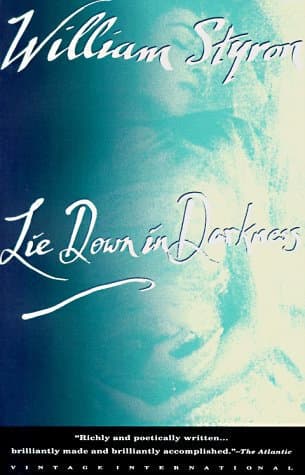
William Styron (1951)
Genre
Literary Fiction
Reading Time
1000 min
Key Themes
See below
Sign in to track this book
In the decaying post-war South, a family's legacy of destructive love unravels into betrayal, infidelity, and the tragic suicide of its most luminous daughter.
The novel opens on the day of Peyton Loftis's funeral in Port Warwick, Virginia. Milton Loftis, her father, drives the hearse, accompanied by his estranged wife, Helen Loftis, and their son-in-law, Harry Miller. The stifling Southern summer heat mirrors the family's emotional oppression. As they go to the cemetery, Milton thinks about Peyton's suicide in New York and the years of marital discord that came before it. Helen, consumed by her rigid moral code and resentment, struggles to stay composed, while Harry, a simple man, is bewildered by his in-laws. The procession is further complicated by a Black revival meeting, whose fervent singing occasionally breaks the mournful silence, creating an unsettling contrast.
Milton Loftis, a charming but weak Southern lawyer, recalls his early life and his courtship of Helen. He saw Helen as a symbol of stability and respectability, a balance to his more impulsive nature. Helen, however, was deeply religious and had a stern, unforgiving temperament. Their marriage, from the start, was a mismatch of personalities and expectations. Milton wanted intellectual and artistic pursuits that Helen dismissed as frivolous or sinful. Their inability to communicate openly and their differing views on life, love, and morality set the stage for a marriage filled with resentment, passive aggression, and a lack of intimacy, which would poison their children's lives.
Peyton, from an early age, became the battleground for her parents' unresolved conflicts. Helen, having lost her first child, developed an intensely possessive love for Peyton, idealizing her while projecting her own anxieties and moral rules onto her daughter. Conversely, Helen largely neglected and even resented her younger, mentally disabled daughter, Maudie. This favoritism created a deep rift in the family. Peyton, though beautiful and seemingly adored, felt the immense pressure of her mother's expectations and the implicit comparison to her less fortunate sister. Milton, while doting on Peyton, lacked the strength to effectively challenge Helen's damaging influence.
As the Loftis marriage worsened, Milton sought comfort and affection outside the home. He began an affair with Dolly Bonner, a vibrant, more worldly woman who offered him the validation and escape he craved. Helen, upon discovering the affair, reacted with a cold, righteous fury that solidified her martyrdom and deepened her resentment toward Milton. The affair became another weapon in their marital warfare, further eroding any remaining trust or affection. Peyton, aware of the domestic strife, witnessed the betrayal and its devastating impact on her parents. This infidelity contributed to her growing disillusionment with love and marriage, and a sense of instability within her own family.
As Peyton became a stunning young woman, she began to rebel against the stifling atmosphere of her home. Her beauty, while a source of pride for Helen, also became a means of defiance for Peyton. She had a series of relationships, often with older or unsuitable men, seeking affection and escape from her parents' suffocating influence. These early relationships were marked by a desperate need for love and attention, but also a growing cynicism. She felt trapped by her family's expectations and the pervasive gloom that hung over their household. Her actions, while appearing rebellious, were often cries for help and attempts to find a sense of self outside her parents' destructive dynamic.
Maudie, the Loftis's younger, mentally disabled daughter, suffered from neglect, particularly from Helen, who could not accept Maudie's condition. While Milton showed her more tenderness, he was often too preoccupied with his own miseries to provide adequate care. Maudie's physical and mental state steadily worsened, ending in her death from pneumonia, a direct result of inadequate care and the family's pervasive emotional chaos. Maudie's death was a stark, tragic symbol of the family's dysfunction and Helen's emotional coldness. It intensified Peyton's guilt and further alienated her from her mother, deepening the chasm of unspoken resentments within the household.
In a desperate attempt to escape her family, Peyton marries Harry Miller, a kind but unsophisticated man who genuinely loves her. Harry represents a chance at normalcy and stability, a stark contrast to the emotional turmoil of her childhood. However, Peyton brings her deep-seated issues into the marriage. She struggles with intimacy, a lingering sense of worthlessness, and the inability to escape the shadow of her parents' failed relationship. Her beauty continues to attract attention, but she remains emotionally distant and self-destructive. Harry, despite his best efforts, is ill-equipped to understand or heal Peyton's profound inner wounds, and their marriage soon begins to crumble under the weight of her unresolved traumas.
Peyton and Harry move to New York City, hoping for a fresh start. However, the change of scenery does little to ease Peyton's internal suffering. She falls into a pattern of infidelity, drinking, and increasingly reckless behavior, seeking fleeting moments of pleasure or oblivion. Her affairs, including one with her former college professor, are less about love and more about a desperate search for validation and an escape from her own identity. Harry, heartbroken and bewildered, tries to reach her, but Peyton is consumed by a deep despair and self-loathing. The city, instead of offering liberation, becomes a backdrop for her accelerated descent into emotional and psychological breakdown.
The novel recounts Peyton's final, agonizing days in New York. Estranged from Harry and increasingly isolated, she spirals into a deep depression. Her attempts to find meaning or connection fail, and she is haunted by the ghosts of her past — her mother's coldness, her father's weakness, Maudie's tragic death. In a moment of ultimate despair, she commits suicide by jumping from a building. Her death is not a sudden impulse but the culmination of a lifetime of emotional neglect, inherited dysfunction, and a relentless search for a love and acceptance she never truly found, either from her family or within herself. Her suicide note, if one existed, is never fully revealed, leaving her motivations ambiguous.
The funeral procession reaches the cemetery. Milton, Helen, and Harry stand over Peyton's grave, each lost in their own grief and guilt. Helen remains outwardly stoic, her piety a shield against genuine emotion, but her internal torment is clear. Milton is consumed by regret and self-pity, aware of his failures as a husband and father. Harry is simply heartbroken, unable to comprehend the depth of Peyton's suffering. The novel concludes with the Loftis family, broken and unredeemed, returning to their lives of quiet desperation. The cycle of pain and dysfunction remains unbroken, and Peyton's death, while an ending for her, is merely another chapter in the ongoing tragedy of those she left behind.
The Protagonist
Peyton's arc is one of tragic decline, from a hopeful young woman seeking love to a broken individual consumed by despair, culminating in her suicide.
The Protagonist/Father
Milton's arc is one of stagnation and regret, as he remains trapped in his self-made misery, unable to break free from his past or take decisive action.
The Antagonist/Mother
Helen's arc is one of unchanging rigidity and increasing isolation, her piety hardening into an impenetrable shell of self-righteousness.
The Supporting
Harry's arc is one of dashed hopes and profound grief, as his attempts to build a life with Peyton are tragically thwarted.
The Supporting
Maudie's arc is brief and tragic, serving as a catalyst for deeper familial despair rather than personal development.
The Supporting
Dolly's arc is static; she serves primarily as a catalyst for Milton's actions and Helen's reactions.
The Supporting
Laverne's arc is largely static, representing a constant, enduring presence rather than personal development.
The Mentioned
Reverend Watters serves as a static background figure, reinforcing Helen's character.
The novel shows how unaddressed conflicts, resentments, and emotional dysfunctions of one generation pass down to the next, often with devastating results. Milton and Helen's loveless marriage and individual neuroses create a toxic environment that directly leads to Peyton's despair and suicide. Helen's suffocating love for Peyton and her neglect of Maudie, coupled with Milton's weakness and infidelity, warp Peyton's understanding of love and self-worth. The family's inability to communicate honestly or process grief healthy traps them in a cycle of suffering, making Peyton's death an almost inevitable outcome of their collective failures.
“For the living and the dead, the unquiet and the quiet, there is no end to the earth's sorrow.”
Styron exposes the dark side of the idealized Southern aristocratic facade. The Loftis family, despite their social standing, is filled with moral decay, emotional repression, and hidden depravities. The outward appearance of respectability and Christian piety, particularly Helen's, hides a lack of empathy, judgment, and emotional cruelty. The novel contrasts this with the uninhibited Black community, suggesting a more authentic, if marginalized, form of spirituality and resilience. The 'Southern way of life' is shown to be a breeding ground for hypocrisy and psychological damage, where unspoken rules and decorum often take precedence over genuine human connection.
“The South, in its heart, was a place where people died of the soul.”
Peyton's striking beauty is a central motif, presented as both a blessing and a curse. It draws attention and admiration, but also makes her an object of projection for others' desires and expectations, particularly Helen's. Peyton struggles to form an identity separate from her physical appearance and her mother's idealized vision. Her beauty becomes a tool for rebellion and self-destruction, as she uses it to seek validation in fleeting relationships, yet it never brings her true happiness or a sense of self-worth. Ultimately, her beauty cannot save her from the internal void created by her family's dysfunction, highlighting the superficiality of external validation.
“Beauty was a terrible burden, a gift that destroyed.”
The novel explores how love, in its various forms, can be corrupted and fail. Milton and Helen's marriage is a wasteland of resentment and unfulfilled desire. Helen's 'love' for Peyton is possessive and suffocating, devoid of genuine empathy. Milton's love for Peyton is complex, tinged with a quasi-incestuous longing and ultimately weak. Peyton herself struggles with intimacy, unable to truly connect with Harry or her various lovers, always seeking an elusive form of unconditional acceptance she never received. The inability of characters to give or receive healthy love is a driving force behind the tragedy, leaving them isolated and emotionally starved.
“And it was that love, so fierce and so terribly misguided, which had finally consumed her.”
Guilt and regret are pervasive emotions that haunt almost every character in the novel, particularly Milton and Helen. Milton is consumed by regret over his failed marriage, his affair, and his inability to protect Peyton. Helen, though outwardly righteous, carries a deep, unspoken guilt over her treatment of Maudie and her role in Peyton's misery. Peyton herself is plagued by a sense of inherited guilt and a feeling that she can never escape her family's shadow. These unresolved feelings fester, preventing any character from finding peace or redemption, and instead perpetuate their suffering. The funeral itself is an arena for these unspoken burdens.
“He knew that he would carry this burden of sorrow and guilt until the very end of his days.”
The story jumps between the present of the funeral and extensive flashbacks.
The novel employs a fragmented, non-linear narrative, primarily moving between the present-day events of Peyton's funeral and extensive flashbacks to various points in her and her family's past. This structure allows Styron to gradually reveal the layers of dysfunction and trauma that led to Peyton's suicide, building suspense and offering multiple perspectives on key events. It mimics the process of memory and grief, where thoughts and images from the past intrude upon the present, creating a mosaic of the Loftis family's tragic history. This device deepens the psychological complexity of the characters and the plot.
The narrative shifts between the internal thoughts of different characters.
Styron frequently utilizes stream of consciousness, allowing the reader direct access to the thoughts, memories, and internal monologues of Milton, Helen, and to a lesser extent, Peyton. This device provides a deeply intimate and often contradictory understanding of each character's motivations, biases, and suffering. It highlights their individual subjective realities and the profound chasm in their perceptions of shared events, underscoring their inability to truly understand or empathize with one another. This technique immerses the reader in the characters' psychological landscapes.
The oppressive Southern environment mirrors the family's internal turmoil.
The oppressive, humid heat of the Southern summer is a recurring symbolic motif throughout the novel. It mirrors the suffocating emotional atmosphere within the Loftis family, the stifling social conventions, and the inescapable weight of their past. The decaying Southern landscape, with its grand but fading houses and moral ambiguities, reflects the internal decay of the characters. The presence of the Black revival meeting, with its fervent singing and spiritual intensity, contrasts sharply with the white family's repressed suffering, offering a counterpoint of raw, uninhibited emotion and a different kind of spiritual release.
Subtle hints and recurring motifs hint at Peyton's tragic fate.
From the opening scene of the funeral, Peyton's suicide is known, but the narrative is rich with subtle foreshadowing that hints at her inevitable decline. Recurring images of confinement, despair, and self-destruction in Peyton's childhood and adolescence build towards her tragic end. For example, her early experimentation with alcohol and her restless unhappiness in relationships all serve to foreshadow her later struggles. The very title, 'Lie Down in Darkness,' itself foreshadows the ultimate despair and death that engulfs Peyton and the family, creating a sense of tragic inevitability.
“All we can do is to try and be a little kinder. That's the only way we can make the world a better place.”
— Milton Loftis reflects on life and human nature.
“We are all of us, in our own way, damned.”
— A pervasive theme throughout the narrative, especially in reflections on the Loftis family's fate.
“The past is never dead. It's not even past.”
— Though famously associated with Faulkner, Styron's novel deeply embodies this sentiment regarding the lingering effects of past events on the present.
“And the earth was without form, and void; and darkness was upon the face of the deep.”
— The opening lines, echoing Genesis, set a tone of despair and emptiness.
“Love is not a feeling, it's a decision.”
— Helen Loftis often grapples with the complexities and failures of her relationships.
“No man is an island, entire of itself; every man is a piece of the continent, a part of the main.”
— The interconnectedness and inescapable influence of family and community on the characters' lives.
“The terrible truth was that he had never loved her, not really, not in the way a man should love a woman.”
— Milton's internal thoughts about his relationship with Helen.
“There was a darkness in her that even the brightest sun could not penetrate.”
— Peyton Loftis's inner turmoil and depression.
“She had always been a creature of impulses, a butterfly flitting from one flower to another.”
— A description of Peyton's flighty and ultimately self-destructive nature.
“The South, the South, with its burden of history, its beauty and its decay.”
— Reflections on the setting and its profound impact on the characters.
“He felt like a man who had been walking in a dream, and now, suddenly, he was awake.”
— Milton's moments of clarity and dawning realization about his life's failures.
“Death is the only pure, beautiful thing left.”
— A despairing thought from one of the characters, reflecting the novel's bleak outlook.
“And the living lay down in darkness, and the dead rose up in light.”
— A reversal of traditional imagery, highlighting the novel's themes of spiritual death among the living.
“It was not a question of good or evil, but of weakness and strength.”
— A character's cynical view on human morality and behavior.
Ready to see how well you understood this book? Take our interactive quiz with 10 questions.

William Clark Styron Jr. was an American novelist and essayist who won major literary awards for his work.







