“The wind was a living thing, snatching at your clothes, trying to tear the breath from your lungs. It was a good distraction.”
— Describing a harsh environment during a mission.

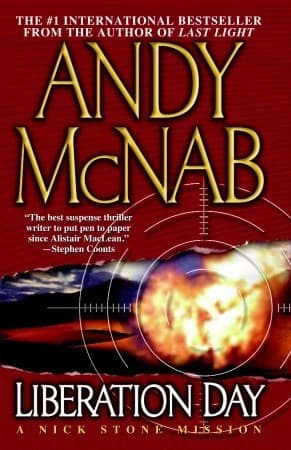
Andy McNab (2002)
Genre
Thriller
Reading Time
500 min
Key Themes
See below
Sign in to track this book
Desperate for a new life, ex-SAS operative Nick Stone dives into a high-stakes CIA assassination in an Arab republic, only to uncover a deeper, deadlier mission against al-Qaeda in the chilling French underworld.
Nick Stone, a former SAS operative, lives in the United States and loves Anna, a successful lawyer. He wants American citizenship to build a stable life with her and leave his past behind. The CIA offers him a deal: assassinate a wealthy, money-laundering businessman named Al-Harbi in an unnamed Arab republic. In return, they will speed up his citizenship application. Stone, despite his doubts about the work, agrees, seeing it as his final step toward a normal life. He prepares carefully for the mission, gathering information and planning his escape, unaware of the true complexities and hidden motives behind this seemingly simple task.
Stone travels to the Arab republic, using his training and experience to bypass security and reach Al-Harbi's heavily guarded compound. He watches the target's routine, finds weak points, and kills Al-Harbi with cold precision. The mission requires him to kill Al-Harbi and retrieve a specific gruesome proof of death—a thumb—to confirm the kill to his handlers. Stone navigates the dangerous environment, completes the objective, and extracts himself from the country, believing he has fulfilled his part of the deal and can now look forward to a peaceful future with Anna.
Upon his return, Stone expects to finalize his citizenship, but his CIA handler, Henderson, avoids him. Stone's suspicions grow when he finds inconsistencies in the information he was given. He realizes that Al-Harbi was just a pawn, and his assassination was a calculated move to destabilize a larger, more complex network. The real target, and the true reason for his mission, begins to emerge as a shadowy figure connected to al-Qaeda. Stone feels betrayed and manipulated, understanding that his 'last job' was just the start of a deeper and more dangerous entanglement.
Needing answers and feeling responsible, Stone follows new leads to France. He explores the dark underworld of Paris and other French cities, meeting various contacts, both legal and illegal. He discovers that al-Qaeda operatives are active in the region, using France as a base for their illegal activities. Stone finds himself caught in a secret war, fighting not just individual terrorists but an entire network. The situation intensifies as he realizes the global importance of the information he is uncovering, and the personal danger grows with every step.
As Stone gets closer to the al-Qaeda network, a devastating personal blow hits him: Anna is kidnapped. This act is clearly direct retaliation and a way to manipulate Stone, showing the reach and ruthlessness of his enemies. Her abduction shatters his hopes for a normal life and plunges him into a desperate race against time. The emotional toll is huge, as he is torn between continuing his pursuit of the terrorists and dropping everything to rescue the woman he loves. This event turns the mission from a professional duty into a deeply personal vendetta.
Stone receives a chilling message from the kidnappers, confirming Anna's capture and giving him an impossible choice. They demand that he stop his operations against them and, possibly, ask him to do something for them, in exchange for Anna's life. The terrorists provide proof of her captivity, leaving Stone in agony. He must face the most lethal dilemma of his life: continue his fight against a global terrorist organization, potentially saving countless lives, or abandon everything to save the one person who means the world to him. The moral and emotional weight of this decision is immense.
Realizing he cannot save Anna alone, Stone makes difficult choices and forms unexpected alliances. He reaches out to some of his former contacts, including intelligence community members who may have their own agendas, and even some from the criminal underworld. These alliances are full of tension and distrust, as Stone knows he is playing a dangerous game. He must navigate these treacherous relationships, using whatever influence and resources he can to find Anna's location and plan a rescue, all while knowing that any mistake could cost Anna her life or compromise his mission.
With information from his desperate alliances, Stone locates Anna at a heavily fortified terrorist safe house. He plans a high-stakes rescue operation, using all his tactical skills and combat experience. The attempt faces fierce resistance from the al-Qaeda operatives guarding Anna. Stone engages in brutal close-quarters combat, navigating booby traps and overwhelming odds. The scene is a frantic and bloody struggle for survival, where Stone pushes his physical and mental limits, driven solely by the urgent need to get Anna out alive, regardless of the personal cost.
Stone successfully rescues Anna, though both are deeply affected by the ordeal. Afterward, the full extent of the conspiracy and the CIA's manipulation becomes clear. Stone uncovers evidence suggesting the CIA was not just using him to fight al-Qaeda, but that elements within the agency might have been involved in a more complex geopolitical game, possibly even using the terrorist threat for their own ends. The lines between good and evil blur, leaving Stone questioning who he can truly trust and the morality of his own actions within this shadowy world. Anna's safety is most important, but the fight is far from over.
Enraged by the betrayal and the near-fatal consequences for Anna, Stone confronts Henderson, his initial CIA handler. He demands a full explanation of the mission, the lies he was told, and the true reasons for using him as a pawn. The confrontation is tense and volatile, with Stone refusing to accept official jargon or excuses. He seeks not just answers, but some justice for the psychological and physical torment he and Anna endured. Henderson, however, is a master of manipulation and evasion, making it difficult for Stone to get the complete truth, further cementing Stone's distrust in the system.
Despite rescuing Anna and confronting Henderson, Stone knows that some threats remain. He takes steps to ensure his and Anna's safety, tying up loose ends related to the al-Qaeda network and rogue elements within the intelligence community. He uses his skills to eliminate remaining threats, making it clear that he will protect what is his at all costs. The experience changes him deeply. His desire for a normal life with Anna is now mixed with a deeper understanding of the world's dark side and his own unavoidable role in it. The future remains uncertain, but Stone is ready for whatever comes next.
The Protagonist
Stone evolves from a detached operative seeking personal peace to a man forced to confront the moral complexities of his world, driven by love and a thirst for justice against those who manipulate him.
The Supporting
Anna starts as a symbol of Stone's desired future and becomes a victim, forcing her to confront the brutal reality of his life and their shared future.
The Antagonist/Supporting
Henderson remains largely static, serving as the inscrutable face of the intelligence community, always one step ahead in his machinations.
The Mentioned/Initial Target
Al-Harbi serves as an initial plot device, his death revealing the true complexity of the mission.
The Antagonists
As a collective, they serve as the constant, evolving threat that Stone must dismantle.
The Supporting/Mentioned
These contacts are largely static, providing episodic support or obstacles for Stone.
A main theme is Nick Stone's constant struggle with the illusion of control, especially over his own life and missions. He believes the assassination of Al-Harbi is his 'last job,' a way to achieve a peaceful future with Anna. However, his handlers, particularly Henderson, repeatedly betray him, manipulating him into a deeper conflict against al-Qaeda. This betrayal is not just professional but deeply personal when Anna is kidnapped, showing how little control Stone actually has over the forces at play and how easily his personal hopes can be used by the powerful. The first mission itself is a lie, setting the tone for later deceptions.
““They don't care about you, Nick. You're just a tool, and when they're done, they'll discard you.””
The novel clearly shows the devastating personal cost of a life of violence and secret operations. Stone's desire for a normal life with Anna clashes with his dangerous job. Anna's kidnapping is the clearest example of this cost, directly linking his past actions and current mission to the threat against the person he loves most. This forces Stone to face the reality that his choices endanger not only himself but also those closest to him, highlighting how impossible it is to truly separate his two worlds. The psychological toll on both Stone and Anna is immense, even after her rescue.
““You can't just walk away from this life, Nick. It always finds a way to pull you back in.””
The story constantly blurs the lines between good and evil, and who truly represents either. The CIA, supposedly a force for good, is shown to be manipulative and self-serving, using Stone as a pawn and hiding important information. Stone himself operates in morally gray areas, committing assassinations for personal gain (citizenship). His alliances are often with unsavory characters from the underworld, further complicating the ethical landscape. This theme makes the reader question traditional ideas of heroism and villainy, revealing a world where everyone acts with their own agenda, and loyalty is not fixed.
““In this game, Nick, everyone has their price. And everyone has their secrets.””
The novel highlights the widespread and far-reaching nature of global terrorism, specifically al-Qaeda. What starts as a seemingly isolated mission in an Arab republic quickly grows into a secret war across continents, with operatives active in the French underworld. This shows how terrorist networks cross national borders, making them a complex and hard-to-catch enemy. The threat is not just theoretical; it directly affects Stone's life through Anna's kidnapping, emphasizing the personal and immediate danger posed by such groups, even in seemingly safe Western countries. The scale of the threat is a constant pressure on Stone.
““They're everywhere, Nick. Like a virus. You cut off one head, and two more grow.””
The protagonist takes on a final dangerous mission to escape his past and achieve a desired future.
This classic thriller trope sets up the initial premise of the novel. Nick Stone agrees to assassinate Al-Harbi, believing it to be his 'last job' that will secure his American citizenship and a peaceful life with Anna. This device immediately establishes high stakes and personal motivation. However, the trope is subverted when the 'last job' is revealed to be a deception, serving as a gateway to a much larger and more dangerous conflict, effectively trapping Stone deeper in the very life he tried to escape. This subversion drives the central conflict and Stone's personal anguish.
A specific, seemingly vital object that drives the initial plot but is ultimately less important than the underlying conflict.
The requirement for Stone to bring back 'gruesome proof' of Al-Harbi's death (a thumb) functions as a MacGuffin. While initially presented as crucial for confirming the assassination and securing Stone's citizenship, its actual significance diminishes as the true nature of the mission is revealed. The proof serves primarily to propel Stone into the initial action and to establish the brutal reality of his world, but the underlying conspiracy and the al-Qaeda threat quickly overshadow its importance, shifting the focus to the larger geopolitical game and Anna's kidnapping.
An early target or character who appears to be central but is a diversion from the true antagonist or objective.
Al-Harbi serves as a false protagonist/initial target. Stone is led to believe that assassinating Al-Harbi is the core mission, and that Al-Harbi himself is the primary problem. However, it is later revealed that Al-Harbi was merely a pawn, and his death was a strategic move to destabilize a larger network or to trigger a subsequent chain of events. This device creates a sense of betrayal and manipulation, forcing Stone to re-evaluate his understanding of the mission and uncover the true, more dangerous adversaries (al-Qaeda and rogue intelligence elements) who are the real focus of the story.
The conflict directly threatens the protagonist's loved ones, raising the stakes dramatically.
While Stone initially has personal stakes (citizenship, future with Anna), the conflict escalates dramatically with Anna's kidnapping. This plot device transforms the mission from a professional obligation into a deeply personal vendetta, increasing the emotional intensity and driving Stone's actions with a fierce urgency. Her abduction is not merely a consequence of his dangerous life but a direct manipulation by his enemies, forcing him into an impossible dilemma and highlighting the ultimate cost of his profession. This significantly amplifies the tension and emotional resonance of the narrative.
“The wind was a living thing, snatching at your clothes, trying to tear the breath from your lungs. It was a good distraction.”
— Describing a harsh environment during a mission.
“Fear was a useful tool if you knew how to wield it. Not to let it wield you.”
— Reflecting on controlling emotions in high-stakes situations.
“In this game, there were no second chances. Only consequences.”
— Considering the unforgiving nature of espionage and special operations.
“He knew the smell of danger. It wasn't always blood; sometimes it was just the absence of noise.”
— A character's heightened senses detecting an impending threat.
“Trust was a luxury few could afford, and even fewer could genuinely offer.”
— Pondering the scarcity of genuine trust within a clandestine world.
“The best way to hide something was in plain sight, especially when everyone was looking for something else.”
— A tactical thought on deception and misdirection.
“Every mission had its own heartbeat, its own rhythm. You just had to learn to dance to it.”
— A metaphorical description of adapting to operational challenges.
“He'd seen enough death to know it wasn't a grand, dramatic affair. Mostly, it was just messy and final.”
— A cynical observation on the reality of death in combat.
“The past was a weapon, and some people were very good at using it.”
— Considering how past events or secrets can be leveraged against someone.
“Sometimes the biggest battles were fought not with bullets, but with information.”
— Highlighting the importance of intelligence in modern warfare.
“Survival wasn't about being the strongest, it was about being the most adaptable.”
— A character's philosophy on staying alive in hostile environments.
“He lived in the shadows, not because he liked them, but because that's where the work was.”
— Explaining a character's chosen profession and its demands.
“The line between hunter and hunted could blur in an instant.”
— Reflecting on the unpredictable nature of a pursuit.
“Regret was a luxury for those who had time to dwell on it. He didn't.”
— A character's stoic approach to past decisions and actions.
Ready to see how well you understood this book? Take our interactive quiz with 10 questions.

Andy McNab is a former SAS soldier turned bestselling author, renowned for his thrilling action novels. His works, including 'Liberation Day,' 'Remote Control,' and 'Traitor,' draw heavily on his real-life experiences in special forces operations. McNab's writing is characterized by its gritty realism and fast-paced plots, making him a prominent figure in the thriller genre.







