“When you have nothing left but God, you have more than enough to start over.”
— Rifka reflects on her family's resilience and faith amidst their struggles.

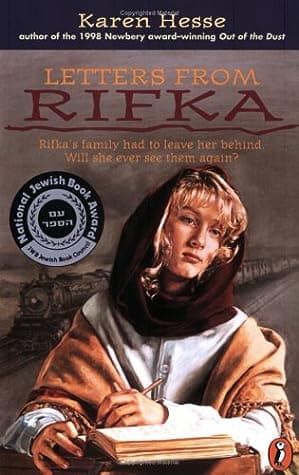
Karen Hesse (1991)
Genre
Children's / Historical Fiction / Young Adult
Reading Time
180 min
Key Themes
See below
Sign in to track this book
A Jewish girl recounts her 1919 journey from Russian pogroms, through medical quarantine in Belgium, to America, dealing with identity, belonging, and family strength.
In August 1919, thirteen-year-old Rifka writes letters to her cousin Tovah. She describes her family's escape from Berdichev, Russia, because of pogroms and forced conscription into the Tsar's army. Her older brother, Nathan, is already gone, and Saul is next. Rifka, her parents, Saul, and her older sister Hannah, bribe a guard to cross the Polish border. During the trip, Rifka gets typhus. This means the family is quarantined in a dirty, crowded hospital tent for weeks. Rifka recovers slowly, and the illness leaves her bald and weak, a reminder of their dangerous journey.
After Rifka recovers from typhus, the family continues their difficult journey across Poland. They deal with hunger, cold, and constant fear, often relying on strangers' kindness or their shrinking money. Rifka describes their cramped train rides and the harsh conditions. In Antwerp, Belgium, the port city where they will sail to America, they have medical inspections by American immigration officials. During this inspection, doctors find Rifka has ringworm on her scalp, a lasting effect of her typhus and poor hygiene during their travels. This diagnosis is a big problem, as ringworm requires quarantine.
Because of her ringworm, American immigration officials say Rifka is medically unfit to enter the United States. Her family, having already bought their tickets and fearing more delays, faces a difficult choice. They decide Rifka must stay in Antwerp for treatment while the rest of the family goes to America. This separation devastates Rifka, who feels abandoned and alone. The Hebrew Immigrant Aid Society (HIAS), an organization that helps Jewish immigrants, takes her in. They place her in a boarding house run by Sister Agnes, who speaks only Flemish, creating an immediate language barrier for Rifka.
Rifka's life in Antwerp is lonely and hard at first. She misses her family greatly and struggles with the language barrier. She communicates with Sister Agnes using gestures and a few Yiddish words. Her main focus is the daily, often painful, treatments for her ringworm. These treatments involve putting harsh chemicals on her scalp and shaving any new hair. This is humiliating for a young girl. Rifka finds comfort in her letters to Tovah, using them to process her experiences and stay connected to her past. She also starts to explore Antwerp and observe the local culture.
Despite her initial isolation, Rifka slowly adapts to her new surroundings. She often visits a local bakery, drawn by the smell of fresh bread. There, she befriends Pieter, a kind baker who is patient with her attempts to communicate. Pieter teaches her some Flemish words, and Rifka practices her English with him, preparing for her eventual arrival in America. Their friendship gives Rifka needed companionship and a sense of normalcy. She also learns more about Flemish culture and the daily life of Antwerp residents, broadening her view.
Months pass, and Rifka's ringworm treatments continue. She visits the doctor regularly, enduring the painful applications and constant shaving of her head. Doctors confirm the ringworm is slowly clearing, but they give a discouraging prediction: her hair might not grow back properly, or at all, because of the severe infection and treatments. This news deeply upsets Rifka, as her baldness has been a source of shame and a constant reminder of her illness. However, she remains determined to recover and join her family, holding onto hope for a new life in America.
One day, Mr. Fargate, an American sailor, notices Rifka and her bald head. He starts a conversation, first in Yiddish, then in English. Mr. Fargate takes an interest in Rifka's story and begins to bring her books from America, especially English-language books and dictionaries. These gifts are very helpful to Rifka. They allow her to improve her English and provide a needed distraction from her treatments. Their friendship gives Rifka new hope and purpose, as she works hard to learn English, believing it will help her in America.
As seasons change and nearly a year passes since her family left, Rifka's patience wears thin. She continues her treatments, writes letters, and studies English, but the emotional toll of separation and uncertainty grows. She longs for news from her family and for the day she can travel. Despite the kindness of Sister Agnes, Pieter, and Mr. Fargate, Rifka feels the weight of her isolation. She often expresses her frustrations and worries in her letters to Tovah, wondering if she will ever reunite with her family and if her hair will grow back.
Finally, the day for Rifka's last medical inspection arrives. She is nervous, knowing this is her final chance to be cleared. To her great relief, the doctors confirm the ringworm is completely gone. Even more, as she prepares for the inspection, she notices soft fuzz beginning to grow on her scalp—her hair is finally returning, though slowly. This development is a huge emotional boost for Rifka, showing not just her physical healing but also her renewed hope and confidence. Officials declare her healthy and fit to travel to America.
With her medical clearance, Rifka prepares for her transatlantic voyage. She says an emotional goodbye to Sister Agnes, Pieter, and Mr. Fargate, who became like family during her long stay in Antwerp. She thanks them for their kindness and support. With her improved English, a new sense of strength, and the letters that documented her journey, Rifka boards the ship to America. She looks forward to a new life, reuniting with her family, and the opportunities in the promised land. She carries the lessons learned from her challenging but changing year abroad.
The Protagonist
From a scared, sick girl dependent on her family, Rifka transforms into an independent, hopeful young woman fluent in English, ready for America.
The Supporting
As an unseen character, Tovah's 'arc' is primarily her role as a constant, unchanging anchor for Rifka's emotional journey.
The Supporting
She endures the trauma of fleeing home and separating from her daughter, holding onto hope for their eventual reunion.
The Supporting
He leads his family through immense hardship, making tough choices to secure their future, and maintains hope for Rifka's eventual arrival.
The Supporting
He experiences the initial fear of conscription and the hardship of the journey, eventually making it to America with the rest of the family.
The Supporting
She shares the family's initial struggles and eventually reaches America with her parents and brother, awaiting Rifka's arrival.
The Supporting
She provides a stable and nurturing environment for Rifka during her year of isolation, becoming a surrogate mother figure.
The Supporting
He offers Rifka a much-needed friendship and helps her begin to learn the local language, easing her loneliness.
The Supporting
He provides Rifka with educational tools and encouragement, significantly aiding her English language acquisition and mental well-being.
Rifka's journey involves her changing sense of self. Her baldness, a physical sign of her illness and hardship, first shames her and makes her feel different. But through her strength and others' kindness, she accepts herself and finds strength in her experiences. Learning new languages and adapting to a foreign culture also shape her identity, turning her from a scared Russian girl into a resourceful young woman ready for America. Her letters show this process of self-discovery.
“Perhaps my hair will never grow. Perhaps I will be bald all my life. But I will be in America, and that is what matters.”
The story shows Rifka's resilience. From surviving typhus and ringworm to enduring separation from her family and loneliness in a foreign land, Rifka consistently faces problems with a strong spirit. She actively seeks solutions, learns new languages, and finds comfort in her writing, refusing to give up hope. Her persistence comes from her strong wish to reunite with her family and embrace the promise of a new life, showing human strength when faced with extreme difficulty.
“I will not let this ringworm defeat me. I will not let it keep me from America.”
The book shows the realities of the early 20th-century immigrant experience for Jewish families fleeing persecution. It highlights the dangers of escape, the poor transit conditions, the strict and often dehumanizing medical inspections, and the difficult decisions families had to make. Rifka's separation in Antwerp shows the bureaucratic and medical problems many immigrants faced. Her eventual journey to America symbolizes the lasting hope for freedom and opportunity that drove many across oceans.
“It is not so easy to come to America. They examine every part of you, every hair on your head.”
Language is a main theme, acting as both a barrier and a connection. Rifka's initial isolation in Antwerp is made worse by her inability to speak Flemish. However, her decision to learn Flemish from Pieter and English from Mr. Fargate becomes a strong tool for connection and self-empowerment. Her letters to Tovah, written in Yiddish (implied), are her main way of communicating, expressing herself, and processing emotions. This shows how writing can overcome physical distance and keep one's identity.
“Each new word I learn is like a key, unlocking a little bit of the world for me.”
The wish for family and a sense of belonging drives Rifka's story. Her initial flight is to keep her family together and safe. Her separation from them is the most painful part of her journey, and her main goal is reunion. The kindness of Sister Agnes, Pieter, and Mr. Fargate helps fill the emptiness, creating a temporary sense of belonging in a foreign land. Ultimately, the hope of joining her family in America fuels her persistence and represents her deepest desire for a secure and loving home.
“My family is in America, and I will join them. That is the only thing that matters.”
The entire story is told through Rifka's letters to her cousin Tovah.
The novel is entirely composed of Rifka's letters to her cousin Tovah. This epistolary format provides an intimate, first-person perspective, allowing readers direct access to Rifka's thoughts, fears, hopes, and observations. It makes the narrative deeply personal and immediate. The letters also serve as a coping mechanism for Rifka, a way to process her experiences and maintain a connection to her past and identity while isolated. The absence of Tovah's replies emphasizes Rifka's loneliness and the one-sided nature of her communication during her separation.
Rifka's hair loss and regrowth symbolize her journey through illness, shame, and eventual healing and renewal.
Rifka's hair, or lack thereof, is a potent symbol throughout the book. Her initial baldness from typhus and the subsequent shaving for ringworm treatments become a source of profound shame and a visible marker of her illness and difference. It symbolizes her vulnerability and the stripping away of her former life. The slow, miraculous regrowth of her hair at the end of the story symbolizes her physical healing, her renewed hope, and her triumph over adversity, representing a new beginning and the restoration of her sense of self and femininity.
A family heirloom exchanged for a bribe, symbolizing sacrifice and desperate measures.
The golden bracelet, a cherished family heirloom belonging to Rifka's Mama, is initially mentioned as a valuable possession. It is later used to bribe a guard at the Polish border, allowing the family to escape Russia. This act symbolizes the immense sacrifices and desperate measures immigrant families had to take to secure their freedom and safety. Its loss signifies the material cost of their journey, yet the gain of freedom far outweighs its monetary value, highlighting the family's priorities.
The inability to communicate in local languages highlights Rifka's isolation and her journey of adaptation.
The language barrier is a significant plot device that emphasizes Rifka's vulnerability and isolation, particularly in Antwerp. Her inability to speak Flemish initially prevents her from fully understanding or being understood by Sister Agnes and the local community. This obstacle forces her to rely on gestures and eventually motivates her to diligently learn new languages, reflecting her adaptability and determination. Overcoming the language barrier symbolizes her progress in integrating into new environments and preparing for her new life in America.
“When you have nothing left but God, you have more than enough to start over.”
— Rifka reflects on her family's resilience and faith amidst their struggles.
“The wind carries a smell of salt and fish, and something else, something I cannot name, but it fills me with a longing.”
— Rifka describes her first sensory impressions of the sea, hinting at her yearning for a new life.
“A scar is a sign that you have been hurt, but it is also a sign that you have healed.”
— Rifka considers the physical and emotional scars she carries from her journey and illness.
“It is not the biggest, the strongest, the cleverest who survive, but those who can change.”
— Rifka ponders the nature of survival and adaptation during her time in quarantine.
“My mind is a tangled skein of worry, hope, and the desire to be free.”
— Rifka expresses her complex emotional state while facing potential deportation.
“Even in the darkest places, there is always a flicker of light, if you only look for it.”
— Rifka finds moments of beauty and kindness despite her challenging circumstances.
“Words are like birds, once they fly out of your mouth, you can never catch them again.”
— Rifka reflects on the power and permanence of spoken words, particularly when writing letters.
“Sometimes, the hardest part of a journey is not the traveling, but the waiting.”
— Rifka endures long periods of uncertainty and quarantine on Ellis Island.
“I am a girl who has learned to make her own way, even when the path is not clear.”
— Rifka asserts her growing independence and self-reliance.
“America. The name tastes like honey on my tongue, and fear in my belly.”
— Rifka describes her mixed feelings about her destination, America.
“To be clean is to be safe, they say. But I think to be loved is to be safe.”
— Rifka contrasts the medical focus on cleanliness with her deeper need for acceptance and connection.
“My letters are my voice, my only way to speak to those I love.”
— Rifka emphasizes the importance of her letters as her primary form of communication.
“The world is a big place, Rifka, and there is room in it for everyone, even a girl with a bald head.”
— A kind nurse reassures Rifka about her appearance and place in the world.
“Hope is a thing with feathers, they say. I think it is a thing with calloused hands, working hard for a new life.”
— Rifka redefines hope based on her experiences of hard work and perseverance.
Ready to see how well you understood this book? Take our interactive quiz with 10 questions.

Biography coming soon.
Dan Gemeinhart
4.5
Kate O'Hearn
4.4

Jeanne Birdsall
4.4

Jen Wang
4.4
Wendelin Van Draanen
4.3

John Marsden
4.3

Chris Van Allsburg
4.3
Jennifer A. Nielsen
4.2