“The worst kind of courage was the kind that came from desperation.”
— Robin considers her own bravery while undercover.

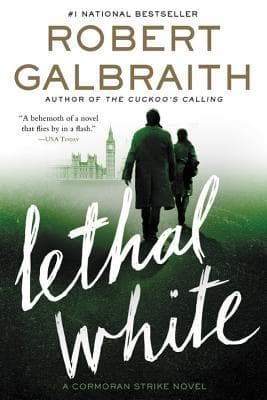
Robert Galbraith (2018)
Genre
Thriller / Mystery
Reading Time
15-20 hours
Key Themes
See below
Sign in to track this book
A mentally distressed man's fragmented memory of a childhood murder sends private investigators Cormoran Strike and Robin Ellacott spiraling through London's hidden elite, Parliament's shadowy corridors, and a sinister country estate, all while navigating their own complicated, fame-addled partnership.
The book starts at Robin Ellacott's wedding reception to Matthew Cunliffe. Cormoran Strike, feeling conflicted about Robin's marriage, leaves when a distressed young man, Billy Knight, appears in his office. Billy says he saw a child murdered years ago and saw the body buried, along with a 'lethal white' horse. He is traumatized and struggles to say details, but his sincerity unsettles Strike. Billy mentions his brother Jimmy and his father, Ted, and refers to a 'bad man' and a 'bad woman.' Before Strike can get more information or help, Billy, overwhelmed by memories and a perceived threat, runs from the office in a panic, leaving Strike interested and worried.
Soon after Billy's exit, Robin, now married, returns to work. Strike is then approached by Jasper Chiswell, the unpredictable Minister of Culture. Chiswell hires Strike to investigate Billy Knight, who he thinks is blackmailing him, possibly with his stepson, Raphael, and his estranged son, Jimmy Knight (Billy's brother). Chiswell wants Strike to find out what Billy and Jimmy know and how they connect to his family. This assignment gives Strike a reason to pursue Billy's story, which he already wants to do, and draws him into the complex Chiswell family.
To get information in Chiswell's household without causing suspicion, Robin works as Jasper Chiswell's temporary assistant at his country estate, Highgate. This lets her observe family dynamics, including Chiswell's difficult wife, Kinvara, his rebellious stepson, Raphael, and his estranged children, Geraint and Izzy. Robin quickly sees the household is full of tension, resentment, and secrets. She also learns about the family's money problems and Chiswell's many enemies, both personal and political. During this time, Robin and Matthew's marriage already shows cracks, made worse by her demanding work and Matthew's jealousy.
While Robin is still undercover at Highgate, Jasper Chiswell is found dead in his study. The police call it a suicide, from carbon monoxide poisoning from a car exhaust pipe rigged to the room, mostly because of a note found nearby. However, Strike and Robin are suspicious. They know Chiswell was a fighter and had too much to lose to commit suicide, especially with an important vote coming. The death changes their investigation from a blackmail inquiry to a possible murder case. Every member of the Chiswell family becomes a suspect. Strike and Robin begin to re-examine the scene and the family's alibis.
Strike and Robin investigate the Chiswell family members and their associates, including Kinvara, Raphael, Geraint, Izzy, and Chiswell's former secretary, Della Winn. They uncover many motives: Kinvara's hatred for Jasper and her money problems, Raphael's sense of entitlement and criminal activities, Geraint's political ambitions, and Izzy's complicated relationship with her father. They also find Chiswell's history of affairs, his difficult personality, and his tendency to make enemies. The 'lethal white' horse Billy mentioned remains a cryptic clue, leading them to research a rare and often fatal genetic condition in horses, and eventually to a specific stable connected to the family.
Following Billy's clues about the 'lethal white' horse and a buried body, Strike focuses his investigation on old stables and properties connected to the Chiswell family. He finds a derelict stable on the Chiswell estate, one used by Chiswell's first wife, Della. After getting permission, Strike and Robin search the grounds. Their digging leads them to a shallow grave where they find a child's remains, confirming Billy's memory and proving a murder happened years ago. This discovery shifts the investigation, linking Chiswell's current murder to a child's past disappearance.
The child's remains are identified as Rosie, the daughter of a woman named Mary, who had been involved with Chiswell years ago. Mary was Ted Knight's (Billy and Jimmy's father) sister. This links the Knight family to the Chiswell family's past and provides a strong motive for revenge. The police, initially dismissive, now must take the case seriously. Strike realizes the original murder was covered up, and the 'lethal white' horse was a key element in the story, perhaps a symbol or even directly involved in the events leading to Rosie's death. The investigation now focuses on who killed Rosie and how that connects to Jasper Chiswell's death.
Through investigation, interviews, and re-examining alibis, Strike and Robin find inconsistencies and hidden motives. They realize Chiswell's apparent suicide was staged. They focus on the financial arrangements, the history of abuse and manipulation within the Chiswell family, and the various resentments against Jasper. The 'lethal white' clue, Rosie's original murder, and the blackmail attempts all come together. Strike eventually deduces that the killer is Della Winn, Jasper Chiswell's first wife and Geraint's mother, who had been having an affair with Raphael. Della had murdered Rosie years ago to stop her from revealing her affair with Jasper, and then killed Jasper to cover up her past and secure her financial future.
Strike confronts Della Winn with the evidence he has gathered, including her motive for murdering Rosie (to protect her reputation and marriage after Rosie, a child of her and Jasper's affair, became a liability), and her later motive for murdering Jasper (to prevent him from revealing the truth about Rosie's death and to secure her inheritance). Della, cornered, confesses to both murders. She describes in detail how she killed Rosie and then staged Jasper's suicide to deflect suspicion. She also reveals her manipulation of Billy and Jimmy, using their trauma and resentment against Jasper.
With Della Winn's confession, Rosie's decades-old murder and Jasper Chiswell's more recent murder are solved. Billy Knight, finally vindicated, starts to get the psychological help he needs. Jimmy Knight, though still troubled, finds some peace. The Chiswell family deals with the revelations. Personally, Robin confronts Matthew about his infidelity and their broken marriage, leading to their separation. Strike and Robin's professional partnership solidifies, though the unspoken tension and affection between them remain, hinting at future developments in their complex relationship.
The Protagonist
Strike grapples with his feelings for Robin and the challenges of his growing public profile, ultimately solidifying his professional partnership with Robin while his personal life remains in flux.
The Protagonist/Supporting
Robin navigates the breakdown of her marriage while solidifying her role as a detective, demonstrating her growing skill and independence.
The Key Witness/Victim
Billy's fragmented memories are validated, leading to the resolution of a decades-old crime and the beginning of his recovery.
The Client/Victim
Chiswell's death initiates the primary murder investigation, revealing the depths of his family's dysfunction and his own hidden past.
The Antagonist
Della is revealed as the cunning and ruthless killer, her carefully constructed life unraveling as Strike exposes her crimes.
The Supporting
Kinvara remains a volatile and unhappy figure, her life continuing to be defined by her destructive relationships and financial struggles.
The Supporting
Raphael remains entangled in criminal activities and dysfunctional relationships, ultimately being used as a pawn in Della's schemes.
The Supporting
Jimmy's initial anger and suspicion are validated by the truth, allowing him a path towards some form of resolution.
The Supporting
Matthew's infidelity and jealousy lead to the irreparable breakdown of his marriage to Robin.
'Lethal White' shows how unresolved injustices from the past can affect the present. Billy Knight's childhood trauma, from seeing Rosie's murder, directly fuels the central mystery decades later. The original cover-up by Della Winn and others leads to blackmail, resentment, and Chiswell's murder. The book shows that secrets, especially those involving violence and betrayal, rarely stay hidden, eventually resurfacing for justice. The 'lethal white' horse itself is a physical representation of this theme, a detail from the past that holds the key to present-day horrors.
“'Sometimes,' Strike said, 'the past isn't even past. It's just… waiting.'”
The Chiswell family is an example of extreme dysfunction, where animosity, greed, and long-held resentments exist under a respectable exterior. Each family member — Jasper, Kinvara, Raphael, Geraint, and Izzy — is driven by self-interest, money problems, or deep hatred. The web of affairs, blackmail, and manipulation shows how family ties can become destructive. The book explores how the quest for inheritance and social standing can corrupt people and lead to tragic results, showing that the most dangerous secrets often reside within close circles.
“'The Chiswells,' Robin thought, 'were like a nest of vipers, each one ready to strike the other.'”
Strike and Robin both go on journeys of self-discovery. Robin deals with her identity as a wife versus her identity as a detective. Her undercover work and the eventual end of her marriage force her to confront what she truly wants from her life and career, solidifying her commitment to the agency. Strike, too, navigates his newfound fame and the emotional complexities of his relationship with Robin, making him acknowledge his own vulnerabilities and desires. The case itself is about finding the true identities of victims and perpetrators, and the self-deception the killer uses to maintain a false persona.
“'She was not a wife anymore. She was a detective. And that, at least, felt like the truth.'”
The book explores how hard it is to find truth, especially through Billy Knight's fragmented and traumatized memories. His inability to tell a clear story makes it hard for others to believe him, yet his core memory of a murder is true. Strike and Robin must piece together fragments of information, conflicting testimonies, and long-buried evidence to reconstruct the true events. The theme also extends to how characters construct false stories to protect themselves or deceive others, showing how memory can be distorted, suppressed, or used as a weapon. The 'lethal white' horse itself functions as a fragmented memory, a key detail that only makes sense once the full truth is revealed.
“'Memory was a trick, a kaleidoscope of shattered glass, but sometimes, just sometimes, a pattern emerged.'”
Billy Knight's fragmented and traumatized testimony serves as the initial, cryptic clue.
Billy Knight's character embodies the unreliable witness. Due to his mental illness and the trauma of his childhood, his account of the murder is disjointed, vague, and often contradictory. This device creates initial doubt and skepticism, both for Strike and the reader, forcing a deeper investigation to discern the truth hidden within his fragmented memories. It also highlights the challenges of obtaining justice for those whose testimony is easily dismissed due to their mental state, making Strike's commitment to Billy's story all the more significant. The 'lethal white' horse is a prime example of a cryptic detail from this unreliable testimony that proves crucial.
Robin goes undercover as Chiswell's assistant to infiltrate the dysfunctional family.
Robin's undercover role as Jasper Chiswell's temporary assistant at Highgate is a crucial plot device. It allows her direct access to the Chiswell household, enabling her to observe the family's dynamics, personal animosities, and hidden secrets firsthand. This immersive perspective provides insights that would be impossible to gain through conventional interviews. It also places Robin in constant danger, heightening the tension and demonstrating her growing skills and courage as a detective. Her observations, though sometimes subjective, are vital for Strike to piece together the complex motives and alibis.
A symbolic and literal clue that links the past and present murders.
The 'lethal white' horse is a central motif and a key plot device. Initially mentioned cryptically by Billy Knight, it refers to a rare genetic condition in horses that is often fatal. This detail seems obscure but becomes a crucial link, leading Strike to a specific stable and ultimately to the discovery of Rosie's body. Symbolically, 'lethal white' can represent hidden danger beneath an outwardly innocent or beautiful facade, mirroring the killer's deceptive nature and the long-buried, deadly secret. It serves as a tangible, yet enigmatic, thread connecting the decades-old murder to the present-day crime.
The Chiswell family's toxic dynamics create a confined suspect pool and a web of motives.
The Chiswell family, confined largely within their country estate and their intricate, hostile relationships, functions as a classic 'closed circle' mystery element. Every member—Jasper, Kinvara, Raphael, Geraint, and Izzy—has strong motives, secrets, and alibis that must be meticulously examined. The intense animosity and lack of trust within the family make it difficult to ascertain the truth, as everyone has something to hide or a reason to lie. This device concentrates the tension and forces Strike and Robin to delve deeply into the psychological complexities and historical grievances binding the family together, or tearing them apart.
“The worst kind of courage was the kind that came from desperation.”
— Robin considers her own bravery while undercover.
“The past was never really past. It was just waiting for a good moment to pounce.”
— Strike reflects on how old cases and personal histories resurface.
“It was impossible to truly know anyone, even those you loved best. People were always, ultimately, alone inside their own heads.”
— Strike's cynical observation about human nature and relationships.
“Truth was rarely simple, and never easy.”
— A recurring theme as Strike and Robin unravel complex lies.
“Grief was a strange thing. It didn't just fade; it changed shape, became a different kind of pain.”
— Characters dealing with past losses and their lasting impact.
“Most people, when they told a lie, tried to make it sound plausible. The really good liars didn't bother.”
— Strike's insight into the psychology of deception.
“The most dangerous secrets were the ones you kept from yourself.”
— Characters' self-deception leading to their downfall.
“Money didn’t buy happiness, but it certainly bought a better class of misery.”
— Observation about the wealthy characters and their problems.
“Sometimes the best way to hide something was to put it in plain sight.”
— A clue or piece of evidence being overlooked due to its obviousness.
“You couldn't escape who you were, no matter how far you ran.”
— Characters attempting to outrun their past or identity.
“Love was not a thing to be earned, but a gift to be given, and often, squandered.”
— Reflections on the complicated romantic relationships in the book.
“Every family had its own mythology, its own private language of grievance and affection.”
— Exploring the dysfunctional dynamics within the Chiswell family.
“The world was full of people who wanted to be seen, but not truly looked at.”
— Strike considering the performative nature of some public figures.
“Justice was a luxury, and often, an illusion.”
— Strike's jaded view of the legal system and its outcomes.
Ready to see how well you understood this book? Take our interactive quiz with 10 questions.

Biography coming soon.







