“I will give myself, but I will not be taken.”
— Marquise de Merteuil's declaration of independence and control in her relationships.

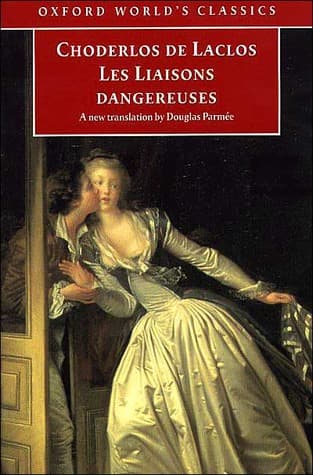
Pierre Choderlos de Laclos, Choderlos de Laclos (1782)
Genre
Historical Fiction / Romance
Reading Time
10-12 hours
Key Themes
See below
Sign in to track this book
In pre-revolutionary France, two aristocratic ex-lovers wage a cynical war of seduction and betrayal, using innocent hearts as pawns in their game of social and sexual conquest.
The novel begins with letters, mainly between the Marquise de Merteuil and the Vicomte de Valmont, showing their cynical and manipulative natures. Merteuil, a calculating widow, wants revenge on her former lover, Gercourt, who left her for Cécile Volanges, a young woman recently out of a convent and engaged to Gercourt. Merteuil plans to corrupt Cécile before her marriage and asks Valmont, a known libertine, to do it. Valmont, however, is more interested in conquering the virtuous and devout Présidente de Tourvel, a married woman known for her piety and resistance to seduction. Merteuil dismisses his goal, believing Tourvel is an impossible target, but Valmont sees it as the ultimate test of his skill.
Valmont, pretending to be uninterested in Merteuil's plan, travels to the country estate where Tourvel is staying. He immediately starts his complex seduction campaign. He pretends to be a changed man, doing charity work and appearing devout, all to impress Tourvel. He writes her many letters, full of declarations of love and feigned despair, carefully creating his image as a man deeply affected by her virtue. Tourvel, at first cautious and resistant, finds herself increasingly drawn to Valmont's constant attention and apparent sincerity, despite her strong morals and commitment to her marriage. Her inner conflict becomes a main theme in their letters, as she fights her growing feelings against her sense of duty.
Meanwhile, Merteuil continues her plot against Cécile. She encourages the young Chevalier Danceny, Cécile's music teacher and a naive young man, to fall in love with his student. Merteuil helps their secret letters and meetings, guiding Danceny in his seduction attempts. Cécile, new from the convent and completely inexperienced, is easily swayed by Danceny's romantic words. Merteuil's real goal is to use Danceny to corrupt Cécile, thereby humiliating Gercourt. Valmont, still in the countryside, eventually decides to help Merteuil by also seducing Cécile, seeing it as an amusing distraction and a way to prove his continued skill, further complicating the young girl's already difficult situation.
Valmont seduces Cécile, taking advantage of her innocence and Danceny's naive approach. He uses Danceny's letters to his own benefit, positioning himself as Cécile's confidant and then her lover. At the same time, Valmont's relentless campaign against Tourvel's virtue finally works. After intense emotional manipulation, where he brings her to despair and then offers comfort, Tourvel gives in to his advances, overwhelmed by her love for him. This double conquest solidifies Valmont's reputation as a master seducer and provides much material for his boastful letters to Merteuil, who, while impressed, sees his attachment to Tourvel as a weakness.
Merteuil, increasingly jealous and suspicious of Valmont's true feelings for Tourvel, demands that he publicly abandon the Présidente. She sees his lingering affection as a betrayal of their cynical agreement and a threat to her emotional control over him. To prove his loyalty and keep their alliance, Merteuil insists that Valmont write a cruel letter to Tourvel, ending their affair in the most dismissive way. Valmont, despite his growing reluctance and a new attachment to Tourvel, ultimately agrees, driven by his pride and his need to keep Merteuil's respect and affection, which he secretly values more than he lets on.
The cruel letter from Valmont completely shatters Tourvel. Her deep love and trust are betrayed, leaving her heartbroken and humiliated. The shock and emotional trauma lead to a quick decline in her physical and mental health. She withdraws from society, falling into a deep depression and a severe illness. Her once lively spirit is gone, and she is consumed by grief and despair. Her suffering shows the devastating results of Valmont's manipulative game, highlighting the extreme vulnerability of those who fall victim to the libertines' schemes.
Danceny, having found out about Valmont's affair with Cécile and, more importantly, Valmont's role in corrupting her, is enraged by the betrayal. He feels humiliated and used, his naive love for Cécile exploited. Driven by a desire for revenge and to defend Cécile's honor, Danceny challenges Valmont to a duel. This fight marks a turning point in the story, as the hidden schemes of the libertines are exposed, leading to a direct and violent outcome. The duel represents a clash between the remains of aristocratic honor and the cynical amorality of Valmont's world.
In the duel, Valmont is mortally wounded by Danceny. In his dying moments, perhaps seeking a final act of revenge against Merteuil or a twisted form of redemption, Valmont gives Danceny a packet of letters. These letters are the incriminating correspondence between himself and Merteuil, showing the full extent of their manipulative schemes, their cynical agreement, and their roles in corrupting Cécile and destroying Tourvel. Valmont's death marks the end of his reign of seduction, but his final act ensures that Merteuil's own carefully built facade will soon crumble.
The letters Valmont gave to Danceny are publicly exposed. Danceny, horrified by the revelations, shares them with Madame de Volanges, Cécile's mother, and others. The scandalous contents reveal Merteuil's true character as a cold, calculating, and completely amoral manipulator. Society, once charmed by her wit and elegance, turns against her. She is shunned, losing her reputation, her friends, and her social standing. To add to her downfall, Merteuil gets smallpox, which disfigures her face and blinds her in one eye, symbolizing her inner corruption showing outwardly. She is forced to flee Paris in disgrace, completely ruined.
Cécile Volanges, deeply affected by her own corruption, the scandal around Valmont and Danceny, and the revelation of Merteuil's manipulations, is overwhelmed by shame and despair. Her innocence is gone, and her reputation is in tatters. Unable to face society or think about a normal life, she decides to go to a convent. This decision is not necessarily a spiritual calling but rather a desperate attempt to escape the results of her experiences and find shelter from the world's harsh judgment. Her future, once bright with the chance of marriage, is now one of seclusion and penance.
The Présidente de Tourvel, unable to recover from the emotional damage caused by Valmont's betrayal, eventually dies from her illness. Her death is due to deep grief and a broken heart. She dies a victim of the libertines' cruel game, her virtue and love mercilessly used and then discarded. Her death is the ultimate tragic result of the novel's main conflict, showing the destructive power of manipulative seduction and the vulnerability of true human emotion in the face of calculated malice. Her death is mourned by those who knew her true worth.
The Antagonist/Protagonist
Valmont progresses from an unassailable master of seduction to a man briefly touched by genuine emotion, only to be destroyed by his own pride and the consequences of his actions.
The Antagonist/Protagonist
Merteuil's arc sees her rise as an untouchable manipulator, only to suffer a spectacular downfall and social ruin due to the exposure of her machinations.
The Victim
Tourvel descends from unassailable virtue to profound despair and ultimately death, a victim of calculated manipulation.
The Victim
Cécile's arc is one of rapid and devastating corruption, transforming from an innocent girl to a shamed recluse.
The Supporting
Danceny evolves from a naive lover to a vengeful figure, inadvertently exposing the libertines' schemes.
The Supporting
Madame de Volanges remains largely static, a symbol of well-meaning but ultimately ineffectual societal norms against the libertines' cunning.
The Supporting
Azolan remains a constant, loyal servant, his arc tied directly to Valmont's fortunes.
The novel shows how seduction, used as a weapon, can destroy individuals and society. Valmont and Merteuil see seduction not as passion, but as a game to gain power and control. Their targets, like Cécile and Tourvel, lose their innocence, reputation, and ultimately their will to live. Cécile's change from naive convent girl to victim, and Tourvel's painful death from heartbreak, clearly show the devastating moral and psychological cost of such calculated manipulation. The libertines' success in corrupting others confirms their cynical view, strengthening their belief in their superiority.
“What a pleasure it is to play with people's minds, to see their souls open up before you, and to lead them, without their knowing it, to the very brink of the precipice!”
A main theme is the contrast between the public faces of the aristocracy and their private immoralities. Merteuil, especially, is a master of this, presenting herself as a virtuous, witty, and respectable widow while secretly planning malicious acts. Valmont also pretends to be a changed and pious man to deceive Tourvel. The novel uses letters, giving the reader direct access to the characters' true thoughts and intentions, which often strongly contradict their outward actions. This exposes the widespread hypocrisy of 18th-century French society, where reputation and social standing often mattered more than real morality.
“I say to you that a woman who has the art of dissimulation, who can control her face and her voice, can do anything.”
The novel explores the complex power dynamics between men and women in a male-dominated society. Merteuil, in particular, shows a fierce, though destructive, form of female power. She states her philosophy of self-creation and control, born from a need to navigate a world where women often lack power. Her schemes are partly a rebellion against societal limits and a desire to use the same power as men. However, her methods ultimately fail her. The fates of Cécile and Tourvel, victims of male seduction, highlight women's vulnerability, while Merteuil's aggressive independence suggests a darker path to power.
“I was born to avenge my sex and to dominate yours.”
The novel presents a cynical view of love, often showing it as a weakness or a tool for manipulation. Valmont and Merteuil openly reject true emotional attachment, seeing it as a hindrance to their freedom and power. Valmont's pursuit of Tourvel is a conquest, not a courtship, and his brief moments of true affection are quickly suppressed by pride. Danceny's naive love for Cécile is easily used. The only character who experiences true, deep love is Tourvel, and it ultimately leads to her destruction. This contrast suggests that in the world of the libertines, authentic love is a dangerous vulnerability, incompatible with their amoral worldview.
“Love, which is so often born of vanity, often owes its death to it.”
Revenge is a main cause for many plot developments. Merteuil's initial plan to corrupt Cécile is directly motivated by a desire for revenge against Gercourt. Her later demands on Valmont come from a vengeful jealousy over his attachment to Tourvel. Ultimately, the novel's climax involves Danceny's duel with Valmont, driven by a desire for retribution for Cécile's ruin. The ending shows Merteuil herself facing a form of poetic justice: her public disgrace and physical disfigurement are retribution for her lifelong cruelty. The story explores the cyclical and destructive nature of revenge, as each act of vengeance leads to another.
“It is not enough that I should have the last word; I must also have the last laugh.”
The entire novel is composed of letters exchanged between characters.
The epistolary format is crucial to the novel's structure and themes. It provides direct, unfiltered access to the characters' private thoughts, intentions, and psychological states, often revealing a stark contrast to their public personas. This allows Laclos to present multiple perspectives on events, build suspense, and create a sense of immediacy. The letters also serve as instruments of manipulation, with characters carefully crafting their messages to deceive, persuade, or provoke others, making the act of writing itself a key part of the seduction game. The exposure of these letters ultimately leads to the downfall of the libertines.
The reader is privy to information that characters within the story are not.
Dramatic irony is heavily employed throughout the novel, primarily due to the epistolary format. The reader is aware of the true, cynical intentions of Merteuil and Valmont from the outset, while characters like Tourvel, Cécile, and Madame de Volanges remain largely oblivious. This creates a constant tension and a sense of impending doom, as the reader watches the innocent characters fall into the libertines' traps. The irony heightens the tragedy of the victims and underscores the cruelty of the manipulators, making their downfall all the more satisfying for the reader.
Seduction and social interaction are consistently framed as a strategic game or wager.
Merteuil and Valmont frequently refer to their schemes as 'games,' 'wagers,' or 'campaigns,' emphasizing the detached, calculated nature of their actions. This metaphor dehumanizes their victims and allows the libertines to view their destructive behavior as a form of intellectual sport, where the goal is to win and prove their superiority. The language of strategy, conquest, and victory pervades their correspondence, highlighting their shared philosophy of cynical manipulation and their competitive relationship. The ultimate 'stakes' of their game, however, are the reputations, hearts, and lives of others.
Merteuil acts as a false confidante to both Cécile and Madame de Volanges.
Merteuil's role as a double confidante is a critical plot device for her manipulations. She maintains a facade of friendship and concern with Madame de Volanges, while simultaneously guiding Cécile's corruption. This allows her to gather information, subtly influence decisions, and deflect suspicion, making her an almost omniscient orchestrator of events. By pretending to advise and protect her victims, she gains their trust, which she then ruthlessly exploits. This device underscores Merteuil's profound duplicity and her mastery of social camouflage.
“I will give myself, but I will not be taken.”
— Marquise de Merteuil's declaration of independence and control in her relationships.
“The pleasure of love is in its change; the greatest charm of love is in its novelty.”
— Valmont's cynical view on love, advocating for variety and new conquests.
“When you want to succeed, you must first know how to dissimulate.”
— Merteuil's advice on the importance of deception and hiding one's true intentions.
“It is not enough to be loved; one must be preferred.”
— Merteuil's desire to be the absolute object of affection and superiority over others.
“One finds oneself sometimes in situations where one must choose between two evils.”
— A reflection on difficult moral choices faced by characters.
“What a strange destiny for a woman whose only fault was to have loved too well!”
— A reflection on the tragic fate of Madame de Tourvel, a victim of Valmont's seduction.
“The most dangerous women are those who are not afraid to be so.”
— A commentary on the fearless and powerful nature of women like Merteuil.
“It is by doing good that one finds the true path to happiness.”
— A rare moment of moral reflection, contrasting with the dominant cynicism.
“One must either be a god or a monster to be indifferent to the tears of a woman.”
— Valmont's internal struggle or feigned empathy while seducing Madame de Tourvel.
“I have never been a friend of those who are afraid to displease.”
— Merteuil's disdain for those who lack the courage to assert themselves or defy conventions.
“The art of seduction is nothing more than the art of making oneself desired.”
— A straightforward definition of seduction's core principle.
“One can only command others by always being master of oneself.”
— Merteuil's philosophy on self-control as a prerequisite for dominating others.
“I have made myself, and I have chosen to be what I am.”
— Merteuil's powerful assertion of self-creation and deliberate identity.
“The greatest pleasure is to be the cause of pleasure to others.”
— Valmont's often manipulative interpretation of giving pleasure, especially in conquest.
Ready to see how well you understood this book? Take our interactive quiz with 10 questions.

Biography coming soon.

Pierre Ambroise François Choderlos de Laclos was a French novelist, official, Freemason and army general, best known for writing the epistolary novel Les Liaisons dangereuses (1782).







