“The wind howled like a hungry wolf, rattling the windows of the cottage.”
— Describing the weather at the beginning of the story.

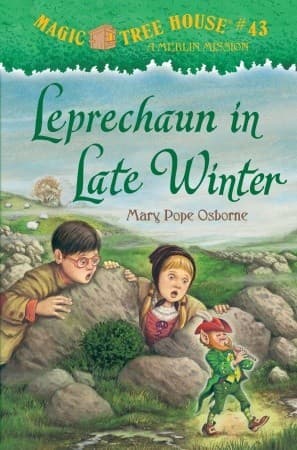
Mary Pope Osborne (2010)
Genre
Fantasy / Children's / Historical Fiction
Reading Time
90 min
Key Themes
See below
Sign in to track this book
In a blustery historical Ireland, Jack and Annie’s magical encounter with a young Irish girl and a mischievous leprechaun helps turn her into Lady Gregory, a champion of Irish legends and cultural pride.
Jack and Annie travel by magic tree house to a snowy forest in Ireland. Their mission from Merlin is to find a creative person who brings happiness through art. They have a rhyme that mentions 'wee folk' and a 'pot of gold.' They find a small, green-clad leprechaun named Finn, trapped under a fallen tree branch. Jack, using his book on Ireland, learns about leprechauns and their mischievous nature, and the legend of their hidden gold. Annie, with her usual empathy, insists they help Finn, despite Jack's caution about leprechaun tricks.
After freeing Finn, the leprechaun says his pot of gold has been stolen, and without it, he cannot perform magic or bring good luck. He reluctantly lets Jack and Annie help him find it, warning them that humans often cause trouble. Following Finn's vague directions, they find a young girl named Augusta sketching in the snow. Augusta is shy but becomes interested in Finn, whom she can also see. She tells them she feels lonely and misunderstood, preferring stories and drawings to other children. Finn suspects Augusta might have seen his pot of gold.
Augusta, with her sharp eye and knowledge of local folklore, points them to a nearby 'fairy fort'—an ancient ring fort believed to house magical creatures. She remembers seeing a glint of gold there recently. Jack is skeptical, relying on facts from his research book, but Annie and Finn are hopeful. As they approach the fort, the atmosphere becomes more mystical. Augusta shares stories she has heard about the fairy folk and their hidden treasures, adding to the children's imagination and Finn's desire to get his pot back. They begin to search the ancient mound for any sign of the missing gold.
Inside the fairy fort, the group faces magical obstacles. They first meet a mischievous pooka, a shape-shifting spirit, who tries to mislead them with riddles and illusions. Jack uses his folklore knowledge to understand the pooka's clues, while Annie's kindness helps calm the creature. Later, they hear the wailing of a banshee, a spirit foretelling death, which frightens them but turns out to be a distraction. Augusta, though scared, finds herself fascinated by these creatures, sparking her imagination and connecting her more deeply to the stories she loves. Finn grows increasingly frustrated by their lack of progress.
Following a final, cryptic clue from the pooka, Augusta finds a hidden entrance to a small cave within the fairy fort, hidden by thick brambles. Inside, they find not Finn's pot of gold, but a collection of old, forgotten Irish artifacts and books. It turns out that a group of mischievous sprites, not humans, had taken Finn's pot and used it to collect these forgotten treasures, hoping to preserve them. Finn is relieved to find his pot, but also touched by the sprites' intentions. Jack realizes the pot of gold is not just about wealth, but about keeping cultural heritage and stories alive.
With his pot of gold back, Finn performs a small, dazzling magic show for the children, creating illusions of dancing fairies and shimmering rainbows. This display, along with the discovery of the forgotten artifacts, deeply affects Augusta. She realizes the power of stories and art to connect people to their past and bring joy. She expresses a new desire to collect and share such tales. Jack and Annie understand that Augusta is the creative person they were sent to inspire. Her passion for her culture and stories is ignited, setting her on a path to share this with others.
As the magic tree house prepares to leave, Jack and Annie say goodbye to Augusta and Finn. Finn, grateful for their help, blesses Augusta with good fortune and a keen eye for stories. Jack and Annie know their mission is complete. As they are whisked away, Jack opens his research book again and finds a new entry about Lady Augusta Gregory, a famous Irish writer and folklorist who helped found the Abbey Theatre and collected many Irish myths and legends. They realize Augusta will grow up to be this influential woman, fulfilling their mission to inspire someone who brings happiness through the arts, specifically by preserving Irish heritage.
Jack and Annie return to the tree house in Frog Creek, feeling a sense of accomplishment. They think about their adventure in Ireland, the magical creatures they met, and the impact they had on Augusta. They understand that creativity comes in many forms, not just music or painting, but also in storytelling and preserving culture. Their third mission for Merlin is a success, and they are one step closer to helping save Camelot. They look forward to their next adventure, wondering what new creative person they will meet and inspire.
The Protagonist
Jack learns to balance his reliance on facts with the acceptance of magic and the importance of intuition and empathy.
The Protagonist
Annie continues to develop her natural empathy and ability to connect with others, reinforcing the power of kindness.
The Supporting
Finn learns to trust humans and appreciates their help, realizing that even 'wee folk' sometimes need assistance.
The Supporting
Augusta's encounter with magic and kindred spirits sparks her lifelong passion for preserving and sharing Irish culture and stories, setting her on the path to becoming Lady Gregory.
The Mentioned
Not applicable, as he is not present.
The book shows how stories, myths, and legends connect people to their heritage and bring joy. Augusta's journey from a lonely girl to a future folklorist highlights the importance of collecting and sharing these tales. The discovery of forgotten artifacts in the cave, protected by sprites, further shows that cultural heritage, like Finn's gold, is a treasure worth preserving. This theme is central to Augusta's character arc and her eventual identity as Lady Gregory, who famously revived Irish legends.
““Stories are like a secret language,” Augusta whispered. “They tell us about the past, and they help us understand the present.””
This theme is seen in the way Jack and Annie work together. Jack uses facts and logic from his research books, often questioning magic, while Annie embraces imagination and intuition, readily accepting the fantastical. Both of their approaches are needed to solve the mystery of Finn's gold and understand Ireland's magical world. Augusta also shows a mix, as her imagination lets her see Finn, but her observation skills help them find clues. The story suggests that a balance of both is essential for discovery and growth.
““But, Annie, leprechauns are just myths,” Jack said, pulling out his book. “Myths can be real, Jack, if you believe in them!” Annie countered.”
Annie's strong empathy and kindness are important throughout the adventure. Her immediate desire to help Finn, despite Jack's warnings about leprechaun tricks, starts the adventure. Her ability to connect with Augusta, who feels lonely, helps the girl open up and share her knowledge. Even the mischievous pooka is calmed by the children's respectful approach. This theme shows that compassion and understanding can overcome suspicion and fear, helping cooperation and leading to good results, both with magical creatures and with other people.
““He’s stuck, Jack! We have to help him!” Annie insisted, her voice full of concern.”
Jack and Annie's main mission is to inspire a creative person who brings happiness through art. In this story, Augusta initially feels lost and unsure, finding comfort only in her drawings and stories. Her journey with Jack, Annie, and Finn, and her exposure to Ireland's magic and rich folklore, ignites a clear passion in her. This experience helps her realize that her love for stories and culture is a valuable art form, setting her on the path to becoming Lady Gregory and fulfilling the mission by using her creativity to enrich others' lives.
““I want to collect all the old stories,” Augusta said, her eyes shining. “And tell them to everyone.””
A magical vehicle for time and space travel.
The Magic Tree House is the primary means by which Jack and Annie travel to different historical periods and geographical locations. It is imbued with powerful magic, allowing them to fulfill missions given by Merlin. In this book, it transports them to Ireland, initiating their quest. It serves as a portal to adventure, a safe haven, and a constant reminder of the larger magical world they are a part of, always appearing when their help is needed for a specific purpose.
A source of factual information and clues.
Jack's research books, specifically the one about Ireland in this story, provide factual background and context for their adventures. They offer insights into local culture, history, and folklore, which Jack uses to identify creatures like leprechauns and understand Irish legends. While not always providing direct answers to magical problems, the books help Jack make sense of their surroundings and inform their decisions, balancing the fantastical elements with grounded knowledge.
A cryptic clue that guides the children's quest.
Merlin's rhyme serves as the initial prompt and guiding mystery for Jack and Annie's mission. It provides vague but specific clues about the creative person they need to find and the nature of their task ('wee folk,' 'pot of gold'). This device creates suspense and directs the children's focus, pushing them to interpret the clues and engage with the magical world to discover the true meaning and fulfill their overarching quest to inspire someone through the arts.
A symbolic object representing luck, magic, and cultural value.
Finn's pot of gold is initially presented as a traditional leprechaun's treasure, symbolizing wealth and magic. However, its true significance evolves throughout the story. It becomes clear that the pot is not just about material riches but about Finn's ability to perform magic and, more broadly, the preservation of good fortune and cultural heritage. Its loss and retrieval drive the immediate plot, leading the children to discover the deeper value of Irish folklore and inspire Augusta.
“The wind howled like a hungry wolf, rattling the windows of the cottage.”
— Describing the weather at the beginning of the story.
“Magic is all around us, if only we have eyes to see it.”
— Seamus, the leprechaun, speaking to Jack and Annie.
“A good story can warm you up better than any fire.”
— Annie saying this to Jack when they are cold.
“Never underestimate the power of a small creature.”
— Seamus hinting at his own abilities.
“Sometimes the biggest treasures aren't made of gold.”
— Reflecting on the true meaning of the leprechaun's treasure.
“The past is never truly gone; it lives in the stories we tell.”
— Discussing the historical elements of the setting.
“Even in the darkest winter, there's always a promise of spring.”
— A hopeful thought during a cold and challenging time.
“Curiosity is a wonderful thing, but it can also lead to mischief.”
— Seamus warning Jack and Annie about their adventurous spirit.
“The world is full of wonders, both seen and unseen.”
— Jack reflecting on the magical experiences.
“Kindness is a language everyone understands.”
— Demonstrated by the children's interactions with Seamus.
“A true friend is worth more than a pot of gold.”
— The bond between Jack and Annie, and their new friend Seamus.
“Sometimes you have to believe in the impossible to make it real.”
— Encouragement to embrace the magic.
“The smallest things can make the biggest difference.”
— Referring to small acts or small creatures like leprechauns.
Ready to see how well you understood this book? Take our interactive quiz with 10 questions.

Biography coming soon.







