“I'm Stephen Leeds. My friends call me Legion. I am, for lack of a better word, a schizophrenic. But I am not insane.”
— Stephen Leeds introducing himself and his unique mental condition.

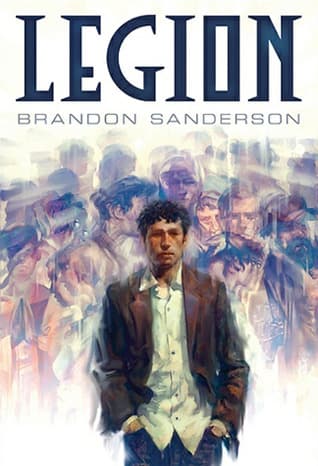
Brandon Sanderson (2012)
Genre
Thriller / Fantasy / Mystery
Reading Time
90 min
Key Themes
See below
Sign in to track this book
A man whose mind holds many hallucinatory experts must find a reality-bending camera and its missing inventor before its power changes human history.
Stephen Leeds, a man whose mind creates many hallucinatory 'aspects'—each a specialist—is asked by the Organization of the American Institute of Applied Sciences (OAIAS) to find Balubal Razon. Razon, a brilliant but unusual inventor, has vanished with his camera. This camera is rumored to capture images from the past, not just the present. Leeds, with his aspects including Tobias, a historian; Ivy, a security expert; and J.C., a linguist—starts his search by looking at Razon's last known location and the strange events around his disappearance. The OAIAS representative, Dr. Alana Whitford, stresses the urgent and sensitive nature of the mission, hinting at the camera's major impact.
Leeds and his aspects explore Razon's apartment and workshop, finding a mix of advanced technology and old items. Tobias, Leeds' historian aspect, quickly sees Razon's deep interest in ancient history, especially the Roman Empire and Pompeii. They find research notes and drawings hinting at the camera's theory, suggesting it does not just capture light but somehow changes space-time to get past information. Ivy, the security expert, notes no signs of forced entry, meaning Razon either left willingly or was taken by someone he knew. J.C., the linguist, finds cryptic notes in Latin, further showing Razon's historical interest and pointing to a specific event or place.
Among Razon's things, Leeds finds a single photograph taken by the camera. The image shows a scene from ancient Pompeii, just before Vesuvius erupted. This proves the camera's abilities and confirms the rumors. However, the photo also has something odd: a modern-looking figure, partly hidden, watching the ancient scene. This figure raises more questions than it answers, suggesting time travel, a trick of light, or something more complex. This discovery makes finding Razon more urgent, as the impact of such a device, able to see and possibly change history, becomes clear to Leeds and his aspects.
Using Ivy's tracking skills and Tobias's historical knowledge, Leeds traces Razon's recent actions. They find proof of Razon buying special equipment, including high-frequency emitters and unusual materials, which do not seem to fit normal scientific research. J.C. deciphers more of Razon's cryptic notes, which mention 'temporal echoes' and 'resonance frequencies.' The trail leads them to an abandoned research facility in a remote desert, a place Razon had used for secret experiments. The facility is well-secured, but Ivy bypasses the defenses, letting Leeds enter. The inside feels strange, suggesting recent activity but no current occupants.
Inside the desert facility, Leeds finds a complex laboratory, much more advanced than anything in Razon's apartment. There are arrays of sensors, energy lines, and a large, empty platform that seems made for the camera. More importantly, he senses subtle time anomalies—flickering lights, small changes in air pressure, and a general feeling of displacement that even his aspects find unsettling. Bits of Razon's research data on computer terminals show he was trying not just to *observe* the past but possibly *interact* with it, or at least create a more stable time window. This means Razon might have pushed the camera's abilities beyond simple photography, entering dangerous ground.
As Leeds continues his search, he realizes he is not alone. He meets agents from a rival group, the 'Syndicate,' who also want the camera, likely for their own purposes. A brief but tense fight follows, with Ivy being very helpful in avoiding them and getting important data. The Syndicate agents are ruthless and well-equipped, showing the stakes are higher than Leeds first thought. This meeting forces Leeds to speed up his efforts and be more careful, knowing Razon's life, and the camera's fate, depend on him reaching the inventor before the competition does.
By looking at Razon's scattered notes, the Pompeii photograph, and new diagrams, Leeds and his aspects figure out Razon's real goal. Razon was not just interested in *any* past event; he was obsessed with a specific moment in Roman history about a lost artifact or a key, poorly documented decision. J.C. translates a final, complex set of Latin writings that, with Tobias's history knowledge, pinpoint the exact historical event and location Razon was aiming for. It becomes clear that Razon believed the camera could answer a long-standing historical mystery, and he was willing to risk everything to get it, possibly even putting himself within the time window.
Leeds tracks Razon to a hidden, fortified bunker, where the inventor is making final adjustments to his camera. Razon is anxious, obsessed with his work, and at first resists Leeds's attempts to stop him. He says he plans to use the camera to project himself, or at least his mind, into the past to directly see the historical event he is focused on. As Leeds tries to reason with him, the camera turns on, creating a powerful, localized time distortion. The bunker starts to flicker in and out of sync with reality, and images from the past blend into the present, showing the camera's huge and unstable power. Razon, lost in his ambition, seems unaware of the danger.
In the chaotic time field, Leeds realizes the camera is dangerously unstable and could badly damage reality if Razon continues. With his aspects' help, especially Ivy neutralizing Razon's defenses and Tobias giving key historical context, Leeds manages to disarm the camera, but not before Razon experiences a brief, intense time feedback loop. Razon is left confused and mentally scarred, his obsession broken. Leeds secures the camera, seeing its potential for both great discovery and terrible destruction. The OAIAS arrives, taking Razon and the device. Leeds is left thinking about what he saw and the fragile nature of time itself. The experience changes him, subtly altering how he sees his own mental condition and the limits of reality.
Afterward, Leeds gives his report to Dr. Whitford, who assures him Razon will get care and the camera will be studied under strict security. However, Leeds remains deeply troubled. He thinks about Razon's single-minded pursuit and the near-disastrous results. He also considers his own aspects—are they just hallucinations, or do they represent a unique consciousness able to process information in special ways? The experience has made him question reality itself and the ethics of changing or even watching the past. He understands that some knowledge might be too dangerous for people to have, and the camera's impact will stay with him long after the mission ends.
The Protagonist
Leeds begins as a man who manages his condition; by the end, he grapples with the profound implications of his 'aspects' and the nature of reality itself, subtly shifting his understanding of his own mind.
The Supporting
Tobias's role is largely consistent, serving as Leeds's historical resource and intellectual anchor throughout the investigation.
The Supporting
Ivy remains a steadfast and practical protector, embodying the necessary skills for navigating the mission's physical dangers.
The Supporting
J.C. consistently provides linguistic expertise, facilitating the understanding of Razon's complex research.
The Antagonist/Supporting
Razon begins as a missing person; he is revealed as a brilliant but dangerous individual whose obsession nearly leads to catastrophe, ultimately ending in mental incapacitation.
The Supporting
Dr. Whitford serves as the initial catalyst for the plot and the institutional face of the consequences, remaining largely consistent in her role.
The Antagonist
The Syndicate provides external conflict, serving as a persistent threat and increasing the urgency of Leeds's mission.
The story blurs the lines between reality and hallucination, especially through Stephen Leeds's aspects. The aspects are 'hallucinations' but have real expertise and affect Leeds's actions and understanding. Razon's camera further challenges reality by capturing images from the past, suggesting that time is not fixed. This theme makes the reader, and Leeds, question what is real, what is perceived, and how much our perceptions shape our understanding of the world. For example, the image of a modern figure in ancient Pompeii directly challenges ideas of linear time and historical observation.
“My aspects aren't real, but they're not unreal either. They are... useful.”
Razon's camera has great power—the power to see, and possibly change, the past. This theme looks at the moral issues of having such knowledge. Razon's single-minded search for historical truth, despite the risks, shows the dangers of uncontrolled ambition. Leeds, in contrast, deals with the ethical duty of containing such a device. The story suggests that some knowledge might be too dangerous for humanity, and that seeking ultimate truth can lead to disaster if not balanced with wisdom. The OAIAS's wish to secure the camera highlights society's struggle with regulating powerful new technologies.
“Some knowledge, Stephen, is best left undisturbed. It's not about what we *can* do, but what we *should* do.”
Stephen Leeds's unique mental condition is key to who he is. He constantly navigates his aspects, accepting them as part of himself, even though they are technically hallucinations. This theme explores how people define themselves in unusual situations. Leeds's journey is not just about solving a mystery, but also about understanding and accepting the complex nature of his own mind. The aspects are not just tools; they are parts of him, showing different sides of his personality and intelligence. His internal struggle to manage and integrate these 'others' into his single self is a core part of his character's journey.
“They are me. Or, at least, they are part of what makes me *me*.”
Balubal Razon shows the theme of obsession. His single-minded pursuit of understanding and interacting with the past, driven by his camera, consumes him completely. This obsession blinds him to the dangers he poses to himself and potentially to reality. The story shows how brilliant minds, when not checked by ethics or self-preservation, can go down destructive paths. Razon's near-disastrous experiment is a warning about letting an intellectual pursuit become an all-consuming, dangerous fixation, ultimately leading to his mental breakdown.
“He didn't want to just see the past, Stephen. He wanted to *touch* it.”
Stephen Leeds's hallucinatory, specialized personalities.
The aspects are the central plot device, enabling Stephen Leeds to solve complex problems by providing him with a vast array of specialized knowledge and skills. Each aspect, like Tobias (historian) or Ivy (security), functions as a living database and tactical advisor, allowing Leeds to perform feats that would be impossible for a single individual. They also serve to externalize Leeds's internal thought processes and provide exposition through their discussions. This device not only drives the plot forward by providing solutions but also defines Leeds's unique character and the narrative's exploration of perception and reality.
A revolutionary camera capable of capturing images from the past.
Balubal Razon's camera is the primary MacGuffin and the catalyst for the entire plot. Its incredible ability to capture images from the past provides the central mystery and the driving force behind the search for Razon. Beyond being a mere object, the camera represents immense power, ethical dilemmas, and the potential to reshape humanity's understanding of history and time. Its unstable nature when pushed beyond its intended limits also introduces a significant threat, elevating the stakes of the story and highlighting the dangers of unchecked scientific ambition.
An unsolved historical event that Razon is obsessed with.
The specific, undisclosed historical mystery that Balubal Razon is obsessed with serves as a key plot motivator. While the exact event isn't fully detailed, its allure drives Razon's actions and provides a compelling, intellectual hook for Leeds and his aspects. This device allows the story to delve into historical research, leveraging Tobias's expertise, and grounds the fantastical elements of the camera in a tangible, academic pursuit. It also raises questions about the nature of historical truth and the desire to fill in the gaps of human knowledge, providing a clear objective for Razon's dangerous experiments.
“I'm Stephen Leeds. My friends call me Legion. I am, for lack of a better word, a schizophrenic. But I am not insane.”
— Stephen Leeds introducing himself and his unique mental condition.
“My mind is a mansion. My senses are the windows and doors. My aspects are the furniture.”
— Stephen explaining the metaphor he uses for his mind and aspects.
“The mind is a powerful thing. It can create entire worlds. Or it can simply create a few dozen imaginary friends.”
— A reflection on the power of the human mind, particularly as it relates to Stephen's condition.
“The truth is, I don't really know where my aspects come from. They just... appear. Fully formed, with their own personalities and expertise.”
— Stephen pondering the origin of his aspects.
“Sometimes I wonder if I'm just a very elaborate method of procrastination.”
— Stephen's wry self-deprecating humor about his reliance on his aspects.
“The greatest mysteries are often the ones we carry within ourselves.”
— A philosophical observation about internal conflicts and self-discovery.
“My aspects aren't just voices in my head. They're real. To me, they're as real as you are.”
— Stephen asserting the reality of his aspects from his perspective.
“You can't solve a mystery if you're afraid of what you'll find.”
— A foundational principle of investigation and problem-solving.
“The world is full of information. My job is to make sense of it.”
— Stephen describing his role as a unique problem-solver.
“Fear is a powerful motivator. But it's also a powerful blindfold.”
— A commentary on the dual nature of fear in decision-making.
“Every person is a universe. And every universe has its own rules.”
— A reflection on individual uniqueness and internal logic.
“The line between genius and madness is often just a matter of perspective.”
— Discussing the societal perception of unique mental states.
“I don't need to be normal. I need to be effective.”
— Stephen prioritizing functionality over conforming to societal norms.
“Knowledge is power, but understanding is wisdom.”
— A distinction between mere information and true comprehension.
Ready to see how well you understood this book? Take our interactive quiz with 10 questions.

Brandon Sanderson is a prolific American author of epic fantasy and science fiction. He is best known for his expansive Cosmere universe, featuring series like Mistborn and The Stormlight Archive, as well as his completion of Robert Jordan's Wheel of Time series. Sanderson's intricate magic systems and compelling world-building have earned him a dedicated global fanbase and critical acclaim.







