“I'm not a criminal. I'm a businessman. What I do is provide a service people want, at a price they're willing to pay.”
— The unnamed protagonist's self-justification for his drug dealing activities.

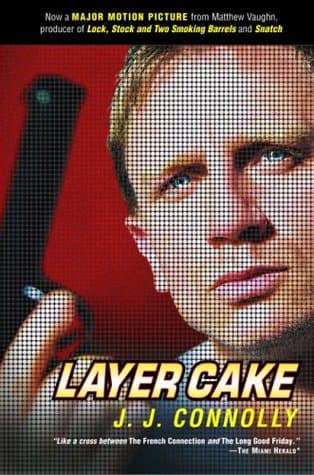
J.J. Connolly (2001)
Genre
Thriller / Mystery
Reading Time
360 min
Key Themes
See below
Sign in to track this book
A smooth-talking London cocaine dealer, aiming for early retirement, finds his exit from the criminal underworld unraveling into a deadly 'layer cake' of double-crosses, neo-Nazis, and a missing socialite, forcing him to become a hitman just to survive.
The unnamed narrator, a sophisticated 29-year-old cocaine dealer, is about to retire from London's criminal underworld. He manages high-level trafficking with his long-time partner, Mister Mortimer, a seasoned veteran of crime. His ambition is to escape the dangers and complexities of the 'layer cake' — the intricate criminal hierarchy — and live a quiet life. However, his plans are interrupted when Morty summons him to a luncheon with Jimmy Price, a legendary and ruthless crime boss. Price, known for always getting his way, presents the narrator with an offer he cannot refuse: find Charlotte Ryder, the missing daughter of construction magnate Edward Ryder. Price sweetens the deal, promising the narrator his freedom from crime if he succeeds, making the 'one more deal' irresistible.
To find Charlotte Ryder, the narrator decides to enlist Billy Bogus, a cunning grifter skilled in mimicry and infiltration, known for fraud and manipulating wealthy women. On his way to meet Bogus, the narrator stops at a nightclub where he encounters Sid, a small-time punk associated with a gang called 'the Yahoos.' Sid, who is with the stunning and flirtatious Tammy, recounts a chilling story about a friend named 'The Duke' being ambushed by a professional crew with laser-sighted Uzis. The narrator, distracted by Tammy's charms and her subsequent offer of her number, does not immediately grasp the significance of Sid's tale, focusing instead on his immediate objective and the alluring prospect of Tammy.
The narrator reports his progress on the Charlotte Ryder case to Jimmy Price's right-hand man, Gene. However, Gene has another proposition: the Yahoos have two million pounds' worth of Grade A ecstasy to sell, and he wants the narrator to broker the deal. This unexpected opportunity offers the perfect sum to secure his retirement fund, making it an offer too good to refuse. The narrator arranges a meeting with Morty and the Yahoo kingpins, Big Frankie and JD, to discuss the ecstasy deal. Meanwhile, Billy Bogus successfully tracks down Charlotte's boyfriend, Kinky. Bogus informs the narrator that Kinky is dead, found in a London housing project, seemingly from an overdose, although a young drug dealer suggests foul play.
The ecstasy tablets, confirmed as top quality by 'chief chemical taster' Sir Alex, appear to be a lucrative venture. Big Frankie and JD remain quiet about the pills' origin, but the narrator and Morty proceed with setting up a sale. Morty arranges a meeting with a crew led by Trevor in Northern England, believing them to be ideal buyers. However, the deal takes a dangerous turn. Trevor's crew reveals that an ecstasy factory was hijacked — likely by the Yahoos — and the pills are now sought by a brutal neo-Nazi sect. They inform the narrator that the neo-Nazis have already raided 'The Duke's' house, confirming Sid's earlier story about the ambush and revealing the dangerous origins of the ecstasy.
Returning to London with Morty, the narrator receives a call from Bogus confirming Kinky's death was likely murder, not an overdose. Shortly after, the narrator meets Tammy in a hotel. As he steps out of the shower, he is ambushed by two toughs, rolled into a carpet, and abducted. He is taken to a construction site where he meets Eddie Ryder, Charlotte's father. Eddie reveals a shocking truth: Jimmy Price orchestrated Charlotte's 'disappearance' as a ploy. Price, having been swindled by Chechens for thirteen million pounds, planned to use the narrator to find Charlotte, then hold her for ransom, effectively using the narrator as an unwitting pawn to recoup his losses. The situation escalates into a triple cross.
The triple cross deepens when Eddie Ryder plays a tape for the narrator, exposing Jimmy Price as a police informant. Price's ultimate plan was to set up the narrator in a sting operation, sending him to jail for a long term and seizing his retirement fund. Faced with utter betrayal and imminent ruin, the narrator's survival instincts kick in. His diplomatic demeanor shatters, replaced by a ruthless resolve. He becomes a man bent on revenge and self-preservation, realizing he must eliminate Jimmy Price to survive the treacherous 'layer cake' he so desperately tried to leave. This revelation marks a critical turning point in his character and the plot.
With Jimmy Price's treachery exposed, the narrator immediately shifts from diplomat to executioner, killing Jimmy Price to neutralize the threat. Next, he strikes a new deal with Eddie Ryder. Ryder agrees to purchase the two million ecstasy tablets, planning to sell them to the Yakuza in Japan. This arrangement not only provides a substantial payout for the narrator, replenishing his endangered retirement fund, but also serves as a strategic alliance. To further ensure his safety and prevent Ryder from any future double-crossing, the narrator subtly reveals a piece of compromising information Jimmy Price had shared about Eddie, establishing leverage and securing his immediate survival.
With Jimmy Price dead and the ecstasy deal seemingly resolved, the narrator believes his troubles are over. However, Jimmy's right-hand man, Gene, along with Morty, confronts the narrator, accusing him of Jimmy's murder and threatening him with dire consequences. To save himself and reveal the truth, the narrator plays the tape given to him by Eddie Ryder. The recording exposes Jimmy Price's extensive dealings with the police, revealing him as an informant who betrayed his own associates. Faced with undeniable proof of Jimmy's treachery, Gene relents, releasing the narrator and agreeing to never speak of the incident again, effectively clearing the narrator's name within the criminal hierarchy.
The two million ecstasy tablets remain the final piece of the puzzle. The narrator's deal to exchange the pills for cash at Heathrow Airport collapses in a flurry of double and triple crosses, but ultimately results in the tablets being relocated to Amsterdam. As he prepares to travel to Amsterdam to collect his earnings, the narrator decides to make a final call to Tammy. This seemingly innocent act proves to be his undoing. Tammy's jealous boyfriend, Sidney, who had been tailing her, ambushes the narrator, shooting him three times, including twice in the head, leaving him for dead.
Miraculously, the narrator survives the shooting and recovers in the hospital. The police, now aware of his involvement in the criminal underworld, order him into retirement and exile, forcing him to leave London for good. He makes one last attempt to connect with Tammy, offering her another chance to meet, but she firmly declines, stating, "girls like dangerous guys but you’re seriously fuckin’ life threatening. How many girls do you know end up covered in blood, chief prosecution witness in an attempted murder trial on their first date?" The narrator finds himself an ex-pat in Curacao, Brazil, with ample time to reflect on his life. He acknowledges the continuous cycle of learning and forgetting, understanding why he left the business but forever bound to the secret of his unnamed identity.
The Protagonist
Transforms from a calculating, detached businessman seeking retirement into a desperate survivor driven by revenge, ultimately finding forced exile and a contemplative peace.
The Supporting
Remains a steadfast, loyal partner throughout the narrator's ordeal, providing support and counsel.
The Antagonist
Revealed as a treacherous police informant, leading to his assassination by the narrator.
The Supporting
Transitions from a seemingly distressed father to a cunning player in the criminal underworld, using the narrator for his own ends.
The Supporting
Initially a romantic interest, she ultimately becomes a witness to the narrator's violent life, leading her to reject him.
The Supporting
Serves as a reliable, though mercenary, information broker for the narrator.
The Supporting
Experiences a crisis of loyalty when he discovers his boss, Jimmy Price, was an informant.
The Mentioned
His jealousy leads to a violent act that ends the narrator's criminal career.
The narrator's strong desire to retire by 30 and his belief in his ability to control his exit from the criminal world is a central theme. Despite his meticulous planning and intelligence, he is constantly pulled back into the 'layer cake' by 'just one more deal' or unforeseen circumstances. His ambition to dictate his own future is repeatedly undermined by the unpredictable nature of the underworld and the manipulative forces within it, culminating in a forced retirement rather than a chosen one. This is evident in his repeated attempts to secure his retirement fund, only to have it jeopardized by betrayals, as seen with Jimmy Price's scheme to steal his money.
“The worst thing about drug dealing…is that you have to relate to a lot of total idiots.”
The novel is a masterclass in betrayal, where loyalty is a fleeting concept. Characters constantly double-cross and triple-cross each other, creating a treacherous environment where trust is a liability. Jimmy Price's elaborate scheme to use the narrator as a pawn and his ultimate exposure as a police informant are prime examples. The narrator himself is forced to betray Price to survive. These shifting loyalties highlight the inherent amorality and self-preservation that define the criminal underworld, where even long-standing partnerships can dissolve in an instant, as seen when Gene's loyalty to Jimmy is shattered by the truth.
“In the layer cake, you’re either eating or being eaten.”
The narrator's ambition to rise to the top of the criminal hierarchy and then escape it comes at a steep cost. His intelligence and drive allow him to accumulate wealth, but they also draw him deeper into a dangerous world, exposing him to violence, manipulation, and near-death experiences. The pursuit of 'one more deal' to secure his retirement continually backfires, leading to greater risks and more severe consequences. Ultimately, his ambition leads not to a peaceful, chosen retirement, but to a forced exile, stripped of his former life and connections, reflecting that the 'cake' always demands its pound of flesh.
“I was too smart to tell you my name, but not smart enough to stay out of trouble.”
The unnamed narrator's refusal to reveal his name highlights a theme of identity in the criminal world. Anonymity is a form of protection, a shield against exposure and accountability. His identity is defined by his profession and his role within the 'layer cake,' rather than a personal name. The very first line of the book emphasizes this, setting the tone for a character who exists in a liminal space, known by reputation and actions rather than a given name. By the end, forced into exile, his anonymity becomes a permanent state, reflecting his detachment from his former life and a new, undefined existence.
“If I told you my name, you’d be as clever as me.”
Creates intimacy and mystery while emphasizing the character's desire for anonymity.
The use of an unnamed narrator immediately establishes a sense of intimacy and mystery. It allows the reader to experience the story directly through his cynical, witty, and often self-serving perspective, fostering a deeper connection. Simultaneously, the lack of a name reinforces the narrator's desire for anonymity and protection within the dangerous criminal underworld, highlighting his pragmatic approach to survival. This device also serves to universalize his experiences, making him a stand-in for anyone caught in the 'layer cake'.
A central metaphor for the intricate, hierarchical, and dangerous criminal underworld.
The 'layer cake' serves as the overarching metaphor for London's organized crime network. It represents a complex, multi-tiered hierarchy where each 'layer' is interconnected but distinct, with its own rules, players, and dangers. The metaphor effectively conveys the narrator's insider knowledge and his struggle to navigate or escape its intricate structure. It emphasizes the idea that everyone has their place, and moving between layers or trying to leave altogether is fraught with peril and often requires dealing with 'idiots' from different strata.
A narrative technique of escalating betrayals that drives the plot's complexity and tension.
The triple cross is a key plot device that propels the narrative forward, constantly subverting expectations and increasing the stakes. What begins as Jimmy Price's betrayal of the narrator (a double cross) quickly escalates when Eddie Ryder reveals Price's true intentions and his status as an informant (the triple cross). This continuous layering of deceit ensures that no character, including the protagonist, can be fully trusted, creating a pervasive atmosphere of paranoia and suspense. It highlights the ruthless and unpredictable nature of the criminal world, where alliances are temporary and self-interest reigns supreme.
An early, seemingly minor detail that later reveals crucial plot information and raises stakes.
The story Sid tells the narrator about 'The Duke's' ambush by a crew with laser-sighted Uzis serves as an effective piece of foreshadowing. Initially, it seems like a colorful anecdote from the criminal world. However, it later becomes crucial when the narrator learns the ecstasy tablets were stolen from a neo-Nazi sect who had already hit 'The Duke's' house. This detail retrospectively explains the origin of the pills and the extreme danger associated with them, transforming a casual conversation into a vital piece of the puzzle and elevating the sense of peril.
“I'm not a criminal. I'm a businessman. What I do is provide a service people want, at a price they're willing to pay.”
— The unnamed protagonist's self-justification for his drug dealing activities.
“You're born, you take your first breath, and from that moment on, you're dying. The only thing that changes is the speed.”
— A cynical observation about life and mortality.
“The thing about being in this game is, you can never really get out. Not completely. It always pulls you back in.”
— The protagonist reflecting on the inescapable nature of his criminal life.
“Every layer of the cake is another problem, another person who wants a slice, another opportunity for it all to go wrong.”
— The protagonist explaining the complexity and fragility of his drug operation, referencing the book's title.
“There are no friends in this business, only temporary alliances and people waiting for you to screw up.”
— A jaded insight into the lack of loyalty within the criminal underworld.
“Money doesn't buy happiness, but it buys a bigger boat to cry in.”
— A darkly humorous take on the limited comfort that wealth provides.
“The biggest mistake you can make in this job is thinking you're smarter than everyone else.”
— A warning about overconfidence and its dangers in the criminal world.
“Sometimes the only way to win is to walk away, but sometimes walking away is the hardest thing to do.”
— The protagonist grappling with the desire to leave his life of crime.
“It's all about perception, isn't it? What people think you are, not what you actually are.”
— An observation on reputation and appearances in his line of work.
“Fear is a great motivator. It makes people do things they never thought they would.”
— Understanding the power of fear in manipulating others.
“You can plan all you want, but in the end, life just happens. And it usually happens in the most inconvenient way possible.”
— Frustration with the unpredictable nature of events.
“Every action has a reaction. Every choice has a consequence. And sometimes, those consequences are lethal.”
— A stark reminder of the dangerous repercussions of his lifestyle.
“The trick is to make people think they've got you cornered, then pull the rug out from under them.”
— A strategic thought on outmaneuvering opponents.
“In this world, you're either the hunter or the hunted. There's no middle ground.”
— A brutal assessment of survival in the criminal hierarchy.
Ready to see how well you understood this book? Take our interactive quiz with 10 questions.







