“The hamlet of Lark Rise lay not in a hollow, but on a gentle slope, and its cottages, all built of local stone, with thatched or tiled roofs, looked out over a wide expanse of fields.”
— Describing the setting of Lark Rise.

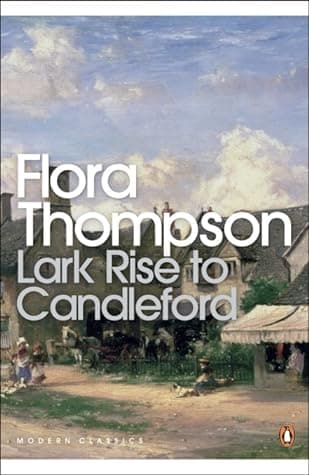
Flora Thompson (1945)
Genre
Historical Fiction
Reading Time
1275 min
Key Themes
See below
Sign in to track this book
This is a detailed account of late 19th-century Oxfordshire, showing May Day celebrations, old games, and the daily routines of farmworkers and craftsmen. It paints a warm picture of Victorian rural life through a young girl's eyes.
The story starts in Lark Rise, a small, isolated village in Oxfordshire in the late 19th century. Laura, who represents the author, is a young girl watching her family and neighbors. Her father, a stonemason, struggles financially, and the family is often poor, relying on a small pension and his irregular work. The Lark Rise community is close. Villagers share what little they have and take part in traditions like May Day celebrations, harvest festivals, and local gossip. Laura clearly describes the cottages, fields, and simple lives of farm laborers and their families. She shows their strength and the difficulties they faced. The story focuses on the community's life and the people in this small world.
Laura's early childhood follows the seasons, each bringing its own work, joys, and challenges. She describes men working in the fields, women doing household chores, and children playing games in the lanes and woods. The village has many old stories, superstitions, and songs passed down through families. Laura talks about simple pleasures like picking berries, gathering firewood, and the excitement of yearly events like pig-killing or a traveling seller arriving. These experiences teach her about the world and how deeply the villagers connect to the land and their shared past, even with their often hard lives.
Laura's family, especially her mother and father, are central to her early life. Her mother, who used to be a lady's maid, is gentle and educated. She encourages Laura's love of reading, which contrasts with the more rustic ways of the village. Her father, a skilled but often unemployed stonemason, provides stability despite their poverty. The children of Lark Rise have their own society, with specific games, rivalries, and friendships. Laura describes the personalities of her siblings and the other village children, showing their innocence, cleverness, and the often tough lessons they learn about life and death in their small world. This section highlights the difference between the children's imaginative play and the constant reality of poverty.
As Laura gets older, her family moves from the poor village of Lark Rise to Candleford Green, a larger, slightly richer village. This move changes their social standing and access to things. Her father finds more steady work in Candleford Green, and the family's money situation gets a little better. Laura sees the differences between the two communities: Candleford Green has more shops, a post office, and a less rustic way of life. This move expands Laura's world, introducing her to new people and customs, though she stays connected to her Lark Rise roots and often visits her grandmother there.
In Candleford Green, Laura continues her careful observations, now focusing on the village's many residents. She notices the small social differences between families—the shopkeepers, wealthier farmers, and working-class families like her own. The village offers more social interaction and chances, including better schooling. Laura describes the church, the village school, and the various tradespeople, each adding to Candleford Green's unique character. She makes new friends and meets different people, giving her a broader view for her social comments and helping her understand rural Victorian society beyond Lark Rise.
At fourteen, Laura leaves school and starts her first job, a big step into adulthood. She becomes an assistant to Miss Dorcas Lane, the postmistress of the bigger market town of Candleford. This move is a major change, separating her from her family in Candleford Green and placing her in the busy, more refined town environment. The post office is not just for mail but also a general store and a social spot, where Laura meets many townspeople and learns about their lives, gossip, and concerns. Miss Lane, a kind and unusual woman, becomes a guide, helping Laura with her new duties and showing her a different world.
Working for Miss Lane, Laura's days are full of various experiences. She handles mail, sells goods, and listens to the stories of the town's people who visit the post office. She meets people like the quiet mailman, the gossiping villagers, and various tradespeople. Laura sees the class differences and social interactions in Candleford, which are more noticeable than in the smaller village. The post office is a small version of town life, giving Laura a special place to observe human nature. She learns about the joys, sadnesses, and unique habits of the townspeople, further expanding her understanding of the world beyond her childhood home.
Miss Dorcas Lane is an important person in Laura's life while she is in Candleford. A single woman with her own money, Miss Lane is known for her kindness, generosity, and strong will. She treats Laura more like a friend than an employee, encouraging her curiosity and giving her a stable, supportive place. Miss Lane has her own quirks, like her interest in new inventions and her sometimes unusual way of doing business. Their relationship is one of mutual respect and affection. Miss Lane gives Laura a look into a life of independence and quiet dignity, which is very different from the struggles of Laura's family in Lark Rise.
Throughout her time in Lark Rise, Candleford Green, and Candleford, Laura sees the slow but certain changes happening in rural England around the turn of the century. She sees old crafts disappearing, young people moving to towns and cities, and the growing influence of modern conveniences and ideas. The old ways of life, tied to farming cycles and close communities, are starting to fade. Laura's story quietly shows a longing for a disappearing world, while also acknowledging how hard those times were. This awareness of change adds a touching layer to her observations, making the book a valuable historical record.
The story ends with Laura thinking about her childhood and youth. She recognizes how much her experiences in Lark Rise, Candleford Green, and Candleford affected her. She looks back with warmth and understanding at the people and places that shaped her, acknowledging both the difficulties and the lasting spirit of the rural communities. The book is a memoir, a tribute to a vanished way of life, and a record of the strength and character of the people Flora Thompson knew. Laura's journey from an innocent child in a remote village to a young woman working in a market town shows her growth and the larger social changes happening in late Victorian England. It leaves the reader with a feeling of both loss and appreciation.
The Protagonist
Laura develops from an innocent child to a perceptive young woman, gaining a deeper understanding of society and her place within it.
The Supporting
She consistently strives to provide for her family and maintain dignity amidst hardship, reflecting resilience.
The Supporting
He consistently provides for his family through hard work and resilience, facing economic challenges with stoicism.
The Supporting
She remains a steadfast, benevolent figure, providing stability and wisdom to Laura and the community.
The Supporting
Her character remains consistent, embodying the unchanging traditions and social life of Lark Rise.
The Supporting
His character remains static, representing the unchanging, sometimes curmudgeonly, spirit of the old hamlet.
The Supporting
Her character embodies the consistent struggle and resilience of a working-class mother in Lark Rise.
The Supporting
He remains a consistent, symbolic figure of connection and the slow pace of rural communication.
The Mentioned
They collectively represent the social tapestry and diverse daily lives of a market town, observed by Laura.
The book shows the strong bonds and shared life within the villages. Despite poverty and hardship, the communities of Lark Rise and Candleford Green have mutual support, shared traditions, and a strong sense of belonging. Laura sees how neighbors help each other, share things, and take part in group celebrations like May Day and harvest festivals. This theme shows the strength and friendship that defined rural life before widespread modern changes, illustrating how community provided both practical help and emotional comfort.
“They were poor, but they were not miserable, and they were not ashamed.”
A constant theme in the story is the harsh reality of poverty in late Victorian rural England and the small but important differences in social class. Laura's family in Lark Rise often struggles financially, showing the uncertain lives of farm laborers and craftsmen. Moving to Candleford Green and then Candleford reveals a wider range of society, with shopkeepers and wealthier farmers living more comfortably. The story quietly explores how class affected daily life, opportunities, and even personal interactions, demonstrating the rigid social structure of the time.
“A man's standing in the village was measured by the breadth of his garden and the number of his pigs.”
The book captures a key time in history as traditional rural life starts to change because of modern influences. Laura sees old customs slowly fading, the impact of new inventions (like the post office's growing services), and the countryside becoming more connected to cities. There is a clear sense of longing for a disappearing world, balanced with an acknowledgment of the good parts of progress. This theme highlights how England was changing and how a particular way of life was ending, making the book a valuable historical document.
“The old ways were dying out, and the children, Laura among them, were growing up in a different world.”
The story focuses on Laura's experiences as a child and young woman, looking at how her surroundings shape who she is and how she sees the world. Her careful observations, her love of reading (encouraged by her mother), and her interactions with many different people help her grow intellectually and emotionally. The book traces her journey from the innocent, watchful child of Lark Rise to the more experienced and thoughtful young woman in Candleford, showing how much her early years influenced her adult self and her eventual path as a writer.
“Childhood in Lark Rise was a kaleidoscope of impressions, vivid and enduring.”
As a memoir, the book stresses the importance of careful observation and the lasting power of memory. Laura, who stands in for the author, closely observes people, places, and customs, capturing the small details of daily life. Her ability to remember and describe these observations years later is central to the story. The entire book shows how memory can preserve a lost world and how writing can turn personal experience into a shared history, helping future generations understand a past era.
“Memory holds a lantern to the past, illuminating what was once commonplace.”
The story is told from the first-person perspective of Laura, a stand-in for the author.
The entire trilogy functions as an autobiographical narrative, with Laura serving as Flora Thompson's alter ego. This device lends authenticity and a deeply personal tone to the observations. It allows for detailed, subjective insights into the protagonist's experiences, thoughts, and feelings, making the reader feel intimately connected to her journey. The 'I' of Laura provides a consistent lens through which to view the changing rural landscape and its inhabitants, blending personal memory with historical record.
The narrative unfolds through a series of vignettes and character sketches rather than a single linear plot.
Instead of a strong, overarching plot, the book is structured episodically, consisting of loosely connected chapters that function as vignettes or character studies. Each chapter often focuses on a particular character, event, or aspect of rural life (e.g., a May Day celebration, a specific neighbor's story, a description of a trade). This structure mirrors the natural rhythm of life in the communities and allows the author to paint a comprehensive picture of the era through a mosaic of smaller, interconnected moments.
A detailed and unvarnished depiction of rural life, including its hardships and joys.
The author employs social realism to portray the lives of the working class in late Victorian England with accuracy and empathy. This device involves presenting the daily struggles, economic realities, social customs, and psychological states of the characters without idealization or romanticization. The descriptions of poverty, hard labor, and the simple pleasures of the villagers are grounded in meticulous observation, providing a faithful and unsentimental portrait of a specific time and place, making the book a valuable social history.
A pervasive tone of longing for a vanishing way of life.
While rooted in realism, the narrative is imbued with a sense of nostalgia and elegy for a disappearing rural England. The author, writing years after the events, looks back at her childhood with affection, but also with an awareness that the world she describes no longer exists in the same form. This device creates a poignant undertone, highlighting the beauty and simplicity of the past while subtly lamenting the loss of traditional ways of life in the face of modernization. It encourages readers to appreciate what was, even as it acknowledges the inevitability of change.
The Candleford post office serves as a central hub for observing town life.
The Candleford post office, where Laura works, functions as a microcosm of the larger market town. It is not merely a place for mail but a general store, a social gathering point, and a center for gossip and news. This setting allows Laura, and by extension the reader, to encounter a wide variety of townspeople from different social strata, observe their interactions, and gain insights into their lives and concerns. It serves as a convenient narrative device for bringing diverse characters and plot threads together in one central location.
“The hamlet of Lark Rise lay not in a hollow, but on a gentle slope, and its cottages, all built of local stone, with thatched or tiled roofs, looked out over a wide expanse of fields.”
— Describing the setting of Lark Rise.
“Childhood was a brief, bright period, soon over, and then came the long, hard years of earning a living.”
— Reflecting on the brevity of childhood in the late 19th century.
“They had little money, but they had time, and time, in such circumstances, can be more valuable than gold.”
— Speaking of the leisure time enjoyed by Lark Rise residents despite their poverty.
“The sun, which had been so hot and brilliant all day, was now sinking in a blaze of crimson and gold, and the long shadows of the elms stretched across the fields.”
— A vivid description of a sunset over the countryside.
“Every cottage had its garden, where vegetables and flowers grew in happy companionship, and the scent of sweet peas and honeysuckle filled the air.”
— Detailing the typical cottage gardens in Lark Rise.
“The Post Office was the hub of the village, a place where news was exchanged, letters collected, and gossip freely circulated.”
— Describing the central role of the Post Office in Candleford Green.
“She was one of those women who seem to have been born old, with a wisdom beyond her years and a quiet dignity that commanded respect.”
— Characterizing a wise elderly woman in the community.
“Their pleasures were simple, but they were real, and often intensified by the very scarcity of them.”
— Discussing the modest joys of the working-class people.
“Life moved at a slower pace then, governed by the seasons and the demands of the land, not by clocks and calendars.”
— Reflecting on the difference in pace of life in the past.
“The wind sighed in the trees, a mournful sound that always seemed to carry a hint of ancient sorrow.”
— A poetic description of the wind's sound.
“Education, for most of them, ended with elementary school, and then it was into service or the fields.”
— Highlighting the limited educational opportunities for working-class children.
“There was a certain self-sufficiency about them, a quiet pride in their ability to make do with little.”
— Observing the resilience and resourcefulness of the rural poor.
“The world outside their small circle was largely unknown and, for the most part, unregarded.”
— Describing the insular nature of the hamlet's community.
“Every woman took a pride in her home, however humble, and the scrubbing and polishing were endless.”
— Detailing the domestic life and pride in keeping a home.
“The silence of the countryside at night was not an empty silence, but full of tiny, rustling sounds and the distant hoot of an owl.”
— A sensory description of the sounds of the countryside at night.
Ready to see how well you understood this book? Take our interactive quiz with 10 questions.







