“I am a Catholic, but I am not a Christian. I am a Catholic because I believe in the Church, but I am not a Christian because I do not believe in Christ.”
— Lancelot's declaration to Father John, encapsulating his spiritual alienation.

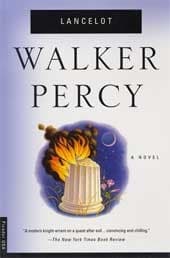
Walker Percy (1977)
Genre
Literary Fiction
Reading Time
360 min
Key Themes
See below
Sign in to track this book
A lawyer, institutionalized after learning of his wife's infidelity, seeks revenge by violently purging society's moral decay.
Lancelot Lamar, a former lawyer, is in an abandoned asylum, which he calls a 'catacomb.' Father John, an old friend who is now a priest, visits him. Lancelot, speaking through a cell grill, begins to tell what led him to confinement. His story is fragmented and philosophical, focusing on his deep unhappiness with modern society, which he sees as corrupt and meaningless. He hints at a violent act he committed and his wish to create a new, pure world from the old one's ruins. He sees Father John as his confessor and a potential ally in understanding his radical views.
Lancelot discusses his past life at Belle Isle, a decaying Southern estate. He describes his marriage to Margot, a beautiful but distant woman, and their daughters, Lucy and Siobhan. His work as a lawyer feels empty, and his social group, including Margot's friends and his associates, seems shallow and decadent. He recalls a growing sense of detachment and disgust with daily routines and conversations, sensing a widespread emptiness and lack of meaning in their lives. This time is marked by simmering unhappiness beneath a polite Southern surface.
Lancelot's breakdown begins when he accidentally overhears Margot and her friend, Raine. He learns his youngest daughter, Siobhan, is not his child, but the result of Margot's affair. This news shatters his weak sense of reality and fatherhood. The betrayal is not just personal; it symbolizes a deeper corruption in his world, confirming his vague suspicions about its falseness and moral decay. This discovery changes him, turning his passive unhappiness into an active, vengeful search for truth and purity.
Driven by the revelation, Lancelot turns his home into a surveillance project. He installs hidden cameras and microphones throughout Belle Isle, documenting Margot's affair with Jacoby, a filmmaker, and the moral state of his household. He observes not only Margot's infidelity but also his elder daughter Lucy's casual drug use and the general self-indulgence among their friends. This surveillance becomes his main focus, a detached observation of what he sees as a corrupt world. He seeks objective proof of the corruption he feels, turning his personal tragedy into a broader criticism of society.
A Hollywood film crew, led by director Raine and featuring actress Anna, arrives at Belle Isle to shoot a movie. This event further blurs the lines between reality and pretense for Lancelot. The film crew's presence, their artificial dramas, and shallow interactions increase Lancelot's contempt for modern culture. He sees them as symbols of the emptiness and manufactured reality he despises. The house, already a place of personal betrayal and surveillance, becomes a stage for another layer of falseness, intensifying Lancelot's alienation and his desire to break from this perceived corruption.
As a hurricane approaches Belle Isle, Lancelot finishes his plan. The coming natural disaster reflects the moral catastrophe he sees in his life and society. He views the storm not as a threat but as an opportunity, a natural force to help his cleansing act. He prepares the house, not for safety, but for its destruction. During this time, he meets Anna, the actress, who briefly seems to offer a glimpse of innocence, but his resolve remains firm. The storm becomes a symbolic background for his coming act of purification through violence.
During the hurricane, Lancelot carries out his plan. He has rigged the house with explosives. After making sure everyone is inside — Margot, Jacoby, Raine, Lucy, and the film crew — he detonates the house, causing a large explosion and fire. He intends to destroy what he sees as the corrupt elements of his life and society, believing that only through such an act can a new, purer world emerge. The fire consumes Belle Isle, a symbolic destruction of the old order and a violent attempt to create a new beginning. He watches the destruction, convinced his actions are right.
In the chaotic aftermath, Lancelot finds that Anna, the actress, survived. This unexpected survival deeply bothers him. He wanted a complete cleansing, and Anna's presence, especially her apparent innocence, conflicts with his vision of universal corruption. He feels drawn to her but also conflicted, as her survival complicates his story of total moral decay. Her continued existence forces him to confront the limits of his radical ideas and introduces an unsettling element of grace or uncorrupted beauty into his planned destruction. Her survival becomes a persistent question in his mind.
Back in the asylum, Lancelot continues his confession to Father John, detailing his reasons and trying to justify his extreme actions. He believes society has reached a point of irreversible moral decay, where traditional values and meanings are lost. He presents his violence as a necessary, even heroic, step toward a new order, a 'new beginning' free from the corruption he saw. He challenges Father John to acknowledge the truth of his assessment and implicitly seeks understanding for his radical vision, seeing himself as a modern knight trying to purify a fallen world.
Lancelot describes his vision for a new, pure world, built on absolute truth and uncorrupted values, free from the 'degeneracy' he destroyed. He imagines a society where meaning is restored and people live authentically. However, as he speaks, the practicalities of such a world become vague. He struggles with how this 'good' world would function and how its purity would be maintained. His vision, while passionately stated, remains largely theoretical, a contrast to the destructive certainty of his past actions. He struggles to connect his destructive impulse with his constructive ideals.
Lancelot confesses to Father John an unspeakable act he committed against Anna after the fire. The exact nature of the act is unclear, but it implies a sexual violation. This confession complicates Lancelot's self-proclaimed role as a purifier. The act against Anna, the innocent survivor, shows a deep contradiction in his philosophy, revealing that his quest for purity is stained by his own violence and corruption. This news casts a dark shadow over his entire story, challenging his justifications and forcing both him and Father John to face the darker impulses behind his noble words.
Throughout Lancelot's confession, Father John mostly stays silent, offering few responses. This silence frustrates Lancelot, who desperately seeks a clear reaction — understanding, condemnation, or a shared recognition of the moral decay he sees. He questions Father John, trying to get a sign, a word, anything that would validate his experience or provide a counter-argument. Lancelot is trapped in his own story, unable to fully process his actions without an outside response. Father John's silence becomes a powerful, unsettling presence, reflecting the deep moral ambiguity Lancelot cannot resolve alone.
Lancelot, near the end of his confession, presents Father John with a stark, almost apocalyptic choice. He challenges Father John to abandon his traditional faith and embrace Lancelot's radical vision of a purified world, even if it means accepting violence as necessary. He frames this choice as one between genuine truth and the comforting lies of a corrupt society, a choice between a 'new heaven' and a 'new hell.' This final challenge is Lancelot's ultimate test for Father John, a demand for a clear alignment, forcing his friend to confront Lancelot's radical philosophy and the possibility of a world beyond traditional morality.
As the conversation ends, Lancelot makes a final, cryptic request to Father John, hinting at a future beyond the asylum. He speaks of needing Father John's help, possibly in understanding or even participating in the 'new beginning' Lancelot envisions. The exact nature of this help is vague, but it suggests Lancelot's journey of purification and his quest for a new order are not over. His confinement, then, is not an end but a pause, a place for confession and planning before a potential return to the world, still driven by his radical and dangerous ideas.
The Protagonist
Lancelot descends from detached observer to vengeful destroyer, seeking to purify a degenerate world, only to find his own purity compromised.
The Supporting
Father John remains largely static, serving as a moral anchor and recipient of Lancelot's confession, his silence amplifying Lancelot's isolation.
The Supporting
Margot remains largely static, serving as the initial catalyst for Lancelot's radicalization and ultimately as a victim of his cleansing act.
The Supporting
Anna starts as a symbol of innocence, survives Lancelot's destruction, but ultimately becomes a victim of his continued moral corruption.
The Supporting
Jacoby serves as a static representation of modern cultural decay, ultimately becoming a victim of Lancelot's cleansing.
The Supporting
Raine remains a static representation of modern cultural superficiality, ultimately becoming a victim of Lancelot's cleansing.
The Supporting
Lucy is a static representation of youthful aimlessness, caught in the crossfire of Lancelot's destructive project.
The Mentioned
Siobhan's existence, though she is barely present, serves as the initial catalyst for Lancelot's journey, though her fate in the fire is implied.
Lancelot believes modern society has lost all real meaning, replaced by shallowness, consumerism, and moral decay. He sees this decline in his marriage, social circle, and the film crew. His actions are an attempt to force a 'new beginning' by violently removing perceived falseness, hoping to find or create a world where truth and authentic values can thrive. This theme is central to his long, philosophical speeches to Father John, where he analyzes the emptiness he sees in everything, from casual conversations to filmmaking.
“What is it, this age? I'll tell you. It is nothing. Nothing at all. There is nothing to say, nothing to do, nothing to be.”
The news that Siobhan is not Lancelot's daughter triggers his violent transformation. This personal betrayal grows into a broader symbol of society's broken trust and moral corruption. Lancelot's obsession with his paternity is not just about personal injury but about the loss of lineage, identity, and truth in a world where even basic relationships are built on lies. This theme highlights his desire to destroy and rebuild, to create a world where such betrayals are impossible, a 'pure' lineage established through violent cleansing.
“I was not the father of my own child. Do you understand what that means? It means nothing is real.”
Lancelot believes extreme violence is necessary to cleanse the world of its widespread corruption. He causes the explosion and fire at Belle Isle as a deliberate act of purification, a 'new beginning' that will remove the corrupt elements (Margot, Jacoby, the film crew, even his daughter Lucy's drug use) and allow a new, uncorrupted society to emerge. This theme is unsettling, as Lancelot frames his actions as a moral duty, a righteous crusade, despite their horrific nature. The hurricane serves as a symbolic backdrop, a natural force of destruction mirroring his own destructive will.
“Sometimes it is necessary to destroy in order to save. To burn in order to cleanse.”
The novel explores the crisis of traditional faith in a modern, secular world. Lancelot, through his radical philosophy, directly challenges Father John's Catholic faith, arguing it cannot address the deep moral decay he sees. He seeks a 'new heaven' and a 'new hell,' a new moral framework outside of religion. Father John's mostly silent presence highlights the struggle of traditional belief to respond to such extreme disillusionment and violence. The novel questions if faith can offer true meaning in a world Lancelot believes has abandoned God.
“Your God is dead, Father. Or if He lives, He lives in a world I have ceased to inhabit.”
Lancelot's search for purity leads him to commit acts of deep evil, most notably the implied sexual violation of Anna, the innocent survivor. This act reveals a paradox in his mission: in trying to remove evil, he becomes evil himself, showing that corruption is not only external but also internal. Anna's survival and victimization challenge Lancelot's black-and-white view of the world, suggesting that innocence can persist even through destruction, but also that it is vulnerable to the very 'purifiers' who claim to protect it. The line between righteous anger and depravity blurs.
“I thought I could burn it all away, the good and the bad, and start over. But some things don't burn.”
Lancelot's confession is filtered through his biased and radicalized perspective.
Lancelot serves as the sole narrator, recounting events from his confinement in the asylum. His narrative is deeply subjective, colored by his profound disillusionment, rage, and radical philosophy. He interprets all events, from Margot's affair to the film crew's presence, through the lens of societal degeneration. This makes the reader question the veracity and objectivity of his account, particularly regarding the motivations of other characters and the details of the fire. The unreliability forces the reader to critically engage with Lancelot's justifications and to discern the truth amidst his self-serving narrative, highlighting the subjective nature of 'truth' itself.
A 'catacomb' that serves as both a literal prison and a symbolic space for confession and introspection.
The abandoned asylum, which Lancelot calls a 'catacomb,' functions as more than just a literal prison. It is a symbolic space of isolation, decay, and profound introspection. Its crumbling nature mirrors the societal collapse Lancelot perceives, while its confinement allows him to meticulously craft and deliver his confession to Father John. The setting emphasizes Lancelot's detachment from the 'normal' world and provides a stark, claustrophobic backdrop for his radical philosophical pronouncements. It underscores the idea that his 'new beginning' must emerge from a place of death and confinement.
Lancelot's meticulous documentation of his family's decay through hidden cameras and microphones.
After discovering Margot's infidelity, Lancelot installs hidden cameras and microphones throughout Belle Isle, turning his home into a laboratory for observing human corruption. This act of surveillance transforms his personal tragedy into a detached, scientific study of societal decay. It allows him to gather 'objective' evidence for his radical theories, reinforcing his belief in universal degeneracy. The surveillance also highlights his alienation and his desire to control and understand the 'truth' of his world, even if that truth is horrifying. It's a modern, technological twist on the quest for knowledge and certainty.
A natural disaster that mirrors Lancelot's internal and external destructive impulses.
The approaching hurricane serves as a powerful symbol, mirroring Lancelot's internal turmoil and his external act of destruction. It is a natural force of chaos and cleansing, providing a fitting backdrop for his planned inferno at Belle Isle. Lancelot sees the storm not as a threat but as an ally, a cosmic endorsement of his violent purification. The hurricane blurs the line between natural catastrophe and human-orchestrated destruction, suggesting a profound alignment between Lancelot's radical will and the forces of nature, giving his acts a terrifying, almost mythical, dimension.
Lancelot's quest for purity is a dark, modern inversion of the Arthurian legend.
The novel's title and Lancelot's self-perception evoke the Arthurian legend of Sir Lancelot and the Holy Grail. However, Percy inverts this motif. Lancelot Lamar's 'quest' is not for spiritual purity or a sacred artifact, but for a profane 'truth' found through destruction and violence. He sees himself as a knight seeking to cleanse a degenerate kingdom, but his methods are brutal and his 'grail' is a new, purified world forged through fire. This ironic inversion highlights the absence of traditional heroism and the corruption of noble ideals in the modern age, transforming a romantic quest into one of revenge and nihilism.
“I am a Catholic, but I am not a Christian. I am a Catholic because I believe in the Church, but I am not a Christian because I do not believe in Christ.”
— Lancelot's declaration to Father John, encapsulating his spiritual alienation.
“The past is a country from which we are all exiles.”
— Lancelot reflecting on his family history and the impossibility of true return.
“The search for truth is a terrible thing.”
— Lancelot musing on the consequences of uncovering uncomfortable realities about his life.
“There are only two kinds of people in the world: those who are looking for a sign and those who have found one.”
— A philosophical observation made by Lancelot, touching on belief and revelation.
“The world is a movie, and I am the projectionist.”
— Lancelot's sense of control and observation over the unfolding drama of his life and others'.
“Evil is not a mistake. It is a choice.”
— Lancelot's stark view on human malevolence, particularly in the context of his revenge.
“The only way to live in this world is to be a stranger in it.”
— Lancelot's embrace of his detached, observational role after his incarceration.
“I will not be reconciled. I will not forgive. I will not forget.”
— Lancelot's unwavering commitment to his anger and vengeance.
“What do you do when you discover that everything you believed in was a lie?”
— Lancelot's internal struggle after discovering his wife's infidelity and his daughter's true paternity.
“The worst sin is to be bored.”
— Lancelot's disdain for the mundane and his quest for intensity, even through violence.
“There is no escape from the self. Only a deeper plunge.”
— Lancelot's realization that his attempts to flee his own nature only lead him further inward.
“The only thing that makes life bearable is the thought of death.”
— A dark reflection from Lancelot, highlighting his nihilistic tendencies.
“We are all in the same boat, Father, adrift in a sea of unknowing.”
— Lancelot expressing a shared human condition of uncertainty to Father John.
“The only thing worse than being a sinner is being a good man.”
— Lancelot's cynical inversion of traditional morality, valuing authenticity over perceived goodness.
Ready to see how well you understood this book? Take our interactive quiz with 10 questions.

Walker Percy, OblSB was an American writer whose interests included philosophy and semiotics. Percy is noted for his philosophical novels set in and around New Orleans; his first, The Moviegoer, won the National Book Award for Fiction.







