“The past, like a corpse, would always surface eventually.”
— Rebus reflecting on old cases and secrets.

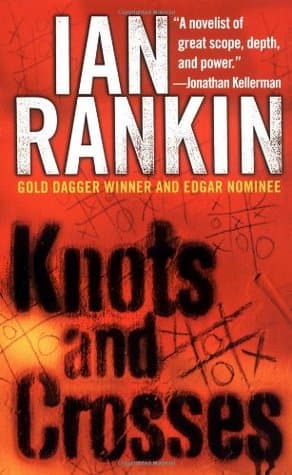
Ian Rankin (1987)
Genre
Thriller / Mystery
Reading Time
300 min
Key Themes
See below
Sign in to track this book
Haunted by his SAS past and dismissed as a crank, Edinburgh Detective John Rebus must untangle a series of ritualistic murders that eerily echo the suppressed terrors of his own mind, before the killer's game consumes them both.
The novel opens with the discovery of a young girl's body, Vicky Miller, in an Edinburgh park, strangled with a series of knots in her shoelaces. Detective Sergeant John Rebus is assigned to the case, which quickly becomes complicated by the apparent lack of motive or connection to the victim. At the same time, Rebus begins receiving anonymous, disturbing letters containing matchstick crosses and drawings of knotted string, stirring up suppressed memories of his past, particularly his time in the SAS and a traumatic incident involving his younger brother, Michael. His ex-wife, Rhona, and daughter, Sammy, live separately, adding to his isolation and internal turmoil. The initial investigation yields few leads, putting pressure on the police force.
Soon after Vicky Miller's murder, another young girl, Janice Kent, is found dead in similar circumstances – strangled with knotted shoelaces. The killer's pattern is established, and the city is gripped by fear. The police investigation intensifies, but without clear forensic evidence or a discernible link between the victims, progress is slow. Rebus finds himself increasingly consumed by the case and tormented by the anonymous letters, which seem to echo details of the murders and his own hidden past. His colleagues, particularly Detective Inspector Gill Templer, notice his erratic behavior and growing obsession, though Rebus keeps the letters a secret, fearing they might implicate him or reveal his instability.
Through fragmented flashbacks, the reader learns about Rebus's brutal SAS training, specifically an exercise involving sensory deprivation and psychological manipulation designed to break recruits. This experience, combined with a childhood incident where he accidentally caused his younger brother, Michael, to fall and suffer a severe head injury, makes up Rebus's deep-seated guilt and psychological trauma. The anonymous letters, with their cryptic symbols and allusions to knots and crosses, act as triggers, making Rebus question his own sanity and whether he might unknowingly be connected to the killer. He begins to suspect the letters are from someone who knows his deepest secrets.
The 'Knots and Crosses Killer' becomes a sensationalized topic in the media, with tabloids fanning public fear and criticizing the police's inability to catch the perpetrator. The pressure on Rebus and the investigation team mounts. A third young girl, Heather Davies, is abducted and murdered, again with the signature knotted shoelaces. The pattern is clear: young, innocent girls, strangled, with no apparent connection. Rebus's obsession with the case grows, and he starts to see connections between the knots in the victims' shoelaces and the knots in his own mind, fueled by the relentless anonymous letters. He feels a desperate urgency to solve the case, not just for the victims, but for his own peace of mind.
After extensive canvassing and forensic work, the investigation yields a potential suspect: Alan McInnes, a man with a history of sexual offenses and a connection to one of the victims through a neighborhood association. McInnes becomes the primary focus of the police, and Rebus is part of the team conducting surveillance and preparing for an arrest. While McInnes fits the profile of a lone predator, Rebus still feels an uneasy sense that something is missing, or that the anonymous letters are leading him down a different path. The letters continue to arrive, becoming more personal and accusatory, making Rebus increasingly paranoid.
Ignoring official protocols, Rebus secretly investigates the origins of the anonymous letters, driven by a desperate need to understand their connection to him. He revisits old haunts, contacts former SAS colleagues, and even travels to the care facility where his brother, Michael, resides. During his visits with Michael, Rebus is confronted with the lasting impact of his childhood accident. Michael, though mentally impaired, occasionally utters cryptic phrases that resonate with the themes of the letters. Rebus begins to suspect that the letter-writer is someone intimately familiar with his family history and his time in the SAS, leading him to question everyone around him.
Alan McInnes is arrested and brought in for interrogation. Despite mounting circumstantial evidence, McInnes maintains his innocence. The interrogation is intense, but McInnes's demeanor and lack of a definitive confession leave Rebus uneasy. While his colleagues are confident they have their man, Rebus's intuition, coupled with the persistent anonymous letters, tells him the case is not closed. He feels a growing conviction that McInnes is either a scapegoat or part of a larger, more complex scheme. Rebus continues his solitary quest for the true perpetrator, increasingly isolated from his colleagues who believe the case is solved.
Driven by a cryptic clue in one of the letters and a memory from his childhood, Rebus has a sudden revelation. He realizes the letter writer is his own brother, Michael. Michael, despite his mental limitations, has been manipulating events, fueled by a distorted memory of his childhood accident and a deep-seated resentment towards Rebus. Michael, having overheard Rebus's conversations and knowing his troubled past, orchestrated the 'knots and crosses' motif to torment his brother and draw him into the investigation. The realization is a profound shock, forcing Rebus to confront the devastating consequences of his past actions.
Rebus confronts Michael at the care facility. During the tense encounter, Michael, in a fragmented but chilling confession, reveals his role in the murders. He explains that he chose his victims based on their superficial resemblance to a girl from their childhood or to punish Rebus indirectly. He meticulously planned the 'knots and crosses' motif, drawing on their shared history and Rebus's SAS training, to specifically target his brother psychologically. Michael’s motive is rooted in a twisted desire for revenge and to make Rebus acknowledge his past guilt over the accident, believing Rebus had deliberately harmed him. The confession is a devastating blow to Rebus, confirming his worst fears.
Following Michael's confession, Rebus arranges for his arrest. The news sends shockwaves through the police department, completely exonerating Alan McInnes. Rebus is left to grapple with the horrific truth: his own brother is a serial killer, and his personal history directly fueled the crimes. The public is informed of the killer's identity, and the media frenzy shifts. Rebus, though praised for solving the case, is inwardly shattered. The novel concludes with Rebus carrying the immense burden of his brother's actions and the unresolved trauma of his past, forever changed by the 'knots and crosses' that entangled his life and family.
The Protagonist
Rebus moves from a state of denial and suppressed trauma to a painful confrontation with his past, accepting the devastating truth about his brother and his own role in their shared history.
The Antagonist
Michael transforms from a seemingly innocent, tragic figure into the chilling, vengeful mastermind behind the murders, revealing the depth of his long-held malice.
The Supporting
Templer maintains her professional integrity, growing more concerned about Rebus's well-being while remaining focused on the case, ultimately witnessing the shocking resolution.
The Supporting
Rhona remains a constant, if distant, figure in Rebus's life, representing the normal domesticity he struggles to maintain.
The Supporting
Sammy remains a symbol of hope and innocence for Rebus, unaffected by the direct events of the plot.
The Supporting
Holmes remains a consistent, if sometimes bewildered, presence in the investigation, serving as a foil to Rebus.
The Mentioned
McInnes is introduced as the prime suspect, then arrested and interrogated, only to be cleared of the charges at the climax of the story.
The Mentioned
Their deaths initiate the plot and provide the core mystery for Rebus to solve.
The novel explores how past traumas, particularly Rebus's SAS training and the childhood accident involving Michael, shape and haunt an individual. Rebus actively suppresses these memories, but the 'knots and crosses' letters force him to confront them. The fragmented flashbacks and Rebus's psychological distress show the lasting impact of unresolved trauma on mental health and behavior. Michael's actions are also a direct result of his own trauma and distorted memories, showing how past events can fester and lead to destructive outcomes for all involved.
“He knew the knots. He knew the crosses. He knew the signs. And they were leading him back into his own past, a past he had worked hard to forget.”
Guilt is a central driving force for Rebus, stemming from his perceived responsibility for Michael's accident. This guilt shows up as self-destructive behavior and an obsessive dedication to his work. The anonymous letters use this guilt, pushing him to the brink. Michael's motivation for the murders is also rooted in a twisted sense of grievance and a desire to make Rebus pay for his perceived wrongs. The novel questions whether true redemption is possible for Rebus, given the tragic outcome, or if he is condemned to perpetually carry the burden of his past.
“The guilt was a constant companion, a shadow that never quite left his side.”
The core of the mystery is within the Rebus family's hidden history. The childhood accident involving Michael is a long-held secret that affects both brothers. Michael's eventual revelation as the killer and the letter writer is a betrayal, turning the most intimate familial bond into a source of terror and manipulation. The novel shows how unresolved family conflicts and unspoken resentments can fester over decades, leading to devastating consequences. The 'knots' symbolize these tangled family ties and secrets.
“Blood. It was always blood, wasn't it? The ties that bind, the ties that strangle.”
'Knots and Crosses' looks into the unsettling idea that evil can emerge from unexpected places, even within one's own family. Michael Rebus, initially seen as a victim, transforms into a calculating and vengeful killer. His motives are personal and psychological, rather than purely random, suggesting a more complex and disturbing form of evil that is intimately tied to the protagonist's own life. The novel explores how trauma and resentment can warp a mind, leading to acts of extreme violence and manipulation, challenging common ideas of villainy.
“Evil wasn't always a stranger in the dark. Sometimes, it was someone you knew. Someone you loved.”
Rebus is the isolated detective, burdened by the horrors he witnesses and his own personal demons. His inability to confide in colleagues, his strained family relationships, and his self-destructive habits all contribute to his profound loneliness. The anonymous letters specifically target his isolation, making him question his sanity. This theme highlights the psychological toll of police work, especially on those who look into the darkest parts of human nature, and how it can separate them from the 'normal' world.
“He was alone with the knots, alone with the crosses, alone with the darkness inside him.”
Cryptic messages that torment Rebus and provide clues to the killer's identity and motive.
The anonymous letters, containing matchstick crosses and drawings of knotted string, serve as a crucial plot device. They are not merely taunts from the killer but are specifically designed to psychologically torment Rebus by referencing his hidden past and SAS training. These letters act as a direct link between Rebus and the killer, fueling his obsession and paranoia. They also function as a narrative device to reveal fragments of Rebus's repressed memories and ultimately lead him to the shocking truth of his brother's involvement, making the case deeply personal.
Non-linear glimpses into Rebus's traumatic past, revealing the origins of his psychological distress.
The novel utilizes fragmented flashbacks to Rebus's time in the SAS, particularly a sensory deprivation exercise, and to the childhood accident involving his brother, Michael. These non-linear glimpses are triggered by the anonymous letters and the details of the murders. They serve to gradually reveal the source of Rebus's deep-seated guilt and psychological trauma, building suspense and providing context for his erratic behavior. This device allows the reader to piece together Rebus's past alongside him, creating a strong sense of empathy and understanding for his complex character.
A recurring symbolic pattern that links the murders to Rebus's personal history.
The motif of 'knots and crosses' is central to the novel. The victims are found with their shoelaces tied in intricate knots, and the anonymous letters contain matchstick crosses and drawings of knotted string. The knots symbolize tangled problems, psychological binds, and the inescapable ties of family and fate. The crosses evoke religious symbolism, guilt, and the burdens Rebus carries. This motif is not just the killer's signature but a deeply personal code designed to resonate with Rebus's specific traumas, particularly his SAS training and the childhood accident, making the murders a direct attack on his psyche.
A seemingly obvious suspect who diverts the police investigation and heightens the eventual reveal.
Alan McInnes serves as a classic red herring in the plot. With a history of sexual offenses and circumstantial connections to the victims, he becomes the primary suspect for the police. His arrest and interrogation create a false sense of resolution for most of the investigative team. This device is crucial for highlighting Rebus's unique intuition and his isolation from his colleagues, as he is the only one who senses that McInnes is not the true killer. The red herring ultimately makes the revelation of Michael Rebus as the killer even more shocking and impactful.
“The past, like a corpse, would always surface eventually.”
— Rebus reflecting on old cases and secrets.
“He knew that feeling of being an outsider looking in, watching the world go by and wondering how to get a ticket.”
— Rebus observing a scene, feeling detached.
“Edinburgh was a city of ghosts, and Rebus often felt like one of them.”
— Rebus's general feeling about his city and his place in it.
“Sometimes the only way to find the truth was to stir up a whole lot of lies.”
— Rebus contemplating his investigative methods.
“There was a darkness in people, a knot of evil, that you could never quite untangle.”
— Rebus's thoughts on human nature and crime.
“He was a man who lived in the shadows, and the shadows were beginning to close in.”
— Rebus feeling the pressure of the case and his past.
“The city had a way of keeping its secrets, even from those who thought they knew it best.”
— Rebus considering Edinburgh's hidden aspects.
“Every secret had a price, and someone always ended up paying it.”
— Rebus's understanding of consequences.
“He'd seen enough death to know that it rarely brought closure, only more questions.”
— Rebus reflecting on the impact of murder.
“Some knots were meant to be tied, others to be cut.”
— Rebus metaphorically considering the puzzles of the case.
“The past wasn't dead; it was just sleeping, waiting for someone to wake it up.”
— Rebus realizing the influence of past events on the present.
“There was a certain kind of madness in trying to make sense of the senseless.”
— Rebus's internal struggle with the nature of the crimes.
“You could run from your past, but you couldn't hide from yourself.”
— Rebus confronting his own personal history and its impact.
Ready to see how well you understood this book? Take our interactive quiz with 10 questions.

Sir Ian James Rankin is a Scottish crime writer and philanthropist, best known for his Inspector Rebus novels.







