“There are a lot of good people in this world, but there are a whole lot of bad ones too, and the bad ones usually win.”
— A general observation on human nature and the town's harsh realities.

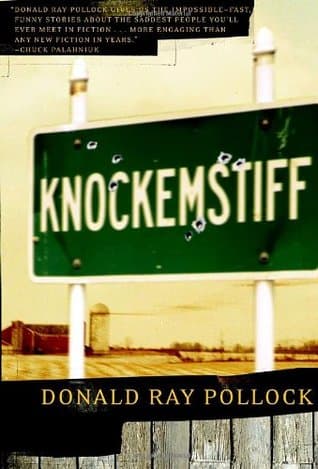
Donald Ray Pollock (2008)
Genre
Literary Fiction
Reading Time
240 min
Key Themes
See below
Sign in to track this book
In the desolate town of Knockemstiff, steroid-fueled fathers, incestuous siblings, and psychotic recluses navigate their bleak, interconnected lives with raw resilience.
In 'The Winnebago,' young Jodie lives with his father, Frank, in a dilapidated Winnebago. Frank, a former bodybuilder, tries to relive his past through Jodie, injecting him with steroids and forcing him into intense training. Jodie, a sensitive and artistic boy, resents his father's pressure and the changes to his body. He often retreats into his own world, sketching and observing the strange characters of Knockemstiff. Frank's harsh discipline and emotional distance create a deep rift between them. Jodie wants a different life, always aware of his father's unfulfilled ambitions weighing on him in their isolated, rural existence.
Arvin Eugene, a young man in Knockemstiff, enters the local drug scene through his acquaintance with the manipulative Junior. Desperate for money to support his ailing mother and escape poverty, Arvin starts running pills for Junior. He quickly gets in over his head, witnessing violence and betrayal that force him to confront the brutal realities of the illegal trade. Arvin struggles with his conscience, torn between surviving and the moral compromises he must make, which leads him further into desperation and danger as he tries to outwit those around him.
Frank, still obsessed with Jodie's physique and seeking new ways to fulfill his ambitions, forces Jodie into brutal, unregulated underground fights. Jodie, now muscular but unwilling, endures these violent encounters, often against older, more experienced fighters. Frank bets heavily on his son, treating him more as an investment than a child. The fights are a spectacle of violence and desperation. Jodie's victories bring fleeting pride to Frank but only deeper alienation and physical pain to Jodie. These events show the destructive nature of Frank's ambition and Jodie's passive resistance.
Lard, a mentally disturbed and isolated recluse in a remote part of Knockemstiff, spends his days watching the strange events in his community. He becomes fixated on siblings Billy and Susan, who are in an incestuous relationship. Lard, with his twisted sense of morality, decides he must intervene. His intervention is violent and horrifying, stemming from his warped understanding of right and wrong, and results in a tragic outcome for the siblings. This story explores the darkest parts of human behavior and the disturbing actions of those on the fringes of society, driven by their own inner demons.
Arvin Eugene, increasingly disillusioned with the drug trade and the violence, retreats into the woods, seeking a temporary escape from his grim reality. There, he finds a group of men engaged in a cruel act of animal torture. The scene deeply disturbs Arvin, reflecting the senseless brutality he has witnessed among humans. This encounter reinforces his growing despair and the pervasive darkness that seems to engulf Knockemstiff. The incident shows how the environment dehumanizes its inhabitants, both human and animal, in their struggle for survival.
The funeral of a local resident, whose death is shrouded in Knockemstiff's blend of mystery and tragedy, brings together many of the town's recurring characters. Jodie, Arvin Eugene, and others attend, each carrying their own burdens and secrets. The event is less about mourning and more about the living, showing the complex and often dysfunctional relationships among community members. Conversations are terse, glances are loaded, and the underlying tensions and shared histories are clear. The funeral becomes a small example of Knockemstiff itself, a place where grief and grim humor mix.
A charismatic but dangerous drifter arrives in Knockemstiff, disrupting the community's fragile balance. He quickly befriends some susceptible residents, including a lonely woman named Evelyn, and begins to exploit their weaknesses. The drifter's presence creates an unsettling unpredictability, leading to small conflicts and heightened paranoia among the townspeople. His manipulative tactics and disregard for local customs eventually lead to a violent confrontation, further showing the precariousness of life in Knockemstiff and how susceptible its inhabitants are to outside influences in their isolated world.
A character, deeply troubled by a past transgression, seeks to confess. This act of seeking redemption, however flawed, shows the lingering psychological toll of living in Knockemstiff. The confession might be to another character, a religious figure, or an internal monologue, but it reveals the character's struggle with guilt and the consequences of their choices. The scene explores themes of sin, repentance, and the difficulty of escaping one's past in a place where secrets are rarely kept and actions have lasting repercussions for both the individual and the community.
Jodie, after years of his father's abuse and Knockemstiff's suffocating atmosphere, finally decides to leave. He plans his escape carefully, gathering his few resources and cutting ties with the past. His departure is risky; he fears his father's reaction and the unknown challenges of the outside world. This moment marks Jodie's desire for self-determination and his rejection of the life his father envisioned. His journey out of Knockemstiff is a symbolic step toward forging his own identity and seeking a future free from his upbringing, though the town's influence will always remain.
Arvin Eugene's involvement in the drug trade comes to a violent end when he confronts Junior. The tensions that have built between them finally erupt, leading to a brutal struggle. This reckoning culminates Arvin's journey into the criminal underworld, forcing him to make life-or-death decisions. The outcome, whether Arvin wins or suffers further loss, marks a significant turning point in his life, solidifying his understanding of Knockemstiff's harsh realities and the irreversible consequences of his choices in the cutthroat world he inhabits.
Years later, Jodie, now an adult and having lived outside Knockemstiff, reflects on his origins. He may or may not return to the town, but its memory and his experiences there continue to shape him. This section explores the lasting impact of one's upbringing and the indelible mark a place like Knockemstiff leaves on its inhabitants. Jodie grapples with nostalgia, resentment, and a complex understanding of the people and events that defined his youth, acknowledging that while he may have left the town, a part of Knockemstiff will always remain with him, influencing his perspective.
The final stories often hint at the cyclical nature of life in Knockemstiff, showing how patterns of poverty, violence, and limited opportunity persist across generations. New characters, or the children of existing ones, begin to navigate the same challenging environment, facing similar struggles and making similar choices. This reinforces the idea that Knockemstiff is not just individual stories but a pervasive environment that shapes destinies. The ending leaves the reader with a sense of the town's enduring character, its capacity for both misery and a strange resilience, as the cycle of life continues in its unique, brutal way.
The Protagonist
Jodie evolves from a passive victim of his father's ambition to a young man determined to escape Knockemstiff and forge his own path, though the town's influence remains.
The Antagonist/Supporting
Frank remains largely static, his character defined by his unfulfilled ambitions and his destructive influence on Jodie, never truly finding redemption.
The Protagonist
Arvin's arc follows his descent into the criminal underworld, forcing him to confront violence and make difficult moral choices, ultimately hardening him but also revealing his resilience.
The Supporting
Lard remains a static, disturbed character, his actions driven by his unchanging internal pathology.
The Antagonist
Junior remains a consistent antagonist, his power and ruthlessness driving much of the conflict in Arvin Eugene's storyline.
The Supporting
Evelyn's arc is one of repeated vulnerability and exploitation, reflecting the harsh realities faced by many women in Knockemstiff.
The Mentioned/Supporting
Billy's arc is tragically cut short by Lard's intervention, serving as a catalyst for a pivotal, disturbing event.
The Mentioned/Supporting
Susan's arc is tragically cut short by Lard's intervention, serving as a catalyst for a pivotal, disturbing event.
Knockemstiff shows a community caught in a cycle of poverty, limited opportunities, and despair. Characters like Arvin Eugene deal drugs ('Pills') out of economic need. The dilapidated Winnebago where Jodie and Frank live ('The Winnebago') symbolizes their inability to escape their socio-economic circumstances. This theme appears in the characters' choices, their lack of prospects, and the general stagnation that fills the town, suggesting that the environment itself prevents any real progress or escape, continuing a grim legacy across generations ('Generations').
“There was a whole lot of evil in Knockemstiff, Ohio, and most of it was in the hearts of the people.”
This theme is clearly shown through Frank's relationship with Jodie. Frank's constant steroid injections and forcing Jodie into bodybuilding and fighting ('The Winnebago', 'The Fights') show his desire to control and relive his own failed dreams through his son. Similarly, Junior's manipulation of Arvin Eugene in the drug trade ('Pills', 'The Reckoning') shows how those with power exploit the vulnerable. The theme highlights how unchecked control, whether familial or criminal, harms those subjected to it, taking away their agency and self-worth.
“He wanted me to be him, only better.”
Knockemstiff is a place where traditional morality is often reversed or absent. The story of Lard intervening in Billy and Susan's incestuous relationship ('Lard') is a prime example, where a disturbed individual acts on a twisted sense of justice, leading to more violence. Characters like Arvin Eugene are forced into morally difficult situations ('Pills'), blurring the lines between victim and perpetrator. The pervasive violence, drug use, and sexual deviance are presented without judgment, forcing the reader to confront the raw aspects of human nature in extreme situations, where survival often matters more than conventional ethics.
“Sometimes it felt like the whole town was just waiting to fall apart.”
Many characters in Knockemstiff want to escape their grim realities and create their own identity. Jodie, stifled by his father's ambitions, dreams of a life beyond bodybuilding and the town ('The Escape'). Arvin Eugene's involvement in the drug trade, though dangerous, is also a desperate attempt to build a different future for himself and his family ('Pills'). Even temporary retreats into nature ('The Animals') symbolize a desire for purity and relief from the town's corruption. This theme shows the universal human desire for self-determination against huge odds, even if the escape is brief or ultimately unsuccessful, as seen in 'The Return'.
“I just wanted to be something other than what my father wanted me to be.”
Individual stories that feature recurring characters and a shared setting, building a larger narrative.
The novel is structured as a collection of linked short stories, each focusing on different characters or events within Knockemstiff. This device allows Pollock to explore the multifaceted nature of the town and its inhabitants from various perspectives, without adhering to a single linear plot. Recurring characters like Jodie and Arvin Eugene appear in multiple stories, allowing their individual arcs to develop gradually and their connections to the community to deepen. This structure creates a rich tapestry of interconnected lives, where the cumulative effect of the stories builds a comprehensive portrait of the town's pervasive despair and occasional moments of resilience.
The use of authentic, regional language and speech patterns to enhance realism.
Pollock employs a distinct local vernacular and dialect throughout the stories, reflecting the speech patterns and cultural nuances of rural Southern Ohio. This device adds a powerful layer of authenticity and immersion to the narrative, making the characters and their dialogues feel incredibly real and grounded in their specific environment. The language is often raw, unpolished, and direct, mirroring the harsh realities of the characters' lives. It contributes significantly to the 'literature of place' aspect of the book, drawing the reader directly into the unique voice and atmosphere of Knockemstiff, making the prose feel both immediate and unflinching.
The pervasive sense of dread and decay that hints at future violence and tragedy.
Throughout the collection, Pollock masterfully uses atmospheric details and character interactions to create a pervasive sense of dread and impending doom. The descriptions of the dilapidated landscape, the characters' grim circumstances, and their often violent or desperate actions subtly foreshadow the tragic events and violent confrontations that inevitably occur. For instance, the constant pressure Frank puts on Jodie or Arvin Eugene's deepening involvement in the drug trade inherently suggests a violent climax. This device keeps the reader on edge, anticipating the worst and reinforcing the idea that in Knockemstiff, violence and despair are not anomalies but ingrained aspects of life.
Animals are used to reflect the brutality and vulnerability present in the human world of Knockemstiff.
Animals in Knockemstiff often serve as powerful symbols, mirroring the brutality, suffering, and vulnerability experienced by the human characters. The scene where Arvin Eugene witnesses animal cruelty ('The Animals') directly reflects the senseless violence and dehumanization he experiences in the drug trade. Similarly, the descriptions of neglected or abused animals throughout the stories parallel the characters' own struggles against exploitation and their lack of agency. This device highlights the pervasive nature of suffering in the town, suggesting that both humans and animals are subject to the same harsh, unforgiving conditions, underscoring the raw, primal struggle for survival.
“There are a lot of good people in this world, but there are a whole lot of bad ones too, and the bad ones usually win.”
— A general observation on human nature and the town's harsh realities.
“The devil don't care if you're a good man or a bad one. He just wants your soul.”
— A reflection on the pervasive evil and lack of redemption in the narrative.
“Some men are born to be good, some to be evil, and some just to get by.”
— A character contemplating the different paths and destinies of people.
“In Knockemstiff, you lived and died and nobody cared. That was the way it was.”
— Describing the sense of isolation and indifference in the titular town.
“He knew that the past was never really past, not in a place like this.”
— A character realizing the inescapable grip of history and memory in Knockemstiff.
“God had long since packed his bags and left Knockemstiff, if he'd ever been there at all.”
— Highlighting the absence of divine presence or hope in the town.
“The only thing worse than living in Knockemstiff was trying to leave it.”
— Illustrating the difficulty and futility of escaping the town's influence.
“Every family in Knockemstiff had its secrets, and most of them were ugly.”
— A general statement about the hidden darkness within the community.
“Some folks just got a bad seed in 'em, no matter how you try to raise 'em.”
— A parent's lament about inherent evil or difficult children.
“There wasn't much hope in Knockemstiff, but there was plenty of stubbornness.”
— Describing the resilient, albeit often destructive, nature of the town's inhabitants.
“The world was a cruel place, and Knockemstiff was just a small, concentrated dose of it.”
— A character reflecting on the town as a microcosm of global harshness.
“He often thought that the only way to survive in Knockemstiff was to be as mean as the place itself.”
— A character's adaptation to the harsh environment by mirroring its brutality.
“The trees along the creek were so thick and dark they seemed to swallow the light.”
— A descriptive passage setting the ominous and claustrophobic mood of the landscape.
“Some sins just stick to a man, like mud to a boot, and you can't ever really wash 'em off.”
— A reflection on the lasting impact of past transgressions.
Ready to see how well you understood this book? Take our interactive quiz with 10 questions.

Donald Ray Pollock is an American author known for his gritty, darkly humorous fiction often set in the rural American South. His debut short story collection, "Knockemstiff," won the PEN/Bingham Prize for Debut Fiction. Pollock's first novel, "The Devil All the Time," was adapted into a film and cemented his reputation for visceral storytelling and unflinching portrayals of troubled characters.







