“The wind was a living thing, whipping at their clothes, tugging at their hair, and whispering secrets in a language they couldn't understand.”
— Describing the harsh weather conditions during their journey.

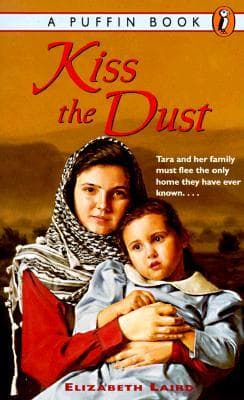
Elizabeth Laird (1991)
Genre
Children's / Historical Fiction / Young Adult
Reading Time
288 min
Key Themes
See below
Sign in to track this book
Forced from her Iraqi home, a young girl faces displacement and a search for belonging as her family travels from Kurdish resistance to British asylum.
Tara, a twelve-year-old Kurdish girl, lives a happy and secure life in a small town in Iraqi Kurdistan. She goes to school, helps her mother, Leila, with chores, and plays with friends, especially Zola. Her father, a respected teacher, is often busy with political meetings. Her younger brother, Jamil, is lively. The family's life blends Kurdish traditions with modern touches, and Tara dreams of being a doctor. However, political tension and the threat from the Iraqi government are always present, though not openly discussed with the children.
The political situation in Iraq quickly worsens. Tara's father, involved with the Peshmerga (Kurdish resistance fighters), becomes a target. One evening, a friend warns them that the Iraqi secret police are looking for him. The family must flee at once. This sudden departure shatters Tara's security. They leave their home, most possessions, and friends behind. The escape begins secretly in the dark, driven by fear. Tara struggles to grasp the danger, only knowing their lives are at risk and they cannot return.
Tara, Jamil, Leila, and their father begin a dangerous trek through the rugged Kurdish mountains. The journey is hard, marked by hunger, thirst, and exhaustion. They travel mostly at night to avoid being seen, enduring harsh weather. Tara sees the suffering of other refugees, which affects her deeply. Her father, despite his own tiredness, remains strong, guiding them through difficult terrain. Jamil, at first playful, becomes quiet from the hardships. Leila tries to keep things normal for her children, but her fear is clear. They eventually reach a refugee camp near the Iranian border, a temporary, basic relief.
Life in the refugee camp is harsh. The family lives in a tent, with little food, water, or sanitation. Sickness is common, and the lack of privacy takes its toll. Tara misses her old life, her friends, school, and home comforts. She tries to help her mother with daily chores and care for Jamil, but the constant uncertainty weighs on her. Her father continues to work with other Kurdish resistance members, trying to secure their future. The camp is a place of waiting, anxiety, and hope for a permanent solution, but also where despair can easily grow.
As Iraq's political situation remains unstable and the refugee camp offers no long-term solution, Tara's father decides to seek asylum in a Western country. After much discussion, they choose Britain, partly because some distant relatives live there. This decision brings mixed emotions: hope for safety and a new start, but also deep sadness at leaving Kurdistan forever and fear of the unknown. Tara struggles with leaving her heritage and starting over in an alien culture, but the promise of safety for her family outweighs her reluctance.
The journey to Britain is long and difficult. The family travels through many countries, often with false papers and smugglers. They endure cramped conditions, long waits, and constant fear of capture or exploitation. Tara observes other refugees, each with their own story of hardship. The experience further exposes her to the realities faced by displaced people. Her father acts as protector, while Leila tries to keep the children's spirits up. This part of their journey ends with their arrival in London, a busy, overwhelming city, very different from their mountain home.
In London, Tara and her family face the challenge of a new country with a different language, customs, and rules. They are first housed in temporary places, feeling isolated. The asylum process is complex and stressful, with interviews and uncertainty. Tara struggles with English, unfamiliar food, and cultural differences. She feels like an outsider at school, placed with other non-English speaking children. Jamil also finds it hard to adjust. Leila misses her family, while her father deals with past trauma and the pressure of supporting his family in a strange place.
Despite initial difficulties, Tara slowly adjusts to her new school. She works hard to learn English. She meets a girl named Carol, who becomes her first British friend. Carol helps Tara with British school life and customs. Tara also befriends other refugee children, finding common ground in their shared experiences. While she still misses Zola and her life in Kurdistan, these new friendships provide connection and hope, helping her feel less isolated.
Tara experiences a growing inner conflict about her identity. She wants to fit in with her British peers and embrace her new life, but she also feels a strong pull toward her Kurdish heritage. There are cultural clashes at home, as her parents try to maintain traditions while Tara and Jamil quickly adapt. Tara sometimes feels embarrassed by her parents' customs or their struggles with English. She also encounters casual racism and misunderstanding from some British people, which makes her feel like an outsider. This period shows the tension between her past and present, her desire to belong, and her need to hold onto who she is.
The family lives under the constant shadow of the asylum decision. Each letter from the Home Office brings hope and dread. Her father spends hours with forms, interviews, and legal advice. The uncertainty weighs on everyone, affecting their ability to plan. Tara understands the decision's importance, knowing it will determine if they can build a new life or face more displacement. The waiting period tests their resilience, with the fear of refusal always threatening their fragile sense of security.
Finally, after a long wait, the family receives the news: their asylum application is granted. Relief washes over them, mixed with tears of joy. This decision marks a turning point, allowing them to move from temporary housing to a more permanent home. Tara's father finds work, and Leila learns English more actively. While the scars of their past remain, and the longing for Kurdistan never fully disappears, they can now begin to build a new life in Britain. Tara feels a growing sense of belonging, understanding that she can embrace both her Kurdish heritage and her new British identity.
As time passes, Tara becomes more confident in her new life. She does well at school, her English improves, and her friendships with Carol and others deepen. She remembers Kurdistan clearly and shares stories of her past, helping her friends understand her journey. She recognizes her family's strength. While displacement trauma is part of her story, it does not define her. Tara looks forward to pursuing her dreams, perhaps becoming a doctor. She learns to navigate her dual identity, understanding that her experiences have made her stronger and more empathetic. The book ends with Tara embracing her future, a symbol of hope for refugees.
The Protagonist
Tara transforms from a sheltered child to a strong, empathetic young woman who navigates cultural clashes and finds a balance between her past and her new life in Britain.
The Supporting
Leila maintains her role as the family's emotional core, adapting to new challenges while preserving her cultural identity and nurturing her children's growth.
The Supporting
He remains steadfast in his principles and dedication to his family, finding new ways to provide for them despite the loss of his former identity and role.
The Supporting
Jamil adapts more quickly to the new culture than his older family members, representing the resilience and assimilation of younger generations.
The Supporting
Zola's character remains static as a memory, serving as a constant reminder of Tara's lost home and identity.
The Supporting
Carol helps Tara integrate into her new environment, developing from a curious peer to a supportive friend.
The Mentioned
Provides consistent support to Tara, remaining a stable, positive adult figure in her new school environment.
The Mentioned
Their role is purely functional, facilitating the plot without personal development.
The book shows the deep trauma refugees experience. Tara and her family lose their home, possessions, security, community, and cultural identity. The constant fear, hard journeys, poor conditions in camps, and asylum uncertainty all contribute to a deep sense of loss. Tara grieves her friendship with Zola and her old life, while her parents struggle with the psychological scars of their experiences. This theme is clear from their sudden flight from Kurdistan to their emotional struggles adapting to an alien culture in Britain, where memories of their past are often sad.
“It was like kissing the dust, that day we left. Kissing goodbye to everything we knew.”
Despite immense suffering, the characters show remarkable resilience. Tara, though initially scared, learns to navigate new languages, schools, and social norms. Her parents, especially Leila, show incredible strength in keeping family unity and hope amidst hardship. The family's ability to survive the dangerous journey, endure the refugee camp, and slowly build a new life in Britain highlights the human capacity to adapt to extreme situations. This theme is especially visible in Tara's efforts to learn English and make new friends, showing her determination to find a place in her new world without forgetting her origins.
“We were like weeds, my mother said. You could pull us up, but we'd grow again somewhere else.”
A central theme is Tara's struggle to connect her Kurdish heritage with her new British identity. She feels like an outsider in London but also fears losing touch with her roots. The book explores the challenges of keeping cultural traditions in a new land, the difficulties of assimilation, and the search for belonging in a world that often sees refugees as 'other.' Tara's journey is about forming a mixed identity, where she learns to embrace both parts of who she is, eventually understanding that her past makes her unique and strong. This is clear in her interactions with Carol and her thoughts on being Kurdish in Britain.
“I was Kurdish. I was British. It was like having two names, two hearts, two homes.”
The novel clearly shows how political conflicts, often distant to those unaffected, have devastating consequences for ordinary families. Tara's father's involvement in the Kurdish resistance, a direct result of the oppression faced by the Kurdish people in Iraq, causes the family's displacement. The story highlights the injustice and violence that force people to become refugees, emphasizing that their flight is not a choice but a desperate need for survival. The constant threat from the Iraqi government and the lack of a safe homeland for the Kurds drives the entire story, showing the human cost of political conflict.
“They hated us because we were Kurds. We just wanted to be free.”
The story is told entirely from Tara's perspective.
The use of first-person narration allows the reader to experience the refugee journey intimately through the eyes of a young girl. This perspective makes the complex political situation more accessible and personal, focusing on the emotional and physical impact on a child. It allows for a gradual understanding of the unfolding events, mirroring Tara's own learning and processing of her traumatic experiences. The reader shares her fears, hopes, confusion, and eventual adaptation, fostering empathy and a deeper connection to her story.
The title 'Kiss the Dust' symbolizes loss, hardship, and the physical reality of displacement.
The phrase 'Kiss the Dust' serves as a powerful symbol throughout the narrative. It literally refers to the arid, dusty landscapes Tara's family traverses during their escape and the harsh conditions of the refugee camp. Metaphorically, it represents the crushing defeat, the loss of everything, and the indignity faced by refugees. It evokes the idea of being brought low, forced to surrender to circumstances, but also, in its final interpretation, perhaps a reluctant farewell to a homeland. The title encapsulates the physical and emotional toll of their journey.
The narrative frequently contrasts Tara's life in Kurdistan with her new life in Britain.
The author effectively uses contrast to highlight the drastic changes in Tara's life. Descriptions of her comfortable home, school, and friendships in Kurdistan are juxtaposed with the harsh realities of refugee camps, the unfamiliarity of London, and the challenges of cultural integration. This contrast emphasizes the profound loss experienced by the family and underscores the difficulty of their journey. It also serves to illustrate Tara's growth and adaptation as she learns to navigate these vastly different worlds, showcasing her resilience and the enduring impact of her past.
The physical journey from Kurdistan to Britain mirrors Tara's internal journey of self-discovery and adaptation.
The family's literal journey across mountains and continents functions as a powerful metaphor for Tara's emotional and psychological development. Each stage of the physical journey—the escape, the camp, the travel to Britain, the initial struggles—corresponds to a phase in Tara's internal growth. She moves from innocence to awareness, from fear to resilience, and from a singular identity to a more complex, hybrid one. The long, difficult road she travels physically is mirrored by the challenging path she takes to understand herself and her place in the world.
“The wind was a living thing, whipping at their clothes, tugging at their hair, and whispering secrets in a language they couldn't understand.”
— Describing the harsh weather conditions during their journey.
“Hope was a tiny spark, easily extinguished, but fiercely guarded.”
— Reflecting on the emotional state of the refugees.
“You can lose everything, but you must never lose your mind.”
— A piece of advice given to Laila by an elder.
“The dust was everywhere. In their clothes, their hair, their food. It coated their very souls.”
— Emphasizing the pervasive and inescapable nature of their environment.
“Home was not a place anymore, but a memory, a fragile dream that receded further with every step.”
— Laila's realization about the loss of her home.
“Sometimes, the only way to keep going was to pretend you weren't tired, weren't hungry, weren't afraid.”
— Laila's internal struggle to maintain strength.
“The mountains watched them, silent and indifferent, ancient witnesses to their modern sorrow.”
— Describing the vast, unchanging landscape they travel through.
“A child's laughter, even in the midst of despair, was a powerful weapon against the darkness.”
— Observing moments of resilience and joy among the younger refugees.
“They were ghosts, moving across a land that didn't want them, leaving no trace but the dust they disturbed.”
— Feeling invisible and unwanted as refugees.
“Every sunrise brought not just light, but the renewed burden of another day of walking.”
— Describing the relentless nature of their journey.
“The greatest kindness, sometimes, was simply to share what little you had.”
— Witnessing acts of generosity among the refugees.
“War takes away everything, even the simple right to be a child.”
— Laila reflecting on the impact of conflict on young lives.
“The stars were the only constant, shining down on their plight with an ancient, unchanging brilliance.”
— Finding a small comfort in the unchanging night sky.
“She learned that courage wasn't about not being afraid, but about moving forward despite the fear.”
— Laila's personal growth and understanding of courage.
Ready to see how well you understood this book? Take our interactive quiz with 10 questions.

Dan Gemeinhart
4.5

Kate O'Hearn
4.4

Jeanne Birdsall
4.4

Jen Wang
4.4
Wendelin Van Draanen
4.3

John Marsden
4.3

Chris Van Allsburg
4.3
Jennifer A. Nielsen
4.2