“The problem with the future, Superman, is that it keeps getting here.”
— Lex Luthor explaining his perspective to Superman.

Sign in to track this book
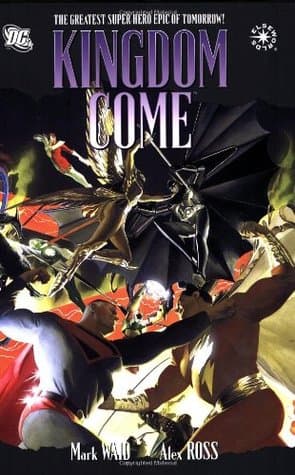
In a grim, near-future DC, a weary Superman returns from exile to unite new super-powered beings and stop a global conflict.
The story begins with Norman McCay, an aging pastor. The Spectre chooses him to witness and explain the coming 'Kingdom Come' — a possible end for humanity and metahumans. Thirty years before, Superman, Wonder Woman, Batman, and the Justice League retired. A new, more violent generation of heroes came to power. This new group, led by characters like Magog, favors brute force and lethal justice. A key event happens when Magog's team, the Justice Battalion, fails to stop Parasite during a battle in Kansas. This causes a nuclear explosion that kills over a million people, including Green Arrow and the Flash. This tragedy makes Superman return from his exile. He wants to restore order and the values of the classic heroes.
Superman spent a decade in his Fortress of Solitude, mourning Lois Lane and the world's state. He decides he cannot stay away. He returns, which immediately causes a stir among the public and metahumans. He starts recruiting former heroes and new metahumans who still believe in his ideals. He forms a new Justice League based in the rebuilt Justice League Satellite. His goal is not to punish, but to teach and guide the reckless new generation. He wants to show them the responsibility that comes with their power. However, many younger heroes resent his authority and 'old-fashioned' methods. They prefer their chaotic, individualistic approach to justice.
Batman, now older and more cynical, relies on an exoskeleton and many robotic drones. He views Superman's return with suspicion. He believes Superman's attempt to impose order will only lead to more conflict and an inevitable war between metahuman groups. Instead of joining Superman's Justice League, Batman forms his own group, the 'Outsiders,' from Gotham City's shadows. This group includes second-generation heroes like Nightstar (Dick Grayson and Starfire's daughter) and Catwoman's daughter, as well as a reformed Lex Luthor and his 'Mankind Liberation Front.' Batman's aim is to prepare for the clash he foresees, ensuring humanity's survival by any means.
As chaos among metahumans grows, with widespread property damage and civilian deaths common, Superman takes a more drastic step. He builds a maximum-security prison, the 'Gulag,' in the American Midwest. This facility is meant to house and re-educate the most dangerous and unruly metahumans, those who refuse his code of conduct. The Gulag quickly fills with heroes who reject Superman's authority, including members of Captain Marvel's faction. This move is controversial. Many see it as limiting freedom and a dangerous consolidation of power, even some in Superman's own Justice League, like Wonder Woman.
Lex Luthor, now elderly but still brilliant and manipulative, formed the 'Mankind Liberation Front' (MLF). This group includes human leaders and disillusioned metahumans, such as the Riddler and Vandal Savage. It aims to use the growing conflict between Superman's Justice League and independent metahumans. Luthor's goal is to eliminate all metahumans, seeing them as a threat to human supremacy. He uses his resources and intelligence to cause discord and destabilize the situation more. He secretly arranges events to push the metahuman groups towards a final, destructive fight, which he plans to use to his advantage.
Tensions peak when a large riot breaks out inside the Gulag. The confined metahumans, fueled by resentment and a wish for freedom, escape. They start a full-scale battle that spreads into the nearby countryside. This event causes the final confrontation that Norman McCay and the Spectre have been watching. Superman's Justice League arrives to stop the riot. Batman's Outsiders, having expected this, also move into position. Lex Luthor's Mankind Liberation Front, which helped the riot grow, watches from the sidelines. They are ready to strike at the right time, hoping to eliminate all metahuman groups.
Captain Marvel, caught between ideologies, is a key figure in Luthor's plan. He respects Superman's ideals but also sympathizes with the younger heroes' desire for freedom. He struggles with Superman's strict methods. Luthor secretly brainwashed Captain Marvel and uses him as a sleeper agent. During the final battle at the Gulag, Luthor activates Marvel, turning him against Superman and the Justice League. Captain Marvel, controlled by Luthor, becomes a devastating weapon. He can unleash incredible power and is tasked with creating a huge explosion to trigger Luthor's ultimate weapon, designed to kill all metahumans.
As the battle at the Gulag becomes uncontrolled, with metahumans from all sides fighting, the United Nations decides to act with a desperate measure. Fearing the metahuman conflict will wipe out humanity, they approve launching three nuclear warheads. These are designed to emit concentrated radiation that will neutralize all metahumans, regardless of their loyalties. This decision, driven by panic, threatens to kill not only the warring heroes and villains but also innocent civilians in the blast area. The Spectre tells Norman McCay that this is the moment of judgment, the 'Kingdom Come' itself.
As the nuclear missiles approach, Superman realizes the severe consequences. He, along with powerful heroes like Wonder Woman and Green Lantern, tries to stop them. Captain Marvel, freed from Luthor's control by Norman McCay and the Spectre's help, understands the seriousness of his actions. In a moment of redemption, Captain Marvel shouts 'Shazam!' and intercepts the last, most dangerous nuclear missile. He detonates it harmlessly in the upper atmosphere. This sacrifice costs him his life. It saves the world from complete destruction but still causes a devastating electromagnetic pulse that incapacitates most remaining metahumans.
After the nuclear detonation, the world is changed. Many metahumans are dead. Survivors must face the results of their actions. Superman, having seen humanity almost destroyed, works to rebuild trust between humans and metahumans. He, Batman, and Wonder Woman, with the remaining heroes, form a new, more unified Justice League. They guide survivors and establish a new world order based on understanding and cooperation. The final scene shows Superman, Batman, and Wonder Woman, much older, sharing a meal. They discuss their future and hope for a better tomorrow. Superman even reveals his true identity to Norman McCay.
The Protagonist
From disillusioned recluse to stern leader, and finally to a wiser symbol of hope and unity, learning that true leadership is about understanding and guidance.
The Supporting
From paranoid strategist to a grudging participant in a new, more unified world order, still pragmatic but willing to work with others.
The Supporting
From a disillusioned warrior to a leader who finds a balance between force and diplomacy, advocating for a new path.
The Protagonist/Narrator
From a bewildered, questioning observer to a vital participant who helps save the world and regains his faith.
The Supporting
From an unfeeling judge to a more understanding entity, influenced by human empathy.
The Antagonist/Supporting
From a celebrated but reckless hero to a figure who recognizes the error of his ways, accepting his role in the chaos.
The Antagonist
Remains a consistent antagonist, his ambition for human supremacy leading to the brink of global catastrophe.
The Supporting
From a conflicted hero to an unwitting weapon, ultimately achieving redemption through self-sacrifice.
The Supporting
Remains a steadfast and powerful ally, embodying consistent strength and commitment.
The Supporting
From a cautious follower of Batman to someone who questions his methods and seeks a more unified approach.
The book looks at how heroic ideals change and become corrupt. Classic heroes like Superman represent a moral code of justice, protection, and non-lethal force. The new generation, shown by Magog, uses a more violent, vengeful kind of justice. The story asks what true heroism is, if power needs restraint, and what happens when moral principles are left behind for 'justice.' This appears in Superman's struggle to bring back his code against the younger heroes' recklessness and Batman's cynical practicality.
“We have the power to move mountains, but we have forgotten how to move hearts.”
A main theme is the conflict between the 'old guard' (Superman, Batman, Wonder Woman) and the 'new generation' of metahumans. The newer heroes often ignore the wisdom of their predecessors, causing chaos and destruction. Children of original heroes, like Nightstar, struggle with their parents' legacies and make their own paths. This shows the weight of inheritance and the challenge of living up to or breaking away from established ideals. This conflict drives the plot and ends in the devastating metahuman war.
“The children of heroes... they wanted to be more than just their parents' shadows. They wanted to be better. But they only knew how to be louder.”
Lex Luthor and the Mankind Liberation Front show humanity's fear of and wish to control or kill metahumans. The story explores the dangers of prejudice and how far ordinary humans will go when they feel threatened by greater power. The UN's choice to launch nuclear missiles against all metahumans, regardless of loyalty, is the clearest example of this fear. It shows how collective panic can lead to self-destructive acts. This theme comments on real-world prejudices and conflicts.
“Metahumans are not gods. They are a disease. And I am the cure.”
Norman McCay's journey with the Spectre gives the story a religious framework. McCay, a pastor, questions his faith as he sees the coming 'Kingdom Come' — a biblical judgment on humanity and metahumans. The story asks about divine intervention, good and evil, and the chance for redemption even with widespread destruction. Captain Marvel's sacrifice is a strong act of redemption. Superman's renewed commitment to hope offers a way forward, suggesting that judgment can lead to new understanding.
“And the Lord looked down upon His children, and He saw the abyss they had created, and He wept.”
This classic superhero theme is central to 'Kingdom Come.' The story examines what happens when individuals with great power neglect their responsibilities or use their abilities without moral guidance. The new generation's reckless use of power leads to terrible results. Superman works to remind them (and himself) of the moral duty that comes with great strength. The Gulag itself tries to enforce this responsibility, though controversially. The main lesson is that power without wisdom destroys.
“With great power... there must also come great responsibility.”
A divine guide and a human witness frame the narrative.
The use of the Spectre and Norman McCay as dual narrators is a key framing device. The Spectre, as a cosmic entity, provides a detached, almost biblical perspective on the unfolding apocalypse, while McCay, an aging pastor, offers a human, moral, and emotional lens through which to interpret the events. This allows for both grand, sweeping statements about the fate of humanity and intimate, questioning reflections on faith and justice. McCay's internal monologue and dialogue with the Spectre guide the reader through the complex ideological landscape of the story, ensuring a moral anchor amidst the chaos.
A controversial prison serving as a catalyst for conflict.
The Gulag is a physical and symbolic plot device. Physically, it's a maximum-security prison for unruly metahumans, directly leading to the climactic riot and the final battle. Symbolically, it represents Superman's controversial shift towards authoritarianism and the dangers of forced order. It polarizes the hero community, highlighting the ideological divide between those who believe in strict control and those who value freedom above all else. Its existence and eventual destruction are central to the escalation of the conflict and the ultimate judgment facing the world.
Hyper-realistic, iconic artwork establishing a sense of grandeur and tragedy.
While not a literary device in the traditional sense, Alex Ross's painted artwork is an intrinsic plot device, integral to the storytelling. Its hyper-realistic, classical style elevates the characters to an almost mythological status, making their fall from grace and the ensuing conflict feel epic and tragic. The detailed, iconic imagery imbues the narrative with a sense of grandeur, history, and gravitas that traditional comic art might not achieve. The visual style itself contributes to the somber, apocalyptic tone and the emotional weight of the story, making the characters' struggles feel monumental and deeply personal.
A biblical prophecy foreshadowing the apocalyptic conflict.
The 'Kingdom Come' prophecy, referenced by the Spectre, serves as a powerful foreshadowing device throughout the narrative. It immediately sets a tone of impending doom and divine judgment, framing the metahuman conflict within a larger, almost biblical context. This prophecy creates a sense of inevitability and raises the stakes, suggesting that the heroes are not just fighting for their lives but for the very soul of humanity. It imbues the events with a profound sense of destiny and moral weight, constantly reminding the reader of the potential for a final, catastrophic reckoning.
A pivotal event that triggers Superman's return and the escalating conflict.
The incident in Kansas, where Magog's Justice Battalion accidentally causes a nuclear explosion, is a crucial inciting incident and a tragic catalyst. It directly leads to the deaths of over a million people, including beloved heroes like Green Arrow and the Flash, and is the event that finally forces Superman out of his self-imposed exile. This single, devastating event highlights the recklessness of the new generation and sets the entire plot into motion, providing a clear reason for Superman's intervention and the subsequent ideological clashes that define the story.
“The problem with the future, Superman, is that it keeps getting here.”
— Lex Luthor explaining his perspective to Superman.
“When you're a god, you don't have to be humble.”
— Wonder Woman to Superman, discussing the new generation of heroes.
“Sometimes, the only way to save a world is to let it destroy itself.”
— Norman McCay's internal monologue reflecting on the impending conflict.
“We're not here to judge. We're here to observe.”
— The Spectre explaining his role to Norman McCay.
“What do you do when the world you've sworn to protect doesn't want to be protected anymore?”
— Superman grappling with the irrelevance of his old ideals.
“Mankind. The only race that can destroy itself and still believe it's doing good.”
— Lex Luthor's cynical view of humanity.
“There's a fine line between justice and vengeance, and these new heroes... they've forgotten where it is.”
— Batman observing the brutal methods of the new generation.
“Even gods can fall. Especially when they forget what they're fighting for.”
— Wonder Woman reflecting on the decline of the old guard.
“The only thing that truly matters is what we do with the power we're given.”
— Superman's core belief, reasserted in a moment of crisis.
“It's not about being stronger. It's about being smarter. And sometimes, being willing to do what they won't.”
— Lex Luthor outlining his strategy against the metahumans.
“Sometimes the greatest strength is knowing when to hold back.”
— Batman explaining his approach to Superman.
“We are a species of survivors. We always find a way.”
— A hopeful statement about humanity's resilience.
“The world doesn't need saviors. It needs good neighbors.”
— Superman's epiphany about his true role after the conflict.
“When you have the power to change the world, the biggest challenge is knowing when not to.”
— Norman McCay reflecting on the limits of divine intervention.
Ready to see how well you understood this book? Take our interactive quiz with 10 questions.
Biography coming soon.







