“There’s no justice in the jungle—there’s only expediency.”
— Peter Marlowe reflecting on the harsh realities of the Changi prison camp.

James Clavell (1950)
Genre
Fantasy / Science Fiction
Reading Time
9-10 hours
Key Themes
See below
Sign in to track this book
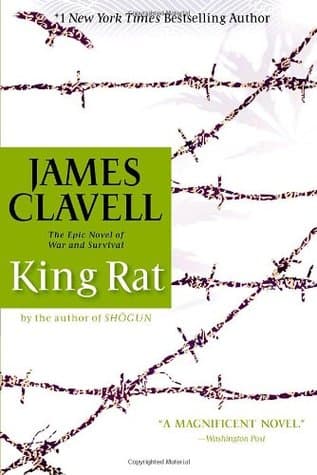
In a Japanese WWII POW camp, an American corporal manipulates despair to build a black market empire, dominating all within his reach.
Peter Marlowe, a young British flying officer, arrives at Changi Prison Camp, Singapore, after being captured by the Japanese. He quickly sees the harsh conditions: starvation, disease, and the constant threat from Japanese guards. Food is scarce, hygiene is absent, and morale is low. Marlowe, an idealist, tries to keep his dignity and follow rules, but he soon sees the desperate actions men take to survive. He notices the clear social order in the camp, where rank offers little protection from hardships, and unofficial economies start, run by the most resourceful prisoners.
Marlowe soon learns about Corporal King, an American prisoner from Brooklyn, who stands out because of his good health and access to goods. King runs a complex black market, trading with guards and local Malays for food, medicine, and other luxuries. Some call him 'King Rat,' a figure of both anger and respect. Marlowe is at first disgusted by King's apparent lack of morals and his willingness to use other prisoners' desperation, but he cannot deny King's success in the camp's harsh environment. King's ability to get items like fresh eggs and even liquor makes him a powerful, almost untouchable figure.
King's business sense is clear when he gets a skinny dog from a Japanese guard. He carefully fattens it using valuable camp rations and secret deals, which many officers find disgusting because they see it as a waste. His plan is to sell the dog for its meat, a valuable item in the starving camp. Marlowe watches this with both interest and horror. King eventually sells the dog to Australian prisoners for a lot of money, showing his sharp understanding of supply and demand, and his ability to profit from anything, even life.
As conditions in Changi worsen, Marlowe, like many others, gets malaria and malnutrition. Weak and confused, he faces death. At this time, King approaches him, offering real help—better food, quinine, and even a mosquito net—in exchange for Marlowe's language skills and his 'officer' status for certain deals. Marlowe, realizing his ideals alone cannot save him, reluctantly agrees. This changes their relationship, as Marlowe starts to see King not just as a profiteer, but as a complex survivor whose methods, while questionable, work.
Marlowe, recovering under King's care, becomes an unofficial part of King's group. He helps King with English letters to Malay contacts and acts as a respectable front for some of King's bolder plans. Through this, Marlowe better understands King's reasons and the complex network he has built. He sees King's calculated risks, his charm, and his efficient ruthlessness. Their partnership, born of need, starts to become a strange friendship, with Marlowe dealing with the moral compromises he makes while recognizing King's clear ability to provide. He sees the complicated nature of survival.
Colonel Smedley-Taylor, a British officer focused on keeping military discipline, becomes worried about King's influence and the widespread black market. He sees King's operations as harming morale and traditional authority. Smedley-Taylor tries to stop the illegal trading, seeing King as a direct challenge to his command. This creates tension between the 'official' hierarchy and King's 'unofficial' power. Smedley-Taylor's efforts mostly fail, as King's network is too deep and too important for many prisoners' survival, showing how traditional rules fail in extreme situations.
King, always seeking bigger gains, plans a bold operation to divert a large amount of rice from Japanese supplies meant for the camp. He involves several trusted contacts, including some Japanese guards he has befriended. The plan is risky and complex, needing exact timing and coordination. However, one of King's partners, driven by greed or fear, betrays part of the operation. While King manages to save some of the rice, the betrayal makes him more cautious and shows the constant danger of working in such a high-risk environment where trust is fragile. The incident also shows the limits of King's control.
Rumors of the war's end begin to spread, at first met with doubt but soon confirmed by Allied planes dropping supplies. The camp explodes in joy and chaos. For most prisoners, freedom means returning to normal life. However, for King, the war's end means the end of his rule. His power and influence depended entirely on the unique conditions of the POW camp. With the return of regular authority and the end of the black market, King's network falls apart. He is no longer 'King Rat' but just an American corporal, without his context and power.
Immediately after liberation, Marlowe finds King, who is now just another prisoner waiting to go home. King is quiet, his usual confidence gone. He understands that his unique skills, so valuable in Changi, are useless outside. They have a final, thoughtful conversation where King admits the random nature of his power and the moral compromises he made. Marlowe, having seen King's change and his own, feels a complex mix of respect and pity. Their parting is bittersweet, marking the end of an unusual time and the realization that the man who was 'King' in Changi will likely be an ordinary man outside.
As Allied forces bring order to the freed camp, investigations begin into the illegal activities during captivity. King, despite helping many prisoners survive, is arrested and faces charges related to his black market operations and his dealings with the Japanese. The very system he used to survive now calls him a criminal. Meanwhile, officers like Colonel Smedley-Taylor, who struggled to keep authority during internment, regain their pre-war status and help restore military discipline. This clear reversal shows the random nature of justice and the return to usual morality.
The Protagonist/Anti-hero
King rises from an ordinary corporal to the most powerful figure in Changi, only to be stripped of his power and arrested upon liberation, returning to an ordinary, marginalized status.
The Protagonist/Observer
Marlowe transforms from an idealistic officer into a more cynical but pragmatic survivor, having witnessed and participated in the moral compromises of the camp, ultimately losing some innocence.
The Antagonist/Supporting
Smedley-Taylor's authority is constantly undermined by King's influence throughout the internment, only to be partially restored upon liberation when conventional rules return.
The Supporting
Grey transitions from a cynical observer to an active participant in King's operations, adapting his moral code to the camp's realities.
The Antagonists/Supporting
Their role remains constant as the external threat, their power diminishing only with the war's end.
The Supporting
McCabe steadily deteriorates throughout the narrative, illustrating the physical and moral toll of the camp on those unable to adapt.
The Mentioned/Supporting
Their role remains as the external trading partners, facilitating King's black market.
The novel shows how far people will go to survive in extreme conditions. Changi removes social rules, revealing a basic drive for self-preservation. King represents this, using his cleverness to get food, medicine, and comfort, even at others' expense. Scenes like King fattening and selling the dog, or Marlowe accepting King's illegal help, show the moral compromises made when facing starvation and disease. The story questions if morality can exist in such a brutal place, suggesting that survival often means letting go of usual ethics.
“In Changi, the only rule was to survive. Everything else was commentary.”
The book explores how power changes and appears in a lawless environment. Traditional military rank and authority, shown by Colonel Smedley-Taylor, become largely unimportant in Changi. Instead, power goes to those who can provide for others, like King, whose control over the black market gives him great influence. His power is unofficial, earned through resourcefulness and exploitation, not given by rank. The conflict between Smedley-Taylor's attempts to create order and King's actual rule shows how fragile traditional authority is when basic needs are not met. This theme shows how need redefines leadership.
“King ruled by supply and demand, not by rank.”
King Rat looks at the complex parts of morality, making characters and readers question what is 'right' when survival is at risk. King is an anti-hero whose actions, while often selfish, also save lives and offer hope. Marlowe's internal struggle, as he slowly joins King's plans, shows this theme. The novel suggests that extreme situations blur the lines between good and bad, and that 'bad' actions can come from a strong will to live. The book challenges simple moral judgments, showing characters as complex results of their environment.
“He was a rat, a king rat, and in this stinking cage, a rat was king.”
Despite the shared suffering of the POWs, class differences and social structures remain, and are even reversed, in Changi. British officers, used to privilege, find their status reduced and their traditional values challenged. American enlisted men, like King, who are more used to a system based on merit or business, become important. The novel shows the tension between the 'gentlemen' officers and the 'common' men, especially the anger directed at King by those who feel their social standing is threatened. This theme explores how crisis can show the superficiality of inherited status.
“Rank meant nothing when you were starving. Only food mattered.”
The unofficial economy that sustains life and power in Changi.
The black market is the central plot device, driving much of the narrative and King's actions. It is the lifeblood of Changi, providing essential goods like food, medicine, and even small luxuries that the Japanese captors deny the prisoners. It allows King to establish his power, manipulate both prisoners and guards, and ultimately survive. The black market serves as a microcosm of capitalism in its most raw form, where resourcefulness, risk-taking, and exploitation dictate success. Its existence highlights the failure of official systems and the ingenuity of individuals under duress.
A symbol of King's cunning and the camp's moral degradation.
The dog is a potent symbol in the novel. Initially a scrawny, unwanted creature, King's decision to acquire, fatten, and then sell it for meat is a masterstroke of his entrepreneurial spirit. It symbolizes King's ability to turn anything into profit and highlights the extreme hunger and moral compromises of the camp. The dog's transformation from pet to commodity underscores the dehumanizing conditions of Changi, where even animal life is valued solely for its caloric content, reflecting the prisoners' own struggle for survival.
A thematic juxtaposition of pragmatism versus traditional order.
The stark contrast between Corporal King and Colonel Smedley-Taylor serves as a crucial plot device to explore the novel's central themes. King embodies raw, amoral pragmatism and effective leadership in extreme circumstances, while Smedley-Taylor represents rigid adherence to traditional military hierarchy and outdated ideals. Their ongoing conflict, though often indirect, highlights the breakdown of conventional authority and the emergence of a new power structure based on survival skills. This duality allows Clavell to critically examine different approaches to leadership and morality when faced with absolute desperation.
The narrative lens through which the reader experiences Changi and King.
Peter Marlowe serves as the primary point-of-view character, allowing the reader to experience the horrors of Changi and the complexities of King's character through a relatively innocent and morally conflicted lens. His initial idealism and subsequent disillusionment provide a relatable emotional arc. Marlowe's observations and internal monologues guide the reader through the moral ambiguities of the camp, making King's actions more comprehensible, if not always palatable. This device allows for a gradual unveiling of the camp's brutal realities and King's unique genius, fostering a deeper understanding of the survival theme.
“There’s no justice in the jungle—there’s only expediency.”
— Peter Marlowe reflecting on the harsh realities of the Changi prison camp.
“Money's not important. What's important is what money can buy.”
— King, explaining his philosophy of power and acquisition to Marlowe.
“Hope is a good breakfast but a poor supper.”
— An observation about the fleeting nature of hope in the prison camp.
“The only thing that matters is not to die. Everything else is secondary.”
— Marlowe's stark realization about the primal instinct for survival.
“The greater the risk, the greater the profit.”
— King's mantra for his illicit trading operations.
“You can always tell a man by the way he treats those who can do nothing for him.”
— A reflection on true character, particularly in a hierarchical prison environment.
“Fear is a powerful weapon, and it's always in your own mind.”
— A thought on the psychological battles faced by the prisoners.
“In a world without rules, the only rule is to survive.”
— Describing the lawless nature of Changi prison.
“The worst part of being a prisoner is not the lack of freedom, but the loss of dignity.”
— A poignant observation on the psychological toll of incarceration.
“Every man has his price, you just have to find it.”
— King's cynical view of human motivation and corruption.
“Food is power. And power is life.”
— The fundamental principle behind King's control of resources in the camp.
“When you have nothing, you have nothing to lose.”
— A thought on the desperation and fearlessness of those at rock bottom.
“The jungle doesn't care who you are, only what you can do.”
— Highlighting the meritocratic and brutal reality of the prison camp.
“The war isn't over when the fighting stops, it's over when the memories stop.”
— A poignant reflection on the lasting psychological impact of war and imprisonment.
Ready to see how well you understood this book? Take our interactive quiz with 10 questions.
Biography coming soon.







