“It was beauty killed the beast.”
— Carl Denham's final line after Kong's fall from the Empire State Building.

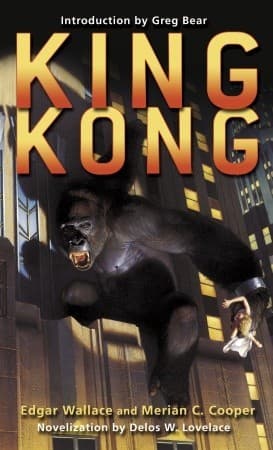
Delos W. Lovelace (1977)
Genre
Fantasy / Mystery / Science Fiction
Reading Time
180 min
Key Themes
See below
Sign in to track this book
A huge ape, taken from his island home, develops a tragic affection for an actress in New York City, becoming both a spectacle and a victim of human exploitation.
Carl Denham, a filmmaker, needs a lead actress for his secret project. He finds Ann Darrow, an actress down on her luck, in New York. Ann is hesitant but joins Denham for adventure and a chance at fame. With his crew, including first mate Jack Driscoll, Denham sails on the Venture, a tramp steamer, to an uncharted island. The crew does not know their true destination or the dangers ahead, thinking it is just another film shoot.
After weeks at sea, the Venture arrives at a fog-covered island not on any modern map. As they get closer, they hear drumming and chanting from a native tribe. They see a large, old stone wall built by humans, stretching across a valley and protecting an unknown interior. During their scouting, the crew sees a native ritual where a young woman is prepared as a sacrifice. Denham, interested, decides to film the natives, but they discover his presence, leading to a tense encounter. The natives see Ann Darrow and are taken by her beauty, which they connect to their 'golden woman' prophecy.
That night, after the first meeting, the natives board the Venture and take Ann Darrow from her cabin. They carry her to their village, through the wall's gate, and prepare her for a sacrifice. Ann is tied to two pillars on an altar outside the wall. The gate opens, showing Kong, a huge gorilla of immense size and power, emerging from the jungle. The natives run in fear as Kong approaches Ann, picks her up, and carries her into the dense jungle. The Venture crew, led by Denham and a frantic Jack Driscoll, realizes what happened and starts a rescue mission.
Jack Driscoll, driven by his love for Ann, leads the chase through the dangerous jungle, with Denham and the remaining crew. The island is a lost world, full of prehistoric creatures like Stegosauruses, Apatosauruses, and a Tyrannosaurus Rex. Kong carries Ann through his territory, at first treating her as a curiosity. He places her on a high ledge and begins to fight off dinosaurs that threaten her. Ann, despite her fear, starts to notice a strange protectiveness in the beast. She watches Kong battle and defeat a T-Rex and other predators to keep her safe, a horrifying yet captivating sight.
The rescue party, having barely escaped several dinosaur attacks, crosses a log bridge over a deep chasm. Kong, sensing their chase and becoming possessive of Ann, confronts them on the bridge. In anger, he shakes the log, causing most of the crew to fall into the abyss, where giant spiders and other insects devour them. Only Denham, Jack Driscoll, and a few others manage to hold on or retreat. Jack hides in a cave below the log, watching Kong try to reach him, before making his way further into Kong's lair, determined to save Ann.
Jack Driscoll, after a difficult journey, reaches Kong's mountain lair. He finds Ann, who is less scared and more resigned to Kong's presence, though still wanting to escape. While Kong is busy fighting a Pterodactyl that tried to grab Ann, Jack takes his chance. He grabs Ann, and they run back toward the great wall. Denham, having gathered the remaining crew, plans to capture Kong. They prepare gas bombs to subdue the ape. As Kong chases Jack and Ann back to the wall, he is lured into a trap. The crew uses gas, eventually knocking the giant beast unconscious.
With Kong subdued, Denham sees an even bigger opportunity than filmmaking. He decides to take the ape back to New York City, believing he can make a fortune by showing the creature as "Kong, the Eighth Wonder of the World." Moving Kong from Skull Island to the Venture, and then across the ocean, is a huge and difficult task. When they arrive in New York, Kong is chained and put on display in a Broadway theater. The event draws huge crowds eager to see the captured monster. Ann Darrow and Jack Driscoll, now in love, are there, but feel uneasy about Kong's fate.
During the opening night of Kong's exhibition, the camera flashes and crowd noise agitate the ape. He mistakes a photographer's flash for an attack and, in a fit of rage and fear, breaks free from his chains. Kong smashes through the theater walls and escapes into the streets of New York City. His first thought is to find Ann. He rampages through the city, causing panic and destruction, overturning cars, tearing down elevated train tracks, and grabbing people from windows, all while looking for the 'golden woman' who had captivated him on the island. The city is in chaos as authorities try to stop the beast.
Kong finds Ann in her hotel room, gently takes her, and climbs the Empire State Building, the tallest structure in New York. He seeks refuge at its top, thinking it a safe place, a high perch like his mountain home on Skull Island. The military, using biplanes, launches an aerial attack on the building. Kong, with Ann in his hand, defends himself against the planes, swatting them from the sky. Ann is scared but also sees a tragic bravery in his last stand, as he tries to protect her even as he dies.
Despite Kong's strength, the machine-gun fire from the biplanes is too much. Wounded and weak, Kong lets out one last roar before dying. He gently places Ann on the observation deck before losing his grip and falling from the top of the Empire State Building. His body drops hundreds of feet, crashing onto the streets below. A crowd gathers around the fallen giant. Carl Denham, watching the tragic scene, says his famous line: "Oh, no, it wasn't the airplanes. It was Beauty killed the Beast." Ann Darrow and Jack Driscoll are reunited, safe but changed forever by their encounter with King Kong.
The Antagonist/Supporting
Denham begins as a fearless explorer and ends as a profiteer whose actions lead to tragedy, yet he remains unrepentant, only lamenting the loss of his 'attraction'.
The Protagonist
Ann transforms from a helpless victim into a woman who understands and pities Kong, while finding love and a new future with Jack.
The Protagonist
Jack evolves from a cynical sailor to a heroic lover, willing to face any danger for Ann.
The Antagonist/Tragic Figure
Kong is introduced as a terrifying god-beast, becomes an obsessed protector, and ultimately a tragic victim of human exploitation.
The Supporting
Englehorn maintains his cautious demeanor throughout, serving as a grounded presence amidst the escalating madness.
The Supporting
Charley remains a steadfast, if sometimes fearful, member of the crew.
The Supporting
Lumpy serves as a background character, witnessing the events with a quiet, superstitious understanding.
The Supporting
The Chief remains a stoic and traditional leader, upholding the customs of his tribe.
The main conflict is humanity's attempt to conquer, control, and use nature's raw power, shown by King Kong. Carl Denham's search for the 'Eighth Wonder of the World' and his capture of Kong in New York show this theme. The tragic end shows how useless and destructive it is to try to force nature into submission. Kong's rampage through the city is nature's violent response to being violated, a fight it loses but with terrible results for the human world.
“''We'll make a show out of him, a giant spectacle! The whole world will pay to see the Eighth Wonder!'”
This classic idea is central to the story, with Ann Darrow as 'Beauty' and King Kong as the 'Beast.' Kong's monstrous look hides a deep, protective affection for Ann, like the traditional tale. Ann's initial fear slowly changes into a mix of fear, pity, and even a strange understanding of Kong's lonely life. The story explores the idea that true affection can go beyond looks and species, and that sometimes the 'beast' can have more humanity than the 'civilized' man, leading to the tragic idea that 'Beauty killed the Beast.'
“'Oh, no, it wasn't the airplanes. It was Beauty killed the Beast.'”
The story criticizes the use of unknown lands and their people. Carl Denham's trip to Skull Island is driven by a colonial mindset, seeing the island and its creatures as resources to be taken for money and show. The natives are seen as primitive, and Kong is reduced from a god to a captive attraction. This theme shows the arrogance of Western civilization encountering the 'other,' demonstrating how a desire for wealth and fame can destroy unique cultures and natural wonders.
“'He's always been king of his world. But we'll teach him a new one.'”
Carl Denham's character shows the destructive nature of ambition and greed. His focus on capturing Kong for exhibition, without caring for the creature's well-being or the potential danger, starts the whole tragedy. His desire for fame and money blinds him to the moral parts of his actions. The chaos and destruction Kong causes in New York are a direct result of Denham's overconfidence, a warning about prioritizing personal gain over ethics and respect for life.
“'We're going to make a picture, but it's going to be something more than a picture. It's going to be a document!'”
Skull Island is a 'lost world,' a place where prehistoric creatures and old ways of life continue, untouched by modern civilization. This setting allows for a look at primal instincts—both animal and human. Kong's actions are driven by basic urges: protecting his territory, and a deep, possessive affection. The human characters, especially Jack, also use primal survival instincts when facing the island's dangers. The theme contrasts the raw, wild nature of the island with the artificiality and order of New York City, showing the lasting power of the wild.
“'Some place where no white man has ever set foot.'”
A mysterious map guiding the expedition to Skull Island.
The uncharted map is the initial catalyst for the entire plot. It represents the lure of the unknown and Carl Denham's adventurous spirit. Its existence fuels the mystery surrounding Skull Island, drawing the Venture crew into an encounter with a lost world. The map acts as a MacGuffin, driving the plot forward by leading the characters to the source of their adventure and danger, setting the stage for the discovery of Kong and the subsequent conflict between man and nature.
An ancient stone barrier separating the native village from Kong's jungle.
The Great Wall on Skull Island is a powerful symbol of separation and protection. Built by the natives, it signifies their attempt to coexist with, yet protect themselves from, the formidable power of Kong and the other prehistoric creatures within the jungle. It serves as a physical barrier that is both breached by the natives for sacrifice and by Kong during his pursuit of Ann, highlighting the futility of human-made boundaries against overwhelming natural forces. It also creates a sense of foreboding, hinting at the immense danger lurking beyond its confines.
Ann's perceived divinity by the natives and her role as a sacrificial offering.
Ann Darrow's 'golden woman' status is a plot device that immediately places her in peril. Her blonde hair and fair skin make her stand out to the Skull Island natives, who associate her with a prophecy or a specific type of sacrifice for Kong. This belief system directly leads to her abduction and offering to Kong, making her the central figure in the beast's developing affection. It establishes her unique connection to Kong and sets the stage for the 'Beauty and the Beast' dynamic, making her the prize in the conflict between Kong and Jack.
The iconic New York landmark chosen for Kong's final stand.
The Empire State Building serves as a powerful symbol and a crucial setting for Kong's tragic climax. As the tallest man-made structure of its time, it represents the pinnacle of human achievement and civilization. Kong's ascent of the building is an act of defiance and a desperate attempt to reclaim a high perch reminiscent of his natural habitat, directly contrasting nature with human ingenuity. His fall from its summit visually represents the triumph of civilization over the wild, but also the tragic consequences of that victory, making the landmark an indelible part of Kong's legend.
Skull Island's interior, teeming with dinosaurs and ancient life.
The prehistoric jungle of Skull Island functions as a 'lost world' setting, a plot device that introduces an element of fantasy and extreme danger. It immediately establishes the extraordinary nature of the island and the challenges faced by the human characters. The various dinosaurs and monstrous creatures encountered by the rescue party elevate the stakes and showcase Kong's immense power and protective instincts as he battles them for Ann's safety. This environment is crucial for establishing Kong as a king in his own domain before his removal to the human world.
“It was beauty killed the beast.”
— Carl Denham's final line after Kong's fall from the Empire State Building.
“He was a king and a god in the world he knew, but now he comes to civilization merely a captive—a show to gratify your curiosity.”
— Denham describing Kong's fate after capture on Skull Island.
“The whole world will pay to see this.”
— Denham's ambitious plan to exhibit Kong in New York.
“It wasn't the airplanes. It was beauty killed the beast.”
— Denham's reflection on Kong's death, emphasizing Ann's role.
“He's always been king of his world, but we'll teach him fear.”
— A crew member's remark about taming Kong on the voyage.
“On this island, the impossible is possible.”
— Describing the mysterious and prehistoric nature of Skull Island.
“She was afraid, but she pitied him too.”
— Ann Darrow's mixed feelings toward Kong after initial capture.
“We're not hunters. We're explorers in a land that time forgot.”
— Denham justifying the expedition to Skull Island.
“The beast's roar was not of anger, but of loneliness.”
— Observing Kong's behavior on Skull Island.
“In his eyes, she saw something more than a monster.”
— Ann perceiving Kong's gentle side during their interactions.
“This is a nightmare from which we may never awaken.”
— A crew member's fear upon encountering Skull Island's dangers.
“He fought not for food or territory, but for her.”
— Describing Kong's battles to protect Ann on the island.
“The city's lights were a poor substitute for the stars of his home.”
— Reflecting on Kong's captivity in New York.
“We brought the jungle to the city, and the city could not contain it.”
— Commentary on the chaos unleashed by Kong in New York.
Ready to see how well you understood this book? Take our interactive quiz with 10 questions.

Delos W. Lovelace was an American author primarily known for his 1932 novelization of the classic film 'King Kong'. Though his literary output was limited, his work on 'King Kong' has cemented his place in popular culture. Lovelace also contributed to other genres during his writing career.







