“In the end, it is not the sword that makes the king, but the king who makes the sword.”
— Merlin speaking to Arthur about Excalibur and leadership.

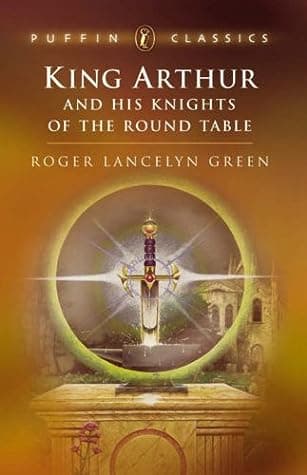
Roger Lancelyn Green (1953)
Genre
Fantasy / Children's / Historical Fiction
Reading Time
350 min
Key Themes
See below
Sign in to track this book
Young readers can explore the valiant quests of King Arthur and his knights, from the sword in the stone to the Holy Grail, retold with charm.
The story begins after King Uther Pendragon's death, leaving Britain without a clear king. Merlin, the enchanter, arranges for Uther's infant son, Arthur, to be secretly raised by Sir Ector, unaware of his royal birth. Years later, at a tournament in London, young Arthur, acting as squire to his foster-brother Sir Kay, pulls a sword from an anvil on a stone. No other knight could do this. This event, repeated several times, shows him to be the rightful king of Britain, as Merlin predicted. Despite initial resistance from many lords, Arthur is crowned, starting his reign and bringing order to the land.
After securing his throne, King Arthur sets up his court at Camelot. Merlin advises him to find a magical sword, as his first sword, though proving his kingship, is not for battle. Guided by Merlin, Arthur goes to a mysterious lake and receives the sword Excalibur from the Lady of the Lake. This sword has great power, and its scabbard protects its wearer from harm. Arthur then gathers the noblest knights from Britain to form the Round Table, a symbol of equality and unity, where all knights, including the King, sit as equals. This marks the beginning of chivalry and many quests and adventures in Arthur's name.
Sir Lancelot du Lac comes to Camelot, a knight of great strength, skill, and courtesy, quickly becoming King Arthur's most trusted friend and the first knight of the Round Table. His early adventures build his reputation. He saves Queen Guinevere from Sir Maleagant, defeats many giants and evil knights, and frees imprisoned ladies. Lancelot's loyalty to Arthur and his skill in battle are famous, but he secretly loves Queen Guinevere. This forbidden love, though a source of inner conflict for Lancelot, starts to slowly weaken Camelot's unity, hinting at future tragedies.
King Arthur's half-sister, Morgan le Fay, a sorceress and student of Merlin, hates Arthur and wants to see him removed from power. She repeatedly tries to steal Excalibur, bewitch Arthur, or use other knights in her plans. Once, she sends a poisoned cloak to Arthur, which Nimue, another Lady of the Lake, stops. Her dark magic and manipulation threaten Camelot, making Arthur and his knights stay alert against enemies inside and out. Her actions show the constant danger of betrayal and the corrupting effect of power.
At a New Year's feast, a Green Knight, entirely green and carrying a large axe, rides into Camelot and challenges any knight to strike him, on the condition that he can return the blow in a year and a day. Sir Gawain, Arthur's nephew, accepts the challenge and cuts off the Green Knight's head. The knight then calmly picks up his head and reminds Gawain of their agreement. Gawain later goes on his quest to find the Green Chapel. Along the way, Lord Bertilak and his lady test him. He resists temptation and keeps his honor, though he slightly fails by hiding a magical green sash. This quest looks at honor, truth, and human error.
The Holy Grail, the cup from which Christ drank at the Last Supper, appears at Camelot during a Pentecost feast, surrounded by divine light and a sweet smell. This vision inspires many knights of the Round Table, including Arthur, to swear an oath to find the Grail and see it fully. However, Merlin warns Arthur that this quest will break up the Round Table, as only the purest knights will succeed. Many knights, including Lancelot, Gawain, and Percival, undertake the quest, but their worldly sins and flaws stop most from achieving it. The quest tests their spiritual purity and devotion to God.
Sir Galahad, Lancelot's son, a knight of great purity and faith, is meant to achieve the Holy Grail. He arrives at Camelot and sits in the Siege Perilous, a seat at the Round Table for the knight who will achieve the Grail, which is deadly to any other. Galahad, with Sir Percival and Sir Bors, goes through trials and spiritual tests, showing his strong faith and devotion. He eventually reaches the castle where the Grail is kept and sees its mysteries. Having completed his purpose, Galahad goes to heaven, leaving the earthly realm. This means the end of the spiritual quest and the start of the Round Table's decline.
Despite their attempts to hide it, the love affair between Sir Lancelot and Queen Guinevere is exposed. Sir Agravaine, Gawain's brother, driven by malice, confronts Arthur with proof of their infidelity. Arthur, saddened and bound by law, must condemn Guinevere to be burned at the stake. Lancelot, trying to save her, kills several loyal knights, including Sir Gareth and Sir Gaheris, Gawain's brothers. This act starts a civil war, as Gawain, filled with grief and revenge, pushes Arthur to pursue Lancelot. This shatters the Round Table's unity and marks the beginning of its end.
King Arthur, urged by the vengeful Sir Gawain, leads his army to France to fight Sir Lancelot, who has fortified himself in his castle. The war is a sad conflict, pitting former friends against each other. During a siege, Lancelot mortally wounds Gawain. Meanwhile, in Britain, Arthur's son, Sir Mordred, uses Arthur's absence. He takes the throne, claiming Arthur is dead, and tries to force Queen Guinevere to marry him. News of Mordred's treachery forces Arthur to return to Britain, leaving Lancelot to mourn the destruction of their fellowship.
King Arthur returns to Britain and confronts Sir Mordred in a final battle on the plains of Camlann. Both armies suffer heavy losses, and almost all the remaining knights of the Round Table die. In the middle of the fighting, Arthur confronts Mordred and kills him with a final blow. However, Mordred also wounds Arthur. With his kingdom in ruins and his dream of Camelot shattered, Arthur tells Sir Bedivere to throw Excalibur back into the lake. The Lady of the Lake receives the sword, and three queens take Arthur away on a mysterious barge to Avalon, leaving Britain without its legendary king and ending the age of chivalry.
The Protagonist
From an unknown youth proving his kingship, Arthur rises to establish a glorious kingdom, only to witness its tragic destruction due to internal strife and betrayal.
The Supporting
Merlin guides Arthur from infancy to kingship, serving as his primary magical and strategic advisor, before eventually departing the earthly realm or being entrapped.
The Supporting
Lancelot rises as the epitome of chivalry, then falls from grace due to his forbidden love, ultimately contributing to the destruction of Arthur's kingdom.
The Supporting
Guinevere begins as the revered queen of Camelot, but her affair leads to her downfall and the kingdom's destruction, ending in a life of repentance.
The Supporting
Gawain evolves from a paragon of chivalry to a figure consumed by vengeance, ultimately driving the kingdom towards its civil war and his own death.
The Supporting
Galahad arrives as a divinely chosen knight, fulfills his destiny by achieving the Holy Grail, and then transcends the earthly realm.
The Antagonist
Mordred grows from a resentful figure to the ultimate betrayer, successfully destroying Arthur's kingdom through his ambition and treachery, leading to his own death.
The Antagonist
Morgan le Fay consistently acts as an antagonist, using her magic and cunning to destabilize Arthur's rule, a force of malevolence throughout the narrative.
The Supporting
The Lady of the Lake acts as a magical benefactor and guardian for Arthur in his early reign, and as the receiver of Excalibur in his final moments, bookending his story with her mystical presence.
Chivalry, with its focus on courage, loyalty, courtesy, and justice, is a main idea in the story. The knights of the Round Table try to live by these ideals through their quests, defending the weak, correcting wrongs, and keeping their vows. Sir Lancelot, despite his later mistakes, is at first the best example of chivalry. The story often tests these ideals, especially during the Grail Quest, where spiritual purity is more valued than fighting skill, and in the tragic downfall, where personal revenge (Gawain's) and betrayal (Mordred's) eventually break the chivalric code, leading to the kingdom's collapse.
“For in those days a knight was accounted of no worth unless he had done some great deed of arms.”
Betrayal is a common theme, directly causing Camelot's downfall. The biggest betrayal is the affair between Sir Lancelot and Queen Guinevere, which breaks Arthur's trust and the Round Table's unity. Sir Mordred's taking of the throne, a direct act of treachery against his father and king, adds to this. Morgan le Fay's constant plans to overthrow Arthur also show this theme. Each act of betrayal, whether personal or political, weakens Arthur's ideal kingdom, showing how internal flaws and moral failings can destroy even the strongest societies.
“Alas, that ever love was false, or that a king should be betrayed by those he trusted most!”
The story carefully shows the creation of King Arthur's kingdom, Camelot, as an ideal place based on justice, equality (the Round Table), and chivalry. Arthur's early reign is unified and prosperous. However, the story also tells of its decline and destruction. This fall comes from several things: the moral failings of its greatest knights (Lancelot's affair), the search for spiritual perfection (the Grail Quest causing division), and the direct treachery of Mordred and Morgan le Fay. The cycle of creation and destruction shows how fragile even the most noble human efforts are.
“Here now lies King Arthur, who was once king, and king will be again.”
The influence of fate and prophecy, especially Merlin's predictions, is a strong part of the story. Arthur's birth and rise to power are preordained. Merlin foresees the doom of the Round Table and the divisive nature of the Grail Quest, yet the characters often make choices that fit with or speed up these fated events. Lancelot and Guinevere's affair, Gawain's vengeful pursuit, and Mordred's treachery are acts of free will that, though perhaps fated, are driven by personal desires and flaws. This tension explores whether characters are just pawns of destiny or cause their own destruction.
“Thus was it ordained from the beginning, and no man may strive against destiny.”
Magic and the supernatural are part of King Arthur's world. Merlin's enchantments help Arthur rise and protect him. The Lady of the Lake provides Excalibur, a magical sword. Morgan le Fay uses dark magic for her plots. The Holy Grail itself is a supernatural object, and its appearance shifts the focus to spiritual quests. These magical elements add wonder and adventure to the tales. They also shape the destinies of characters and the kingdom, often beyond human control, showing the mystical nature of Arthur's legend.
“Then saw King Arthur stand by the lake’s side a hand clothed in white samite, that held a fair sword in that hand.”
Symbols of Arthur's rightful kingship and divine authority.
The Sword in the Stone (or anvil) serves as the initial divine proof of Arthur's royal lineage and destiny, a clear sign that he is the chosen king. Excalibur, later given by the Lady of the Lake, is not only a powerful weapon but also a symbol of Arthur's legitimate authority and the magical protection afforded to his reign. Its scabbard, which prevents injury, represents the invincibility of Camelot in its prime. The return of Excalibur to the lake at the end of the story symbolizes the end of Arthur's magical protection and the passing of his age.
A symbol of equality, unity, and the chivalric ideal.
The Round Table is a physical and symbolic representation of King Arthur's vision for his kingdom: a place where all knights, including the king, are equal in status and purpose. It fosters camaraderie, justice, and the pursuit of noble quests. Its circular shape signifies that no knight is superior to another. The gradual fracturing of the Round Table, first by internal strife (Lancelot's affair) and then by the spiritual quest for the Grail, directly mirrors the decline of Arthur's kingdom, making it a potent symbol of Camelot's rise and fall.
A divine artifact that tests spiritual purity and leads to division.
The Holy Grail is a mystical, divine artifact that appears in Camelot, inspiring a spiritual quest among the knights. It serves as a test of moral and spiritual purity, highlighting the contrast between earthly chivalry and divine grace. While it offers ultimate spiritual enlightenment, its pursuit ultimately divides the Round Table, as many knights are too worldly or sinful to achieve it. Its achievement by Sir Galahad marks a spiritual climax but also signals the end of the secular chivalric age, leading to the dissolution of the Round Table and a shift in the kingdom's focus from earthly to heavenly pursuits.
Merlin's predictions and narrative hints of future events.
Merlin, as a seer, frequently delivers prophecies that foreshadow key events, such as Arthur's kingship, the coming of the Grail, and the eventual downfall of Camelot. These prophecies create a sense of predetermined destiny and inevitability, adding a layer of tragic grandeur to the narrative. The narrative also uses foreshadowing through subtle hints, such as the initial unease surrounding Lancelot and Guinevere's relationship or the constant threats from Morgan le Fay, to build tension and prepare the reader for the unfolding tragedies. This device emphasizes the idea that certain events are inescapable.
“In the end, it is not the sword that makes the king, but the king who makes the sword.”
— Merlin speaking to Arthur about Excalibur and leadership.
“The Round Table was made that all should be equal, for there is no head nor foot, but each is as high as his fellow.”
— Description of the Round Table's purpose in Camelot.
“For in the world there is nothing so wonderful as a true and faithful love.”
— Narrator reflecting on the love between Lancelot and Guinevere.
“Adventure is the food of the soul for a knight of the Round Table.”
— Sir Gawain speaking about the knights' quests.
“The greatest magic is not in spells or enchantments, but in the courage to do what is right.”
— Merlin advising Arthur on ruling justly.
“A knight's word is his bond; without it, he is but a hollow shell.”
— Sir Lancelot emphasizing honor to a young squire.
“In every man there is both light and shadow; the test is which he chooses to follow.”
— Arthur contemplating the fall of Mordred and other foes.
“The quest for the Holy Grail is not to find a cup, but to find purity in one's own heart.”
— Galahad explaining the Grail quest to other knights.
“Camelot was not built of stone alone, but of dreams and the will to make them real.”
— Narrator describing the founding of Camelot.
“Even in defeat, there is honor if one has fought with all one's might.”
— Arthur comforting a knight after a lost battle.
“The sword in the stone was a test not of strength, but of worthiness.”
— Merlin explaining the significance of Arthur pulling the sword.
“True friendship is a shield stronger than any armor.”
— Sir Bedivere speaking of his loyalty to Arthur.
“Magic may shape the world, but it is men who must live in it.”
— Merlin warning about the limits of magical intervention.
“The legend of Arthur will live as long as there are those who believe in justice and courage.”
— Narrator's closing reflection on Arthur's legacy.
Ready to see how well you understood this book? Take our interactive quiz with 10 questions.

Biography coming soon.







