Biography coming soon.

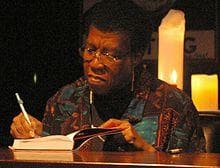
Octavia E. Butler (1979)
Genre
Fantasy / Young Adult / Romance
Reading Time
12 Minutes
Key Themes
See below
Sign in to track this book
In 1976 California, Dana, an African American woman, is celebrating her 26th birthday with her white husband, Kevin. As they unpack books, Dana suddenly feels dizzy and finds herself transported to a pre-Civil War Maryland plantation. She sees a young white boy, Rufus, drowning in a river and pulls him out. His mother, Margaret Weylin, and father, Tom Weylin, appear. Tom, angry at Dana's presence and her touching his son, threatens her with a shotgun. Just as he is about to shoot, Dana is pulled back to her living room, disoriented and injured. Kevin sees her sudden reappearance, confirming the impossible event.
A few days after her first jump, Dana is pulled back to the past when Rufus, now older, sets his curtains on fire. This time, Kevin holds onto her when the jump occurs, and they both arrive in the past. They put out the fire and save Rufus, who recognizes Dana. Tom Weylin is suspicious of Kevin's origins and education. Dana and Kevin invent a story about being from New York, having lost their papers, and being distant relatives of Rufus's father. They are forced to stay on the Weylin plantation, experiencing the brutal realities of slavery firsthand, with Kevin posing as Dana's owner.
Dana experiences another jump, this time alone, and finds Rufus as a young man with a broken leg after falling from a tree. She tends to his injury, solidifying her role as a caretaker in his life. During this extended stay, Dana is forced into the role of a house servant and tutor to Rufus and his cousin, Hagar. She witnesses the daily cruelties inflicted upon the enslaved people, including whippings and forced separations. She struggles to maintain her modern sensibilities while navigating the dangerous social hierarchy. Her relationship with Rufus, though complicated by his ownership, deepens as she becomes essential to his survival.
After another involuntary return to the present, Dana finds herself back in the past, discovering that Kevin has been stranded there for five years. Rufus, now an adult, has become increasingly cruel and possessive, mirroring his father's behavior. Kevin, hardened by his time in the past, has adapted to the era, even owning enslaved people to protect himself. Dana struggles with Rufus's attempts to force her into a sexual relationship with him, believing it is his right. The tension between Dana, Rufus, and the Weylin family escalates, highlighting the moral compromises forced upon everyone by the system of slavery.
Dana, increasingly desperate to escape Rufus's control and the suffocating environment of the plantation, attempts to run away with a fellow enslaved man, Isaac. They are caught. Isaac is brutally beaten and sold, his ears cut off. Dana is also severely whipped by Tom Weylin, a traumatic experience that marks her both physically and psychologically. This event shows the absolute power slaveholders held and the immense risks involved in any act of defiance. The brutal punishment forces Dana to confront the limitations of her agency and the danger she faces as a Black woman in the antebellum South.
Following her whipping, Dana recovers, but the psychological toll and physical pain are immense. Rufus, despite his cruelty, still feels a twisted connection to her and continues to assert his ownership. When Tom Weylin, Rufus's father, dies of a heart attack, Rufus inherits the plantation and becomes even more unpredictable and tyrannical. Dana is again in a life-threatening situation with Rufus, who attempts to rape her. In self-defense, Dana grabs a knife and stabs him, triggering her immediate return to the present. The trauma of the event leaves her deeply shaken, and she carries a permanent injury from the struggle.
Dana returns to the past and finds Rufus even more entrenched in his cruelties. He has forced Alice, an enslaved woman he desires, into a relationship and has children with her. Dana tries to help Alice, who is a distant ancestor of Dana's, navigate the brutal realities of her life under Rufus. Rufus's affection for Dana is a twisted mix of desire, dependence, and possessiveness, making her situation perilous. Dana grapples with the morality of her interventions and the devastating impact of slavery on individuals and families, particularly as she witnesses Alice's suffering and attempts to escape.
Rufus's mental state deteriorates further, marked by increasing paranoia and violence. He sells Alice's children, his own children, out of spite and anger when Alice attempts to run away again. This act is a betrayal and devastates Alice, leading her to commit suicide. Dana witnesses this horrific chain of events, feeling helpless and despair. The sale of the children highlights the ultimate power of slaveholders and the complete dehumanization of enslaved people, even those with familial ties to their owners. Dana's own connection to Rufus through her lineage becomes increasingly disturbing.
Rufus, now completely unhinged and desperate, attempts to force Dana into a sexual relationship, threatening her and asserting his ownership. He has lost everyone he cared about, and Dana is the only one remaining from his past. Dana, realizing that her life is in imminent danger and that Rufus will never truly let her go, is forced to make a final, desperate choice. As he lunges at her, she stabs him again with a knife, killing him. This act of self-preservation also severs her connection to the past permanently. As she is pulled back to the present, her left arm is absorbed into the wall, a permanent scar from her ordeal.
Dana returns to 1976, but her left arm is severed at the shoulder, a physical manifestation of her final violent escape from Rufus and the past. Kevin, who has been waiting for her, is relieved but also deeply affected by their shared ordeal. They try to piece together the history of the Weylin plantation and the descendants of Alice and Rufus, discovering that their own family line is directly connected. Dana is left with psychological scars, having experienced the horrors of slavery firsthand. The novel concludes with Dana and Kevin attempting to heal and understand the impact of her journeys through time, and the weight of history on their present.
The Protagonist
Dana transforms from a relatively naive modern woman into a hardened survivor, forever marked by the horrors of slavery but also gaining a deeper understanding of her own heritage and resilience.
The Supporting
Kevin starts as a modern, somewhat detached observer but becomes more empathetic and understanding of Dana's ordeal, though he is also hardened and changed by his own experiences in the past.
The Antagonist
Rufus degenerates from a vulnerable child into a cruel, desperate, and ultimately murderous slaveholder, embodying the destructive nature of unchecked power and systemic racism.
The Supporting
Tom remains largely static, a consistent figure of patriarchal authority and the embodiment of the slaveholding system until his death.
The Supporting
Margaret's mental and emotional instability fluctuates, but her underlying cruelty and jealousy remain consistent, reflecting the corrosive effects of the slave system on white women.
The Supporting
Alice's arc is one of tragic decline, as she is systematically stripped of her agency and hope, ultimately leading to her suicide, a stark illustration of slavery's devastating impact.
The Supporting
Sarah's arc is largely static, representing the enduring pain and resilience of those who have lost everything to the slave system.
The Supporting
Sam's arc is cut short, serving as a cautionary tale of the dangers of attraction and connection under slavery.
The novel shows how absolute power corrupts, not only the wielders of power but also those subjected to it. Rufus, Tom, and even Margaret Weylin are all warped by their ability to control other human beings. Rufus, in particular, transforms from a vulnerable child into a cruel and entitled master. Dana herself struggles with the temptation to use her knowledge of the future or her modern sensibilities to manipulate situations, showing how easily one can be compromised by the environment. Slavery is presented as the ultimate corruptor, dehumanizing both the enslaver and the enslaved.
“I was back in the past, trapped, and I was going to have to do what I had to do to survive. I had to learn to take orders, to be subservient, to be a slave. I had to learn to be a part of a system I hated.”
Kindred illustrates that the past is never truly past. Dana's involuntary journeys force her to confront the brutal realities of slavery firsthand, revealing its lasting impact on individuals, families, and society. The physical and psychological scars Dana carries back to 1976 symbolize the intergenerational trauma of slavery that continues to affect African Americans. The novel links Dana's present-day identity and her family lineage directly to the horrors of the past, arguing that the historical injustices of slavery continue to shape contemporary racial dynamics and personal identities.
“I lost an arm on my last trip home. My left arm. And I lost about a year of my life and much of my sanity. It was worth it. It was worth it to be rid of the past.”
Dana's struggle for identity and survival is central to the narrative. As she is repeatedly forced into the role of an enslaved person, she must constantly negotiate between her modern self and the submissive role demanded of her. She grapples with the psychological toll of being treated as property, the internal conflict of 'acting' like a slave to survive, and the erosion of her self-worth. Her relationship with Kevin also highlights the racial dynamics of identity, as he, a white man, has a vastly different experience in the past. The novel explores the impact of environment on identity and the lengths to which individuals will go to survive.
“I wondered if I was becoming too much a part of this place. If I was losing myself. If I was losing my connection to the present, to Kevin, to my own time.”
The novel explores the often twisted nature of relationships formed under slavery. Dana's relationship with Rufus is a central example: he is her ancestor and dependent, yet also her tormentor and would-be rapist. Their bond is a horrifying blend of necessity, manipulation, and warped affection. Similarly, Kevin's presence as a white man in the past complicates his relationship with Dana, forcing him to confront his own privilege and the moral compromises he must make. The novel exposes how power imbalances fundamentally alter human connection, often blurring the lines between love, dependence, and abuse.
“He was a child, a spoiled, precocious, dangerous child. But he was also the thread that connected me to my family, to my life. I had to keep him alive.”
Kindred shows the precariousness of freedom, particularly for African Americans. Dana, a free Black woman from the 20th century, is repeatedly stripped of her freedom and forced into bondage. Her experiences highlight that freedom is not an inherent right but a constantly threatened state, especially in a society built on racial hierarchy. The attempts of enslaved characters like Alice and Isaac to escape, and their brutal punishments, further emphasize the difficulty and danger of achieving true liberty. The novel is a reminder of how easily freedom can be taken away and the constant struggle required to maintain it.
“Freedom was a luxury I hadn't realized I had until it was gone. And then it was all I could think about, all I craved.”
Involuntary jumps between 1976 and the antebellum South.
The primary plot device, time travel, is presented not as a controlled scientific endeavor but as an involuntary, visceral, and often painful experience. Dana is inexplicably pulled back in time whenever Rufus, her ancestor, is in mortal danger. This mechanism serves to directly immerse a modern Black woman into the historical realities of slavery, making the past immediate and tangible. The unpredictable nature of the jumps, and the physical toll they take, heighten the sense of danger and entrapment, preventing Dana from ever truly settling in either time period.
Dana's existence tied to Rufus's survival.
Dana's direct genetic link to Rufus Weylin is a crucial plot device. She must save his life repeatedly because his survival is essential for her own existence and the continuation of her family line, specifically through his children with Alice. This creates a profound moral dilemma for Dana, forcing her to protect her tormentor. This device emphasizes the inescapable connection between past and present, and the complex, often disturbing, ways in which personal histories are intertwined with larger historical injustices, directly linking Dana's modern identity to the institution of slavery.
A physical manifestation of slavery's brutality.
The whipping Dana endures from Tom Weylin serves as a powerful and visceral plot device. It is a turning point that shatters any remaining illusions Dana might have had about her ability to remain detached or exempt from the full brutality of slavery. It is a physical manifestation of her subjugation and a symbolic initiation into the suffering of enslaved people. The lasting physical and psychological scars from this event, and others, underscore the indelible impact of violence and trauma, extending beyond the immediate moment to shape Dana's identity and memory.
A permanent physical scar representing the past's indelible mark.
Dana's severed arm at the novel's conclusion is a potent symbolic plot device. It is the ultimate, permanent physical manifestation of her traumatic journeys and her final, violent break from the past and Rufus. It signifies that the past, particularly the trauma of slavery, leaves indelible marks that cannot be simply forgotten or escaped. It also represents the cost of survival and the profound, irreversible changes wrought by her experiences, ensuring that the legacy of slavery remains a tangible part of her present reality and a constant reminder of her personal history.
Ready to see how well you understood this book? Take our interactive quiz with 10 questions.
Biography coming soon.







