“The money-god is as jealous as any other god.”
— Gordon Comstock's reflection on the power of money in society.

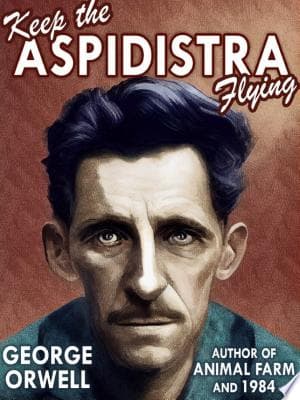
George Orwell (2022)
Genre
Literary Fiction / Politics
Reading Time
360 min
Key Themes
See below
Sign in to track this book
In 1930s London, a poet's defiant war against the 'money-god' spirals into a darkly comic descent through poverty, petulance, and the inescapable lure of the very conformity he despises.
Gordon Comstock, a struggling poet in his late twenties, deliberately embraces poverty in 1930s London as a rebellion against what he sees as the pervasive worship of money. He works a low-paying job at the New Albion Library, a small bookshop, earning barely enough to live in a squalid bedsit in Willowbed Road. His ambition is to write a significant poem, 'London Pleasures,' and his first collection, 'Mice,' saw limited success years prior. He despises the middle-class values represented by his relatively well-off sister, Julia, and her husband, and constantly feels the sting of his financial inadequacy, particularly in his relationship with Rosemary Waterlow, whom he loves but cannot afford to properly court. His only true friend is Ravelston, editor of a socialist literary magazine, who occasionally offers him work.
Gordon's poverty dictates every aspect of his life, leading to constant embarrassment and self-loathing. He meticulously calculates every penny, often forgoing meals or essential items. His attempts to socialize with Rosemary are repeatedly marred by his lack of funds. An outing to the countryside with Rosemary and Ravelston shows his financial limitations when he cannot afford a proper meal or even a decent tip. He resents Rosemary's middle-class background and her expectation of normal dates, which he cannot provide. The aspidistra, a common houseplant symbolizing lower-middle-class respectability, becomes a recurring reminder of the life he despises yet is drawn into.
Gordon attempts to treat Rosemary to a 'proper' dinner, saving up for weeks for a meal at a respectable restaurant. However, the evening is a disaster. He feels out of place and embarrassed by the cost, which he struggles to pay. The situation worsens when he realizes he has forgotten his wallet. Rosemary has to pay, deepening his humiliation. Later, fueled by cheap whiskey and self-pity, Gordon has a drunken outburst, ranting about money and his perceived failures, alienating Rosemary. This incident further solidifies his belief that money is the ultimate barrier to happiness and genuine connection, pushing him deeper into his self-imposed misery.
Ravelston, concerned about Gordon's deteriorating state, offers him a job at a prosperous advertising agency, 'Great London Publicity,' writing copy. The salary is a significant improvement over his bookshop wages, offering a chance to escape his grinding poverty. Initially, Gordon resists, viewing advertising as the epitome of the commercialism he despises and a betrayal of his artistic integrity. However, the lure of financial stability and the increasing pressure of his circumstances, coupled with Rosemary's subtle encouragement, eventually persuade him to accept the position, though he does so with a sense of self-loathing and hypocrisy.
Gordon begins his job at Great London Publicity, a world of slick professionalism and manufactured desire that he scorns. Despite his disdain, he finds himself surprisingly competent at writing advertising copy, a skill he deplores. The increased income brings a temporary respite from his most acute financial anxieties. He can afford better food, a slightly less squalid room, and even small luxuries. However, this material comfort does not bring him happiness or artistic fulfillment. He views his work as soul-destroying and continues to secretly write his poetry, feeling like a hypocrite living off the 'money-god' he purports to despise.
Gordon's relationship with Rosemary, though strained by his poverty and cynicism, continues. One evening, Rosemary reveals that she is pregnant. This news shatters Gordon's carefully constructed world of artistic rebellion and self-pity. He is initially overwhelmed by panic and despair, seeing the child as an ultimate trap, forcing him into the very middle-class respectability and financial servitude he has so vehemently rejected. He contemplates various desperate solutions, but Rosemary firmly rejects such ideas. The reality of impending fatherhood forces him to confront his responsibilities and the limitations of his anti-money philosophy.
After much internal agonizing and desperate conversations with Rosemary, Gordon makes the momentous decision to marry her. This choice signifies a complete capitulation to the very 'money-god' he has fought against. He realizes that he cannot condemn Rosemary and their unborn child to the kind of poverty he has romanticized for himself. The prospect of marriage and a family forces him to abandon his artistic pretensions and fully embrace the conventional, financially driven life he once scorned. He recognizes the necessity of providing for his family, even if it means sacrificing his perceived intellectual and artistic freedom.
Following their decision to marry, Gordon and Rosemary find a small, respectable flat in a typical London suburb. The move marks a definitive step into the middle-class existence Gordon once railed against. In a symbolic act of acceptance, or perhaps resignation, they acquire an aspidistra, the very plant that had come to symbolize everything Gordon detested about petty-bourgeois respectability and financial constraint. The aspidistra, placed prominently in their new home, signifies his abandonment of his radical ideals and his reluctant embrace of a conventional, financially secure, but perhaps unfulfilling, life.
Gordon settles into married life with Rosemary, continuing his job in advertising. While he still harbors cynical thoughts about the 'money-god' and the compromises he has made, a grudging contentment begins to emerge. He finds unexpected satisfaction in providing for his wife and unborn child, and in the small comforts of a stable home. He realizes that his previous rebellion was perhaps more about self-pity and a fear of responsibility than genuine artistic integrity. Though his poetic ambitions have largely faded, he finds a new, albeit mundane, purpose in his domestic life, accepting the aspidistra as an emblem of his new reality.
By the novel's end, Gordon fully accepts his fate as a husband, father, and advertising man. He understands that his rebellion against money was ultimately futile, and that the 'money-god' is an inescapable force in society. He still has moments of bitterness and regret for his lost artistic dreams, but these are increasingly tempered by the practical realities and small joys of his new life. The aspidistra in his window represents not just his capitulation, but also a certain peace with his conventional existence. He has, in essence, joined the ranks of the very people he once scorned, finding a quiet, if resigned, happiness within the system he once fought.
The Protagonist
Gordon moves from an idealistic, self-destructive rebellion against money to a reluctant acceptance of conventional life and its financial demands after becoming a husband and father.
The Supporting
Rosemary remains steadfast in her affection for Gordon, eventually pushing him towards maturity and responsibility through her pregnancy.
The Supporting
Ravelston consistently acts as a supportive, if sometimes misunderstood, influence on Gordon, offering practical aid.
The Supporting
Julia remains a constant, if often distant, symbol of the conventional life Gordon resists.
The Mentioned
Her role is static, serving as a backdrop to Gordon's poverty.
The Mentioned
His role is static, representing the mundane work Gordon performs.
The Mentioned
His influence is primarily historical, shaping Gordon's early motivations.
The Mentioned
Her influence is primarily historical, contributing to Gordon's understanding of poverty.
This is the central theme of the novel. Gordon Comstock's entire life is a rebellion against what he calls the 'money-god,' which he believes dictates every aspect of human existence and corrupts genuine relationships and artistic expression. His poverty is a deliberate act of defiance, yet it ultimately proves to be as corrupting and restrictive as the pursuit of wealth. Orwell shows how the lack of money leads to social humiliation, isolation, and a constant, debilitating anxiety, demonstrating that money, or its absence, is an inescapable force that shapes identity and destiny. The novel argues that while money doesn't guarantee happiness, its absence guarantees misery and compromise.
“Money is the most important thing in the world. It is the only thing that matters.”
Gordon struggles constantly with the tension between his desire to be a serious poet and the practical necessity of earning a living. He believes that true art cannot flourish under the shadow of commercialism or the need for financial gain. His low-paying job in the bookshop is a conscious choice to maintain his integrity, but it also starves his creative spirit by consuming his energy and mental peace. His eventual move into advertising, a job he despises, represents the ultimate capitulation of his artistic ideals to the demands of material necessity, questioning whether pure art is truly possible for those without independent means.
“You couldn't be a poet and not have money. You couldn't be a poet and not be a gentleman. It was impossible.”
The novel portrays the rigid class structure of 1930s London and its impact on individual lives. Gordon's poverty places him firmly outside the respectable middle class, leading to constant social awkwardness and a feeling of inferiority. The 'aspidistra' itself is a symbol of lower-middle-class respectability, a standard Gordon both despises and, ultimately, is forced to embrace. His interactions with Rosemary and Julia highlight the different expectations and limitations imposed by class, showing how deeply ingrained social stratification influences personal choices, relationships, and even self-worth.
“The aspidistra is the tree of life, the tree of all good and evil. It is the tree of the money-god.”
Gordon's relationship with Rosemary is a central way to explore themes of love, responsibility, and the sacrifices required for genuine connection. His poverty initially prevents him from fully committing to Rosemary, as he feels unable to provide for her or offer her a 'normal' life. His fear of responsibility is a major barrier to their happiness. However, Rosemary's pregnancy forces him to confront his selfish rebellion and accept the responsibilities of impending fatherhood and marriage. This decision requires him to sacrifice his anti-money ideals and embrace a conventional life, suggesting that true love and responsibility often necessitate personal compromise.
“He loved Rosemary, but he hated the thought of marrying her, because it meant money.”
A recurring symbol of lower-middle-class respectability and financial constraint.
The aspidistra plant, a hardy, common houseplant, serves as the central and most potent symbol in the novel. For much of the story, it represents everything Gordon Comstock despises about petty-bourgeois respectability, financial conformity, and the 'money-god.' It is the emblem of the dull, conventional life he actively rebels against. Its appearance in his sister's home, then his new respectable flat, marks his gradual, reluctant capitulation to the very values he once scorned. By the end, the aspidistra in his own window signifies his acceptance of his fate, a symbol of resignation and grudging contentment within the system.
Provides deep insight into Gordon's cynical mind while allowing for broader social commentary.
The novel is primarily told from Gordon Comstock's perspective, offering intimate access to his thoughts, anxieties, and cynical worldview. This allows the reader to deeply understand his rebellion against money and his internal struggles. However, Orwell frequently employs a narrative voice that, while close to Gordon, also steps back to offer broader social commentary and critique, sometimes subtly undermining Gordon's self-pitying perspective. This blend allows for both character-driven insight and Orwell's characteristic social criticism, making Gordon an object of both empathy and critical examination.
Used to highlight the futility of Gordon's rebellion and the pervasive nature of money.
Irony is a pervasive device in 'Keep the Aspidistra Flying.' Gordon's deliberate embrace of poverty, intended as an act of rebellion, ironically traps him in an even more miserable and restrictive existence than the one he sought to escape. His attempts to defy the 'money-god' only make him more obsessed with money and its absence. The ultimate irony is his eventual capitulation, marrying Rosemary and taking a well-paying advertising job, thereby becoming a part of the very system he so vehemently opposed, finding a reluctant peace in the conventional life he once scorned. This highlights the futility of individual rebellion against deeply entrenched societal forces.
Different areas of London symbolize social class and Gordon's changing circumstances.
Orwell uses the geography of London to symbolize social class and Gordon's psychological state. His squalid bedsit in Willowbed Road represents his self-imposed poverty and alienation. The respectable, but ultimately dull, suburbs he moves to with Rosemary at the end symbolize his embrace of conventionality and middle-class life. The contrast between these areas, and his uncomfortable forays into more affluent parts of the city during dates with Rosemary, visually reinforces the class divisions and the inescapable influence of money on social mobility and individual experience within the urban landscape.
“The money-god is as jealous as any other god.”
— Gordon Comstock's reflection on the power of money in society.
“The world is a raft sailing through space with, potentially, plenty of provisions for everybody; the idea that we must all cooperate and see to it that everyone does his fair share of the work and gets his fair share of the provisions, seems so blatantly obvious that one would say that no one could possibly fail to accept it unless he had some corrupt motive for clinging to the present system.”
— Gordon's socialist critique of economic inequality.
“The lower-middle-class people in there, behind their lace curtains, with their children and their scraps of furniture and their aspidistras—they lived by the money-code, sure enough, and yet they contrived to keep their decency.”
— Gordon observing his neighbors and their values.
“It is not so much doing things that one regrets, as having done them.”
— Gordon's musing on regret and action.
“The aspidistra is the tree of life and the tree of knowledge and the tree of good and evil all in one.”
— Symbolic interpretation of the aspidistra plant.
“To be born into this world is to be born into enemy territory.”
— Gordon's cynical view of society and existence.
“Money is what God used to be. Good and evil have no meaning any longer except failure and success.”
— Critique of materialism replacing spiritual values.
“The real secret of class distinctions in the West... is summed up in four frightful words... The lower classes smell.”
— Gordon's bitter observation on class prejudice.
“One can't be both a rebel and a success.”
— Gordon's dilemma between artistic integrity and financial stability.
“The money-code is a sort of world-wide conspiracy against the human spirit.”
— Gordon's indictment of capitalist values.
“It is a mysterious thing, the loss of faith—the gradual, hardly noticeable slipping away of something that you never knew you had until you lost it.”
— Reflection on losing belief in societal or personal ideals.
“The aspidistra is the tree of life; and the tree of life is the aspidistra.”
— Repetition emphasizing the plant's symbolic importance.
“In a country like England, the greatest cruelty one can inflict on a poor man is to ridicule him.”
— Comment on social cruelty and class dynamics.
Ready to see how well you understood this book? Take our interactive quiz with 10 questions.

Eric Arthur Blair, better known by his pen name George Orwell, was an English novelist, essayist, journalist, and critic. His work is characterised by lucid prose, social criticism, opposition to totalitarianism, and support of democratic socialism.







