“Every one of us is, in a sense, a world. And that world is made up of our experiences, our memories, our beliefs, our values.”
— A reflection on individuality and the composition of self.

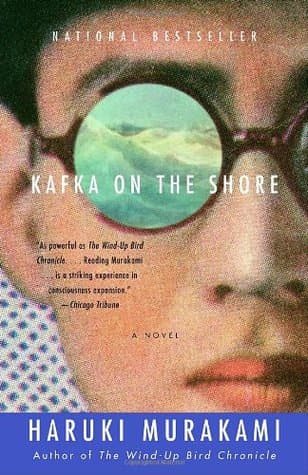
Haruki Murakami (2002)
Genre
Literary Fiction / Fantasy
Reading Time
580 min
Key Themes
See below
Sign in to track this book
In a world where cats talk, fish fall from the sky, and old prophecies connect, a teenage runaway and an elderly man with a secret past go on a strange journey to escape fate and find out why their lives are linked.
On his fifteenth birthday, Kafka Tamura, a boy worried by his sculptor father's harsh prediction, runs away from his Tokyo home. He takes the name 'Kafka' and plans to live secretly, heading for Shikoku. His inner voice, 'The Boy Called Crow,' often talks to him, pushing him forward. At the same time, in Tokyo, the elderly, simple Nakata, who lost his memories and ability to read after a strange childhood event, is hired to find a missing cat named Goma. Nakata can talk to cats, which he uses to find Goma. This simple task soon leads him into a darker and stranger investigation, starting his own journey.
Kafka arrives in Takamatsu, Shikoku, and finds comfort in a small, private library. He meets Oshima, a kind and smart transgender man who works there and offers him a place to stay. Kafka also meets Ms. Saeki, the distant but beautiful director of the library. He feels an immediate, strong connection to her and notices she looks like a photo of his mother from his father's studio. Ms. Saeki spends much of her time listening to a sad song she wrote when she was young, 'Kafka on the Shore.' She seems to live in her own world of memories and sadness, making Kafka more suspicious that she might be his long-lost mother.
Nakata's search for the missing cats leads him to a strange house in a remote part of Tokyo. There, he meets a man calling himself Johnnie Walker. This man, dressed like the whiskey mascot, talks about a plan to gather cat souls to make a magic flute. Johnnie Walker is a truly evil person. In a terrible fight, Nakata, guided by an unknown power, kills Johnnie Walker with a knife. The act is gruesome and leaves Nakata confused, as he does not fully understand what he has done. This murder causes fish to rain from the sky nearby, a supernatural event linked to the violence.
After the murder, Nakata leaves the scene and soon meets Hoshino, a young, thoughtful truck driver who offers him a ride. Even with Nakata's simple mind and the odd situation, Hoshino feels a strong, unexplained need to help him. Nakata has a clear dream or vision about an 'entrance stone' that needs to be closed to stop a disaster. He believes this stone is in Shikoku, in Takamatsu. This leads Hoshino to change his route and go with Nakata on this new, mysterious search. Their journey becomes a search for this hard-to-find object, guided only by Nakata's unclear understanding and Hoshino's growing loyalty.
Kafka learns from Oshima that Ms. Saeki had a lover who died young, and that the song 'Kafka on the Shore' was written for him. He also finds out that Ms. Saeki's lover was murdered. Kafka's focus on Ms. Saeki grows. He believes she is his mother and wants to understand her pain. One night, Kafka has a dream-like, close experience with Ms. Saeki, where she appears as both her younger self and her current self. This experience blurs the lines between dream and reality, past and present, and further connects their lives, making Kafka question his own identity and their bond.
Back in Tokyo, Kafka's father, the famous sculptor Koichi Tamura, is found brutally murdered. The police start an investigation, and Kafka, who ran away shortly before the murder, is a main suspect. His father's prediction about Kafka killing him and sleeping with his mother and sister weighs heavily on Kafka's mind. He wonders if he could have done it in a trance or through some unseen means. The media attention around the murder adds to Kafka's inner trouble and fear, even though he was in Shikoku when the murder happened. This creates a puzzling situation in the story.
Nakata and Hoshino arrive in Takamatsu. Nakata, guided by his senses, is drawn to the library where Ms. Saeki works. He feels a strong link between her and the 'entrance stone' he is meant to find. Nakata struggles to explain his goal, but Ms. Saeki seems to understand him on a deeper level. She eventually says that the entrance stone is hidden inside the library, under the floor of a certain room. This discovery is a big step in Nakata's search, linking his supernatural task directly to Kafka's world and Ms. Saeki's past.
As Nakata and Hoshino get ready to open the entrance stone, Ms. Saeki's body falls into a coma. However, her younger spirit, the ghost of her dead lover, and her younger self, guide Nakata to the exact spot. Nakata, with Hoshino's help, digs up the entrance stone and, following his gut, puts his hand on it. This act 'closes' the entrance to the other world, sealing away the strange events and the lasting sadness. As the stone closes, Nakata feels a deep peace, but the effort completely drains him, and he collapses, his life ending.
After Ms. Saeki's death, Kafka feels a strong urge to go into the forest next to the library. Oshima warns him about the forest's dangers and its reputation for people getting lost, but Kafka feels he must go. Inside the forest, Kafka finds himself in a strange, timeless place. He meets soldiers who have lived there since World War II, seemingly without aging, and sees strange things that blur the lines between life and death, past and present. This 'world of the dead' is a place of memory and forgotten time, where Kafka faces the deeper secrets of his own life and his connection to Ms. Saeki.
Inside the forest, Kafka meets the young Ms. Saeki, a lively spirit from her past. Through their talks, the truth of Kafka's parents is revealed: Ms. Saeki is his mother, and his father was her brother. This makes Kafka the child of an incestuous relationship. The prophecy, then, has a twisted, symbolic fulfillment rather than a literal one. Ms. Saeki's spirit explains that she left him as a child to protect him from her family's dark past. This meeting gives Kafka the answers he wanted, bringing closure to his search for identity.
After closing the entrance stone, Nakata's body, already weak, gives out. He dies peacefully in Hoshino's arms, having finished his task. Hoshino, deeply affected by his time with Nakata, feels a deep loss but also a new understanding of the world's hidden parts. He takes on the job of guarding the entrance stone, now closed, and carries on Nakata's work in a way, understanding that some things cannot be logically explained. Hoshino changes from a cynical truck driver to a man with a spiritual connection to the world, forever changed by meeting Nakata.
After his experiences in the timeless forest, Kafka chooses to return to the living world. He comes out of the woods with Oshima, leaving behind the realm of the dead and the past. He has accepted the truth of his origins and the symbolic fulfillment of his father's prophecy, understanding that he did not literally kill his father or sleep with his mother in the usual sense. The experience has made him mature, allowing him to let go of his past burdens and embrace his future, not as a victim of fate, but as a person with control over his life. He is ready to live, no longer running, but moving forward with new clarity.
The Protagonist
Kafka starts as a boy running from fate and his past, but through his surreal journey, he confronts the truth of his origins and accepts his identity, finding a path forward.
The Protagonist
Nakata begins as a passive, simple man but becomes an active participant in a cosmic struggle, fulfilling his destiny and bringing balance to the world before his peaceful demise.
The Supporting
Ms. Saeki is initially a figure shrouded in mystery and grief, but through her interactions with Kafka and Nakata, her past is revealed, and her spirit finds a form of peace.
The Supporting
Oshima remains a stable, guiding force, providing support and wisdom without undergoing a significant personal transformation, serving as an anchor for Kafka.
The Supporting
Hoshino evolves from a pragmatic, somewhat cynical individual to a man deeply connected to the spiritual world, accepting his role as the guardian of the entrance stone.
The Supporting
Crow is a consistent internal guide for Kafka, helping him navigate his path and integrate his fractured self, eventually becoming less distinct as Kafka gains self-awareness.
The Antagonist
Johnnie Walker is a static force of evil whose existence is terminated by Nakata, serving as a catalyst for Nakata's larger quest.
The Supporting
Colonel Sanders serves as a brief, enigmatic guide for Hoshino, providing crucial information without undergoing any personal change.
The Mentioned
Koichi Tamura's arc is defined by his prophecy and his death, which acts as a catalyst for Kafka's journey and the unraveling of family secrets.
Both Kafka and Nakata search for who they are, though in different ways. Kafka actively tries to define himself apart from his father's prophecy, taking a new name and running away. His journey into the library and the 'world of the dead' makes him face his true parents and accept himself. Nakata, having lost his memories, searches for a fragmented sense of self and purpose, which he finds through cats and the 'entrance stone.' The book explores how identity is shaped by memory, fate, and the choices we make, even when those choices seem set.
“And once the storm is over, you won’t remember how you made it through, how you managed to survive. You won’t even be sure, in fact, whether the storm is really over. But one thing is certain. When you come out of the storm, you won’t be the same person who walked in. That’s what this storm’s all about.”
The book looks at the struggle between fate and individual choice, mainly through Kafka's fight against his father's prophecy. Kafka tries to escape his fate by running away, yet events happen in ways that suggest an unavoidable destiny, though often symbolic rather than literal. Nakata, too, seems led by an unseen power, doing a job he does not fully understand. However, the characters' choices and their willingness to face the unknown ultimately shape their paths. This suggests that while destiny may set the stage, free will allows for interpretation and acceptance.
“Every one of us is, in a sense, a sleepwalker, trying to walk a straight line on the edge of a cliff. Which is why we need to hold on to something, hold on for dear life.”
Memory is an important theme, especially for Ms. Saeki, who is stuck in the sad memories of her youth and lost love, and for Nakata, who lost all his personal memories in a childhood event. Kafka also deals with unclear memories of his mother and sister. The book suggests that memory can be both a burden and a guide, a force that shapes our present and connects us to the past. The 'world of the dead' in the forest is a place of living memories, where the past is always present, showing the lasting effect of what is remembered and forgotten.
“Memories warm you up from the inside. But they also tear you apart.”
Murakami mixes everyday life with the truly strange. Normal actions like an old man looking for a cat or a boy working in a library quickly become meetings with talking cats, rains of fish and leeches, a cat-killing demon, and a strange figure like Colonel Sanders. This contrast shows that the supernatural is not separate from reality but part of it, often appearing in subtle or symbolic ways. The characters accept these strange events with quiet calm, which highlights the book's unique magical realism.
“Sometimes fate is like a small sandstorm that keeps changing directions. You change direction, but the sandstorm chases you. You turn again, but the storm does the same. Until you stop for a moment and close your eyes, then open them to realize that the storm is not really a sandstorm. It's you. What's inside you.”
Love is explored in many ways, from the strong bond between Ms. Saeki and her murdered lover to the growing, complex feelings between Kafka and Ms. Saeki. However, the book also addresses incest, showing that Kafka is the child of his mother Ms. Saeki and her brother. This changes the prophecy, making it a symbolic, inherited burden rather than a literal act. The incestuous family line highlights themes of fate, inherited pain, and the blurred lines of family relationships, suggesting that some destinies come from very complex and unsettling beginnings.
“I’m not a bad person. I’m just a boy who’s about to turn fifteen. And there’s nothing wrong with that.”
Two seemingly unrelated storylines that eventually intertwine.
The novel employs a dual narrative structure, alternating between the story of Kafka Tamura and the story of Satoru Nakata. These two seemingly disparate plotlines, set in different locations and featuring characters with vastly different experiences, gradually reveal their interconnectedness. The parallel narratives create suspense, allow for multiple perspectives on the novel's themes, and ultimately merge to reveal a larger, unified story, demonstrating how individual destinies are often linked in unseen ways.
A mythological curse that drives Kafka's journey.
Kafka's father pronounces an Oedipal prophecy upon him: that Kafka will kill his father and sleep with his mother and sister. This prophecy serves as the primary catalyst for Kafka's flight and his quest for identity. It functions as a classic literary device that explores themes of fate versus free will, and its eventual 'fulfillment' is revealed to be symbolic and complex rather than literal, reinterpreting the ancient myth within a modern, surreal context. It creates a powerful psychological burden for Kafka.
A magical realism element that connects Nakata to the supernatural world.
Nakata's unique ability to communicate with cats is a key element of magical realism in the novel. It serves as his primary means of interacting with the supernatural world and is the catalyst for his journey, beginning with his search for the lost cat Goma. The cats often provide clues, warnings, and philosophical insights, bridging the gap between the mundane and the fantastical. This device highlights Nakata's innocent wisdom and his connection to forces beyond human understanding, making the surreal seem natural within his world.
A mystical portal linking the living world with a timeless, spiritual realm.
The 'entrance stone' is a crucial symbolic and literal plot device. It is a mystical portal that, when open, allows for the blurring of reality, causing strange phenomena like the rain of fish and connecting the living world to a timeless 'world of the dead' (or a metaphorical 'other side'). Nakata's quest is to find and close this stone, while Kafka inadvertently enters this parallel realm in the forest. It represents the boundary between life and death, memory and oblivion, and its closure signifies a return to balance and a resolution of certain spiritual conflicts.
Supernatural meteorological events reflecting underlying cosmic shifts.
The inexplicable rains of fish and later leeches are potent examples of symbolic weather. These events are direct consequences of major supernatural occurrences in the narrative, specifically Nakata's murder of Johnnie Walker. They serve as physical manifestations of the disruption in the cosmic order, signaling that the boundary between worlds has been breached. These bizarre meteorological phenomena ground the metaphysical shifts in a tangible, if surreal, way, emphasizing the interconnectedness of all things in the novel's universe.
“Every one of us is, in a sense, a world. And that world is made up of our experiences, our memories, our beliefs, our values.”
— A reflection on individuality and the composition of self.
“When you come out of the storm, you won't be the same person who walked in. That's what this storm's all about.”
— A character's insight into the transformative nature of hardship.
“Sometimes fate is like a small sandstorm that keeps changing directions. You turn one way and the sandstorm chases you. You turn the other way, and the sandstorm chases you.”
— Kafka Tamura's internal monologue about the inescapable nature of destiny.
“Memories warm you up from the inside. But they also tear you apart.”
— A poignant observation on the dual nature of memories.
“Taking crazy things seriously is a kind of art.”
— Oshima's philosophical remark on how to approach the absurdities of life.
“The world is a metaphor, Kafka Tamura. But we have no way of knowing what it's a metaphor for.”
— Oshima explaining the enigmatic nature of reality.
“If you remember me, then I don't care if everyone else forgets.”
— Kafka's desperate desire for a specific connection amidst his isolation.
“What we call the present is nothing but an accumulation of the past.”
— A reflection on the continuous influence of history on the current moment.
“You can't get rid of the past, but you can choose how you deal with it.”
— A pragmatic view on confronting personal history and trauma.
“Silence, I've discovered, is a talent.”
— A character's observation on the power and utility of quietness.
“Every book has a soul, the soul of the person who wrote it and the soul of those who read it and dream about it.”
— Miss Saeki's profound statement about the life within books.
“It's all a question of imagination. Our responsibility begins with the power to imagine.”
— A profound statement on the human capacity for empathy and creation.
“The wind blows, and the rain falls, and the world is full of things that can't be explained.”
— A simple yet evocative description of the world's inherent mystery.
“If you're going to read, read good books.”
— A straightforward piece of advice from a character valuing quality literature.
Ready to see how well you understood this book? Take our interactive quiz with 10 questions.

Haruki Murakami is a Japanese writer. His novels, essays, and short stories have been bestsellers in Japan and internationally, with his work translated into 50 languages and having sold millions of copies outside Japan. He has received numerous awards for his work, including the Gunzo Prize for New Writers, the World Fantasy Award, the Frank O'Connor International Short Story Award, the Franz Kafka Prize, and the Jerusalem Prize.







