“The world's a scary place, but it's also a beautiful place, and you have to take the good with the bad.”
— From 'The Gingerbread Girl', reflecting on life's duality.

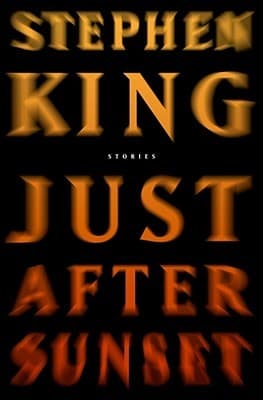
Stephen King (2008)
Genre
Thriller / Fantasy / Mystery
Reading Time
10-12 hours (approx. 539 pages)
Key Themes
See below
Sign in to track this book
Between dusk and dark, Stephen King presents a collection where porta-potties become portals, stationary bikes transport riders to terror, and a blind girl's kiss works a miracle as reality starts to unravel.
Dave is on a flight to Pittsburgh when he sees his wife, Willa, across the aisle. This is impossible, as Willa died in a car accident hours before. She and several other passengers seem to be waiting for something, unaware of their deaths. Dave tries to talk to her, but she does not acknowledge him. Eventually, the deceased passengers, including Willa, leave the plane as if it were a normal stop. Dave, bewildered and heartbroken, realizes they are waiting for a connecting flight to the afterlife, and he is still alive, left with his grief.
Emily Portman, devastated by the accidental death of her infant daughter, moves to a secluded house on Key Largo, Florida. She runs constantly, pushing her physical limits. One day, while running, she meets a strange, threatening man named Pickering, who has been stalking her. He breaks into her home, and Emily, resourceful and determined, must use her wits and the island's isolation to outsmart and escape her captor. The story becomes a tense chase, with Emily fighting for her life against a relentless predator.
Harvey tells his wife, Janet, about a vivid and unsettling dream. In the dream, their daughter, the family dog, and other familiar things are subtly wrong or missing, and a strange message is written on a calendar. As Harvey describes the dream, Janet becomes more disturbed, not just by the dream's content, but by the eerie feeling that some details are appearing in their waking reality. The story ends with an ambiguous hint that the dream might be prophetic, or that their reality is slowly falling apart.
Scott Staley, a 9/11 survivor because he overslept, starts finding personal items belonging to his deceased colleagues mysteriously appearing in his apartment. These items—a baseball glove, a sweater, a photograph—are often mundane, but they carry the emotional weight of their former owners. Scott feels he must return these items to the victims' families, a task that becomes a painful journey of grief, guilt, and unexpected connection. He deals with survivor's guilt and the uncanny nature of the objects, which seem to be a form of communication from the dead.
A privileged, somewhat cynical young man named Archie watches a graduation ceremony from his window. He thinks about his mundane life, his girlfriend, and his future, feeling bored. Suddenly, a massive, catastrophic explosion, implied to be a nuclear attack, shatters the world. The story is a brief, poignant reflection on the abrupt end of ordinary life and the uselessness of future plans in the face of sudden, overwhelming destruction. It captures the shock and disbelief of an apocalyptic event from a very personal, immediate perspective.
Dr. John Goetz receives a new patient, 'N.', who has severe obsessive-compulsive disorder, meticulously arranging stones in a specific pattern to prevent a cosmic horror from entering their world through a 'rift' in a field in Ackerman's Field, Maine. N. believes that elder gods, the 'Cthun,' are held back by these rituals. Dr. Goetz first dismisses it as delusion, but as he looks deeper into N.'s case, and then the cases of N.'s previous psychiatrist and a cousin, he finds disturbing evidence that N.'s 'delusions' might be protecting humanity from an unimaginable evil. The story unfolds through N.'s journal entries and Dr. Goetz's investigation, leading to a chilling revelation about N.'s condition and its global implications.
Hitman Halston is hired by an elderly, wealthy pharmaceutical magnate, Mr. Drogan, to kill a cat. Drogan believes the cat is supernaturally vengeful, sent to punish him for his company's unethical practices, which led to the deaths of thousands of test subjects, including three people who owned the cat. The cat, black and seemingly harmless, proves to be unnervingly resilient and malevolent. Halston, initially skeptical, soon finds himself in a terrifying battle against the feline, which seems to have uncanny strength and a demonic will for revenge. The story ends in a gruesome confrontation.
Annie receives a phone call from her husband, who died in a car crash two days prior. He calls her at 6:00 AM, as he always did on his way to work. He tells her about events that are yet to happen, specifically mentioning news headlines from the next day's New York Times. Initially terrified, Annie begins to cherish these calls, finding comfort in hearing his voice and the illusion of continued connection. However, the calls are brief and always end abruptly, leaving Annie to deal with the grief of his absence and the unsettling nature of their communication, which offers no real comfort or resolution.
Monette, a traveling book salesman, picks up a mute hitchhiker. Monette, lonely and desperate to confess, tells the silent man everything, detailing his affair and his plan to murder his wife. The hitchhiker remains impassive, seemingly just listening. However, when Monette is later arrested by the police, he realizes the 'mute' hitchhiker was a Jesuit priest who had taken a vow of silence and was fulfilling his duty to listen to confession, but also his civic duty to report a planned crime. The story explores confession, guilt, and the unexpected consequences of revealing one's darkest secrets.
An old man is dying of cancer when a mysterious, blind girl named Ayana visits him. She offers him a miraculous kiss and the touch of her hand, which seems to ease his pain and bring peace. Ayana's visit is brief and enigmatic, and she appears to be a messenger of hope or a divine presence. The story is a tender and spiritual look at faith, miracles, and comfort in the face of death, leaving the reader to wonder about Ayana and her extraordinary gift.
Two orderlies in a nursing home meet a new patient, a man so incredibly old that he seems almost inhuman. He is frail, barely responsive, and appears to be constantly decaying, yet he persists. His presence disturbs the staff and other residents. The story looks at the unsettling nature of extreme longevity and its physical and psychological toll, hinting at a being that has outlived its time and clings to existence by the thinnest of threads, an endurance that is both awe-inspiring and horrifying.
Richard Sifkitz, a freelance artist, starts an exercise routine on a stationary bike to improve his health. He creates an imaginary landscape for his rides, a road he calls the 'arterial highway,' complete with landmarks and a 'fat-man' monitor. As his health improves, the imaginary world becomes more vivid and real. He starts encountering strange, malevolent figures, the 'life-regulators,' who seem intent on stopping him. Richard realizes his exercise is blurring the lines between reality and imagination, putting him in mortal danger as he races to outpace these terrifying entities.
This story is presented as a news report or documentary transcript detailing a horrific school shooting that happened on the last day of school. It describes the events, the victims, the shooter's motivations, and the aftermath. The narrative is chillingly realistic, aiming to capture the stark, brutal reality and the devastating impact of such tragedies. It comments on gun violence and the emotional scars left on a community, reflecting on the senselessness and the lingering questions that follow such an event.
Peter and his wife have a typical Sunday afternoon routine: lunch, reading the paper, and a nap. Peter thinks about his life, his marriage, and a past affair. The story explores the quiet currents of a long-term relationship, the secrets kept, and the comfort of routine. However, a seemingly harmless comment or observation from his wife during their quiet afternoon hints at a deeper, unsettling truth about his past transgression, suggesting that his secrets may not be as hidden as he believes, leaving him with a profound sense of unease.
A writer, whose name is not given, struggles with a character he created named John Strand. Strand, a villain in one of his stories, refuses to stay dead or disappear from the writer's imagination. He appears as a persistent, almost tangible presence, haunting the writer and demanding to be written back into existence. The story explores the power of creation, the blurred lines between author and character, and the idea that some fictional creations can take on a life of their own, becoming uncontrollable and even menacing.
The Protagonist
Emily transforms from a grieving, escaping woman into a fierce survivor who reclaims her will to live through a harrowing ordeal.
The Protagonist/Patient
N. remains trapped in his ritualistic cycle, a tragic figure whose 'madness' is revealed as humanity's only defense.
The Supporting/Investigator
Dr. Goetz's arc is one of transformation from scientific skepticism to horrified belief, as he inherits the burden of N.'s knowledge.
The Protagonist
Halston's arc is a swift descent from confident professional to terrified victim, highlighting the limits of human control against the supernatural.
The Protagonist
Scott grapples with survivor's guilt and finds a form of catharsis and connection through returning the objects, slowly accepting his role as a bridge between worlds.
The Protagonist
Richard's journey evolves from a mundane self-improvement effort into a desperate fight for survival within a reality he inadvertently created.
The Supporting/Deceased
Willa's brief appearance serves as a poignant representation of the journey beyond life, offering a glimpse of peace for the departed.
The Supporting/Victim
Drogan's arc is a swift and brutal encounter with supernatural justice, culminating in his violent demise.
The Supporting/Mystical
Ayana's presence is a brief, miraculous intervention, offering comfort and a glimpse of the transcendent without undergoing personal development.
The Protagonist
Monette's arc moves from a state of guilty planning to unexpected exposure and arrest, highlighting the unforeseen repercussions of his actions.
Many stories in 'Just After Sunset' explore the thin line between the living and the dead, suggesting that the departed are never truly gone. In 'Willa,' Dave sees his recently deceased wife on a plane, heading towards an afterlife connection. In 'The Things They Left Behind,' objects from 9/11 victims mysteriously appear in Scott Staley's apartment, linking him to the deceased and forcing him to confront their lingering presence. 'The New York Times at Special Bargain Rates' features a widow receiving calls from her dead husband, who provides future news, blurring past, present, and future and denying a clean break from grief. These stories show that death is not always a definitive end, but sometimes a transition with lingering echoes.
“Sometimes the dead just… keep going, don't they? Like a connecting flight you didn't know you had.”
This collection often looks at how easily reality can warp and sanity can unravel, often triggered by trauma or an encounter with the unknown. In 'N.,' a man's obsessive-compulsive disorder is a desperate, sane act to prevent cosmic horrors from entering our world, challenging the usual understanding of madness. 'Stationary Bike' shows Richard Sifkitz's exercise routine leading him into a terrifying alternate reality his mind created, where imaginary 'life-regulators' become very real threats. 'Harvey's Dream' presents a disturbing dream that subtly begins to appear in waking life, eroding the characters' sense of what is real. These stories highlight how fragile our perceived reality is and the thin line between reason and terrifying delusion.
“What if the things we call crazy are just… the things we aren't supposed to see?”
The deep impact of loss and the complex emotions around grief and guilt are central to several stories. Emily Portman in 'The Gingerbread Girl' is driven into a fight for survival partly as an escape from the unbearable grief of losing her daughter. Scott Staley in 'The Things They Left Behind' deals with immense survivor's guilt after missing 9/11, finding a purpose in returning the items of his deceased colleagues. Dave in 'Willa' experiences the surreal agony of seeing his dead wife, unable to reach her, his grief worsened by the unreality of the situation. These stories explore the many ways people process loss, from escape to acceptance, and the burden of living when others have died.
“The worst part of losing someone isn't the missing, it's the knowing that life goes on, relentlessly, without them.”
King often explores both human evil and external, often supernatural, malevolent forces. In 'Mute,' Monette's internal darkness—his affair and murderous intent—is revealed by an unexpected confessor. 'The Cat from Hell' shows external evil directly, presenting a demonic feline seeking revenge for corporate wrongdoing, a clear manifestation of karmic retribution. 'The Bunker Hill Last Day of School Massacre' confronts the chilling reality of human violence and the senseless tragedy it inflicts. 'N.' dives into cosmic horror, a vast, ancient evil threatening to break into our dimension. This theme shows that terror can come from both the depravity of the human heart and forces beyond human understanding.
“There are monsters in the world, some with teeth and claws, and some with just a human face.”
Characters whose perceptions or sanity are questionable, blurring reality.
This device creates suspense and psychological depth by presenting events through the lens of a character whose mental state, or the very nature of their reality, is ambiguous. In 'N.,' the patient's account of cosmic entities is initially dismissed as delusion, making the reader question if he is insane or truly a protector. Similarly, in 'Harvey's Dream,' the subtle bleed of the dream into reality makes both Harvey and Janet, and by extension the reader, doubt what is real. This device forces the audience to actively interpret events and question the nature of truth within the story.
The physical or psychic appearance of the deceased or their belongings.
King frequently uses supernatural events as a direct consequence or expression of intense grief and loss. In 'Willa,' the protagonist sees his dead wife, a vivid hallucination or genuine encounter that embodies his inability to let go. In 'The Things They Left Behind,' the objects of 9/11 victims appear, acting as a physical manifestation of survivor's guilt and the lingering presence of the dead. These manifestations are not just scary; they are deeply emotional, forcing characters to confront their unresolved feelings and the enduring impact of those they've lost.
Everyday objects or routines become conduits for horror.
This device takes ordinary, relatable elements of daily life and twists them into sources of terror, making the horror more unsettling because it invades the familiar. In 'Stationary Bike,' a simple exercise routine transforms into a terrifying journey into an alternate dimension. In 'The Cat from Hell,' a common house pet becomes a supernatural engine of vengeance. Even a routine phone call in 'The New York Times at Special Bargain Rates' becomes chilling when it's from a deceased loved one. This technique grounds the fantastical in the everyday, making the supernatural intrusions more impactful and disturbing.
The fear of the unknown, vast, and incomprehensible forces beyond human understanding.
Drawing from Lovecraftian influences, King uses cosmic horror to evoke a sense of insignificance and dread in the face of ancient, alien, and utterly indifferent entities. 'N.' is the prime example, where a patient's OCD is a ritualistic defense against elder gods waiting to break through a rift. This device emphasizes the fragility of human existence and sanity when confronted with powers that operate outside our known laws of physics and morality, suggesting that humanity is merely a speck in a vast, terrifying, and uncaring universe.
“The world's a scary place, but it's also a beautiful place, and you have to take the good with the bad.”
— From 'The Gingerbread Girl', reflecting on life's duality.
“Sometimes dead is better. But sometimes... sometimes it's not.”
— A dark rumination on death and its aftermath, a recurring theme.
“Memory is a funny thing. Sometimes it's a blessing, sometimes it's a curse.”
— From 'Graduation Afternoon', on the nature of memory and its impact.
“The older you get, the more you realize that the only person who can really save you is yourself.”
— A moment of self-realization and independence.
“There are things in the dark that are better left undisturbed.”
— A classic horror warning, prevalent in many stories.
“It's not the fall that kills you, it's the sudden stop at the end.”
— A grim, metaphorical observation on the suddenness of catastrophe.
“Love is a choice, not a feeling. And sometimes, it's the hardest choice you'll ever make.”
— From 'The Things They Left Behind', exploring the complexities of relationships.
“The past is never dead. It's not even past.”
— A Faulknerian echo, used to describe the lingering effects of history.
“Sometimes the truth is worse than any lie.”
— A character facing a difficult, stark reality.
“Fear is a great motivator, but it's a terrible master.”
— From 'The Cat from Hell', discussing the power and pitfalls of fear.
“There are two kinds of people in this world: those who run, and those who stand.”
— A simple dichotomy presented in a moment of crisis.
“Every life is a story, and every story has an end.”
— A poignant reflection on mortality and narrative.
“The world keeps turning, no matter what you do.”
— A humbling thought on the indifference of the universe.
“Sometimes the nightmares are real, and sometimes the real things are the nightmares.”
— From 'N.', blurring the lines between dream and reality.
Ready to see how well you understood this book? Take our interactive quiz with 10 questions.

Stephen Edwin King is an American author of horror, supernatural fiction, suspense, crime, science-fiction, and fantasy novels. Described as the "King of Horror", his books have sold more than 350 million copies as of 2006, and many have been adapted into films, television series, miniseries, and comic books. King has published over 65 novels/novellas, including seven under the pen name Richard Bachman, and five non-fiction books. He has also written approximately 200 short stories, most of which have been published in book collections.







