“God creates dinosaurs. God destroys dinosaurs. God creates Man. Man destroys God. Man creates dinosaurs.”
— Ian Malcolm's observation on the hubris of recreating extinct species.

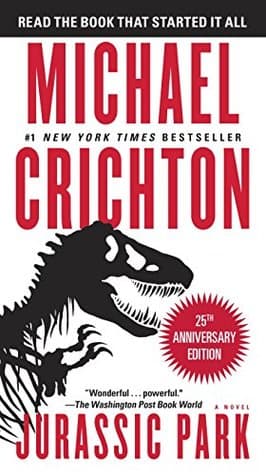
Michael Crichton (1990)
Genre
Thriller / Fantasy / Science Fiction
Reading Time
900 min
Key Themes
See below
Sign in to track this book
On a remote island, a millionaire's dinosaur theme park becomes a nightmare when the resurrected predators escape, turning a scientific wonder into a terrifying fight for survival against creatures humanity brought back from extinction.
Strange attacks on children and workers in Costa Rica, including a construction worker mauled by an unknown creature, lead Dr. Marty Gutierrez, a local doctor, to investigate. Victims describe a small, lizard-like animal. At the same time, a private island, Isla Nublar, owned by InGen and billionaire John Hammond, prepares to open a theme park. Paleontologist Alan Grant and paleobotanist Ellie Sattler are invited to tour the park as consultants after incidents, including a worker attacked by a Velociraptor during its transfer. Grant and Sattler fly to the island with mathematician Ian Malcolm and lawyer Donald Gennaro to endorse the park and calm investors.
Upon arrival, Grant, Sattler, Malcolm, and Gennaro tour Jurassic Park. Hammond reveals his achievement: he has cloned dinosaurs using ancient DNA from mosquitoes in amber. The scientists see living Brachiosaurus, Triceratops, and a Tyrannosaurus rex. They are amazed and deeply concerned. Malcolm, a chaos theorist, immediately doubts the park's stability and the unpredictable nature of complex systems, predicting its failure. Gennaro focuses on the financial aspects and liability.
The group, now with Hammond's grandchildren, Tim and Lex Murphy, begins a guided tour in electric Ford Explorers. The tour quickly runs into problems. A Triceratops is found sick, so Sattler investigates with the park's veterinarian, Dr. Harding. A tropical storm brews, threatening the island. Park systems start to fail. This is later revealed to be the work of chief programmer Dennis Nedry, bribed by BioSyn to steal dinosaur embryos. Nedry disables the park's security, including the electric fences, to help his escape with the embryos.
Nedry's sabotage creates chaos. The electric fences for the most dangerous predators, including the Tyrannosaurus rex and Velociraptors, are off. The T-Rex escapes and attacks the tour vehicles, overturning one and injuring Ian Malcolm. Donald Gennaro is eaten by the T-Rex while hiding. Alan Grant, with Tim and Lex, barely escapes the T-Rex's rampage and must travel through the park on their own. The storm gets worse, making rescue and communication harder.
Grant, Tim, and Lex, separated from the main group, must brave the wild, dinosaur-filled park. They again see the sick Triceratops that Sattler and Harding had been examining. They find a newly hatched Velociraptor, raising questions about the park's claim that all dinosaurs are female and sterile. They barely escape a Dilophosaurus attack and later a terrifying encounter with the T-Rex in the river. Tim, with his dinosaur knowledge, is very helpful for their survival, and Lex's quick thinking also helps them avoid danger. Their journey shows the unpredictability and danger of the unleashed creatures.
Back at the control room, Hammond, Muldoon, Arnold, and Wu struggle to regain control of the park's systems. Nedry, trying to escape with the embryos, crashes his jeep and is killed by a Dilophosaurus. Muldoon and Ed Regis, Gennaro's replacement, try to rescue the children but fail, and Regis is killed by the T-Rex. Arnold tries to reset the entire system, but this needs manually restarting the power grid in the maintenance shed. This dangerous task falls to Muldoon and Sattler, as Velociraptors are loose in the service tunnels.
Sattler and Muldoon go on the dangerous mission to the maintenance shed. Muldoon, an experienced hunter, recognizes the intelligence and cunning of the Velociraptors. They are ambushed, and Muldoon is killed by the Raptors, who use coordinated hunting. Sattler reaches the shed and restores power, but a Raptor pursues her, and she barely escapes. Power restoration reactivates the perimeter fences, but the Raptors remain a threat inside the park's buildings.
Grant, Tim, and Lex finally return to the visitor center, hoping for safety. They reunite with an injured Ian Malcolm and the remaining staff. However, they soon discover that the Velociraptors have entered the visitor center, showing they can open doors and navigate complex areas. A chase happens through the visitor center's kitchen, where Lex's quick thinking with a computer and Tim's knowledge again help them avoid the intelligent predators. The group realizes the Raptors are hunting them systematically.
The survivors are cornered by the Velociraptors in the visitor center. Grant, using his knowledge of their behavior, lures some Raptors into a freezer. Lex, using her computer skills, accesses the park's security system and locks the remaining Raptors in. In a final confrontation, the remaining Raptors are fought off, some falling into the T-Rex paddock after the T-Rex breaks through the visitor center's glass roof during the commotion. Hammond, still denying the park's failure, is later found dead after being startled by a Compie and falling down a ravine. Grant, Sattler, Malcolm, Tim, and Lex escape Isla Nublar by helicopter.
After their escape, the survivors are debriefed by the Costa Rican government. The government, with the US, decides to bomb Isla Nublar with napalm to remove the dinosaurs and the potential biohazard. Grant, Sattler, and Malcolm think about the ethical issues of genetic engineering and the overconfidence of creating life without understanding the results. Malcolm repeats his warnings about the instability of complex systems and humanity's inability to control nature. The experience leaves them traumatized and changed, with a strong belief against bringing back extinct species.
The Protagonist
Transforms from an aloof academic to a protective guardian, learning empathy and courage through his ordeal.
The Supporting
Maintains her scientific integrity and practicality under extreme duress, proving her bravery and resourcefulness.
The Protagonist
His initial warnings are validated by the park's collapse, solidifying his role as a prophet of chaos.
The Antagonist
Remains in denial about his park's flaws until his death, never truly realizing the ethical implications of his actions.
The Supporting
Transforms from a timid boy into a brave and resourceful survivor, using his knowledge to aid the group.
The Supporting
Overcomes her initial fear and insecurity to become a vital contributor to the group's survival, utilizing her computer skills.
The Antagonist
His greed and incompetence lead directly to the park's downfall and his own demise.
The Supporting
His warnings about the Velociraptors are tragically validated by his own death at their hands.
The Supporting
His focus on profit and self-preservation leads to his swift and brutal demise.
The Supporting
His scientific hubris is shattered by the park's collapse, leading to his demise.
This theme is central to the novel, shown by John Hammond's effort to create Jurassic Park without understanding the power he uses. Hammond thinks he can control nature and profit from it, despite Malcolm's warnings and the dangers, which leads to disaster. The park's geneticist, Henry Wu, also shows this overconfidence, sure of his genetic changes to control the dinosaurs' sex and breeding, only to be proven wrong when breeding is discovered. The story constantly questions the idea that technology alone can solve complex natural problems, suggesting that a lack of ethical foresight and understanding of natural systems can cause disaster.
“"God creates dinosaurs. God destroys dinosaurs. God creates man. Man destroys God. Man creates dinosaurs."”
Dr. Ian Malcolm shows this theme, often explaining how the park, as a complex system, is unstable and unpredictable. He argues that even with careful planning, unforeseen things will cause its collapse. The many system glitches, the dinosaurs' unexpected behaviors (like breeding or new intelligence), and the failures started by Nedry's sabotage all prove Malcolm's theories. The novel uses chaos theory to question humanity's illusion of control over nature and technology, showing that life will always find a way to break free from artificial limits.
“"Life breaks free. Life expands to new territories. Painfully, perhaps even dangerously. But life finds a way."”
Despite human efforts to control them, the dinosaurs show nature's power and ability to recover. From the Velociraptors' intelligence and hunting methods to the T-Rex's destructive force, the creatures do not follow the park's artificial boundaries. The most important part of this theme is the discovery that the dinosaurs are breeding, even though they were engineered to be all female and sterile. This 'life finds a way' idea shows that nature, in its complexity, will always adapt and overcome human intervention, proving its control over any attempt to completely manage it.
“"You stood on the shoulders of geniuses to accomplish something as fast as you could, and before you even knew what you had, you patented it, and packaged it, and slapped it on a plastic lunchbox, and now you want to sell it."”
The whole idea of Jurassic Park relies on the belief that humans can safely contain genetically engineered, extinct predators for entertainment. Hammond and his staff design backup systems, electric fences, and advanced computer controls, but all of these fail. Nedry's sabotage is the initial trigger, but the system's flaws and the dinosaurs' unpredictable nature quickly make the situation uncontrollable. The novel shows that even with advanced technology, human error, greed, and nature's power make absolute safety impossible when dealing with such dangerous creations.
“"All the major systems are breaking down. The park is out of control."”
Jurassic Park is an example of science driven by business interests instead of ethical or purely scientific goals. John Hammond's main reason is to create a profitable, amazing theme park, viewing the cloned dinosaurs as things to be used. This commercial focus leads to shortcuts (e.g., Nedry's low pay), a lack of strict safety testing, and a disregard for the ethical issues of bringing back extinct species. The novel criticizes the modern trend to turn life and scientific discovery into commodities, warning that profit-driven ventures can lead to dangerous and irresponsible outcomes when dealing with powerful new technologies.
“"Don't you see the danger, John, inherent in what you're doing here? Genetic power is the most awesome force the planet's ever seen, but you wield it like a kid who's found his dad's gun."”
A mathematical concept used to predict the park's inevitable failure
Introduced and frequently articulated by Dr. Ian Malcolm, chaos theory serves as a pervasive intellectual framework for the novel. It's not just a theme but a narrative device that foreshadows the park's collapse. Malcolm's explanations of non-linear dynamics, sensitivity to initial conditions (the 'butterfly effect'), and the unpredictability of complex systems directly mirror the plot's progression. Every system failure, every unforeseen dinosaur behavior, and the escalating disaster itself serve as empirical evidence for Malcolm's theoretical predictions, making his character a prophetic voice and the theory a structural element of the plot's unfolding tragedy.
A genetic failsafe designed to control the dinosaurs' survival
The lysine contingency is a genetic engineering failsafe implemented by Dr. Henry Wu, designed to prevent the dinosaurs from surviving outside the park. The dinosaurs are engineered to be unable to produce lysine, an essential amino acid, and must receive supplements from the park staff. This device initially provides a false sense of security regarding containment. However, its ultimate failure – as some dinosaurs are later found to be eating lysine-rich plants and others are simply not dying immediately – highlights the theme of nature's resilience and the hubris of human control, demonstrating that even carefully planned safeguards can be circumvented by biological adaptability.
The central control mechanism and the target of a crucial act of betrayal
The park's advanced, interconnected computer system is both its brain and its Achilles' heel. It controls everything from electric fences and climate to visitor vehicles and security cameras. Dennis Nedry's sabotage of this system, specifically turning off the perimeter fences and communications, is the primary inciting incident that plunges the park into chaos. The computer system acts as a ticking clock and a source of tension, as the characters race against time to reboot it. Its vulnerability and Nedry's betrayal underscore the theme of human error and the illusion of control, showing how even the most sophisticated technology can be undone by a single disgruntled individual.
A recurring symbol of the park's biological instability
The ailing Triceratops is a minor but significant plot device. Its mysterious illness initially draws Ellie Sattler away from the main tour, separating her from the group just before the T-Rex attack. Later, its reappearance allows Grant to demonstrate his knowledge of dinosaur physiology and the dangers of exotic plants. The fact that its illness remains undiagnosed for some time, despite the park's advanced facilities, subtly foreshadows the larger ecological and biological instability of the park. It represents a small, early sign of the inherent problems in the engineered ecosystem, a 'canary in the coal mine' that the scientists initially struggle to interpret.
A dynamic antagonist, showcasing unexpected cunning and problem-solving skills
The Velociraptors are more than just dangerous predators; their high intelligence and problem-solving abilities serve as a crucial plot device to escalate tension and challenge the human characters. Their ability to open doors, learn patterns, and coordinate hunting strategies makes them a terrifying and unpredictable force. This device emphasizes the theme of nature's indomitable power, showing that life, once created, can evolve beyond human expectations and control. Their cunning forces the human characters to rely on their own wits rather than technology, providing intense, suspenseful sequences, particularly in the visitor center kitchen.
“God creates dinosaurs. God destroys dinosaurs. God creates Man. Man destroys God. Man creates dinosaurs.”
— Ian Malcolm's observation on the hubris of recreating extinct species.
“Your scientists were so preoccupied with whether or not they could, they didn't stop to think if they should.”
— Ian Malcolm's critique of InGen's scientific endeavors.
“Life finds a way.”
— Ian Malcolm's famous line about the resilience and adaptability of life, specifically the dinosaurs.
“The problem with the scientific power that you're using is that it's not a power that you control. You don't understand it. You simply stand on the shoulders of others who were there before you, and you don't even know what you're doing.”
— Ian Malcolm warning Hammond about the uncontrolled nature of their genetic engineering.
“All major changes are like a series of dominoes, each one tipping the next, creating a cascade of events.”
— Dr. Grant reflecting on the interconnectedness of events, particularly in an ecosystem.
“The most advanced computers are still only as good as the data they're given.”
— Henry Wu explaining the limitations of the park's systems, particularly in tracking dinosaurs.
“You never have enough time to do it right, but you always have enough time to do it over.”
— Muldoon's cynical remark about the hurried and often flawed development of the park.
“Discovery is always a rape of the natural world. Always. Every time.”
— Ian Malcolm's harsh view on the impact of scientific exploration.
“The purpose of science is not to make things worse.”
— Ian Malcolm's sarcastic retort to Hammond's optimistic view of the park.
“You think you can control what you have there, but you can't.”
— Ian Malcolm's repeated warning to Hammond about the inherent uncontrollability of the park's creations.
“They were not making an amusement park. They were making a new world.”
— Dr. Grant's realization of the profound implications of InGen's work.
“The greatest thing about this island is that it's a living laboratory. A living, breathing, evolving laboratory.”
— John Hammond's enthusiastic, though ultimately misguided, description of Isla Nublar.
“An illusion of order. That's what you have. And it's going to fail.”
— Ian Malcolm predicting the collapse of the park's carefully constructed systems.
“The planet has been through a lot worse than us. The planet will be here long after we're gone.”
— Ian Malcolm's perspective on humanity's transient impact on Earth.
Ready to see how well you understood this book? Take our interactive quiz with 10 questions.
Biography coming soon.







