“I, Judy Moody, will predict the future. I will be a Moody psychic. I will be Judy the Great.”
— Judy decides she has psychic abilities after a lucky guess.

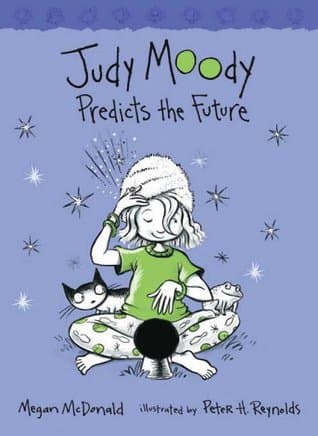
Megan McDonald (2003)
Genre
Children's / Young Adult
Reading Time
60 min
Key Themes
See below
Sign in to track this book
Armed with a mood ring and a flair for the dramatic, Judy Moody makes outrageous predictions, leaving her friends and family to wonder if her premonitions are real or just another one of her unforgettable moods.
Judy Moody is in a bad mood, specifically a 'stink' mood, when her friend Rocky buys a mood ring from the novelty shop. Judy is curious and buys one too, hoping it will help her understand her changing moods. The ring changes colors, supposedly showing her feelings (blue for calm, black for angry, etc.). Later, at home, Judy is trying to decide what to wear for 'Wacky Wednesday' at school. She puts on her mood ring, and it turns green. Suddenly, she predicts that her brother, Stink, will spill his milk, which he promptly does. This unexpected event makes Judy think: maybe her mood ring isn't just about moods, but about predicting the future. She decides to test this new 'psychic' ability.
Judy arrives at school for 'Wacky Wednesday' in mismatched clothes, ready to try her predictive powers. During morning announcements, her mood ring turns green, and she predicts that Ms. Pinky, the principal, will announce a test. To everyone's surprise, Ms. Pinky announces a pop quiz in math. Later, in class, Judy's ring turns yellow, and she predicts that her teacher, Mr. Todd, will show a movie. Again, Mr. Todd announces they will watch a film about the Amazon rainforest. These accurate predictions start to convince her classmates, Rocky and Frank Pearl, that Judy might be psychic. Judy herself starts to believe it too, enjoying the attention and the excitement of her supposed ability.
The third-grade class is getting ready for a spelling bee. Judy's mood ring turns yellow, and she predicts that Frank Pearl will win. This prediction causes a stir among her classmates, especially Frank, who becomes nervous, and Jessica Finch, who is a strong speller and now feels extra pressure to prove Judy wrong. During the spelling bee, Judy watches Frank closely, trying to make her prediction come true. As the competition goes on, Frank struggles with his words, making it seem unlikely that Judy's prediction will happen. Jessica Finch, as expected, performs well, adding to the tension in the classroom.
During the spelling bee, Frank Pearl, despite Judy's earlier prediction, mispronounces 'hippopotamus' and is out. Jessica Finch correctly spells 'chimpanzee' and wins the spelling bee, to the class's applause and Judy's disappointment. Her mood ring, which she had been relying on, turns black, showing her anger and frustration. Judy feels like a fraud and is embarrassed that her prediction for Frank did not come true. Her classmates, who had been impressed by her earlier predictions, now look at her with doubt. Judy realizes that her 'psychic' abilities might not be as real as she thought, leading her to question the true power of her mood ring and her own intuition.
Feeling bad about her failed spelling bee prediction, Judy decides she needs professional help to understand her powers. With her brother Stink, she visits Madame LaZoom, a local psychic. Madame LaZoom lives in a house filled with crystals, candles, and a crystal ball. Judy asks Madame LaZoom to predict her future, specifically whether she will ever win a spelling bee. Madame LaZoom, however, offers only vague predictions, such as Judy being 'surrounded by friends' and 'finding something lost.' Judy and Stink are not impressed by the experience, as Madame LaZoom's predictions lack the specific, immediate nature of Judy's earlier 'hits.'
After visiting Madame LaZoom, Judy returns home, still thinking about predictions. She finds that her homework, a drawing of a 'super-duper secret animal,' is missing. Frantically, she searches her room, convinced it's lost forever. Her mood ring turns a frantic red. Suddenly, she has an idea, a strong feeling that her homework is 'under the bed.' She confidently tells Stink her prediction, who is skeptical. They both look under her bed, and to Judy's surprise and relief, her drawing is there, crumpled but found. This unexpected success makes Judy believe again, not necessarily in her mood ring, but in her own inner 'sixth sense.'
The local pet show is coming up, and Stink plans to enter his pet, a three-toed sloth named Toady. Judy, feeling her predictive abilities are back after finding her homework, has a strong feeling that Stink and Toady will win the 'Most Unusual Pet' award. She confidently tells Stink her prediction, making him excited and nervous. Jessica Finch is entering her cat, Sir Reginald, and Rocky is entering his dog, Dogzilla. The competition is tough, and Judy watches closely, hoping her prediction will come true. She still wears her mood ring, but her focus has shifted from the ring's colors to her own internal feelings and intuition.
At the pet show, the judges like Toady the sloth's uniqueness. To Judy's delight and Stink's excitement, Toady wins the 'Most Unusual Pet' award. Judy's prediction has come true! This success, combined with the earlier homework incident, helps Judy understand something important. She realizes that her predictions weren't always tied to her mood ring's colors, but often came from a strong gut feeling or observation. She concludes that her 'psychic' ability is not about the ring itself, but about paying attention, making educated guesses, and sometimes, just having a lucky feeling. She still enjoys her mood ring but no longer relies on it as a magical predictor of the future, instead valuing her own intuition.
The Protagonist
Judy starts by believing a mood ring gives her psychic powers, but through trial and error, she learns to distinguish between genuine intuition and mere coincidence.
The Supporting
Stink remains a constant, slightly skeptical yet supportive presence, often benefiting from Judy's eventually accurate intuition.
The Supporting
Rocky observes Judy's journey, reflecting the initial awe and eventual understanding of her 'powers'.
The Supporting
Frank's character arc is minor, mostly reacting to Judy's prediction and its outcome, which serves to advance Judy's understanding.
The Supporting
Jessica consistently demonstrates academic excellence, providing a contrast to Judy's more whimsical approach to success.
The Supporting
Mr. Todd remains a steady and consistent authority figure, serving as a catalyst for some of Judy's initial 'successful' predictions.
The Mentioned
Madame LaZoom's role is static, providing a counterpoint to Judy's evolving understanding of prediction.
The Supporting
Toady's presence leads to Stink's pet show victory, confirming Judy's final, accurate prediction.
The book explores the line between intuition and coincidence. Judy first thinks her successful predictions are from a magical mood ring, but as the story goes, she learns that some 'predictions' are just lucky guesses or paying attention to small details. Her failed spelling bee prediction for Frank Pearl shows the role of chance, while her successful prediction about her homework and Stink's pet show win show that sometimes, a strong gut feeling or an educated guess can feel like a prediction. Ultimately, Judy learns to trust her own inner sense rather than a magical object.
“"It wasn't the ring. It was me!"”
Judy's journey is one of self-discovery, as she deals with her belief in her own abilities. First, she believes the mood ring is the source of her 'powers.' However, through successes and failures, she gradually realizes that any 'psychic' ability she has comes from within herself — from her observations, her quick thinking, or her gut feelings. This theme shows the importance of trusting one's own judgment and recognizing one's strengths, rather than relying on external objects or superstitions.
“"Maybe she really did have a sixth sense. A Judy sense."”
The book touches on how predictions and expectations can influence outcomes and perceptions. Judy's predictions, especially about the spelling bee, create pressure and nervousness for Frank Pearl. Her classmates are swayed by her first 'hits,' showing how easily people can be convinced by seemingly supernatural events. This theme shows how belief and suggestion can shape reality, even if the 'predictions' themselves are not truly psychic.
“"Frank Pearl looked like he might throw up his lunch. Judy's prediction was making him nervous."”
The story celebrates a child's imagination. Judy's belief in her psychic powers, her dramatic reactions, and her creative problem-solving (like visiting a real psychic) are all typical of childhood play and fantasy. The book embraces the joy and seriousness with which children engage with imaginary scenarios, even as it gently guides Judy towards a more realistic understanding of the world. Her 'Wacky Wednesday' outfit and Stink's unique pet further show the fun and creativity in the children's world.
“"A mood ring! It was just what she needed to keep track of her moods. All one hundred and one of them."”
A novelty item that acts as a catalyst for Judy's belief in her psychic powers.
The mood ring is the central plot device that kickstarts Judy's adventure. Initially, she uses it to track her moods, but after a few coincidental 'predictions,' she attributes psychic powers to it. The changing colors of the ring (green for predicting, black for angry, yellow for happy) become a visual representation of Judy's perceived abilities and her emotional state. The ring serves as a tangible symbol of her belief in magic, which she eventually outgrows as she learns to trust her own intuition.
A narrative structure where Judy makes a series of predictions with varying outcomes.
The story is structured around a series of predictions made by Judy, each with a different result. This arc allows the author to explore the themes of coincidence, intuition, and the power of suggestion. The initial successful predictions build suspense and convince characters (and the reader) of Judy's powers, while the failed spelling bee prediction creates a turning point. The arc culminates in a successful prediction based on intuition, providing a clear resolution to Judy's journey of understanding her 'abilities.'
Characters who highlight aspects of Judy's personality or challenge her beliefs.
Characters like Jessica Finch and Madame LaZoom serve as foils to Judy. Jessica, with her academic prowess and logical approach, contrasts with Judy's more whimsical and superstitious nature, especially during the spelling bee. Madame LaZoom, a 'professional' psychic who offers vague predictions, highlights the specificity and personal connection Judy feels to her own 'predictions,' making Judy realize her intuition is more valuable than generic fortune-telling. These characters help Judy to better understand herself and the true nature of prediction.
Judy's inner thoughts and feelings, revealing her developing understanding.
A significant portion of the story is told through Judy's internal monologue, allowing readers direct access to her thoughts, moods, and evolving beliefs. This device is crucial for understanding her conviction in her psychic powers, her disappointment when predictions fail, and her eventual realization that her 'powers' stem from her own observation and intuition rather than a magical object. It provides insight into her childlike logic and emotional responses, making her journey of self-discovery more personal and relatable.
“I, Judy Moody, will predict the future. I will be a Moody psychic. I will be Judy the Great.”
— Judy decides she has psychic abilities after a lucky guess.
“What if her fortune-telling abilities were gone? What if they had left her like a runaway dog?”
— Judy worries she's lost her psychic powers after a prediction goes wrong.
“Her crystal ball was a super-bouncy, grape-scented, glow-in-the-dark bouncy ball.”
— Judy uses a toy bouncy ball as her 'crystal ball' for predictions.
“Stink was a pest, a bother, a little brother who sometimes smelled.”
— Judy's typical sibling perspective on her brother, Stink.
“It was just a plain, ordinary, run-of-the-mill, nothing-special, boring, ho-hum, yawn-inducing, everyday kind of day.”
— Judy describes a day before her 'psychic' abilities emerge, highlighting her desire for excitement.
“She could see it! She could feel it! She could taste it! Judy Moody had a psychic premonition!”
— Judy's exaggerated reaction to what she believes is a genuine psychic vision.
“The future was not something you could just look up in a book. It was a mystery.”
— Judy reflects on the unpredictable nature of the future.
“Maybe predicting the future was more fun than actually knowing it.”
— Judy considers whether the anticipation is better than certainty.
“She tried to predict what she would have for lunch. She tried to predict what kind of socks she would wear.”
— Judy practices her 'powers' on mundane daily events.
“It was a good thing she was Judy Moody, and not Judy Mopey.”
— Judy's positive self-talk, refusing to be sad or discouraged.
“Sometimes, even if you try your very hardest, things don't always go the way you predict.”
— Judy learns a lesson about the unpredictability of life.
“She just had to pay attention. Really, really pay attention to everything.”
— Judy realizes observation skills are more useful than psychic powers.
“Being a kid was hard work, especially when you were trying to predict the future.”
— Judy's humorous take on the challenges of childhood.
“It was like having a secret power, but without the cape and the flying.”
— Judy describes the feeling of having special insight.
“Maybe the best predictions are the ones you make happen yourself.”
— Judy's ultimate realization about agency and making your own future.
Ready to see how well you understood this book? Take our interactive quiz with 10 questions.

Biography coming soon.

Dan Gemeinhart
4.5

Kate O'Hearn
4.4

Jeanne Birdsall
4.4

Jen Wang
4.4

Wendelin Van Draanen
4.3

John Marsden
4.3

Chris Van Allsburg
4.3

Jennifer A. Nielsen
4.2