“"The world seems to be constructed in such a horrible way that the most necessary things are those which are most hated."”
— Jude's early reflections on his ambition for learning and the obstacles he faces.

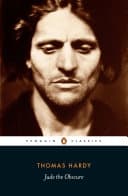
Thomas Hardy (1995)
Genre
Historical Fiction
Reading Time
10-12 hours (based on 418 pages and average reading speed)
Key Themes
See below
Sign in to track this book
A stone mason's intense pursuit of knowledge and love collapses against class barriers, social rules, and a tragic fate tied to his free-spirited cousin in Victorian England.
Jude Fawley, an orphaned boy living in Marygreen with his great-aunt, becomes fascinated with the distant university city of Christminster. He spends his youth reading classical texts and teaching himself Latin and Greek, hoping to become a scholar and a divine. His studies are interrupted by his attraction to Arabella Donn, a coarse but attractive village girl. Arabella tricks Jude into marriage by pretending to be pregnant, trapping him in a life he did not want. The marriage is a disaster, marked by their incompatibility and Arabella's narrow-mindedness. She eventually leaves him and moves to Australia with her parents, leaving Jude free but disappointed, though still legally bound.
After Arabella leaves, Jude moves to Christminster, hoping to enroll in one of the university colleges. He works as a stone mason, spending his evenings studying and watching academic life from afar. However, his humble background and lack of formal education are impossible barriers; his applications are rejected, often with condescending advice. During this time, he learns of his cousin, Sue Bridehead, who is studying at a teacher training college in the city. Intrigued by her intelligence and independent spirit, Jude seeks her out. Their first meetings show an immediate intellectual and emotional connection, though Sue is cautious and values her independence most.
Sue Bridehead, feeling stifled by the strict environment of the teacher training college and her own unconventional views, runs away to live with Jude. Their platonic cohabitation raises eyebrows, and Jude, aware of social expectations and his own feelings for Sue, encourages her to consider her options. Meanwhile, Richard Phillotson, Jude's former schoolmaster and a kind, scholarly man, has proposed marriage to Sue. Phillotson, much older than Sue, knows her eccentricities but genuinely cares for her. Despite her deep affection for Jude and her dislike of conventional marriage, Sue, perhaps wanting stability or to avoid scandal, eventually agrees to marry Phillotson, much to Jude's despair.
Jude’s marriage to Arabella is still legally binding, though she is far away. Sue's marriage to Phillotson quickly goes wrong. Sue finds the physical intimacy of marriage repulsive and her intellectual freedom limited. Phillotson, recognizing her deep unhappiness and her strong, though perhaps unacknowledged, love for Jude, makes the unusual decision to grant her a separation. This selfless act, though scandalous, allows Sue to return to Jude. Their bond, initially platonic, deepens as they live together, sharing their intellectual pursuits and their increasingly unconventional views on marriage and social norms. They are drawn to each other by a strong, often unexpressed, emotional and intellectual connection.
Jude and Sue, now both free from their previous spouses (Jude's divorce from Arabella is final, and Sue is separated from Phillotson), choose to live together as unmarried partners. They travel from town to town, seeking work and trying to escape society's judgment. Jude continues his work as a stone mason, while Sue attempts teaching, but their 'irregular' relationship makes it hard for them to find steady employment or acceptance. They face constant scrutiny, whispers, and outright rejection from landlords, employers, and the public. Despite these hardships, their intellectual and emotional bond stays strong, and they find comfort in each other's companionship and shared ideals, even as their circumstances become more difficult.
Arabella Donn unexpectedly returns from Australia, bringing a young boy, Little Father Time, who she claims is Jude's son. Jude, despite his initial shock and the disruption this causes to his life with Sue, accepts the boy. Soon after, Sue gives birth to two children of her own with Jude. Their household now includes Jude, Sue, Little Father Time, and their two infants. The financial strain on Jude, who struggles to find work due to his reputation, becomes immense. The children further complicate their already uncertain social standing, making it even harder for them to find housing and employment, as society views their arrangement with increasing disapproval.
Jude, still holding onto his academic dreams, makes one last desperate attempt to return to Christminster, hoping to find work and perhaps some acceptance. He brings his family, including the three children, to the city, but their arrival is met with the usual social condemnation. They cannot find suitable lodgings, and their poverty deepens. Little Father Time, an unusually melancholic and philosophical child, becomes acutely aware of their family's outcast status and the burden they place on his parents. Overwhelmed by the world's indifference and their bleak future, and believing he is helping his parents by reducing their burden, he tragically kills his younger siblings and then himself.
The deaths of the children completely devastate Jude and Sue. The tragedy pushes Sue to the edge of madness, and she sees the events as divine punishment for their 'sinful' cohabitation and defiance of conventional marriage. Overcome with guilt and a desperate need for forgiveness, she undergoes a profound and extreme religious conversion. She believes that their suffering is God's judgment and that they must atone for their 'crimes.' This leads her to an increasingly ascetic and self-punishing lifestyle, rejecting all earthly comforts and pleasures, including Jude's love. She becomes convinced that her only path to salvation is to return to her lawful husband, Richard Phillotson.
Driven by her overwhelming guilt and religious fervor, Sue divorces Jude and, against Phillotson's initial reluctance and her own deep-seated dislikes, remarries him. This act is a deep betrayal for Jude, who cannot understand her radical change. He tries to reason with her, reminding her of their shared ideals and love, but Sue remains firm, believing her actions are necessary for her soul's salvation. Devastated and broken by Sue's departure and the loss of his children, Jude's health quickly declines. He succumbs to illness, made worse by his constant struggles and deep emotional pain, finding comfort only in alcohol.
Jude, now completely alone and gravely ill, finds himself again with Arabella. She returns to him, supposedly to nurse him in his final days, but her motives are, as always, self-serving. She sees a chance to gain some financial benefit or at least avoid social criticism by appearing to care for her dying husband. Jude, weakened and resigned, cannot resist her presence. His last days are marked by deep sadness, a longing for Sue, and bitter thoughts on his failed ambitions and life's cruelties. He remains intellectually and emotionally distant from Arabella, despite her physical closeness.
In a moment of delirium or desperate clarity, Jude, on his deathbed, overhears a procession from Christminster. He gathers his last strength to quote Job 3:3-11, a passage expressing a deep wish for death and release from suffering. This act is his final, bitter sermon, a lament against life's unfulfilled promise and the crushing weight of social judgment and personal failure. His words are a direct accusation against the institutions and rules that stopped his ambitions and destroyed his happiness. He dies shortly after, his dreams of scholarship and love shattered, leaving behind only the cynical Arabella.
After Jude's death, Arabella quickly moves on, showing little real grief. She attends his funeral, mainly concerned with appearances and her own future. She later reunites with her former lover, Cartlett, and returns to her previous life, seemingly unaffected by the profound tragedy that has happened. Sue Bridehead, still caught in her self-imposed religious penance with Phillotson, remains tormented by her past and the memory of Jude. The novel ends with the sense that the cycles of disappointment, social limits, and personal suffering will continue, and that Jude's life, despite his great intelligence and noble aspirations, will largely be forgotten, an obscure footnote in a world that refused to accept him.
The Protagonist
Jude begins as an idealistic youth, full of hope, but gradually descends into disillusionment, despair, and finally death, his dreams crushed by societal barriers and personal tragedy.
The Co-protagonist/Love Interest
Sue evolves from a fiercely independent, anti-establishment intellectual to a guilt-ridden, religiously fanatical woman who sacrifices her happiness for perceived atonement.
The Antagonist
Arabella remains largely static, a consistent force of earthy pragmatism and self-interest throughout the novel.
The Supporting
Phillotson's arc involves a fall from societal grace due to his compassionate decision, followed by a quiet reinstatement, and a re-marriage to Sue driven by her religious penance.
The Supporting/Symbolic
Little Father Time's brief arc moves from a melancholic observer to a desperate actor, culminating in a tragic, symbolic sacrifice.
The Supporting
Aunt Drusilla remains a static figure, representing the traditional, often pessimistic, wisdom of the countryside.
The Mentioned
Static, providing commentary.
The Mentioned
Static, a device for Arabella's deception.
The Mentioned
Static, a symbol of Arabella's stable, if unremarkable, future.
The novel clearly shows how social class limits individual ambition. Jude Fawley, despite his intelligence and strong desire for knowledge, is repeatedly denied higher education because of his humble background and lack of money. The 'Christminster' he dreams of remains an inaccessible place, shown by the condescending rejection letters he receives. His attempts to bridge the gap between his working-class reality and his intellectual hopes are met with scorn and indifference, illustrating how rigid Victorian class structures stifle individual potential, regardless of merit. The theme highlights the unfairness of a system that values birth and wealth over talent and dedication.
“''It was not till now that he fully realized what an ironical thing it was that he should have chosen for his field of labour the very city to which his aspirations had tended, and where his dreams lay like the dead body of a dear friend.''”
Hardy criticizes the restrictive and often hypocritical nature of Victorian moral codes, particularly about marriage and cohabitation. Jude and Sue's attempts to live authentically, based on love and intellectual companionship rather than legal ties, are constantly punished by society. Their 'irregular' union leads to social exclusion, job loss, and the ultimate tragedy of their children's deaths, which Sue sees as divine retribution. The novel shows how social institutions, especially marriage, can become tools of oppression, forcing individuals into unhappy unions and condemning those who dare to defy convention. Sue's eventual return to Phillotson, driven by guilt and fear, emphasizes the immense pressure to conform.
“''The beggarly question of what he was, and of what this man was, had been with him ever since he could remember; and for a man to be a stonemason, and not a doctor or a parson, was a cruel punishment for having been born in such a position.''”
The novel explores the complex and often contradictory aspects of human relationships. Jude and Sue's bond is primarily intellectual and spiritual, a meeting of minds that goes beyond conventional physical desire, which Sue finds especially challenging. Their love is presented as a higher, more refined connection, yet it is ultimately too weak to withstand external pressures and internal neuroses. In contrast, Jude's relationship with Arabella is purely physical and practical, without intellectual or emotional depth. Hardy questions whether true love can survive in a world that prioritizes social norms over individual happiness, suggesting that a purely spiritual connection, while deep, may be too fragile for life's harsh realities.
“''I think I am an idealist… I can't bear to associate with any one for long, except you. And I can't bear to be married to you, either!''”
A strong sense of fatalism runs through the novel, suggesting that characters are often controlled by forces beyond them. Jude's life is a series of misfortunes, from his early, ill-fated marriage to Arabella to his persistent inability to achieve his academic dreams. The story often hints at an indifferent or even malicious universe, where human aspirations are destined to be stopped. While characters make choices, these choices often seem to lead inevitably to suffering, reinforcing the idea that individuals are trapped by their circumstances, their pasts, and the inherent 'curse' of their nature or lineage. The tragic death of the children, especially Little Father Time's philosophical despair, underscores this pervasive sense of determinism.
“''Events did not rhyme with principles.''”
Jude initially hopes to become a divine, reflecting a traditional path to intellectual and spiritual fulfillment. However, his experiences lead him to question and ultimately lose his faith in conventional Christianity and its institutions. Sue, too, is a skeptic, initially rejecting religious dogma. Yet, facing immense tragedy, Sue undergoes a radical religious conversion, seeing their suffering as divine punishment and seeking atonement through extreme self-denial. This theme explores the void left by declining traditional faith and the desperate, sometimes destructive, ways individuals seek meaning and comfort in a world that offers little solace, highlighting the human need for belief even when it leads to suffering.
“''I am in a chaos of principles--groping in the dark--for a little light.''”
Hints at future tragic events and character fates.
Hardy frequently employs foreshadowing to create a sense of impending doom and inevitability. Early in the novel, Jude's great-aunt makes comments about the Fawley family's history of unhappy marriages and ill-fated intellectual pursuits, hinting at Jude's own tragic trajectory. Little Father Time's melancholic nature and his early expressed wish never to have been born strongly foreshadow his eventual, devastating act. These subtle and sometimes overt hints contribute to the novel's fatalistic atmosphere, suggesting that the characters' fates are largely predetermined, amplifying the sense of tragedy as events unfold.
The contrast between expectation and reality, often with tragic results.
Irony is a pervasive device in *Jude the Obscure*, highlighting the gap between characters' aspirations and their grim realities. Situational irony is evident in Jude's move to Christminster, the very city of his dreams, only to find himself an outcast, working as a stone mason on the colleges he can never attend. Dramatic irony occurs when the reader understands the destructive nature of certain choices (like Sue's extreme penance) before the characters fully grasp their consequences. The entire narrative is an ironic commentary on the 'obscurity' of Jude, whose profound intellect and noble spirit are ignored by a society obsessed with superficial distinctions, ultimately leading to his tragic demise.
Objects, places, and characters representing abstract ideas.
Hardy uses rich symbolism to deepen the novel's themes. Christminster symbolizes unreachable intellectual aspiration and societal exclusion. The pigs, particularly the one Arabella slaughters, represent the raw, earthy, and often brutal realities of life that clash with Jude's refined sensibilities. Little Father Time is a powerful symbol of inherited suffering, the crushing weight of societal judgment, and the ultimate despair of a world that offers no hope. Phillotson's schoolhouse symbolizes conventional education and morality, which Sue initially rejects but eventually returns to, representing her forced conformity. These symbols infuse the narrative with deeper layers of meaning, underscoring the novel's critique of Victorian society.
An all-knowing narrator who comments on society and fate.
The novel is told by an omniscient third-person narrator who frequently interjects with philosophical observations and moral judgments. This narrative voice is often detached and fatalistic, emphasizing the characters' powerlessness against societal forces and an indifferent universe. The narrator provides insights into the characters' inner thoughts and motivations while also maintaining a critical distance, allowing for a broader commentary on the human condition and the injustices of Victorian society. This detached yet knowing perspective reinforces the tragic tone and the sense of inevitability that pervades Jude's story, framing it as a universal struggle against an unyielding world.
“"The world seems to be constructed in such a horrible way that the most necessary things are those which are most hated."”
— Jude's early reflections on his ambition for learning and the obstacles he faces.
“"It was a moment when the ties of blood were as naught, and the only bond was the equality of their misfortune."”
— Describing the shared desolation between Jude and Sue.
“"We are a base, heartless, immoral, and degraded crew, I know. But we are not so bad as you think."”
— Sue Bridehead's ironic self-assessment of her and Jude's unconventional relationship.
“"The letter 'A' was a cross. He had never before seen a 'cross' which was not a 't'."”
— Jude's early struggle with literacy, highlighting his humble beginnings.
“"I am in a vale of tears, and never shall I get out of it again."”
— Jude's despair after a series of misfortunes and rejections.
“"The social moulds are constructed to hold so much, and no more."”
— Reflecting on the rigid social structures that limit individual aspirations.
“"You are a creature of your time, Jude. You cannot escape your destiny."”
— A general observation on Jude's inability to transcend his circumstances.
“"Marriage is a sort of legal adultery, isn't it?"”
— Sue Bridehead's radical view on marriage, challenging conventional norms.
“"The University was to him a sort of Holy City, thither he was bound."”
— Jude's initial idealized vision of Christminster (Oxford University).
“"We are a jaded, sorry couple, are we not?"”
— Jude's weary assessment of his and Sue's situation after much hardship.
“"The great social law was against them, and they were against the great social law."”
— Describing Jude and Sue's conflict with societal expectations and norms.
“"It was no use to him to have come to Christminster, if he could not be one with its spirit."”
— Jude's realization that his presence in Christminster doesn't equate to acceptance or belonging.
“"Is there anything more ruinous than a good education for a poor man?"”
— Jude's bitter reflection on how his aspirations for learning have led to his downfall.
“"The ultimate aim of the universe is to produce a good man, but it does not succeed."”
— A philosophical musing on the nature of existence and human suffering.
Ready to see how well you understood this book? Take our interactive quiz with 10 questions.
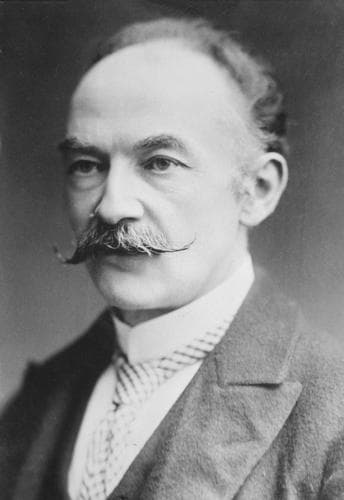
Thomas Hardy was an English novelist and poet. A Victorian realist in the tradition of George Eliot, he was influenced both in his novels and in his poetry by Romanticism, including the poetry of William Wordsworth. He was highly critical of much in Victorian society, especially on the declining status of rural people in Britain, such as those from his native South West England.







