“All that is gold does not glitter, Not all those who wander are lost.”
— A poem about Aragorn's true nature.

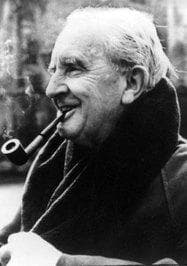
J.R.R. Tolkien (1955)
Genre
Fantasy / Young Adult
Reading Time
28-30 hours
Key Themes
See below
Sign in to track this book
A hobbit's journey to reclaim a dragon's treasure turns into a fight for Middle-earth against the darkness of the One Ring.
Bilbo Baggins, a hobbit in the Shire, likes his quiet life. Then the wizard Gandalf arrives, with thirteen dwarves led by Thorin Oakenshield. Gandalf has named Bilbo the 'burglar' for their trip. They want to get the dwarves' treasure back from the dragon Smaug in the Lonely Mountain. Bilbo does not want to go at first. He likes comfort, but he is taken on the adventure. Their trip has many dangers. These include trolls, goblins in the Misty Mountains where Bilbo finds a magic ring after a riddle game with Gollum, and the Mirkwood forest. There, they meet giant spiders and are caught by Wood-elves. Bilbo's new ring makes him invisible and helps his friends.
After leaving the Wood-elves, the group reaches Lake-town. The people there are excited about Smaug's defeat. Bilbo uses the secret entrance found on Durin's Day. He goes into the Lonely Mountain and talks to Smaug. He finds a weak spot on the dragon's belly. Smaug gets angry and flies to destroy Lake-town. But Bard the Bowman, a descendant of Dale's lords, kills Smaug by shooting his weak spot. News of Smaug's death brings Men, Elves, and Goblins (led by Bolg) to claim the treasure. Thorin, wanting the treasure for himself, will not share. This creates a tense situation. Gandalf tells them a goblin army is coming. This makes Men, Elves, and Dwarves form a shaky alliance. The Battle of Five Armies follows, with many losses.
During the Battle of Five Armies, Thorin is badly hurt. He makes peace with Bilbo before he dies. Bilbo goes back to the Shire. He has changed, but his neighbors think he is strange. He keeps the magic ring he found, not knowing its true power. Sixty years later, for his 111th birthday, Bilbo leaves the Shire. He gives the ring to his nephew, Frodo Baggins. Soon after, Gandalf tells Frodo the ring's terrible truth: it is the One Ring, made by Sauron. It wants to go back to its master. Sauron's power is growing in Mordor. He sends his Nazgûl, the Ringwraiths, to find it in the Shire. Frodo must run.
Frodo, with his gardener Samwise Gamgee, and later Merry Brandybuck and Pippin Took, begins a dangerous trip to Rivendell. They escape the Nazgûl many times. They get help from people like Tom Bombadil and Strider (who is secretly Aragorn, the heir to Gondor's throne). Frodo is hurt by a Morgul-blade on Weathertop. Aragorn takes them to Rivendell, where Elrond heals Frodo. A council is held, with people from all free lands. The Council of Elrond decides the One Ring must be destroyed in Mount Doom in Mordor, the only place it can be unmade. Frodo offers to carry the Ring. The Fellowship of the Ring is formed to help him.
The Fellowship, with Frodo, Sam, Merry, Pippin, Gandalf, Aragorn, Legolas, Gimli, and Boromir, leaves Rivendell. They try to cross the Misty Mountains. A snowstorm stops them. They must take a dangerous path through the Mines of Moria. There, they meet goblins and a Balrog, an old demon. Gandalf fights the Balrog and falls into a deep hole, seeming to die. The rest of the Fellowship goes to Lothlórien, the land of the Galadhrim Elves. Galadriel and Celeborn give them gifts and advice. As they travel down the Anduin River, the Ring's power to corrupt grows. Boromir, wanting to save his people, tries to take the Ring from Frodo at Amon Hen. Frodo knows the danger. He decides to continue his trip alone, but Sam will not leave him.
After the Fellowship breaks, Merry and Pippin are caught by Uruk-hai, Saruman's Orcs. The Orcs want to take them to Isengard. Boromir is badly hurt defending them. Aragorn, Legolas, and Gimli chase the Orcs across Rohan. Merry and Pippin escape their captors in Fangorn Forest. They meet Treebeard, the oldest Ent, an ancient tree-herder. They tell Treebeard and the other Ents about Saruman's betrayal and how he destroyed the forest. The Ents get angry. They march on Isengard. They defeat Saruman's fortress of Orthanc and trap him in his tower. Meanwhile, Aragorn, Legolas, and Gimli meet Gandalf. He is now Gandalf the White. He has come back to life and has more power after fighting the Balrog.
Gandalf the White joins Aragorn, Legolas, and Gimli. They ride to Edoras to free King Théoden of Rohan from Gríma Wormtongue's influence. Gríma is secretly working for Saruman. Théoden, now clear-headed, decides to fight Saruman. He leads his people to the stronghold of Helm's Deep for defense. Gandalf rides to get more fighters. Saruman's large army of Uruk-hai and Dunlendings attacks Helm's Deep. The defenders, including Aragorn, Legolas, Gimli, and Théoden, fight bravely all night against many enemies. At dawn, Gandalf arrives with Éomer and the Rohirrim cavalry. This changes the battle. Saruman's forces are defeated. Many of the remaining Orcs are driven into Fangorn Forest and killed by the awakened Huorns.
Meanwhile, Frodo and Sam continue their hard trip to Mordor. They cross the empty Emyn Muil. Gollum, who has been tracking the Ring, ambushes them. Frodo shows mercy. He controls Gollum and makes him promise to guide them to Mordor. Gollum leads them through the Dead Marshes and then to the Black Gate, which they cannot pass. Gollum then suggests a secret, dangerous path through the pass of Cirith Ungol. On the way, Faramir, Boromir's brother, captures them. He resists the Ring's temptation, unlike his brother. He lets them continue their trip, warning them of dangers ahead. Frodo and Sam trust Gollum and follow him to the hidden entrance to Mordor.
Gollum leads Frodo and Sam into Shelob's terrifying lair. Shelob is an old, giant spider. Gollum wants Shelob to kill Frodo so he can get the Ring back. Shelob stings Frodo, making him unable to move. But Sam bravely fights her off with Sting and the Phial of Galadriel, hurting the spider badly. Sam thinks Frodo is dead. He takes the Ring to continue the quest. But Orcs arrive and take Frodo's body. They reveal he is only unconscious. Sam is sad but determined. He follows them into the Orc-tower of Cirith Ungol. At the same time, Mordor's forces attack Gondor. Denethor, the Steward of Gondor, loses hope. Gandalf and Pippin arrive in Minas Tirith, getting ready for the attack. Aragorn tries to gather allies.
Mordor's forces, led by the Witch-king of Angmar, attack Minas Tirith. The city's defenses are almost broken. Denethor, made mad by Sauron's influence and sadness, tries to burn himself and Faramir. But Pippin and Gandalf save Faramir. Meanwhile, Aragorn, with Legolas, Gimli, and the Grey Company, takes the dangerous Paths of the Dead. He calls the Oathbreakers, an army of ghosts bound by a curse to help the King of Gondor. They appear on the southern coasts. They scare the Corsairs of Umbar and the Haradrim. They sail up the Anduin. They arrive at the Pelennor Fields just as the Rohirrim, led by King Théoden, charge into battle. The Witch-king kills Théoden. But Éowyn, dressed as a man, and Merry bravely defeat the Witch-king.
Even with the win at the Pelennor Fields, Sauron's power is great. To create a distraction and give Frodo a chance to reach Mount Doom, Aragorn, Gandalf, and the captains of the West lead a small army to the Black Gate of Mordor. They want to draw Sauron's remaining forces away from Mount Doom. Inside Mordor, Sam saves Frodo from the tower of Cirith Ungol after a hard fight with Orcs. Tired and hurt by the Ring, they go to Mount Doom. At the Crack of Doom, Frodo gives in to the Ring's power and claims it. But Gollum, driven by his obsession, attacks Frodo. He bites off Frodo's finger with the Ring. In his joy, he slips and falls into the lava, destroying the One Ring forever.
When the One Ring is destroyed, Sauron's power is completely broken. His fortress falls, and his armies are defeated. Aragorn is crowned King Elessar of the Reunited Kingdom of Gondor and Arnor. The Fellowship members go home. But Saruman and his men have ruined the Shire while the hobbits were away. Frodo, Sam, Merry, and Pippin, now experienced fighters, lead the hobbits in the Scouring of the Shire. They drive out Saruman's forces and fix their home. Peace returns, but Frodo has deep scars, both body and spirit, from his hard journey. Years later, Frodo, Bilbo, Gandalf, Elrond, and Galadriel leave from the Grey Havens to the Undying Lands. This is a final trip for the Ring-bearers and the last of the Elves. They leave Middle-earth for Men. Sam returns to the Shire, becomes Mayor, and lives his life.
The Protagonist
Frodo transforms from an innocent hobbit into a world-weary hero, sacrificing his own peace of mind for the salvation of Middle-earth.
The Supporting
Gandalf undergoes a spiritual rebirth, returning with greater power and clarity to lead the forces of good against Sauron.
The Protagonist
Aragorn accepts his destiny, proving his worthiness to reclaim his ancestral throne and uniting the fragmented kingdoms of Men.
The Supporting
Sam grows from a humble gardener into a true hero, demonstrating unwavering loyalty and courage that proves crucial to the quest's success.
The Antagonist/Supporting
Gollum remains consumed by his obsession with the Ring, leading him to his ultimate, accidental role in its destruction.
The Antagonist
Sauron's power grows throughout the narrative until his ultimate and complete downfall with the destruction of the One Ring.
The Supporting
Bilbo transitions from a home-loving hobbit to an adventurous spirit, eventually passing on his burdens and finding peace in the Undying Lands.
The Supporting
Legolas overcomes ancient racial prejudices to forge a deep friendship with Gimli, symbolizing unity among the free peoples.
The Supporting
Gimli transforms from a proud, prejudiced Dwarf into a loyal friend of Elves, demonstrating the power of unity and mutual respect.
The Antagonist
Saruman falls from a wise leader to a corrupt tyrant, driven by ambition and a lust for power, ultimately leading to his demise.
The One Ring is the main symbol of this idea. Its evil and power to corrupt even good hearts are clear in the story. From Gollum's long suffering to Boromir's sad try to take it from Frodo, the Ring shows that power, especially all power, always corrupts. Even Frodo, the strongest Ring-bearer, gives in to its power at Mount Doom. This shows that no one is safe from its pull. The idea suggests that real victory is in saying no to such power, not using it.
“"Many that live deserve death. And some that die deserve life. Can you give it to them? Then do not be too eager to deal out death in judgement. For even the very wise cannot see all ends."”
This idea is best shown by the hobbits, especially Frodo and Sam. Unlike the strong Elves, powerful wizards, or brave Men, hobbits are humble, comfort-loving creatures. But Frodo, a small hobbit, is chosen to carry the Ring. Samwise, his loyal gardener, is the most steady and brave friend. Their bravery comes not from great strength or magic, but from strong loyalty, simple goodness, and lasting effort against great evil. This shows that real bravery can be found in unexpected places. It often involves quiet strength, not big acts.
“"There's some good in this world, Mr. Frodo, and it's worth fighting for."”
Friendship and loyalty are key to the quest's success and Middle-earth's survival. Frodo and Sam's bond is the clearest example. Sam's strong dedication helps Frodo through his hardest times. The growing friendship between Legolas and Gimli, closing old divides between their races, also shows this idea. The Fellowship itself is built on these ideas. Even after it breaks up, the members stay loyal to their cause and to each other. These strong, supportive relationships give strength against sadness and being alone.
“"I will take the Ring," he said, "though I do not know the way."”
Middle-earth is shown as a world changing. It moves from the age of Elves and old wonders to the age of Men. The Elves leaving for the Undying Lands, magic fading, and old kingdoms like Gondor declining show a loss. But this loss also makes way for new things. This is clearest with Aragorn becoming king and the Reunited Kingdom starting. The Scouring of the Shire, then its repair, also shows this cycle. It suggests that even with loss and change, there is always hope for new starts and new times, though often with a price.
“"The world is indeed full of peril, and in it there are many dark places; but still there is much that is fair, and though in all lands love is now mingled with grief, it may be that the grief keeps it from fading."”
The fight between good and evil is the main conflict of the whole story. It is shown by Sauron's darkness against the Free Peoples of Middle-earth. But the idea goes deeper than just opposing sides. It explores the moral choices people make. Characters like Boromir and Saruman give in to temptation. This shows the constant fight inside. Frodo's mercy to Gollum, despite the dangers, is a main moral choice that leads to the Ring's destruction. The story shows that beating evil often depends on individual acts of kindness, courage, and saying no to evil's ways, not just matching its power.
“"I wish it need not have happened in my time," said Frodo. "So do I," said Gandalf, "and so do all who live to see such times. But that is not for them to decide. All we have to decide is what to do with the time that is given us."”
A magical artifact that drives the entire narrative and embodies the corrupting nature of power.
The One Ring is the central macguffin and most significant plot device. Forged by Sauron, it grants its wearer invisibility and prolongs life but corrupts the mind and binds the wearer to Sauron's will. Its existence drives Frodo's quest, its allure tempts various characters (Boromir, Gollum), and its ultimate destruction is the only way to defeat Sauron. It is a symbol of absolute power and its inherent evil, constantly influencing the plot through its presence and absence.
The fundamental structure of the story, involving a perilous journey to achieve a crucial goal.
Both 'The Hobbit' and 'The Lord of the Rings' are fundamentally quest narratives. Bilbo's journey to the Lonely Mountain and Frodo's quest to Mount Doom form the backbone of their respective stories. This device allows for exploration of Middle-earth, encounters with diverse characters and cultures, and the development of the protagonists through hardship. The journey itself is as important as the destination, shaping the characters and revealing the vastness and perils of their world.
Foreshadowing events and highlighting the preordained roles of certain characters.
Prophecies, ancient lore, and the concept of destiny play a significant role. Aragorn's lineage and his eventual claim to the throne are tied to ancient prophecies. Gandalf's understanding of the larger cosmic struggle and his guidance often align with a sense of preordained purpose. The return of the King and the final confrontation with Sauron feel fated, even as characters make their own choices. This device adds a layer of grandeur and significance to the events, suggesting a higher order at play in Middle-earth's fate.
A recurring motif representing good and evil, hope and despair.
Light and darkness are pervasive symbols. The Eye of Sauron, Mordor's perpetual gloom, and the Nazgûl represent oppressive darkness and evil. Conversely, the Phial of Galadriel, the light of Elves, Gandalf's radiance as Gandalf the White, and the dawn breaking at Helm's Deep or the Pelennor Fields symbolize hope, goodness, and the triumph over shadow. This binary opposition reinforces the moral clarity of the conflict and provides visual cues for the narrative's thematic elements.
Gollum's perspective and guidance often mislead or endanger the protagonists.
While the main narrative is largely omniscient, Gollum's role as a guide introduces an element of unreliability. His internal conflict between Sméagol and Gollum, and his overriding obsession with the Ring, mean his intentions and guidance are always suspect. He leads Frodo and Sam through perilous paths like the Dead Marshes and, most critically, to Shelob's lair, demonstrating how his corrupted mind directly influences the plot and creates significant obstacles for the protagonists.
“All that is gold does not glitter, Not all those who wander are lost.”
— A poem about Aragorn's true nature.
“I wish it need not have happened in my time.”
— Frodo expressing regret about the burden of the Ring.
“The road goes ever on and on, Down from the door where it began.”
— Bilbo's walking song, reflecting on journeys.
“Even the smallest person can change the course of the future.”
— Galadriel to Frodo about his role.
“It's a dangerous business, Frodo, going out your door.”
— Bilbo warning Frodo about adventures.
“There is some good in this world, and it's worth fighting for.”
— Sam encouraging Frodo in Mordor.
“The world is indeed full of peril, and in it there are many dark places.”
— Gandalf discussing the dangers of Middle-earth.
“Faithless is he that says farewell when the road darkens.”
— Gimli expressing loyalty to the fellowship.
“I will not say: do not weep; for not all tears are an evil.”
— Gandalf comforting others after the Ring's destruction.
“Deeds will not be less valiant because they are unpraised.”
— Aragorn speaking about quiet courage.
“Short cuts make long delays.”
— Pippin's observation about hasty decisions.
“The burned hand teaches best.”
— Gandalf on learning from mistakes.
“He that breaks a thing to find out what it is has left the path of wisdom.”
— Gandalf criticizing destructive curiosity.
“Where there's life there's hope, and need of vittles.”
— Sam's practical optimism during hardship.
Ready to see how well you understood this book? Take our interactive quiz with 10 questions.
Biography coming soon.







