“What, do you mean like a boy, or like a man, a big man, what kind of man?”
— JR's early attempts to understand business concepts.

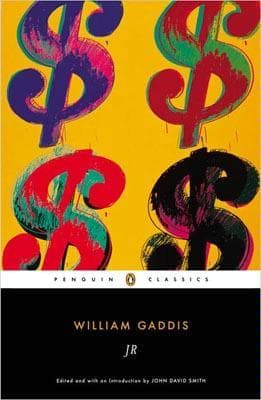
William Gaddis (1975)
Genre
Literary Fiction
Reading Time
25-30 hours
Key Themes
See below
Sign in to track this book
A sixth-grader’s mail-order ambitions explode into a nationwide corporate empire of dubious deals and disaffected adults, revealing the farcical side of American business through colliding voices.
The novel opens on a chaotic school bus ride. Sixth-grader J.R. Vansant is already trying to do business, distributing flyers for penny stocks and discussing deals. His teacher, Jack Gibbs, a struggling composer, is overwhelmed by the noise and the students' disinterest in traditional education. J.R.'s entrepreneurial spirit, fueled by mail-order ads and a basic understanding of the stock market, immediately sets the novel's tone for its look at American capitalism. He is trying to sell thousands of surplus Navy picnic forks, a deal he has already started, showing an early grasp of supply and demand, though in an unconventional setting.
J.R., with the help of some unwitting adults, particularly the bewildered Jack Gibbs, begins to acquire shares in a bankrupt textile mill in upstate New York. He uses proxies and a series of complex, often misunderstood, financial moves to gain control. The adults around him, including lawyers and brokers, are either too distracted, too incompetent, or too eager to make a quick buck to fully grasp the scale of J.R.'s operations. This early expansion sets the stage for the J.R. Corp, showing J.R.'s ability to identify undervalued assets and exploit loopholes, often with a complete disregard for ethics.
As J.R.'s financial empire grows, he acquires a sprawling, dilapidated tenement on East 96th Street in New York City. This building becomes the headquarters for the J.R. Corp. It is a hub of constant activity and even greater chaos, filled with boxes, legal documents, and a rotating cast of eccentric characters, many of whom are employees or unwilling participants in J.R.'s schemes. The tenement shows the corporation's disorganization and the tangled web of its ventures, from timber to textiles to nursing homes. It is a place where deals are made, broken, and constantly renegotiated amidst ringing phones and shouted instructions.
Jack Gibbs, initially J.R.'s teacher, finds himself pulled into the J.R. Corp's orbit. His attempts to compose music are constantly interrupted and ultimately undermined by his involvement in J.R.'s schemes. J.R., in a misguided attempt to support the arts (and perhaps for tax write-offs), funds a 'frozen music' project, which becomes another chaotic part of the corporation. Gibbs's artistic integrity is challenged as he navigates the bewildering world of finance, legal jargon, and J.R.'s relentless demands, leading to frustration and disillusionment.
A subplot involves the Farber-Schramm corporation, a complex entity that J.R. tries to acquire or merge with. This involves lawyers, brokers, and various corporate functionaries, all speaking in dense, often nonsensical jargon. The negotiations are full of misunderstandings, double-dealings, and legal quibbles, highlighting the absurdity and opacity of corporate finance. J.R.'s relentless pursuit of this acquisition, often through proxies and phone calls from payphones, further shows his detached yet effective approach to business, where the human element is largely secondary to numbers.
One of J.R.'s more questionable ventures involves establishing a chain of nursing homes, which he quickly realizes can be combined with funeral parlors for maximum profit. This scheme shows the novel's critique of unchecked capitalism, where even the most vulnerable people become commodities. The venture is handled with the same detached, profit-first mentality as all of J.R.'s other businesses, highlighting the ethical void at the heart of his empire. The bureaucratic hurdles and the callous discussions about the care of the elderly and the deceased further underscore the satirical edge of the narrative.
As J.R.'s conglomerate grows increasingly complex and sprawling, it eventually draws the attention of regulatory bodies and Congress. Investigations begin into the legality and ethics of the J.R. Corp's various operations, from its obscure financial dealings to its questionable business practices. These hearings and legal battles are portrayed with cynical humor, showing the superficiality and often performative nature of official oversight. J.R., through his proxies and lawyers, navigates these challenges with surprising agility, often by exploiting the very systems designed to regulate him, further demonstrating pervasive corruption and inefficiency.
Anselm, a talented but struggling painter, finds himself caught in J.R.'s financial web. J.R., in another attempt to manage his corporate image or for tax purposes, invests in Anselm's art. However, this patronage comes with strings attached and is subject to J.R.'s unpredictable whims and the chaotic demands of the corporation. Anselm's artistic integrity and personal life are continually disrupted by his reliance on J.R.'s money, mirroring Gibbs's struggles. His story highlights the corrosive effect of money on creative pursuits and the difficulty of maintaining artistic independence in a world dominated by commercial interests.
The vast, unwieldy, and largely fictitious J.R. Corp begins to unravel. The intricate web of shell corporations, dubious assets, and speculative investments proves unsustainable. A market downturn, particularly a significant drop in pork belly futures – a commodity J.R. has invested heavily in – acts as a catalyst for the empire's collapse. The chaotic final scenes depict a frantic scramble to salvage what little remains, with characters yelling into phones, desperate to understand what went wrong. The collapse is less a dramatic implosion and more a slow, bewildering dissolution, reflecting the ephemeral nature of J.R.'s paper empire.
After the J.R. Corp's collapse, many characters are left to pick up the pieces of their disrupted lives. Gibbs, deeply disillusioned, tries to return to his music, but the experience has left a lasting mark. Others are financially ruined or simply bewildered by the sudden disappearance of the empire they were a part of. J.R. himself, though his grand scheme has failed, remains largely unfazed, already looking for the next opportunity. The novel ends with a sense of lingering chaos and the suggestion that the cycle of speculative capitalism and human folly will continue, leaving a profound sense of the absurdity of modern life.
The Protagonist/Antagonist
J R's arc is less about personal growth and more about the relentless expansion and eventual collapse of his financial empire, demonstrating the inherent instability of his detached, purely transactional approach to life.
The Protagonist/Supporting
Gibbs devolves from an idealistic artist to a disillusioned participant in the corporate world, his creative spirit increasingly suffocated by financial entanglements, though he ultimately seeks to reclaim his artistic life.
The Supporting
Bast navigates the chaos of the J R Corp's orbit, maintaining a degree of artistic integrity despite the pervasive commercial pressures, serving as a witness to the unfolding events.
The Supporting
Amy struggles to maintain her relationship with Gibbs amidst his growing distraction and disillusionment, often feeling neglected and frustrated.
The Supporting
Frank Bast's arc reinforces the idea that legal expertise can be readily co-opted for unethical financial gain, as he thrives within the chaotic legal framework of J R's empire.
The Supporting
Anselm experiences the commodification of his art under J R's patronage, illustrating the tension between artistic creation and commercial exploitation.
The Supporting
Coen's arc is one of increasing bewilderment and futility as he attempts to impose order on the inherently chaotic and illogical operations of the J R Corp.
The novel is a scathing critique of unchecked capitalism. It portrays it as a system that prioritizes profit above all else, leading to ethical decay, human exploitation, and a devaluation of intrinsic worth. J.R.'s empire, built on speculation, loopholes, and a complete disregard for human well-being (as seen in the nursing home venture), exemplifies this. The constant transactional dialogue, where every person and object has a price, highlights how capitalism can reduce all aspects of life to mere commodities. The chaos and meaninglessness of the corporate jargon further underscore the hollowness at the heart of this system, as seen when Gibbs tries to understand the financial dealings.
“Money, money, money...everything's money. It's like a disease.”
Gaddis explores how artistic integrity and cultural value are compromised when subjected to commercial demands. Jack Gibbs's struggle to compose amidst the corporate cacophony, and Anselm's experience of having his art commodified by J.R., illustrate this theme. The 'frozen music' project, initiated by J.R. for ostensibly artistic but ultimately financial reasons, becomes a symbol of art distorted and made meaningless by corporate interference. The novel suggests that genuine creativity struggles to survive, let alone flourish, in a world obsessed with profit and efficiency, where art is seen as a tax write-off or a status symbol rather than an end in itself.
“It's all business, isn't it? Even art.”
A central theme is the breakdown of meaningful communication, replaced by jargon, clichés, and transactional dialogue. Characters often talk past each other, into phones, or at each other, rarely truly connecting or understanding. The dense, often unintelligible corporate and legal language masks a lack of substance and genuine purpose. This linguistic chaos mirrors the structural chaos of J.R.'s empire and the modern world, where information overload leads to a deficit of understanding. The endless, overlapping conversations contribute to the reader's sense of disorientation, reflecting the characters' own confusion.
“Hello? Hello? Is anyone there?”
The novel portrays modern life, particularly corporate and governmental structures, as absurd and self-perpetuating. The vast, incomprehensible bureaucracy of the J.R. Corp, with its endless paperwork, obscure regulations, and illogical decisions, highlights this. The characters are often caught in Kafkaesque situations, trying to navigate systems that defy logic. The humor in the novel often comes from the sheer ridiculousness of the situations and the characters' reactions to them, emphasizing a world where common sense is rare and the most illogical outcomes are often the most likely.
“It's not what you know, it's who you know. Or what forms you fill out.”
Dialogue presented without explicit speaker tags.
Gaddis's most distinctive stylistic choice, unattributed dialogue, forces the reader to infer who is speaking based on context, voice, and subject matter. This device immerses the reader in the chaotic, overlapping conversations, mimicking the experience of being in a crowded room or listening to multiple phone calls simultaneously. It highlights the breakdown of clear communication and the blurring of individual identities within the corporate milieu, making the reader actively participate in deciphering the narrative's meaning.
Multiple voices and conversations occurring simultaneously.
The novel is characterized by a constant stream of overlapping, fragmented conversations, often occurring in different locations (school bus, tenement, phone calls). This polyphonic structure creates a sense of overwhelming noise and information overload, mirroring the chaotic and fragmented nature of the modern world. It emphasizes the difficulty of focused thought or meaningful connection amidst the relentless chatter and transactional exchanges, effectively placing the reader within the disorienting soundscape of J R's world.
J R Vansant is rarely seen, operating mostly through intermediaries and phone calls.
J R, the central character, is almost entirely an unseen presence, conducting his vast empire from phone booths and through proxies. This absence emphasizes the impersonal, detached nature of modern finance and power. It also allows J R to function as a symbolic figure of unchecked capitalism rather than a fully developed psychological character, highlighting how abstract forces can drive real-world chaos without a visible, accountable agent. His youth further underscores the idea that the system itself is the true antagonist, operating with a childish amorality.
Humor used to critique societal norms and institutions.
Gaddis employs sharp satire and pervasive irony to expose the absurdities and hypocrisies of corporate America, the legal system, and even the art world. The humor often arises from the juxtaposition of serious financial dealings with ridiculous details, or from characters' earnest attempts to make sense of an inherently nonsensical situation. This device allows the novel to be both profoundly critical and darkly comedic, inviting the reader to laugh at the very systems that are causing such widespread dysfunction and ethical decay.
“What, do you mean like a boy, or like a man, a big man, what kind of man?”
— JR's early attempts to understand business concepts.
“The only thing that really matters is that you're making money.”
— A recurring cynical business mantra throughout the novel.
“The whole thing is, you see, a question of how you package it.”
— Illustrating the superficiality of presentations over substance.
“You can't just give people money, you have to give them something to do.”
— A perspective on charity and aid, often from a capitalist viewpoint.
“It's all in the timing, you see, it's all in the timing.”
— Business strategy and opportunistic decision-making.
“Nobody understands anything, that's the whole point.”
— A commentary on the pervasive confusion and lack of genuine understanding.
“You just keep buying and selling, that's what it's all about.”
— Simplistic view of the financial markets.
“The only reason you do anything is to make money, right?”
— Reflecting the dominant motivation in the world of JR.
“Art is a commodity, a very valuable commodity.”
— The commodification of art within the novel's commercial landscape.
“You can't trust anybody in this business, not anybody.”
— A common sentiment of paranoia and distrust in the business world.
“What does he want? He wants to be rich, that's what he wants.”
— Simplifying the aspirations of many characters.
“It's all paper, you see, just paper.”
— Highlighting the abstract and often insubstantial nature of finance.
“The less you know, the better off you are, believe me.”
— Ironic advice suggesting ignorance can be bliss or advantageous.
“You gotta diversify, that's the key, diversify.”
— A piece of financial advice, often delivered haphazardly.
Ready to see how well you understood this book? Take our interactive quiz with 10 questions.

William Thomas Gaddis, Jr. was an American novelist. The first and longest of his five novels, The Recognitions, was named one of TIME magazine's 100 best novels from 1923 to 2005 and two others, J R and A Frolic of His Own, won the annual U.S. National Book Award for Fiction. A collection of his essays was published posthumously as The Rush for Second Place (2002). The Letters of William Gaddis was published by Dalkey Archive Press in February 2013.







