“A journey of a thousand miles begins with a single step.”
— Often attributed to the novel, though it's a Chinese proverb; reflects the pilgrims' long quest.

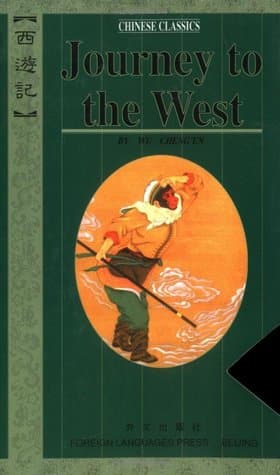
Genre
Fantasy
Reading Time
Many hours (2346 pages)
Key Themes
See below
Sign in to track this book
A mischievous monkey king, a pig, a friar, and a dragon horse escort a devout monk through a fantastical, demon-infested ancient China on a perilous quest for sacred Buddhist scriptures.
The story begins with Sun Wukong, the Monkey King, born from a magic stone on the Mountain of Flowers and Fruit. He becomes king of the monkeys and finds a waterfall leading to the Water Curtain Cave. He seeks immortality, travels the world, learns seventy-two transformations, cloud-somersaulting, and great strength from the Patriarch Subodhi. Upon his return, he gets the Ruyi Jingu Bang, a magic staff from the Dragon King of the East Sea, and removes his name from the Register of Death in the Underworld. His growing power and defiance lead the Jade Emperor to offer him a minor position in Heaven, which he soon abandons in boredom, calling himself 'Great Sage, Equal to Heaven'.
Sun Wukong's arrogance grows as he demands a higher position. He eats the Peaches of Immortality, drinks the Elixir of Immortality, and causes chaos during the Grand Festival of Immortal Peaches, defeating celestial armies. The Jade Emperor, unable to control him, asks the Buddha for help. Buddha challenges Wukong to escape his palm, a feat Wukong fails, unknowingly flipping out of Buddha's hand only to find his 'destination' was Buddha's finger. As punishment for his rebellion, Buddha traps Sun Wukong under the Five Elements Mountain for 500 years, where he stays until a destined pilgrim arrives to free him and lead him to redemption.
In the East, the Tang Emperor Taizong holds a Grand Mass for the dead. The Bodhisattva Guanyin, disguised as a monk, appears and says that the Emperor's prayers are not enough without true Buddhist scriptures from the West. The Emperor seeks a brave monk to undertake this dangerous journey. Xuanzang, a devout and virtuous monk, volunteers for the mission to retrieve the Mahayana Buddhist scriptures from India, which he believes will bring salvation and peace to the Tang Empire. He is given the name 'Tripitaka' (Sanzang) and receives a golden begging bowl and a white horse.
As Tripitaka begins his journey, he comes to the Five Elements Mountain. There, he finds Sun Wukong, who has been imprisoned for 500 years. Wukong, after much pleading and a promise to protect Tripitaka on his journey, is freed by the monk. Guanyin had told Wukong to await Tripitaka and serve him. To ensure Wukong's obedience, Guanyin gives Tripitaka a magic golden fillet, which, when worn by Wukong, allows Tripitaka to control him with a spell, causing great pain. Wukong, though initially resentful, accepts his new role as Tripitaka's protector.
Continuing their journey, Tripitaka and Sun Wukong meet Zhu Bajie (Pigsy), a former Marshal of the Heavenly Canopies who was exiled to the mortal realm and cursed into a pig-like form for a transgression. He was terrorizing a village and trying to marry a human woman. After a fierce battle and Guanyin's help, Bajie agrees to join the pilgrimage, though he remains lazy, gluttonous, and lustful. Soon after, they meet Sha Wujing (Sandy), a former Curtain-Lifting General exiled to the Flowing Sands River. He too was instructed by Guanyin to await the scripture pilgrim. Wujing, a more humble and steady character, also joins the group, completing the core team of disciples.
Early in their journey, Tripitaka's white horse is eaten by a dragon. This dragon, a son of the Dragon King of the West Sea, had been condemned to death for a crime and was saved by Guanyin, who tasked him with awaiting the pilgrim. Sun Wukong battles the dragon, but Guanyin ultimately transforms the dragon into a new white horse for Tripitaka to ride. The pilgrimage then faces many trials, including the dangerous Yellow Wind Monster, the cunning White Bone Demon, and many other spirits and demons who seek to eat Tripitaka to gain immortality. Wukong's fierce nature often clashes with Tripitaka's compassion, causing frequent tensions.
A recurring conflict happens when Sun Wukong, with his fiery eyes, sees demons disguised as humans, while Tripitaka, due to his mortal perception, sees only innocent people. The White Bone Demon shows this, repeatedly appearing in different human disguises to trick Tripitaka. Each time, Wukong slays the demon, but Tripitaka, believing Wukong is needlessly killing humans, scolds and punishes him with the golden fillet. After the third such incident, Tripitaka, frustrated and convinced of Wukong's cruelty, banishes him from the pilgrimage. Wukong, heartbroken, returns to his Mountain of Flowers and Fruit.
Without Sun Wukong's unmatched protection, Tripitaka, Bajie, and Wujing quickly fall to powerful demons. The Yellow Robe Demon captures Tripitaka and turns him into a tiger, while Bajie and Wujing are unable to defeat the formidable foe. Realizing their desperate situation, Bajie reluctantly travels back to the Mountain of Flowers and Fruit to beg Wukong for help. Despite his anger and resentment, Wukong's loyalty to his master wins out. He agrees to return, rescues Tripitaka, and defeats the Yellow Robe Demon, showing his key role in the pilgrimage.
The pilgrimage continues through many trials. They encounter the River of Weak Water, the difficult Flaming Mountains (where Wukong must borrow the Iron Fan from Princess Iron Fan and her husband, the Bull Demon King, after multiple attempts), and the Kingdom of Women (where Tripitaka almost marries the Queen). They face demons disguised as kind elders, powerful shapeshifters, and sorcerers. Each challenge tests their faith, resolve, and the bonds between the disciples, often needing Wukong's cleverness, Bajie's reluctant help, Wujing's steady support, and occasional divine intervention from Guanyin or other Buddhas and Bodhisattvas.
One of the most challenging parts involves the three powerful demon kings: the Green Lion Spirit, the Yellow Elephant Spirit, and the Golden-Winged Great Peng. These demons are so formidable that even Sun Wukong struggles to defeat them, finding himself outmatched by their combined strength and cunning. The situation becomes dire, pushing the pilgrims to their limits. Ultimately, they discover that these demons are actually mounts or relatives of powerful celestial beings – Manjushri, Samantabhadra, and the Buddha's own uncle, respectively – who have come to the mortal realm. With their divine masters' help, the demons are subdued, allowing the pilgrimage to proceed.
After enduring a grand total of eighty-one trials, including battles with many demons, overcoming natural obstacles, and surviving spiritual tests, the pilgrims finally arrive at Vulture Peak, the Buddha's home. They are received by the Buddha and his disciples. However, they face one final 'trial' when the scripture custodians, Ananda and Kasyapa, demand bribes, giving them blank scriptures initially. Wukong exposes this, and they are eventually given the true scriptures. The Buddha explains that the eighty-first trial was a necessary part of their spiritual journey, showing the importance of every challenge they faced.
With the scriptures in hand, the pilgrims begin their journey back to the East. They face one last minor trial, a fall into a river, before successfully returning to Chang'an. The Tang Emperor and his court receive them with great fanfare and reverence. Upon their return, the Buddha gives each pilgrim their rightful reward and celestial rank. Tripitaka becomes the Buddha of Candana Merit. Sun Wukong, having shown true devotion and protection, becomes the Victorious Fighting Buddha. Zhu Bajie, because of his lingering desires, is made the Altar Cleanser. Sha Wujing becomes the Golden Bodhisattva, and the Dragon Horse becomes the Eight-Treasures Merit Dragon.
The Protagonist
From a naive and vulnerable monk, he grows in spiritual understanding and resilience, ultimately achieving Buddhahood.
The Protagonist/Disciple
From a rebellious and self-serving immortal, he transforms into a devoted protector and ultimately achieves Buddhahood, finding purpose in service.
The Disciple
While struggling with his vices throughout the journey, he ultimately contributes to the pilgrimage and achieves a lesser divine rank.
The Disciple
He maintains his steady devotion throughout the journey and is rewarded with a divine position.
The Supporting
From a disgraced dragon prince, he finds redemption and attains Buddhahood through his service to the pilgrimage.
The Supporting
As a divine being, her role is primarily to guide and orchestrate, rather than to undergo personal transformation.
The Supporting
His character remains largely static, serving as the figurehead of celestial authority.
The Supporting
As an enlightened being, his character is static, serving as the ultimate source of wisdom and power.
The Antagonist
Her arc is one of consistent malice and ultimate defeat, serving as a catalyst for Wukong's temporary exile.
The central theme is that even flawed beings can achieve spiritual enlightenment through penitence and dedicated service. Sun Wukong, a rebellious and destructive force, finds his purpose and ultimately Buddhahood by protecting Tripitaka. Zhu Bajie and Sha Wujing, also exiled immortals, similarly make up for their past sins. The difficult journey itself tests their transformation, forcing them to confront their weaknesses and develop virtues like patience, loyalty, and compassion. This theme shows when Wukong, despite his frustrations, always returns to his master, showing his growing commitment to his vows.
““If you are truly sincere, the Buddha will give you the Golden Fillet to wear, and your master will be able to recite a spell that will make your head ache so badly you'll wish you were dead.””
The pilgrimage shows unwavering faith and perseverance in the face of overwhelming obstacles. Tripitaka's steady belief in his mission, despite his personal weaknesses and constant threats, drives the entire journey. The disciples, especially Wukong, often face seemingly impossible demons and dangerous places, yet they continue forward, driven by their vows and the promise of ultimate enlightenment. The eighty-one trials represent the many difficulties one must overcome on any spiritual path, showing that true faith is tested and strengthened through hardship.
““There is no road to the West, but only the path of the heart.””
The story explores the blurred lines between good and evil, and the internal struggles within each character. Demons are not always purely evil; they sometimes have complex motivations or even divine connections. Conversely, the 'good' pilgrims, especially Wukong, show violent tendencies, and Tripitaka's compassion can be naive. This theme asks the reader to look beyond appearances, as Wukong often sees the true demonic nature hidden beneath human disguises, while Tripitaka struggles with this distinction. It suggests that true goodness is often achieved through internal battle and understanding, not just external actions.
““What you see as human, I see as a heap of white bones.””
The novel satirizes and depicts the strict bureaucracy of both the earthly and celestial realms. Heaven itself is a vast, bureaucratic system with officials, ranks, and protocols, which Sun Wukong initially disrupts. The process of scripture retrieval involves celestial record-keeping, divine interventions, and formal procedures. Even the demons often operate within their own hierarchies and territories. This theme highlights the order and sometimes the rigidity of established systems, contrasting it with the chaotic, individualistic spirit of Wukong.
““The Jade Emperor is benevolent, but his court is full of officials who are less so.””
The pilgrimage is an allegory for the journey to spiritual enlightenment, with each character representing different aspects of human nature. Tripitaka embodies purity and faith, Wukong represents the mind/will, Bajie symbolizes worldly desires (gluttony, lust, laziness), and Wujing signifies diligence and inner peace. The constant battles with demons are not just physical fights but also allegories for overcoming internal temptations and obstacles on the path to spiritual awakening. The pilgrims' ultimate attainment of Buddhahood signifies the successful purging of worldly attachments and the realization of higher consciousness.
““The journey of a thousand miles begins with a single step, and the path to enlightenment with a single thought.””
A magical headband used to control Sun Wukong.
The Golden Fillet is a magical headband given to Tripitaka by Guanyin. When worn by Sun Wukong, it allows Tripitaka to control him by reciting a spell, causing Wukong immense pain. This device serves as a crucial mechanism for maintaining order within the pilgrimage, curbing Wukong's rebellious nature, and ensuring his obedience to his master. It symbolizes the necessary discipline and constraint required for spiritual progress, reminding Wukong of his vows and the authority he must respect, even when he disagrees with it.
Sun Wukong's magical, size-changing staff.
The Ruyi Jingu Bang is Sun Wukong's signature weapon, originally a measuring rod used by Yu the Great to control floods, which he acquired from the Dragon King of the East Sea. It is incredibly heavy, can change size from a needle to a towering pillar, and obeys Wukong's commands. This staff is not merely a weapon; it is an extension of Wukong's power and will. It symbolizes his immense strength, his ability to overcome obstacles, and his unique, often unconventional, approach to problem-solving. It is indispensable in nearly every battle against demons.
A predetermined number of challenges the pilgrims must face.
The concept of eighty-one trials is a narrative framework that dictates the number of tribulations the pilgrims must endure before achieving their goal. This device provides a clear structure to the episodic nature of the story, ensuring that every encounter, no matter how small, contributes to the overall spiritual journey. It emphasizes the Buddhist concept of karma and the necessity of enduring suffering and overcoming obstacles to achieve enlightenment. The final 'missing' trial, the fall into the river on the return journey, highlights the precise and often unexpected nature of divine plans.
The ability of characters (especially demons and Wukong) to change appearance.
Disguises and transformations are a pervasive plot device, primarily used by demons to trick Tripitaka and by Sun Wukong to infiltrate enemy strongholds or escape danger. Demons often appear as innocent humans (e.g., the White Bone Demon) to lure Tripitaka, highlighting his mortal inability to discern true evil. Wukong's 72 transformations allow for creative problem-solving and often lead to humorous situations. This device underscores the theme of appearance versus reality and the difficulty of perceiving truth, especially in a spiritual context, and demonstrates the ingenuity required to navigate a world filled with illusion.
The frequent involvement of gods, Buddhas, and Bodhisattvas.
Divine intervention is a common plot device, with Guanyin, the Jade Emperor, Buddha, and various other celestial beings frequently stepping in to guide, rescue, or test the pilgrims. Often, powerful demons turn out to be escaped celestial mounts or servants, requiring their divine masters to retrieve them. This highlights the interconnectedness of the mortal and celestial realms and the idea that the pilgrimage is part of a larger cosmic plan. It also demonstrates the hierarchical structure of the divine world and the ultimate authority that resides in higher spiritual powers, often resolving situations that the pilgrims cannot on their own.
“A journey of a thousand miles begins with a single step.”
— Often attributed to the novel, though it's a Chinese proverb; reflects the pilgrims' long quest.
“I am the Great Sage Equal to Heaven!”
— Sun Wukong's boastful declaration of his divine status and power.
“Even the Buddha cannot escape the cycle of cause and effect.”
— A philosophical reflection on karma and destiny in the story.
“The mind is the root of all suffering.”
— A Buddhist teaching shared during the pilgrims' spiritual lessons.
“Do not be deceived by appearances, for demons often take pleasing forms.”
— Warning given to Tripitaka about the deceptive nature of evil.
“With great power comes great responsibility.”
— Implied theme as Sun Wukong learns to use his abilities for good.
“The true path is often the hardest to walk.”
— Comment on the challenges faced by the pilgrims in their quest.
“Even a monkey can become a Buddha if he cultivates his mind.”
— Highlighting Sun Wukong's potential for enlightenment through discipline.
“Water flows downward, but the heart should aspire upward.”
— Metaphorical advice on spiritual ambition and humility.
“In unity, there is strength; divided, we fall.”
— Lesson learned by the pilgrims as they face obstacles together.
“The sutras are not in the words, but in the understanding.”
— Emphasizing the deeper meaning behind religious texts.
“A hero is not measured by his strength, but by his heart.”
— Reflection on the true qualities of Sun Wukong and other characters.
“Patience is the key that unlocks all doors.”
— Advice given during the long and trying journey to the West.
“The greatest treasure is not gold, but enlightenment.”
— Contrasting material wealth with spiritual gain in the quest.
Ready to see how well you understood this book? Take our interactive quiz with 10 questions.







