“As long as the heart beats, as long as a human being has a will, he can't be said to be dead.”
— Professor Lidenbrock's relentless optimism.


Jules Verne (2010)
Genre
Fantasy / Science Fiction
Reading Time
240 min
Key Themes
See below
Sign in to track this book
An eccentric professor, his nephew, and their stoic guide descend into an Icelandic volcano, uncovering a prehistoric world of giant mushrooms, ancient creatures, and dangerous geological wonders hidden deep within the Earth.
The story begins in Hamburg, Germany, where Professor Otto Lidenbrock, a famous but eccentric mineralogist, lives with his nephew and assistant, Axel. One day, Professor Lidenbrock buys an old Icelandic saga, 'Heimskringla,' by Snorri Sturluson. While looking at the book, he finds a coded parchment hidden inside. The parchment, written in runic script, is very hard to understand. After days of trying, Lidenbrock, with Axel's accidental help, finally breaks the code. The message, written by the 16th-century Icelandic alchemist Arne Saknussemm, describes a path to the center of the Earth through the crater of Snaefellsjökull, an extinct volcano in Iceland. The professor immediately says he will go on this dangerous journey, much to Axel's dismay.
Professor Lidenbrock, consumed by the discovery, carefully prepares for the expedition. He buys many scientific instruments, supplies, and weapons, all while ignoring Axel's protests and fears. Axel, a timid and unwilling participant, tries to reason with his uncle, pointing out the huge dangers and scientific impossibilities of such a trip. However, Lidenbrock's decision is firm. They quickly pack their things and, with little fuss, leave Hamburg for Copenhagen, then continue their journey by ship to Reykjavík, Iceland. Their departure marks a definite commitment to Arne Saknussemm's incredible claim, with Axel's worry growing with every mile closer to the desolate Icelandic landscape.
When they arrive in Reykjavík, Professor Lidenbrock and Axel see the stark beauty and isolation of Iceland. They look for a local guide and are introduced to Hans Bjelke, a quiet, calm eider-duck hunter known for his strength, reliability, and ability to remain unfazed by any situation. Hans, with his loyal dog, Graüben, agrees to go with them on their dangerous journey for a small fee. His calm manner and practical skills quickly become very valuable, sharply contrasting with Lidenbrock's academic passion and Axel's nervousness. Hans proves to be an essential member of the expedition, providing calm and effective help in the face of the unknown.
The team, now Professor Lidenbrock, Axel, and Hans, begins the difficult trek across the rugged Icelandic landscape towards Snaefellsjökull. The journey is hard, marked by bad weather and difficult ground. As they climb the slopes of the extinct volcano, Lidenbrock carefully searches for the specific crater mentioned in Saknussemm's code. The instructions say the entrance is revealed by the shadow of a peak at noon during the last days of June. After a tense wait and careful looking, they finally find the correct crater, which indeed casts a shadow pointing towards the designated opening. This discovery confirms Saknussemm's message and strengthens Lidenbrock's resolve, while Axel's fear grows.
With the entrance found, the three adventurers begin their descent into the dark, narrow shafts of Snaefellsjökull. They navigate dangerous passages, using ropes and their scientific instruments to measure depth and direction. The journey immediately has dangers, as they encounter crumbling rocks, suffocating darkness, and the heavy silence of the underground world. Axel, suffering from claustrophobia and fear, often expresses his doubts and worries, but Professor Lidenbrock's steady determination pushes them onward. Hans, always resourceful, ensures their safety with his steady hands and practical solutions, often saving them from dangerous falls or getting lost in the winding tunnels. Their descent marks the real start of their extraordinary journey.
During one particularly difficult part of the descent, Axel, disoriented and tired, gets separated from Professor Lidenbrock and Hans. He tumbles down a side shaft and finds himself completely alone in the crushing darkness, his lamp out. Panic sets in as he calls out, but his voice is swallowed by the vast silence. He wanders without direction, suffering from hunger, thirst, and the terrifying realization of his situation. His despair grows with each hour, believing he will die deep in the Earth. Miraculously, after what feels like forever, he hears his uncle's voice and, by following the echoes, is eventually reunited with his relieved companions, having learned a hard lesson about the dangers of the underground world.
After continuing their descent for many days, enduring incredible hardships, the explorers come out into a huge cavern. To their surprise, they find themselves on the shores of a vast, lit underground sea, later named the Lidenbrock Sea. The cavern is lit by an unknown source, perhaps electrical phenomena, like an underground sun. The air is warm and breathable, and the shores are lined with prehistoric plants. Most remarkably, the sea is full of ancient, huge creatures — ichthyosaurs and plesiosaurs — fighting fiercely. This amazing discovery shatters all of Axel's previous scientific beliefs about the Earth's interior, confirming Saknussemm's incredible claims and pushing the limits of their understanding.
To cross the huge Lidenbrock Sea, Hans cleverly builds a sturdy raft from the petrified wood found on the cavern's shores. The explorers begin a dangerous voyage across this underground ocean. During their journey, they face various dangers, including a terrifying battle between two monstrous marine reptiles, a huge storm with electric phenomena, and the unsettling vastness of the sea. They also discover a small island with a geyser and a forest of giant mushrooms. Professor Lidenbrock carefully charts their course and records their observations, while Axel deals with the awe and terror of seeing a living prehistoric world. Their navigation is guided by a compass, and by the hope of finding Saknussemm's further instructions.
After days drifting on the Lidenbrock Sea, they finally reach the opposite shore. Here, they make several surprising discoveries. They find a vast plain filled with the bones of prehistoric mammals, including mastodons, and, most incredibly, a perfectly preserved human skeleton. This discovery challenges all known theories of human evolution and the timeline of life on Earth. Nearby, carved into a rock face, are the initials 'A.S.' — Arne Saknussemm — confirming that he had indeed reached this point. Even more astonishing, they find a gigantic, ape-like human, a primitive man of huge size, looking after a herd of mastodons. This brief encounter with a living prehistoric human is a deep and terrifying moment for the explorers.
Following Saknussemm's carved arrow, the explorers continue their journey into a new series of tunnels. However, the path soon becomes blocked by a massive rockfall. Professor Lidenbrock, desperate not to be stopped, decides to use dynamite to clear the obstruction. Despite Axel's strong protests about the danger, Lidenbrock goes ahead with the plan. The explosion, while clearing the path, also causes a massive earthquake. This seismic event opens a new, deeper crack, but also leads to an unexpected result: it drains the water from the Lidenbrock Sea, forcing them into a new, downward-sloping tunnel. The results of their actions are immediately and dramatically felt.
The earthquake and the subsequent draining of the Lidenbrock Sea lead them into a narrow, vertical shaft. They realize they are now trapped within a volcanic pipe. The temperature quickly rises, and they hear the ominous rumbling of an upcoming eruption. The ground beneath them begins to rise, pushed by the immense pressure of magma. The explorers are caught in the heart of an active volcano, experiencing the terrifying forces of nature. They are lifted upwards at an incredible speed, barely escaping being burned by the superheated rock and gases. Their journey to the center of the Earth is being violently reversed, becoming a desperate fight for survival against the very forces they wanted to explore.
After a terrifying ascent through the volcanic pipe, the explorers are violently ejected from the crater of an active volcano. They land, relatively unharmed, on the slopes of a mountain, finding themselves in a land of lush plants and warm sun. Confused and disoriented, they soon discover they have been expelled from Stromboli, a volcano on an island north of Sicily, Italy. Their journey has taken them not only through the Earth's interior but also across continents. Tired but successful, they are rescued by local villagers. Their incredible story, at first met with disbelief, eventually gains wide recognition, making Professor Lidenbrock a celebrated figure and forever changing Axel's view on life and adventure.
The Protagonist
Professor Lidenbrock begins as a purely academic, somewhat detached figure, but his journey solidifies his reputation and proves his theories, making him a celebrated adventurer.
The Protagonist/Narrator
Axel transforms from a timid, skeptical young man into a seasoned adventurer, gaining courage, scientific understanding, and a profound appreciation for the unknown.
The Supporting
Hans remains consistently reliable and stoic throughout, his character serving as a steadfast pillar rather than undergoing significant personal change.
The Mentioned
As a historical figure, Saknussemm's 'arc' is revealed through his past actions and discoveries, which are gradually uncovered by the protagonists.
The Supporting
Graüben remains a static character, serving as a symbol of home and motivation for Axel.
The novel is a powerful tribute to the human desire to explore the unknown and expand scientific understanding. Professor Lidenbrock shows this theme with his relentless search for Saknussemm's secret and his firm belief in the possibility of an inner world. The careful scientific observations, the collection of geological samples, and the constant measurement of depth and temperature all highlight the scientific method applied to an unprecedented adventure. The discovery of prehistoric life and geological wonders deep within the Earth (e.g., the Lidenbrock Sea, the mastodons, the giant human) are the ultimate rewards of this exploratory spirit, challenging common scientific thought and expanding the characters' (and the reader's) idea of what is possible.
“What a journey! What a discovery! What a magnificent spectacle!”
A central theme is the conflict between human ambition and the overwhelming power of the natural world, especially the Earth's raw, wild forces. The explorers face countless natural obstacles: dangerous descents, suffocating darkness, extreme temperatures, lack of water, underground storms, and finally, a volcanic eruption. The Lidenbrock Sea, with its huge prehistoric creatures, further emphasizes nature's indifference to human presence. The journey is a constant fight for survival against the elements, showing humanity's vulnerability and strength. Even as they go deep into the Earth, they are ultimately at the mercy of its geological processes, as shown by their violent expulsion from Stromboli.
“We were completely in the hands of the elements, lost in the bosom of the terrestrial globe.”
The novel explores the tension between established scientific theories and observed facts. Axel, at first a strong believer in empirical evidence, constantly refers to existing geological knowledge to argue against the journey's possibility. Professor Lidenbrock, while a scientist, is driven by a more daring, almost speculative, theory (Saknussemm's journey) that goes against contemporary science. As they descend, Axel's observations begin to contradict his learned theories, forcing him to face the limits of known science. The discovery of the Lidenbrock Sea, living prehistoric creatures, and even a primitive human deeply challenges and ultimately expands Axel's scientific worldview, showing that experience can override prior beliefs.
“All I knew about the earth's formation was overturned by this single fact.”
Despite the constant dangers and seemingly impossible obstacles, the characters show remarkable courage and persistence. Professor Lidenbrock's steady resolve is the driving force, never letting despair take hold. Axel, though initially timid, repeatedly overcomes his fear to continue the journey, showing a growing inner strength. Hans, with his quiet steadfastness, embodies persistence in its purest form, never complaining or faltering. Whether facing separation, thirst, hunger, or the fury of a volcanic eruption, their ability to push forward against all odds illustrates the human spirit's capacity for endurance and bravery when facing the unknown.
“To go forward, always forward!”
A coded message acting as the inciting incident and ongoing guide.
The runic cipher discovered by Professor Lidenbrock is the primary plot device that initiates the entire adventure. It serves as both a mystery to be solved and a literal map, providing the initial motivation and subsequent directions for the journey. Without Saknussemm's message, the expedition would never have begun. As the explorers delve deeper, further clues from Saknussemm (like his carved initials and arrows) continue to guide them, making the cipher an enduring presence throughout the narrative and maintaining the sense of a grand, pre-ordained quest.
A character whose consistent stoicism and practical skills resolve numerous crises.
Hans Bjelke functions as a vital plot device by consistently providing practical solutions and unwavering support in the face of extreme danger and uncertainty. His stoicism and resourcefulness often save the protagonists from perilous situations, whether it's building a raft, finding water, or navigating treacherous terrain. He acts as a foil to Lidenbrock's academic fervor and Axel's anxiety, grounding the narrative in practicality. His quiet competence ensures the continuation of the journey, preventing the expedition from failing due to logistical or physical challenges.
A vast underground ocean that reveals a world of prehistoric wonders.
The Lidenbrock Sea serves as a major plot device, marking a significant turning point in the narrative. Its discovery not only provides a new environment for exploration but also introduces the most fantastical elements of the story: prehistoric marine life, ancient forests, and even a primitive human. This vast expanse allows for a 'sea voyage' within the Earth, adding variety to the exploration and creating new challenges (storms, sea monsters). It profoundly shifts Axel's scientific understanding and escalates the sense of wonder and danger, pushing the boundaries of the imagined world.
A natural disaster that provides a dramatic escape route from the Earth's interior.
The volcanic eruption is a critical plot device that serves as the climax and provides the means for the explorers' return to the surface. After their deliberate descent, the eruption offers a violent, uncontrolled ascent, creating immense tension and a race against time. This natural phenomenon, triggered partly by their own actions (the dynamite), demonstrates the Earth's immense power and unpredictability. It functions as a deus ex machina of sorts, providing a dramatic and scientifically plausible (within the novel's context) explanation for their unexpected emergence in a distant location, neatly concluding their impossible journey.
“As long as the heart beats, as long as a human being has a will, he can't be said to be dead.”
— Professor Lidenbrock's relentless optimism.
“Science, my lad, is made up of errors, but of errors that it is useful to commit, because they lead little by little to the truth.”
— Professor Lidenbrock's view on scientific progress.
“The sea! The sea! The sea!”
— Axel's ecstatic reaction upon discovering the subterranean sea.
“One day, a great scholar, a man known to all the world, will find a way to descend into the bowels of the Earth.”
— Professor Lidenbrock's initial belief in the feasibility of the journey.
“It is not enough to be enterprising; one must also be prudent.”
— Axel's cautious nature contrasting with his uncle's daring.
“What a magnificent spectacle! What a sublime horror!”
— Axel's reaction to the prehistoric forest and creatures.
“So, we were going to be the first to tread upon this virgin soil, the first to penetrate this mysterious world!”
— The realization of their pioneering journey.
“The earth is not a solid mass; it is composed of strata, of layers, of various materials.”
— Professor Lidenbrock explaining geological concepts.
“We shall see what we shall see!”
— Professor Lidenbrock's characteristic phrase of determination.
“There are depths in the human heart that even a plummet cannot sound.”
— A reflection on the unknown aspects of human emotion.
“To the center of the Earth, then!”
— The rallying cry for their incredible expedition.
“How many wonders are hidden in the abysses of the sea!”
— Axel contemplating the mysteries of the subterranean ocean.
“My uncle was not a man to be trifled with.”
— Axel's description of Professor Lidenbrock's formidable personality.
“The most beautiful discoveries are made by chance.”
— A philosophical observation on the nature of discovery.
Ready to see how well you understood this book? Take our interactive quiz with 10 questions.
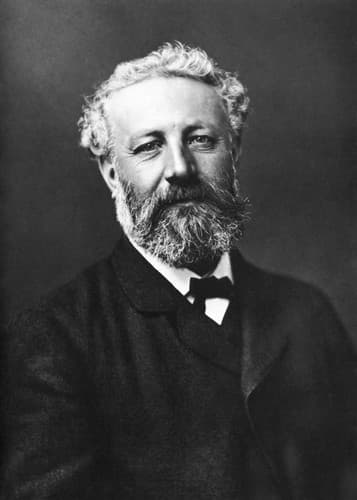
Jules Gabriel Verne was a French novelist, poet, and playwright. His collaboration with the publisher Pierre-Jules Hetzel led to the creation of the Voyages extraordinaires, a series of bestselling adventure novels including Journey to the Center of the Earth (1864), Twenty Thousand Leagues Under the Seas (1870), and Around the World in Eighty Days (1872). His novels, always well documented, are generally set in the second half of the 19th century, taking into account the technological advances of the time.







