“Joseph had a little overcoat. It was old and worn.”
— Opening lines, introducing Joseph and his overcoat.

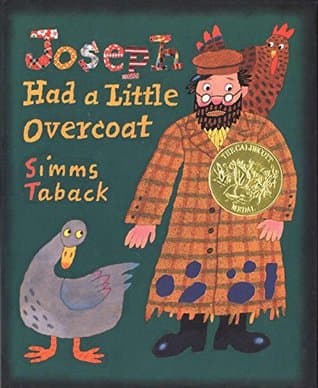
Simms Taback (1977)
Genre
Children's
Reading Time
10 min
Key Themes
See below
Sign in to track this book
Joseph cleverly turns his worn overcoat into a series of new items, proving that even old things hold many possibilities.
Joseph, a Jewish farmer, owns a beautiful, large overcoat he wears daily for work, celebrations, and music. He loves this overcoat. Over time, with constant wear, the coat shows significant signs of age, developing many holes and becoming threadbare. Despite its condition, Joseph is resourceful and does not want to throw away something he values.
When the overcoat becomes too old and damaged to wear as it is, Joseph decides to change it instead of replacing it. With his skilled hands, he takes the large, worn overcoat and cuts and sews it into a smaller, useful jacket. The jacket uses the same fabric, reshaped, allowing Joseph to keep wearing a part of his beloved garment in a new way.
Like the overcoat, the jacket eventually wears out from daily use, becoming old and full of holes. Not wanting to waste the material, Joseph uses his creativity and tailoring skills again. He carefully transforms the worn jacket into an even smaller garment: a vest. The vest, though smaller, still holds the essence of the original overcoat, letting Joseph keep a piece of his cherished clothing.
The vest also reaches a point where it is too old and full of holes for its original purpose. Joseph, always practical, finds another use for the remaining fabric. He carefully cuts and sews the vest into a long, narrow scarf. This new item provides warmth and comfort, showing that even a small amount of fabric can be useful. The scarf continues the life of the original overcoat, adapting to Joseph's needs.
Inevitably, the scarf also gets old and full of holes. Joseph, with his steady ingenuity, refuses to let the material go to waste. He picks up his needle and thread again and turns the tattered scarf into a stylish necktie. This smaller, more refined item lets Joseph keep wearing a piece of his original overcoat, though in a different form, showing his ability to make the most of what he has.
Even the necktie eventually becomes too old and full of holes to wear. Joseph, always resourceful, finds another way to use the last good pieces of fabric. He carefully cuts and sews the necktie into a small, practical handkerchief. This change shows his commitment to sustainability and his cleverness in extending the life of his possessions, no matter how small they become.
The handkerchief, after much use, also gets old and full of holes. By this time, very little fabric remains from the original overcoat. However, Joseph is not stopped. From the last tiny usable scrap of the handkerchief, he manages to make a single, sturdy button. This final, tiny change highlights Joseph's incredible resourcefulness and his ability to see value in even the smallest remnants.
Sadly, after all the changes and careful repurposing, Joseph eventually loses the button. It simply falls off and is gone. This moment marks the physical end of the overcoat's journey, as no material is left to change further. It is a sad moment, marking the complete disappearance of the physical object that began as a large, beautiful overcoat.
Despite losing the last physical piece of his overcoat, Joseph's story continues. He realizes that while the overcoat is gone, its memory and the tale of its many changes live on. Joseph decides to write a book about his overcoat, documenting its journey from a large, new coat to a tiny lost button. This act ensures that his resourcefulness and the overcoat's life continue.
Joseph's book, the one the reader holds, becomes the ultimate change. With nothing physical left of the overcoat, Joseph creates a new, intangible, yet powerful item: a story. The book itself shows that even when something is completely gone, its essence, its lessons, and its memories can inspire and create something new and valuable. This reinforces the theme of creativity and making something from nothing.
The Protagonist
Joseph begins with a beloved overcoat and, through a series of creative transformations, demonstrates unwavering resourcefulness until the physical object is gone, ultimately creating a lasting legacy through storytelling.
The Central Object/Symbol
The overcoat physically deteriorates and is transformed into progressively smaller items, until it is completely gone, only to live on as a story.
The Supporting/Mentioned
The mice remain consistent, simply being creatures that cause wear and tear.
The Supporting/Mentioned
The farm animals remain consistent background elements.
A main theme is Joseph's ability to make something new from something old. Instead of discarding his worn-out overcoat, he finds creative ways to reuse the fabric, turning it into a jacket, then a vest, a scarf, a necktie, a handkerchief, and finally, a button. The die-cut pages visually show the shrinking and changing garment. Joseph embodies the idea of 'waste not, want not,' showing how creativity can extend the life of objects, even when they seem beyond repair, as when he makes a button from the last tiny scrap.
“When the overcoat was old and worn, Joseph made it into a jacket.”
The story shows how life and things change over time. The overcoat goes through a full cycle: from new and large, to old and worn, to smaller forms, and then to complete physical disappearance. But the cycle does not end there; the memory and story of the overcoat are reborn as a book. This shows that while physical forms may disappear, stories and legacies can last and be created again. This theme appears in every change, ending with the book itself, which comes from the 'nothing' left of the physical coat.
“You can always make something out of nothing.”
Initially, the overcoat has material value and use. As it wears out and changes, its physical presence shrinks, but its value changes. Joseph's connection to the coat seems to be more than just its function; it is part of his life. In the end, when the physical overcoat is completely gone, its true lasting value is in the story it inspires. The book becomes the most important 'thing' to come from the overcoat, showing that memories, stories, and lessons (like resourcefulness) can be more lasting and valuable than any physical object. This is clear when Joseph, after losing the button, writes a book about it.
“But Joseph didn't throw it out. He made it into a story.”
The story ends with the theme of storytelling as a way to keep memories and create a legacy. After the last physical piece of the overcoat (the button) is lost, Joseph does not mourn its disappearance. Instead, he turns the experience and memory of the overcoat into a book. This act ensures that the overcoat's journey, and Joseph's cleverness, will live on and be shared. The book itself becomes the ultimate 'something' made from 'nothing,' proving that stories can come from experiences and memories, giving them new life and meaning beyond their original physical form.
“You can always make something, even out of nothing.”
Physical holes in the pages that visually represent the shrinking garment.
The die-cut holes are a key interactive element of the book. As readers turn the pages, a progressively smaller hole reveals the next transformation of Joseph's overcoat. This device not only engages children by inviting them to guess what comes next but also visually reinforces the central theme of the garment shrinking and being repurposed. It literally shows the 'holes' that motivate Joseph's actions and provides a tangible, dynamic representation of the transformations, making the story more immersive and concrete.
A consistent pattern of 'old and worn, full of holes, Joseph made it into...' for each transformation.
The story employs a simple, repetitive structure for each transformation: the garment gets 'old and worn and full of holes,' and then 'Joseph made it into...' a new, smaller item. This predictability is comforting and engaging for young readers, allowing them to anticipate the pattern while still being surprised by the specific new item. It reinforces the central theme of resourcefulness and the cycle of transformation, making the narrative easy to follow and memorable, while also building a rhythm that propels the story forward.
Detailed and vibrant illustrations that convey much of the narrative and character.
The illustrations are not merely supplementary but integral to the storytelling. They depict Joseph's vibrant world, his expressions of joy and determination, and the specific details of each transformation, often showing the 'before' and 'after' in a single spread. The visual details, such as the mice nibbling or the progression of the garment's size, convey significant plot points and emotional nuances without needing extensive text. The cheerful, folk-art style adds to the book's charm and accessibility, making the narrative understandable even without reading every word.
“Joseph had a little overcoat. It was old and worn.”
— Opening lines, introducing Joseph and his overcoat.
“So Joseph took his overcoat to the tailor. 'Please mend it,' he said.”
— Joseph deciding to get his overcoat fixed.
“He made a jacket from his overcoat.”
— First transformation of the overcoat.
“When the jacket got old and worn, Joseph made a vest.”
— Subsequent transformation after the jacket.
“When the vest got old and worn, Joseph made a scarf.”
— Another transformation, showing the coat getting smaller.
“When the scarf got old and worn, Joseph made a necktie.”
— The coat is now a very small item.
“When the necktie got old and worn, Joseph made a handkerchief.”
— The coat is now a tiny item.
“When the handkerchief got old and worn, Joseph made a button!”
— The final, smallest transformation of the overcoat.
“When the button got lost, Joseph didn't have anything left.”
— The ultimate fate of the overcoat, showing its complete disappearance.
“But Joseph still had a story.”
— The powerful conclusion, highlighting the lasting value of experience.
“And that's why Joseph Had a Little Overcoat is a book.”
— Meta-commentary, linking the story to the physical book.
“The mice in the holes chewed away at the cloth.”
— Illustrations often show mice interacting with the overcoat's holes.
“Snip, snip, snip.”
— Sound effect illustrating Joseph cutting the fabric.
“Stitch, stitch, stitch.”
— Sound effect illustrating Joseph sewing the fabric.
Ready to see how well you understood this book? Take our interactive quiz with 10 questions.

Biography coming soon.

Dan Gemeinhart
4.5
Kate O'Hearn
4.4

Jeanne Birdsall
4.4

Jen Wang
4.4
Wendelin Van Draanen
4.3

John Marsden
4.3

Chris Van Allsburg
4.3
Jennifer A. Nielsen
4.2