“The English have always been a magical race. They have simply forgotten it.”
— A general observation on the state of magic in England.

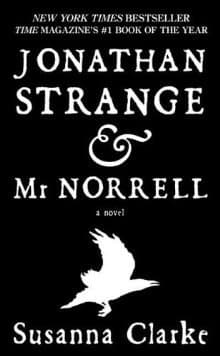
Susanna Clarke (2004)
Genre
Fantasy / Historical Fiction
Reading Time
1200 min
Key Themes
See below
Sign in to track this book
In 19th-century England, where magic is a forgotten art, two rival magicians rediscover its power. One is cautious, the other reckless. Their conflict risks not just their partnership but reality itself as they explore the dangerous world of the ancient Raven King and Faerie.
In 1806, English magicians, part of groups like the York Society of Magicians, believe practical magic no longer exists. They spend their time discussing old texts. However, Mr. Norrell, a private and wealthy magician from Hurtfew Abbey, changes this. He appears before the York Society and, to their surprise, makes the cathedral statues speak and move. This shows that true magic is not lost, just forgotten. Norrell, wanting to bring magic back to England, announces he will move to London and offer his help to the government in the war against Napoleon.
In London, Mr. Norrell faces doubt from the government, especially from Sir Walter Pole. To prove himself, Norrell agrees to bring back Sir Walter's fiancée, Lady Pole, who died just before their wedding. He successfully performs the difficult magic, bringing Lady Pole back to life. However, she is now linked to the fairy world and haunted by the Gentleman with the Thistle-down Hair. This act establishes Norrell as England's only practical magician. He begins to help the war effort, creating phantom fleets and roads to confuse the French.
Meanwhile, in Shropshire, Jonathan Strange, a wealthy but aimless young man, is told by a street magician, Vinculus, that he will be a great magician. Strange initially dismisses this but soon finds himself doing magic without explanation. He travels to London, meets Norrell, and becomes his student. Their personalities clash immediately: Norrell is careful, precise, and obsessed with control, while Strange is intuitive, adventurous, and drawn to older, wilder forms of magic, especially those linked to the legendary Raven King. Despite their differences, they work together on several magical projects for the war.
Jonathan Strange joins the Duke of Wellington's army in Portugal. His magic proves very useful. He creates roads, conjures illusions to trick the enemy, and even moves forests for strategic advantage. His practical, battlefield magic earns him fame and the admiration of soldiers, including the Duke. This success, however, highlights the philosophical divide between Strange and Norrell. Strange's willingness to experiment and embrace magic's chaotic side deeply worries Norrell, who believes such practices are dangerous and uncivilized, fearing they will awaken past horrors.
The Gentleman with the Thistle-down Hair, a powerful and unpredictable fairy, becomes obsessed with Stephen Black, the butler to Sir Walter and Lady Pole. The Gentleman, who was involved in Lady Pole's resurrection and now holds part of her soul, often visits Stephen in the fairy realm of Lost-hope. He promises Stephen power and a kingdom, manipulating him with grand visions and hinting at a deeper connection to the Raven King. Stephen, despite his initial reluctance, becomes more involved in the fairy's plans, becoming a pawn in the Gentleman's long-term goal to bring the Raven King back to England.
The gap between Strange and Norrell's ideas widens. Strange publishes a book, 'The History and Practice of English Magic,' arguing for the return of the Raven King's wilder, older magic. This directly contradicts Norrell's conservative views. Norrell, angered by Strange's defiance and what he sees as reckless ideas, publicly denounces him. Their animosity leads to a bitter public argument and a complete break in their relationship. Strange, feeling limited by Norrell's rules, decides to find the lost magic of the Raven King on his own.
Driven by his interest in the Raven King, Jonathan Strange travels across Europe, seeking old magical texts and forgotten lore. He studies in Venice and other historical centers, delving deeper into the history of the Raven King's magic, which Norrell had always forbidden. Meanwhile, Norrell, increasingly isolated and paranoid, continues his cautious approach to magic, but his influence lessens as Strange's reputation grows. Norrell's former student, Childermass, tries to mediate, but the divide is too great. Strange's journey leads him to increasingly dangerous and obscure magical practices.
While Strange is abroad, his wife, Arabella, is taken by the Gentleman with the Thistle-down Hair. The Gentleman, having previously taken part of Lady Pole's sanity, now claims Arabella, taking her into the fairy realm of Lost-hope. Strange, upon his return, is devastated by his wife's disappearance. He believes she has died and, overwhelmed by grief, blames himself and his pursuit of magic. This tragedy pushes him into a desperate and dangerous search for her. He believes only by mastering the darkest magic of the Raven King can he rescue her from the fairy.
In their individual pursuits of magic, both Norrell and Strange become caught in a powerful and dangerous enchantment known as the Nameless Dread, or the Invisible Road. This magic, a form of imprisonment, traps them physically within a magical darkness. They are invisible to the outside world and cannot fully interact with it. They are conscious but isolated, their bodies flickering in and out of existence. This is a direct result of their pride and the dangerous magic they invoked, especially Strange's attempts to raise the dead and Norrell's initial resurrection of Lady Pole.
The Gentleman with the Thistle-down Hair continues to manipulate Stephen Black, slowly drawing him deeper into the fairy world. The Gentleman, wanting to undermine the Raven King's legacy, arranges for Stephen to be crowned King of England within the fairy realm of Lost-hope. Stephen, initially reluctant, gradually accepts his new role, finding a sense of belonging and power. This act challenges the historical link between the Raven King and the English throne, both mortal and magical, setting the stage for a confrontation between the human and fairy worlds.
Vinculus, the enigmatic street magician, is more than he seems. He carries the 'book' of the Raven King's prophecy, tattooed on his skin, and acts as a reluctant messenger for the ancient magic. He often appears to both Strange and Norrell, delivering cryptic messages about magic's return and England's fate. The Gentleman with the Thistle-down Hair, a powerful fairy, is linked to the Raven King's prophecy, having been one of the fairies who took the young boy to Faerie. His actions come from a mix of jealousy, ambition, and a desire to take over the Raven King's legacy.
Jonathan Strange, learning Arabella's true fate, finally enters the fairy realm of Lost-hope to confront the Gentleman with the Thistle-down Hair. He is helped by Childermass, Norrell's former assistant, and eventually by Norrell himself, who has also been drawn into the same magical space. The confrontation is a desperate battle of wills and magic. Strange uses all his knowledge of the Raven King's ancient, wild magic. He discovers Arabella is alive but enchanted, and he must break the Gentleman's hold over her and others, including Stephen Black.
In the climax, as the confrontation between Strange, Norrell, and the Gentleman peaks, the Raven King briefly appears. His power, though short-lived, is enough to disrupt the Gentleman's enchantments and break the Invisible Road spell that trapped Strange and Norrell. This momentary return allows Strange to rescue Arabella from the Gentleman. The Raven King's intervention signifies the rebalancing of magic in England, though his presence quickly vanishes, leaving magic's future to the human magicians once more.
Despite the Raven King's intervention and Arabella's rescue, Jonathan Strange and Mr. Norrell remain bound by a powerful and complex magical entanglement. They find themselves constantly traveling on an 'Invisible Road' of their own making. They cannot fully return to the mortal world or fully escape each other's presence. Others see them only as fleeting glimpses. This represents their intertwined destinies and their shared responsibility for the return of English magic, as well as a continued penance for their pride and the dangerous paths they chose.
With Norrell and Strange trapped on their Perpetual Road, the future of English magic is uncertain but open. Childermass, Lascelles, and others are left to manage, knowing that magic is now undeniably real and possibly accessible to more people. Norrell's restrictive, scholarly magic has been challenged by Strange's wilder, older approach, and the Raven King's influence has been acknowledged. The Gentleman with the Thistle-down Hair is banished, and Stephen Black is freed from his control, finding his own path. The novel ends with a sense of potential and an acknowledgment that magic, once awakened, cannot be easily contained or controlled.
The Protagonist
Norrell begins as the sole practitioner of magic, controlling its narrative. He gradually loses control as Strange's influence grows, leading to his magical entanglement and eventual shared fate with Strange, forcing him to confront the limitations of his rigid views.
The Protagonist
Strange evolves from an accidental magician to a powerful practitioner, challenging Norrell's dominance. His quest for ancient magic, fueled by personal tragedy, leads him to confront the fairy world and ultimately share an entangled magical fate with Norrell.
The Supporting
Arabella begins as a grounded, loving wife. Her abduction transforms her into a victim of fairy magic, whose rescue becomes the central goal of her husband, ultimately forcing her to confront the reality of the magical world.
The Antagonist
The Gentleman acts as a malevolent force, orchestrating suffering. He is eventually confronted and his power weakened, but his existence serves as a constant reminder of the perils of fairy magic.
The Supporting
Stephen begins as a subservient butler. He is gradually drawn into the fairy world, manipulated into becoming a puppet king, and eventually finds a form of liberation through self-awareness and the breaking of the fairy's enchantment.
The Supporting
Childermass remains loyal to Norrell, but his actions often transcend simple subservience, demonstrating his own moral compass and magical intuition, ultimately playing a key role in the confrontation with the Gentleman.
The Supporting
Vinculus, initially a mysterious prophet, reveals his true nature as the embodiment of the Raven King's prophecy, acting as a catalyst and guide for the magicians, ultimately fulfilling his role in the Raven King's return.
The Supporting
Lady Pole is resurrected into a state of enchantment and madness. Her suffering serves as a constant reminder of the dangers of magic, and her eventual liberation from the fairy's thrall marks a partial triumph over his power.
The Supporting
Sir Walter begins as a skeptical politician who benefits from Norrell's magic. He remains largely unaware of the deeper magical machinations, representing the limited understanding of the mundane world.
The Supporting
Drawlight consistently seeks to benefit from the magicians' fame, moving between them as circumstances dictate, ultimately serving as a symbol of the superficiality that surrounds the reawakening of magic.
The novel explores the basic differences between two ways of approaching magic: Mr. Norrell's careful, academic, and restrictive view, and Jonathan Strange's intuitive, wild, and ancient approach. Norrell believes magic should be controlled, documented, and kept separate from fairy influence, fearing the chaos and danger of the Raven King's magic. Strange, however, is drawn to the forgotten, powerful magic of the Raven King, seeing it as the true core of English magic. This conflict is central to the plot, driving the rivalry between the two magicians and ultimately shaping magic's future in England. The novel suggests that true magic is inherently wild and cannot be easily organized or confined.
“''What is the point of a magician who does not work magic?''”
The pursuit and practice of magic come with significant personal and societal costs. Mr. Norrell's resurrection of Lady Pole, while a success, binds her to the fairy realm and drives her to madness. Jonathan Strange's search for the Raven King's magic leads to his wife Arabella's abduction and plunges him into despair and dangerous practices. Both magicians, in their pride and ambition, become trapped by their own enchantments, isolated from the world. The novel shows that wielding great power requires great responsibility and often leads to unexpected and tragic outcomes, affecting not only the magicians but also those around them.
“''Magic is not a game you play for amusement. It is a terrible, a dangerous, a most solemn business.''”
The novel subtly explores themes of colonialism and otherness, particularly through Stephen Black. As a Black butler in early 19th-century England, Stephen is marginalized and used, even by those who claim to care for him. The Gentleman with the Thistle-down Hair's promises of a kingdom and power in Lost-hope can be seen as a twisted colonial fantasy, offering a 'better' life under fairy control. The story also touches on the English view of magic as uniquely 'English,' often dismissing or fearing foreign magical traditions. This reflects historical imperial attitudes towards other cultures. The fairies themselves, as 'others,' are seen with suspicion and fear by the English magicians.
“''He was a king in a foreign land. He was a black king and he had no subjects.''”
The story often highlights the importance of stories, books, and historical accounts in shaping understanding and belief. The entire premise of the novel relies on the forgotten history of English magic and the Raven King. Norrell's library shows the power of accumulated knowledge, while Strange's book challenges Norrell's established narrative. Vinculus, with the Raven King's prophecy tattooed on his body, literally embodies the power of ancient stories. How history is remembered, or forgotten, directly affects the present and future of magic. The novel suggests that history is not static but a living, evolving story that can be rediscovered and reinterpreted, with significant consequences.
“''Books are for reading, not for keeping. And a magician who does not read is no magician at all.''”
Madness and enchantment are closely linked throughout the novel, often as a result of contact with the fairy world or powerful magic. Lady Pole's fits of prophetic madness, from her partial soul being held by the Gentleman, are a clear example. The Gentleman himself, with his unpredictable and cruel nature, embodies a form of magical madness. The magical 'Invisible Road' that traps Norrell and Strange can also be seen as a form of enchanted isolation, bordering on madness. The novel explores how the human mind struggles to understand or cope with the non-rational, often giving in to altered states when faced with magic's raw power, blurring the lines between sanity and enchantment.
“''The trouble with magic is that it is not at all like a science. It is not like a book with a beginning and an end. It is like a forest, full of paths and dangers, and you can get lost in it.''”
An ancient, tattooed prophecy foretelling the return of English magic and two magicians.
The Raven King's prophecy is a central plot device, literally carried on the body of Vinculus. It foretells the reawakening of English magic and the emergence of two magicians, one who will 'raise the dead' and another who will 'find the lost.' This prophecy guides the narrative, shaping the destinies of Norrell and Strange, even as they attempt to understand or defy it. It provides a sense of overarching fate and mystery, hinting at a larger magical design beyond the characters' immediate understanding. The ambiguity of the prophecy allows for multiple interpretations and drives the magicians' differing approaches to magic.
A magical affliction that traps individuals in a state of invisibility and isolation.
The Invisible Road, also referred to as the Nameless Dread, is a powerful and dangerous enchantment that affects both Norrell and Strange. It is a magical prison that renders its victims invisible and intangible to the mortal world, while they remain conscious and aware. This device symbolizes the isolation and self-inflicted traps that come with unchecked magical ambition and hubris. It forces the two rival magicians into an unwilling, perpetual proximity, highlighting their intertwined destinies and the consequences of their actions. It also serves to remove them from the immediate world, allowing for a shift in the magical landscape.
The act of fairies taking humans into their realm, often with devastating consequences.
Fairy abduction and enchantment are recurrent plot devices, primarily demonstrated through Lady Pole's resurrection and Arabella Strange's capture by the Gentleman with the Thistle-down Hair. This device introduces the unpredictable and often malevolent nature of the fairy world, contrasting sharply with the more controlled magic practiced by humans. It highlights the dangers of interacting with fairies and serves as a major catalyst for the magicians' actions, particularly Strange's desperate quest to rescue Arabella. It also underscores Norrell's deep-seated fear of fairy magic and its corrupting influence on human affairs.
The practical application of magic in the Napoleonic Wars.
The use of magic in the Napoleonic Wars is a significant plot device that grounds the fantasy elements in a historical context. Norrell initially uses magic to create phantom fleets and roads, while Strange applies his magic directly on battlefields, creating illusions, moving forests, and aiding Wellington's army. This device not only demonstrates the practical power of magic but also contrasts the two magicians' approaches: Norrell's cautious, strategic use from afar versus Strange's direct, hands-on involvement. It earns Strange fame and respect, further fueling the rivalry and showcasing magic's potential as a transformative force in the mundane world.
“The English have always been a magical race. They have simply forgotten it.”
— A general observation on the state of magic in England.
“Magic is not a game. It is a terrible, a dangerous, an unholy thing.”
— Mr Norrell's stern view on the practice of magic.
“He who would be a magician must change himself from the ordinary to the extraordinary.”
— A description of the transformation required for a true magician.
“A gentleman, as I understand the word, is one who is never rude unintentionally.”
— A witty definition of a gentleman, often attributed to Strange.
“There are no ordinary things. There are only things that we do not understand.”
— A philosophical statement about the nature of reality and perception.
“The Raven King, of course, was never really gone. He was simply waiting.”
— Reference to the ancient, legendary figure of English magic.
“It is a strange thing to be a magician. You are surrounded by beauty, and yet you are always alone.”
— A reflection on the isolation that can come with magical power.
“Norrell had always believed that the only proper use of magic was to make things orderly and safe.”
— Mr Norrell's conservative approach to magic.
“Strange, on the other hand, was of the opinion that magic should be wild and free.”
— Jonathan Strange's contrasting, more adventurous view of magic.
“The desire to be useful, to be of service, is a very strong one in England.”
— A comment on English national character and the societal value of utility.
“He knew that the world was full of wonders, and that most of them were quite terrible.”
— A realization about the dual nature of wonder and terror in the world.
“The more you study magic, the more you realise how much there is to be afraid of.”
— A sobering thought on the deeper understanding of magic's perils.
“A gentleman does not boast of his powers. He simply uses them.”
— A statement about the understated nature of a true gentleman magician.
“What is the good of magic, if it cannot make a man happy?”
— A poignant question about the ultimate purpose and limitations of magic.
Ready to see how well you understood this book? Take our interactive quiz with 10 questions.

Susanna Mary Clarke is an English author known for her debut novel Jonathan Strange & Mr Norrell (2004), a Hugo Award-winning alternative history. Clarke began Jonathan Strange in 1993 and worked on it during her spare time. For the next decade, she published short stories from the Strange universe, but it was not until 2003 that Bloomsbury bought her manuscript and began work on its publication. The novel became a best-seller.







