“The custom flash drives he’d given me were still taped to my thigh, warm against my skin. State of the art, they were. The best money could buy.”
— Johnny reflecting on his data storage implants.

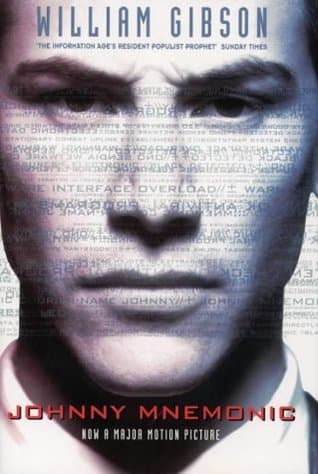
William Gibson (1995)
Genre
Children's / Science Fiction
Reading Time
160 min
Key Themes
See below
Sign in to track this book
A data courier with a brain overloaded by corporate secrets races against time and the Yakuza, who crave his cryogenically preserved head, to deliver his illicit cargo before it kills him.
Johnny Mnemonic is a data courier who specializes in transporting sensitive information stored directly in his brain. He has a surgically implanted wetware storage system, allowing him to carry much data. However, he has recently taken on a package far exceeding the safe limit of his capacity – 160 gigabytes, double his usual maximum. This overload causes him severe headaches and nosebleeds, signs of impending neural damage. He's in Beijing, waiting for his client to download the data, but the connection is delayed. He knows that if the data isn't offloaded soon, he risks permanent brain damage, including memory loss and even death.
Johnny meets with Ralfi, his client, at a club, expecting to finally offload the data. Instead, Ralfi tries to kill him, showing that the data Johnny carries is important and sought after. During the struggle, Johnny learns that the Yakuza, a criminal organization, is also after the information, and specifically, after Johnny himself. Johnny escapes Ralfi's attack, but Ralfi is killed by a Yakuza enforcer named Shinji, who is now pursuing Johnny relentlessly. Johnny realizes the danger he's in and that the data's true value is much greater than he first thought.
Fleeing the Yakuza, Johnny goes to the Lower City, a lawless district populated by outcasts and cybernetically enhanced individuals. He seeks out a black market surgeon known as Spider, hoping Spider can extract the data before it destroys his brain. However, Spider tells him that the data is locked with a complex password, making extraction impossible without the key. While at Spider's clinic, Johnny meets Jane, a tough, cybernetically enhanced bodyguard and street fighter, who initially attacks him, mistaking him for someone else. Their encounter is brief but sets the stage for their future alliance.
After their first fight, Johnny and Jane form an alliance. Jane, who is also an independent contractor and has her own reasons for helping Johnny, agrees to protect him. They travel to the LoTeks' territory, an underground community of anti-technology rebels who live in the ruins of the old subway system. The LoTeks, led by J-Bone, are wary of Johnny and his high-tech implants, but they agree to shelter him, recognizing his situation against powerful corporations and the Yakuza. They also distrust the systems that Johnny represents, creating a tense but necessary alliance.
Among the LoTeks, Johnny learns about Jones, a hacker dolphin once used by the military for cyber warfare. Jones is now old and kept in a tank, suffering from neural degradation, but he is said to have extraordinary hacking abilities and a unique connection to the global information network. Johnny believes Jones might be able to crack the encryption on the data in his head. The LoTeks are skeptical but allow Johnny to pursue this lead, as it represents their best chance against the powerful forces against them. The journey to Jones becomes Johnny's main goal.
Shinji, the Yakuza enforcer, tracks Johnny and Jane to the LoTeks' underground sanctuary. A battle starts between Shinji's men and the LoTeks, showing the LoTeks' resourcefulness and Jane's fighting skill. During the chaotic fight, Johnny and Jane must fight for their lives. Shinji, with his advanced cybernetic enhancements, is a tough opponent. The LoTeks, despite their technological disadvantage, hold their ground, showing their commitment to their anti-establishment ideals and their solidarity in protecting Johnny.
Johnny and Jane reach Jones. With the LoTeks' help, they connect Johnny's neural interface to Jones's brain. The process is dangerous and painful for Johnny, as Jones's hacking capabilities go deep into his overloaded wetware. After a tense period, Jones cracks the complex encryption, revealing the data's true nature: a cure for Nerve Attenuation Syndrome (NAS), a neurological plague affecting millions. The data also implicates the pharmaceutical corporation PharmaKom in suppressing the cure for profit.
The unlocked data reveals a truth: PharmaKom, a powerful pharmaceutical corporation, developed a cure for NAS but has been suppressing it to maximize profits from their symptomatic treatments. The cure, if released, would hurt their business. The data contains proof of their corporate wrongdoing and their decision to let millions suffer and die for money. This revelation changes Johnny's mission from mere survival to a fight for humanity's well-being, putting him against a global corporate giant.
Realizing what the data means, Johnny, Jane, and the LoTeks make a plan: to broadcast the cure data across the global information network, making it available to everyone and exposing PharmaKom's crimes. They decide to use the LoTeks' hacking abilities and their access to hidden network nodes to ensure the data's spread. This plan is risky, as PharmaKom will retaliate with all its resources to prevent the truth from getting out, turning the LoTeks' hideout into a central command for a digital war.
As the LoTeks prepare to broadcast the cure, Shinji, driven by his Yakuza honor and his mission, launches a final assault on their stronghold. At the same time, PharmaKom activates its security systems and a team of corporate enforcers to prevent the data from being released. A multi-front battle happens, with Johnny, Jane, and the LoTeks fighting for their lives against both Shinji's Yakuza and PharmaKom's trained operatives. The fate of the cure, and potentially millions of lives, depends on the broadcast happening amidst the chaos.
In a struggle, Johnny, Jane, and the LoTeks overcome Shinji and PharmaKom's forces. Jane's combat skills are crucial, and the LoTeks' hacking expertise ensures the broadcast goes through. Shinji is defeated, and PharmaKom's attempts to stop the data are thwarted. The cure for NAS is uploaded and spread across the global network, becoming accessible to everyone. The world now has the knowledge to combat the disease, and PharmaKom's conspiracy is exposed, marking a victory for humanity against corporate greed and technological control.
With the cure for NAS released, Johnny is free from the data in his head and the constant threat to his life. He has found a new purpose, having played a part in exposing a corporate conspiracy and saving countless lives. He stays with the LoTeks, finding a sense of belonging among the rebels who fought for a better world. The exposure of PharmaKom's crimes sends shockwaves through the corporate world, starting a period of change and accountability. Johnny, once a courier, has become a symbol of resistance and hope in a technologically advanced, yet corrupt, future.
The Protagonist
Johnny transforms from a self-interested data mule into an unlikely hero, fighting for humanity's well-being and finding a new purpose beyond his original quest for profit and lost memories.
The Supporting
Jane evolves from a mercenary protecting Johnny for a fee to a committed partner in his fight against corporate injustice, finding a cause worthy of her formidable abilities.
The Antagonist
Shinji remains steadfast in his mission, ultimately failing to retrieve the data but upholding his Yakuza honor until his defeat.
The Supporting
J-Bone initially distrusts Johnny but comes to recognize him as a crucial ally in the fight against corporate oppression, solidifying his role as a leader of resistance.
The Supporting
Jones serves as a pivotal plot device, using his unique abilities to unlock the data, effectively completing his final, most important mission.
The Mentioned
Ralfi's arc is cut short by his death, serving primarily as the catalyst for Johnny's flight and the initiation of the main conflict.
The Supporting
Spider provides critical information and services early in the narrative, helping Johnny understand the depth of his predicament.
The Antagonist
The PharmaKom executives are exposed and their conspiracy is brought to light, leading to their downfall.
The central theme is information – its value, its dangerous potential, and its role as a commodity in a connected, corporate-dominated future. Johnny's brain is a storage device, showing how personal identity can be overtaken by data. The data he carries, a cure for NAS, holds power over life and death, and its suppression by PharmaKom shows how information can be used for corporate gain. The LoTeks' desire to broadcast the data democratizes this power, making it accessible to all and challenging the established order. This theme is clear in every scene, from Johnny's overloaded brain to the final broadcast.
“''I'm a data trafficker. I've got 160 gigs in my head. I'm gonna die if I don't get it out.''”
The story explores the blurred lines between humanity and technology, and the struggle between individual freedom and corporate control. Johnny himself shows this, having traded parts of his organic memory for technological storage. The Yakuza enforcers and PharmaKom's advanced security systems represent the oppressive side of technology, used to control and exploit. In contrast, the LoTeks embody resistance, rejecting corporate technology and advocating for human connection. The story ultimately champions the human spirit and collective action against the dehumanizing forces of unchecked technological advancement and corporate greed, as seen when the LoTeks facilitate the cure's broadcast.
“''This place is a graveyard of the future. But we're still here. We're fighting.''”
Johnny's job directly affects his memory, as he has traded personal recollections for data storage capacity. This raises questions about what makes up identity when parts of one's past are overwritten or inaccessible. His desire to retrieve his own memories is a motivation, showing the human need for a personal history. The threat of permanent brain damage and memory loss is a fear for Johnny, emphasizing the importance of individual identity in a world where information is fluid and manipulated. The theme concludes as he finds a new identity through his actions.
“''I've had my memory wiped so many times, I don't know who I am anymore.''”
In the harsh, dystopian future depicted, survival is a struggle, and adaptation is key. Johnny, Jane, and the LoTeks all show resilience and resourcefulness in navigating a dangerous world. Johnny's ability to evade his pursuers, Jane's combat skill, and the LoTeks' ingenuity in creating a community from societal scraps are all examples of adaptation. The characters must adjust to new threats and circumstances, highlighting the drive to survive in a technologically advanced but corrupt world. Their collective survival depends on their ability to work together and adapt.
“''In this world, you either adapt or you die.''”
Johnny's brain implant for storing sensitive data.
This is the central plot device, driving Johnny's entire predicament. His wetware implant allows for the secure, physical transport of vast amounts of data, making him a valuable commodity. However, its limitations (capacity, encryption, neural damage) create immediate conflict and tension. The device acts as both a tool and a ticking time bomb, forcing Johnny into action and making him a target for powerful factions. It symbolizes the extreme integration of technology into human biology and the potential dangers that arise from it.
The hidden data that exposes PharmaKom's conspiracy.
The cure for Nerve Attenuation Syndrome (NAS) is the MacGuffin of the story, the highly sought-after information that everyone is chasing. It represents the immense power of medical knowledge and its potential for both good and evil. Its suppression by PharmaKom provides the primary motivation for the antagonists and establishes the high stakes of Johnny's mission. The cure transforms the narrative from a simple chase into a fight for humanity, giving Johnny's actions profound moral significance.
A cybernetically enhanced dolphin capable of advanced hacking.
Jones is a unique and critical plot device. His specialized neural interface and hacking abilities are the only means to unlock the complex encryption on the data in Johnny's head. He serves as a 'deus ex machina' for the encryption problem, but his character also raises ethical questions about animal exploitation and intelligence. His existence highlights the advanced and often bizarre technological landscape, while also providing a moment of unexpected assistance that propels the plot forward towards its resolution.
A sanctuary and operational base for anti-technology rebels.
The Lower City and the LoTek stronghold serve as a crucial setting and a plot device for providing Johnny with allies and resources. It functions as a safe haven from the corporate and criminal powers above, allowing Johnny to regroup and strategize. The LoTeks' anti-technology stance and their collective hacking skills are essential for the plan to broadcast the cure. The stronghold acts as a symbol of resistance and a temporary refuge that enables the protagonist to mount a counter-offensive against seemingly insurmountable odds.
“The custom flash drives he’d given me were still taped to my thigh, warm against my skin. State of the art, they were. The best money could buy.”
— Johnny reflecting on his data storage implants.
“The city was a vast, sprawling organism, a concrete jungle of chrome and glass, neon and grit.”
— A description of the dystopian urban landscape.
“It was a world where information was currency, and the fastest way to get rich was to steal it.”
— Narrator describing the value of data in their world.
“I was a mnemonic courier. A data mule. My brain was a hot-wired, high-capacity storage device.”
— Johnny introducing himself and his profession.
“The Yakuza. They were always there, lurking in the shadows, their fingers in every pie.”
— Johnny's awareness of the omnipresent criminal organization.
“Sometimes you just had to run. Run and hope you didn't run into anything worse.”
— Johnny's philosophy on survival in his dangerous world.
“The street finds its own uses for things.”
— A common Gibsonian theme, referring to technology's adaptation.
“He moved with the weary grace of a man who had seen too much, and still had to see more.”
— Describing a character who is world-weary but still active.
“Memory is a funny thing. Sometimes it's all you have left.”
— A reflection on the importance and fragility of memory.
“The matrix was a consensual hallucination, experienced daily by billions of legitimate operators, in every nation.”
— A foundational description of cyberspace.
“You never knew who was watching. Or what they wanted.”
— Johnny's constant paranoia in a surveilled world.
“The future was already here, it was just unevenly distributed.”
— A famous Gibson quote, reflecting on technological disparity.
“A man without a past is a man without a future.”
— A character's philosophical remark on identity and history.
“The ice was starting to melt. And I was standing on it.”
— Johnny realizing his precarious situation is worsening.
Ready to see how well you understood this book? Take our interactive quiz with 10 questions.

William Ford Gibson is an American-Canadian speculative fiction writer and essayist widely credited with pioneering the science fiction subgenre known as cyberpunk. Beginning his writing career in the late 1970s, his early works were noir, near-future stories that explored the effects of technology, cybernetics, and computer networks on humans—a "combination of lowlife and high tech"—and helped to create an iconography for the information age before the ubiquity of the Internet in the 1990s. Gibson coined the term "cyberspace" for "widespread, interconnected digital technology" in his short story "Burning Chrome" (1982), and later popularized the concept in his acclaimed debut novel Neuromancer (1984). These early works of Gibson's have been credited with "renovating" science fiction literature in the 1980s.

Dan Gemeinhart
4.5

Kate O'Hearn
4.4

Jeanne Birdsall
4.4

Jen Wang
4.4

Wendelin Van Draanen
4.3

John Marsden
4.3

Chris Van Allsburg
4.3

Jennifer A. Nielsen
4.2