“I am not afraid... I was born to do this.”
— Joan's declaration of her divine mission to lead the French army.

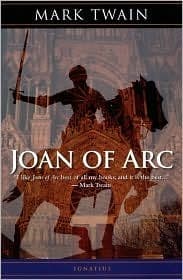
Mark Twain (2017)
Genre
Historical Fiction / Spirituality
Reading Time
1500 min
Key Themes
See below
Sign in to track this book
Mark Twain's surprisingly earnest and deeply researched account elevates the Maid of Orléans from historical figure to a beacon of unwavering faith and courage, as seen through the eyes of her loyal page.
The story begins in the small village of Domremy, France, in 1429, told by Sieur Louis de Conte, Joan's page and secretary. He talks about Joan's childhood, showing her as a very pious, kind, and smart girl, loved by her community. From a young age, Joan has divine visions and hears heavenly 'Voices' – specifically those of Saint Michael, Saint Catherine, and Saint Margaret – which tell her to save France from English occupation and to crown the Dauphin, Charles VII, as king. Despite her youth and humble background, Joan believes firmly in these divine messages, even as she initially keeps them secret from most people, only telling a few close friends and family, including Louis de Conte himself.
Led by her Voices, Joan travels to Vaucouleurs to meet with Robert de Baudricourt, the local commander, to ask for an escort to Chinon to see the Dauphin. Baudricourt at first dismisses her as a crazy peasant girl, making fun of her claims of a divine mission. Joan, however, shows great persistence and an unusual ability to predict future events, such as the French defeat at the Battle of Rouvray (the 'Battle of the Herrings'). Her strong faith and the growing support of local villagers, including Jean de Metz and Bertrand de Poulengy, eventually influence Baudricourt, who, though still doubtful, provides her with a small escort and a letter of introduction to Charles VII, convinced there might be something unusual about her.
Arriving at Chinon, Joan faces another challenge: getting to see the Dauphin, Charles VII, who is weak and surrounded by doubtful courtiers. To test her, Charles hides among his nobles. However, Joan, guided by her Voices, immediately identifies him, despite never having seen him before. She then reveals a secret prayer Charles had made, convincing him of her divine role. She promises to lift the Siege of Orléans and lead him to Reims for his coronation. Despite ongoing doubt from some of his advisors, Charles is deeply impressed and gives her command of the French army, ordering her to be equipped with armor and a standard.
Joan takes command of the French forces, bringing discipline, courage, and a new sense of divine purpose to the discouraged soldiers. She famously sends a letter to the English commanders, demanding they surrender. Against usual military strategy, she leads a series of bold and quick attacks on the English fortifications around Orléans. Her presence on the battlefield, carrying her banner and often leading the charge, inspires the troops. Despite being wounded by an arrow, she quickly returns to battle, leading the final, successful attack on Les Tourelles. The English are defeated, and the Siege of Orléans, which had lasted for months, is lifted in days, marking a turning point in the Hundred Years' War and fulfilling Joan's first major prediction.
After the victory at Orléans, Joan continues her military campaign along the Loire River. She leads the French army to a series of swift and decisive victories against the English, including battles at Jargeau, Meung-sur-Loire, Beaugency, and most notably, the Battle of Patay, where the English army suffers a great defeat. These victories remove the English threat in the region and clear a safe path to Reims, the traditional place for the coronation of French kings. Joan continually urges the hesitant Charles to go to Reims, stressing the importance of his anointing as God's chosen king for France, despite the dangers and the advice of his cautious advisors.
Against the advice of many of his nobles, Charles VII, persuaded by Joan's conviction and the series of victories, begins the march to Reims. The journey meets little resistance, as towns along the way open their gates to the advancing French army, inspired by Joan's reputation. On July 17, 1429, Charles VII is formally crowned King of France in Reims Cathedral, with Joan standing clearly beside him, holding her banner. This moment is the completion of her most important mission, fulfilling the prophecy of her Voices. Joan considers her work mostly done, saying she wants to return home, but the King and his advisors convince her to stay with the army.
After the coronation, Joan argues for an immediate march on Paris, which is under Burgundian and English control, to free France fully. However, King Charles and his advisors, especially La Trémoille, are hesitant and prefer talks over direct military fighting. They deliberately delay the attack on Paris, giving the city time to strengthen its defenses. When Joan finally leads an attack, the royal army's lack of full commitment and support, combined with Joan suffering a painful leg wound, leads to a failed attack. This time marks a decrease in Joan's influence and the start of her being pushed aside by the court, who increasingly see her as a threat to their power.
Joan continues to fight for France, taking part in various small battles and sieges, but without the full support she once had. Her Voices warn her she will be captured. In May 1430, while trying to help the besieged town of Compiègne, Joan leads a sortie against the Burgundian forces. During the fierce fighting, the drawbridge of the town is raised too early, cutting her off from her retreating troops. She is surrounded and captured by the Burgundians, who are allied with the English. The French king, Charles VII, makes no significant effort to ransom or rescue her, leaving her to her fate.
The Burgundians sell Joan to the English for a large sum. She is then moved to Rouen, a city under English control, to face trial. Her trial is arranged by Pierre Cauchon, the Bishop of Beauvais, a strong English supporter, with the clear goal of condemning her as a heretic and witch. The trial is a political sham, meant to discredit Joan and, by extension, Charles VII's claim to the throne, as his coronation was achieved through her 'sorcery.' Despite being a layperson, Joan is denied legal counsel and questioned constantly by a group of hostile clergymen and university doctors, who try to trick her with theological questions.
During her imprisonment, Joan is held in a secular prison, guarded by English soldiers, a violation of church law. She endures harsh conditions, constant threats, and attempts on her life. The English and the court try to break her spirit with psychological torment and threats of torture. Tired and alone, and fearing the fire, Joan is eventually forced to sign an abjuration document, retracting her Voices and admitting to heresy. However, she quickly regrets this forced confession, feeling she has betrayed God. She is later accused of returning to heresy when she puts on male clothes again, which she does for protection against sexual assault.
Having gone back on her word, Joan is condemned to death. On May 30, 1431, at 19 years old, Joan of Arc is led to the Old Market Place in Rouen. She asks for a cross, which is held before her as she is tied to the stake. She repeatedly calls upon Jesus and maintains that her Voices were from God and had not deceived her. As the flames consume her, she dies a martyr, her last word being 'Jesus!' The English soldiers and many spectators are clearly moved by her courage and piety, with some reportedly saying they have burned a saint. The English take steps to ensure her ashes are scattered in the Seine to prevent relics, but her spirit remains, inspiring France.
Years after Joan's death, with the English finally pushed out of France, King Charles VII orders a retrial (or Nullification Trial) to clear her name, driven by his conscience and the need to make his own reign legitimate, which was based on her divine mission. This process, which begins in 1450 and ends in 1456, carefully gathers testimonies from hundreds of witnesses, including many who knew Joan personally and served with her. The trial ultimately cancels her conviction, declaring her innocent of heresy and a martyr. Sieur Louis de Conte concludes his story by stressing Joan's lasting legacy as a symbol of faith, courage, and national pride, a figure of historical and spiritual importance.
The Protagonist
Joan transforms from a simple village girl into the military and spiritual leader of France, ultimately sacrificing her life for her country and faith, achieving martyrdom.
The Narrator and Supporting Character
From a young boy captivated by Joan, he grows into her most faithful follower and ultimately dedicates his life to preserving her memory and clearing her name.
The Supporting Character
He is transformed from a hesitant Dauphin to a crowned king by Joan, but ultimately reverts to his cautious nature, abandoning her.
The Antagonist/Supporting Character
He remains a constant political adversary to Joan, successfully diminishing her influence after the coronation.
The Supporting Character
He remains a loyal and brave soldier throughout Joan's campaigns, a testament to her inspiring leadership.
The Supporting Character
He remains a loyal and brave soldier throughout Joan's campaigns, a testament to her inspiring leadership.
The Supporting Character
He remains a steadfast, if boastful, soldier loyal to Joan throughout her campaigns.
The Supporting Character
He remains a steadfast and good-natured soldier loyal to Joan throughout her campaigns.
The Supporting Character
He transforms from a cynical doubter to a reluctant enabler of Joan's mission.
The Antagonist
He orchestrates Joan's condemnation and execution, serving as the embodiment of her earthly persecutors.
Central to the novel is Joan's faith in her divine Voices and God's mission for her. Twain says her strength, courage, and military skill come directly from this spiritual connection, not from earthly training or ambition. Her faith inspires discouraged soldiers, convinces doubters like Baudricourt and Charles VII, and sustains her through betrayal, imprisonment, and execution. The book shows her as a vessel of divine will, suggesting that true power comes from spiritual conviction rather than worldly might, and that faith can achieve the seemingly impossible.
“What is faith? It is to believe what you do not see; the reward of this faith is to see what you believe.”
Joan shows great courage, not only on the battlefield, where she leads charges and endures wounds, but also in facing doubt, political plots, and her unjust trial. She persists against great odds, from convincing a hesitant Dauphin to enduring the psychological torment of her questioners. Her courage is shown to be contagious, inspiring the French army to great victories. Even in death, she keeps her beliefs, showing a moral and spiritual strength that goes beyond physical bravery.
“Courage is resistance to fear, mastery of fear – not absence of fear.”
The novel highlights the betrayal Joan experiences, especially from King Charles VII and his court, who abandon her to her enemies after she has secured his crown. Her trial is shown as a great injustice, a politically motivated sham arranged by English sympathizers like Bishop Cauchon, meant to discredit her and her divine mission. This theme contrasts Joan's purity with the corrupt, self-serving nature of human institutions and power. Her martyrdom is a direct result of this betrayal and injustice, making her a tragic figure.
“I was abandoned by my King and the Church, but not by God.”
Twain contrasts Joan's selfless, divinely inspired leadership with the weak, self-serving, and politically motivated leadership of figures like Charles VII and La Trémoille. Joan leads by example, through absolute conviction, moral purity, and a genuine love for her country and its people. She inspires loyalty and courage, changing a discouraged army into a victorious force. Her leadership is not about personal power but about fulfilling a divine purpose, showing that true leadership comes from integrity, vision, and a willingness to sacrifice for the greater good.
“The test of a man's courage and self-sacrifice is not the time when he is strong, but when he is weak.”
The story has a strong sense of French nationalism and patriotism, as Joan's mission is to free France from English occupation and unite the nation under its rightful king. Her love for France and her desire for its freedom drive her actions. She embodies the spirit of a nation fighting for independence, gathering the French people and soldiers to a common cause. Twain presents her as the ultimate national hero, whose sacrifice ultimately secures France's future.
“I am come from God to deliver France.”
An aged page recounts Joan's life from a devoted perspective.
The entire story is narrated by Sieur Louis de Conte, Joan's fictional page, writing his memoirs many years after her death. This device allows for a deeply personal and reverent portrayal of Joan, filtered through the eyes of someone who loved and admired her unconditionally. It lends an air of authenticity to the historical fiction, while also permitting Twain to express his profound admiration for Joan without directly inserting himself. The retrospective nature allows the narrator to reflect on events with wisdom and sorrow, emphasizing Joan's tragic fate and ultimate vindication.
Joan's divine guidance and source of her authority.
The Voices of Saint Michael, Saint Catherine, and Saint Margaret are the primary supernatural plot device. They serve as Joan's direct link to God, providing her with guidance, prophecies, and the divine mandate for her mission. The unquestioning belief in these Voices by Joan, and by extension, the narrator, underpins her entire character and the narrative's central conflict. They are both the source of her miraculous successes and the primary point of contention during her heresy trial, highlighting the clash between divine inspiration and worldly skepticism/authority.
Characters who highlight Joan's virtues through contrast.
Twain uses several characters as foils to emphasize Joan's extraordinary qualities. King Charles VII's weakness and indecision highlight Joan's strength and unwavering conviction. La Trémoille's self-serving political maneuvering contrasts sharply with Joan's selflessness and purity of purpose. Even characters like the boastful Paladin, while loyal, serve to emphasize Joan's humility and genuine heroism. These contrasts elevate Joan's character, making her virtues shine brighter against the backdrop of human frailty and corruption.
Joan's predictions that validate her divine mission.
Throughout the narrative, Joan makes several specific prophecies, such as the French defeat at the Battle of the Herrings, the lifting of the Siege of Orléans, and the coronation of Charles VII at Reims. The consistent fulfillment of these prophecies serves as irrefutable proof within the story of her divine inspiration and legitimacy. This device builds suspense, validates Joan's authority, and strengthens the reader's belief in her mission, making her eventual betrayal and condemnation even more tragic and unjust.
“I am not afraid... I was born to do this.”
— Joan's declaration of her divine mission to lead the French army.
“Every man gives his life for what he believes. Every woman gives her life for what she believes. Sometimes people believe in little or nothing, and so they give their lives to little or nothing.”
— Joan reflecting on the nature of sacrifice and conviction.
“One life is all we have and we live it as we believe in living it. But to sacrifice what you are and to live without belief, that is a fate more terrible than dying.”
— Joan's philosophy on living authentically according to one's beliefs.
“I know now that the voices were right and it was you who were wrong.”
— Joan's retort to her accusers during her trial, affirming her divine guidance.
“The sun does not shine for a few trees and flowers, but for the wide world's joy.”
— Joan's metaphor for the universal nature of her mission and God's grace.
“I would rather die than do a thing which I know to be a sin, or to be against God's will.”
— Joan's steadfast refusal to recant her beliefs under pressure.
“It is better to be alone with God. His friendship will not fail me, nor His counsel, nor His love. In His strength I will dare and dare and dare until I die.”
— Joan finding solace and strength in her spiritual connection.
“You say you are my judge; I do not know if you are; but take good heed not to judge me ill, because you would put yourself in great peril.”
— Joan warning her judges of the spiritual consequences of unjust judgment.
“I am a soldier; I do not fear the field of battle.”
— Joan asserting her identity and courage as a military leader.
“If I am not in a state of grace, I pray God may put me in it; if I am, I pray He may keep me so.”
— Joan's humble prayer during her trial, expressing her faith and submission to God.
“The world is full of kings and queens who blind your eyes and steal your dreams. It's God who says who you are.”
— Joan's critique of earthly authority compared to divine truth.
“I have never done anything against God or the faith.”
— Joan's defense of her actions and beliefs during her trial.
“My voices have told me I shall be delivered, but I do not know the day or the hour.”
— Joan expressing hope in her eventual liberation, despite her imprisonment.
“It is true that I wore men's clothing; I did it by command of Our Lord and of the angels.”
— Joan explaining her unconventional attire as part of her divine mission.
Ready to see how well you understood this book? Take our interactive quiz with 10 questions.
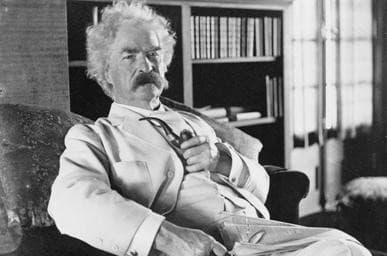
Samuel Langhorne Clemens, best known by his pen name Mark Twain, was an American writer, humorist, entrepreneur, publisher, and lecturer. He was praised as the "greatest humorist the United States has produced", and William Faulkner called him "the father of American literature". His novels include The Adventures of Tom Sawyer (1876) and its sequel, Adventures of Huckleberry Finn (1884), the latter of which has often been called the "Great American Novel". Twain also wrote A Connecticut Yankee in King Arthur's Court (1889) and Pudd'nhead Wilson (1894), and co-wrote The Gilded Age: A Tale of Today (1873) with Charles Dudley Warner.







