“"The rainforest was like a giant, living puzzle, and he was just one small piece trying to fit in."”
— Jessie's initial feelings about the rainforest.

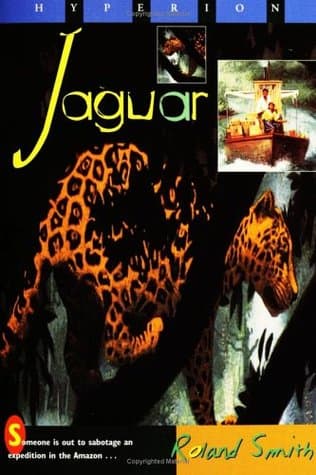
Roland Smith (1997)
Genre
Children's / Young Adult
Reading Time
256 min
Key Themes
See below
Sign in to track this book
In the Amazon, a young boy uncovers a poaching operation, risking everything to protect the rainforest's jaguars and solve the mystery of his father's past.
Thirteen-year-old Jacob Lansa and his father, Dr. Alex Lansa, travel to Manaus, Brazil, a city on the Amazon River. Jacob is still recovering from his mother's recent death and his adventures in the Kenyan savanna. Dr. Lansa, a wildlife biologist, has a grant to study jaguars in the Amazon rainforest. Their mission is to locate and track a specific group of jaguars using new satellite tracking technology. Upon arrival, they meet Dr. Lansa's old colleague, Dr. Susan Meyers, and her assistant, Miguel. Jacob is hesitant about the new environment and its dangers, contrasting with his father's scientific enthusiasm.
The team, consisting of Dr. Alex Lansa, Jacob, Dr. Susan Meyers, and Miguel, travels up an Amazon tributary on a research boat. The dense, green canopy of the rainforest surrounds them, a stark difference from the open plains Jacob remembers. They navigate through waterways, encountering wildlife. Eventually, they reach a secluded clearing where they establish their base camp. Jacob helps set up, but his mind often drifts to potential dangers, from snakes to the jaguars they are there to study. Dr. Lansa stresses safety protocols and the importance of respecting the jungle.
The work begins as the team ventures into the rainforest to find signs of jaguar activity. They set up camera traps and search for tracks. Jacob, despite his initial apprehension, is a keen observer, often spotting things others miss. They learn that tracking jaguars in the dense undergrowth is far more difficult than tracking lions. The jaguars are stealthy and elusive. Dr. Lansa explains the importance of their research in understanding jaguar behavior and conservation needs. Jacob also starts to bond with Miguel, who knows about the local plants and animals, and learns about indigenous tribes in the region.
While tracking, Jacob and Dr. Lansa find crude traps and discarded cartridges, signs of poachers. Dr. Lansa is angry, knowing that illegal hunting threatens the endangered jaguar population. He reports their findings to local authorities via satellite phone, but help is slow to arrive. The poachers add danger and urgency to their mission. Jacob becomes more aware of human impact on the rainforest and its creatures, realizing their scientific work is part of a fight against exploitation.
After days of tracking, the team tranquilizes a male jaguar. Jacob is amazed by the animal's power and beauty even while sedated. Dr. Lansa, Dr. Meyers, and Miguel work quickly to take measurements, collect samples, and fit the jaguar with a satellite tracking collar. Jacob assists by holding equipment and observing the process. The experience is exciting and a scientific achievement. This collaring allows them to monitor the jaguar's movements and behavior, providing data for their research. It also deepens Jacob's connection to the rainforest and its wildlife.
While Dr. Lansa and Dr. Meyers are away on another research trip, Jacob and Miguel stay at camp. During a routine check of camera traps, poachers ambush them. The poachers, led by a man named Scarface, demand to know the collared jaguar's location. They suspect the research team is interfering with their operations. Jacob and Miguel escape through quick thinking and jungle knowledge, but after a terrifying chase. This confrontation escalates the danger, showing that the poachers are a serious threat to both the jaguars and the research team.
After their escape, Jacob, fearing for their safety and the jaguars, plans to lead the poachers away from the collared jaguar and potentially trap them. He uses his jungle knowledge and tracking equipment. Miguel, initially hesitant, agrees to help. However, during their attempt to lure the poachers, Scarface and his men catch Miguel. Jacob sees Miguel's capture, feeling guilt and determination. He realizes he must act quickly to rescue his friend and protect the jaguars, even if it means putting himself in danger. He is now alone, facing a formidable adversary.
Alone in the rainforest, Jacob relies on the tracking skills he learned from his father and his experiences in Africa to follow the poachers. He uses subtle signs — broken twigs, footprints, discarded items — to stay on their trail. The jungle, once a place of apprehension, now becomes a landscape he must master for survival. He is driven by his loyalty to Miguel and his commitment to protecting the jaguars. Jacob also uses the satellite tracking device from the collared jaguar to understand movements in the area, hoping it might lead him closer to Miguel or give him an advantage against the poachers.
Jacob finds the poachers' hidden camp. He finds Miguel tied up and guarded. Using his wits and surprise, Jacob creates a diversion, causing chaos in the poachers' camp. He frees Miguel, and together they run, with Scarface and his men close behind. The chase through the dense jungle is dangerous, with close calls. Jacob and Miguel use their knowledge of the terrain, employing traps and diversions to slow their pursuers. The collared jaguar also helps their escape by drawing the poachers' attention away at a crucial moment.
Just as Jacob and Miguel are nearing exhaustion and almost cornered, Dr. Lansa and Dr. Meyers return, alerted by the satellite communicator. They arrive with park rangers and local authorities, who had finally responded to Dr. Lansa's calls. A coordinated effort leads to the capture of Scarface and his poaching gang. Jacob and Miguel are safe, though shaken. The collared jaguar is also secure. The authorities dismantle the poaching operation, ensuring the immediate safety of the wildlife. Jacob, having faced dangerous criminals and survived the jungle, feels a sense of accomplishment and a deeper connection to the rainforest and its inhabitants.
With the poachers apprehended and the research continuing, Jacob reflects on his journey. He has contributed to scientific research and proven his courage, resourcefulness, and loyalty. His bond with his father has strengthened, and he has a new friendship with Miguel. The Amazon rainforest, once daunting, has become a place he understands and respects. He realizes the importance of conservation and his role in it. As the book concludes, Jacob looks forward to future adventures, eager to continue learning about the natural world and facing new challenges alongside his father, his grief for his mother now tempered by new purpose and experience.
The Protagonist
Jacob transforms from a hesitant, grieving boy into a courageous and resourceful young man, finding his place and purpose in the wild.
The Supporting
Dr. Lansa continues his conservation efforts, realizing the importance of involving Jacob and trusting his growing abilities.
The Supporting
Miguel proves his loyalty and bravery, solidifying his friendship with Jacob and his role in the conservation effort.
The Supporting
Dr. Meyers contributes significantly to the research, reinforcing her commitment to wildlife conservation.
The Antagonist
Scarface's reign of terror is ended by the combined efforts of the research team and authorities.
The Mentioned
The collared jaguar represents the success of the conservation efforts and the continued hope for its species.
The novel emphasizes wildlife conservation, especially protecting endangered species like the jaguar, and preserving ecosystems like the Amazon rainforest. Dr. Lansa's research is an effort to understand and save these animals. The threat of poachers, like Scarface, highlights destructive forces against conservation. Jacob's journey makes him witness to both the beauty and fragility of nature, inspiring him to advocate for its protection. The successful collaring of the jaguar and the apprehension of the poachers show the positive impact of dedicated conservation work.
“"The jaguars are more than just magnificent creatures, Jacob. They're a keystone species. Their survival means the health of the entire rainforest."”
Jacob's journey in the Amazon is a part of his coming-of-age. Still grieving his mother, he is initially hesitant and overwhelmed by the new environment. However, by facing challenges like the dense jungle, dangerous animals, and poachers, he develops courage, resourcefulness, and self-reliance. His experiences force him to mature quickly, taking on responsibilities and making difficult decisions. The transformation from a boy who fears the jungle to one who navigates it expertly and stands up to criminals shows his personal growth and identity formation.
“"He wasn't just Jacob Lansa anymore, the kid who missed his mom. He was Jacob Lansa, jungle survivor, protector of jaguars, and friend."”
The Amazon rainforest is a character itself, a place of immense beauty and danger. The narrative describes its lush plants, diverse animals, and waterways, highlighting its ecological significance. Simultaneously, it exposes its perils: venomous snakes, powerful predators, and the jungle's vastness. This dual portrayal stresses the respect and caution needed to survive in such an environment. Jacob's initial fear and eventual mastery of the jungle show how one can appreciate its wonders while acknowledging its threats.
“"The jungle breathed around them, a symphony of unseen life and unspoken threats."”
The bond between Jacob and Miguel is a central theme, showing the power of friendship and loyalty. Despite different backgrounds, they form a deep connection based on shared experiences and mutual respect. Miguel's local knowledge and support are important for Jacob, while Jacob's courage and determination drive him to rescue Miguel. Their loyalty is tested during the confrontation with the poachers, where they rely on each other for survival. This friendship highlights the importance of human connection and solidarity in adversity.
“"You don't leave a friend behind, especially not in the middle of the Amazon."”
Technological tools used to monitor jaguars and advance research.
The satellite tracking collars are a crucial plot device. They represent the cutting-edge technology used in modern wildlife conservation, allowing the research team to gather vital data on jaguar movements and behavior. Scientifically, they drive the mission. Narratively, the collared jaguar's movements sometimes inadvertently aid Jacob and Miguel by drawing the poachers' attention away or providing a sense of direction. The collars also symbolize the human effort to understand and protect nature, contrasting with the destructive actions of the poachers.
External antagonists who provide direct conflict and raise the stakes.
Scarface and his poaching gang serve as the primary antagonists, introducing a clear external threat to both the jaguars and the research team. They embody the destructive forces of greed and exploitation against nature. Their presence creates immediate danger, driving much of the plot's action and suspense, particularly when they ambush Jacob and Miguel. This device elevates the stakes from a purely scientific mission to a fight for survival and justice, forcing Jacob to develop courage and resourcefulness beyond his initial expectations.
Foreshadowing and a source of acquired skills and resilience.
Jacob's previous adventures in Africa (from 'Thunder Cave') serve as a crucial plot device, providing him with a foundation of survival skills, tracking knowledge, and resilience. These past experiences are frequently referenced, not only to explain his capabilities but also to highlight his emotional journey, as he compares the Amazon to the African savanna. This device allows Jacob to quickly adapt to the new challenges, making his heroic actions more plausible and demonstrating his continuous growth as an adventurer and a person. It connects the sequel to the previous book, providing continuity for the character's development.
“"The rainforest was like a giant, living puzzle, and he was just one small piece trying to fit in."”
— Jessie's initial feelings about the rainforest.
“"Sometimes the most dangerous things are the most beautiful."”
— Jessie's reflection on the jaguar and the jungle.
“"Fear was a powerful thing, but so was curiosity."”
— Jessie's internal struggle when encountering new things.
“"Every creature had its place, a role to play in the grand scheme of things."”
— Jessie observing the ecosystem of the rainforest.
“"You don't just see the jungle; you feel it, smell it, hear it."”
— Martín explaining the immersive experience of the rainforest.
“"The jungle always had secrets, and it didn't give them up easily."”
— Jessie's growing understanding of the mysterious rainforest.
“"A person could learn a lot just by watching, if they knew what to look for."”
— Jessie's father teaching him about observation.
“"Sometimes you had to be brave, even when you didn't feel brave at all."”
— Jessie facing a difficult or scary situation.
“"The silence of the jungle wasn't empty; it was full of life waiting to be heard."”
— Jessie realizing the subtle sounds of the rainforest.
“"Conservation wasn't just about animals; it was about people too."”
— A discussion about the broader impact of rainforest preservation.
“"He was learning that strength wasn't always about muscle, but about knowing when to be still, when to listen."”
— Jessie's evolving understanding of different kinds of strength.
“"The jaguar was a ghost, a shadow, a whisper in the trees."”
— Describing the elusive nature of the jaguar.
“"Every footprint told a story, if you knew how to read it."”
— Jessie learning tracking skills.
“"Some things you just had to experience to understand."”
— Jessie reflecting on his journey in the rainforest.
Ready to see how well you understood this book? Take our interactive quiz with 10 questions.

Biography coming soon.

Dan Gemeinhart
4.5

Kate O'Hearn
4.4

Jeanne Birdsall
4.4

Jen Wang
4.4

Wendelin Van Draanen
4.3

John Marsden
4.3

Chris Van Allsburg
4.3
Jennifer A. Nielsen
4.2