“Bean stomped her foot. 'I hate fossils! They're stupid! And boring! And old!'”
— Bean's initial reaction to the idea of looking for fossils, showing her characteristic impatience.

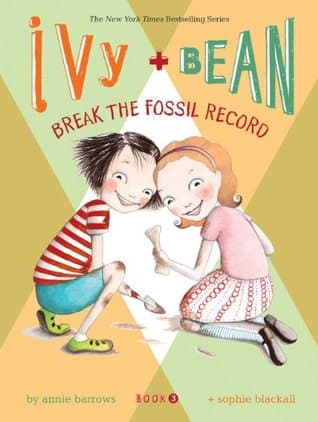
Annie Barrows (2007)
Genre
Children's
Reading Time
90-120 min
Key Themes
See below
Sign in to track this book
Second-graders Ivy and Bean, armed with shovels and big dreams, go on a funny journey to find a dinosaur and become world record holders.
Mrs. Aruba, the second-grade teacher at Pancake Elementary, introduces her class to world records. She shows them a video of famous record breakers, like the tallest man and the person who ate the most hot dogs. This makes the students excited, and they start thinking of their own record attempts. Ivy, usually quiet, and Bean, always full of energy, get caught up in it. Bean first tries to break the pogo stick jumping record but quickly gives up. The whole class becomes focused on becoming famous by setting a world record.
After the pogo stick attempt, Bean tries other solo record ideas. She tries to hold her breath for a long time but can only manage a few seconds. She also tries to balance spoons on her face, but they keep falling off. Ivy watches Bean's enthusiastic but clumsy efforts with amusement and a hidden wish for her own record. Nancy, another classmate, successfully sets a record for putting the most rubber bands around her head. This makes the class more competitive and makes Bean even more determined to find her own record.
During a quiet moment, Ivy, who loves to read, suggests a new idea to Bean: finding a dinosaur. Ivy remembers a news report about a child who found a dinosaur bone and realizes they could be the youngest people to ever discover one. Bean immediately likes this big, exciting plan, seeing it as a sure way to set a world record. They decide that finding a dinosaur is more impressive and possible than their earlier, failed tries, and they start planning their expedition.
With their new goal, Ivy and Bean go to the library to research dinosaurs. Ivy, being more academic, reads books about paleontology, fossils, and where dinosaurs are found. Bean, less interested in details, focuses on the adventure. They learn that dinosaurs lived millions of years ago and their bones turn into fossils. They decide they need tools like shovels and buckets for digging. They also pack snacks and water, believing their quest needs serious preparation.
Ivy and Bean choose Bean's backyard as their main digging site, thinking it's a good and easy place to start. They begin digging with excitement but soon realize that digging for fossils is harder than they thought. The ground is hard, and they mostly find rocks, worms, and dirt. Their initial excitement fades as the physical work proves more difficult than the idea. They keep digging for a while, driven by their desire for a world record, but find no immediate signs of a dinosaur.
After several hours of not finding anything in Bean's backyard, Ivy and Bean decide to move. Ivy remembers reading that fossils are often found near water or in exposed rock. They decide to go to the creek bed behind Bean's house, a place they often play. They believe the creek, with its eroding banks and exposed earth, offers a better chance of finding old bones. They pack their shovels and buckets, feeling hopeful that a new spot will bring them closer to their dinosaur discovery.
At the creek bed, after more digging and searching, Ivy and Bean finally unearth what they are sure are dinosaur bones. They find several large, oddly shaped rocks that, to their imaginative minds, look exactly like old bone pieces. They are thrilled, certain they have found proof of their world-record discovery. They carefully gather their 'fossils,' filled with triumph and the certainty that they are now the youngest dinosaur discoverers in history. Their excitement is clear as they imagine the fame and recognition waiting for them.
The next day, Ivy and Bean proudly bring their 'dinosaur bones' to school for show and tell. They are very excited, sure they are about to become famous. They present their findings to Mrs. Aruba and their classmates, explaining their trip and the importance of their discovery. Their classmates are at first impressed by the size and look of the 'bones,' and the classroom is full of anticipation and awe for their adventurous friends.
As Ivy and Bean finish, Mrs. Aruba carefully looks at their 'fossils.' Kindly and gently, she explains that while the objects are interesting rocks, they are not dinosaur bones. She clarifies that real fossils have specific features and that what Ivy and Bean found are just ordinary stones. The girls are at first sad and disappointed, their hopes of a world record gone. The class is also a little down, but Mrs. Aruba's explanation is sensitive.
Even though their dream of breaking the fossil record is over, Ivy and Bean don't stay sad for long. Mrs. Aruba praises their effort, research, and adventurous spirit, saying that the journey and learning were valuable. Ivy and Bean realize that even though they didn't find a dinosaur, they had a great adventure together. They think about the fun they had digging and exploring, and the shared experience makes their bond stronger. They learn that some of the best parts of an adventure are the experiences themselves, not just the result.
As the day ends, Ivy and Bean walk home, talking about their failed record attempt. They realize that while they didn't break the fossil record, they did something else special: they had an amazing adventure together. They decide that their friendship and the fun they have is a type of record—a record for having the most fun or being the best of friends. This realization brings them joy and contentment, shifting their focus from outside praise to the true worth of their bond and shared experiences.
The Protagonist
Ivy learns that the value of an experience lies in the journey and friendship, not just the outcome.
The Protagonist
Bean learns to appreciate the process of adventure and the strength of friendship over the need for external recognition.
The Supporting
Not applicable, she serves as a consistent supportive figure.
The Supporting
Not applicable, she serves as a minor plot point.
The book celebrates the friendship between Ivy and Bean. Their adventures, even the ones that don't work out, make their friendship stronger. They learn to support each other's ideas and find joy in being together, no matter the outcome. This is clear in how they plan, dig, and deal with disappointment, realizing their friendship itself is a 'record' (Scene 10, 11).
“Maybe we didn't break the fossil record, but we broke the record for having the most fun.”
The story shows children's strong imaginations and how they often clash with reality. Ivy and Bean's belief that they can simply 'find' a dinosaur in a creek shows their big imagination. Mrs. Aruba's gentle explanation that their 'bones' are just rocks (Scene 9) helps them come back from their fantasy, teaching them a subtle lesson about scientific reality without crushing their spirits.
“They were just rocks. Interesting rocks, Mrs. Aruba said. But not dinosaur bones.”
At first, Ivy and Bean want to break a world record and become famous. But they eventually discover that the adventure itself is more rewarding than the final goal. Their research, digging, and exploration, even without finding a fossil, give them excitement and valuable shared memories. The book highlights that effort, teamwork, and experiences are what truly matter (Scene 10).
“Sometimes the best part of an adventure is just having it.”
The plot starts because the second grade wants recognition from breaking a world record. From Bean's early, clumsy tries to Ivy's more thought-out dinosaur idea, the children are motivated by the promise of fame and being 'the best.' This theme explores how children are influenced by outside praise and slowly learn that inner satisfaction can be more fulfilling.
“Everybody wanted to be famous. Everybody wanted to be the best.”
The dinosaur fossil serves as the primary goal driving the plot.
The 'dinosaur fossil' acts as a MacGuffin in the story. It is the object that Ivy and Bean are relentlessly pursuing, providing the primary motivation for their adventure, research, and digging. While the actual discovery of a fossil isn't the true point of the story, the quest for it drives all the action and allows the characters to experience growth and strengthen their friendship. The fossil itself is less important than the journey it inspires.
The 'dinosaur bones' found in the creek bed mislead the characters and the reader.
The 'dinosaur bones' that Ivy and Bean unearth in the creek bed serve as a red herring. For a significant portion of the story, both the characters and the reader are led to believe that they might have actually succeeded in their quest. This creates anticipation and excitement, only for the truth to be revealed later by Mrs. Aruba (Scene 9). This device builds tension and then provides a gentle plot twist, reinforcing the themes of imagination versus reality.
The world record fever is already established at the story's outset.
While not strictly 'in medias res' in the traditional sense, the story quickly establishes the 'world record fever' as an ongoing phenomenon in the second grade. The reader is dropped into a classroom already buzzing with ideas and attempts, rather than seeing the very genesis of the idea. This immediately immerses the reader in the book's central conflict and the characters' motivations without lengthy exposition, allowing Ivy and Bean's specific quest to begin quickly.
Mrs. Aruba provides gentle, supportive guidance to the protagonists.
Mrs. Aruba acts as a mentor figure for Ivy and Bean. She doesn't directly solve their problems or prevent their mistakes, but she provides the initial spark (the world record presentation) and then, crucially, offers gentle, empathetic guidance when their dreams are dashed. Her explanation about the 'fossils' and her praise for their effort (Scene 9, 10) allows the girls to learn from their experience without feeling shamed, reinforcing positive lessons about resilience and the value of effort.
“Bean stomped her foot. 'I hate fossils! They're stupid! And boring! And old!'”
— Bean's initial reaction to the idea of looking for fossils, showing her characteristic impatience.
“'Don't worry, Bean. We'll find something amazing. We always do.'”
— Ivy reassuring Bean, highlighting their shared history of adventure and discovery.
“'It's not just a rock. It's a rock that used to be alive!'”
— Ivy trying to explain the concept of a fossil to Bean, showcasing her imaginative understanding.
“Bean loved to dig. She loved to get dirty. She loved to find things.”
— Narrator describing Bean's natural inclinations, which make the fossil hunt more appealing to her.
“'Maybe it's a dinosaur tooth! A really, really big one!'”
— Bean's excited speculation upon finding an interesting object, demonstrating her vivid imagination.
“'You can't just wish for a fossil, Bean. You have to look for it.'”
— Ivy gently correcting Bean's magical thinking, emphasizing the need for effort.
“The world was full of amazing things, if you just knew where to look.”
— A general observation about the potential for discovery in everyday life, a core theme of the series.
“'It's a fossilized wormhole! It leads to another dimension!'”
— Ivy's imaginative (and incorrect) interpretation of a spiral shell fossil.
“Bean made a face. 'Why can't we just find a fossilized pizza?'”
— Bean's pragmatic and food-oriented wish, contrasting with Ivy's more scientific interests.
“'Even if it's not a dinosaur, it's still pretty cool,' Ivy said.”
— Ivy finding value in a discovery even if it doesn't meet their initial grand expectations.
“They were archaeologists, paleontologists, and explorers, all rolled into two small girls.”
— Narrator summarizing Ivy and Bean's adventurous spirit and their self-appointed roles.
“'We broke the fossil record!' Bean shouted, even though they hadn't, really.”
— Bean's enthusiastic (and slightly exaggerated) declaration of success at the end of their fossil hunt.
“It was just a rock, but it was *their* rock, and they had found it together.”
— Highlighting the importance of shared experience and ownership over the actual scientific value of their find.
“'Maybe we'll find a fossilized unicorn horn next time!'”
— Bean's enduring hope for magical discoveries, showing her persistent whimsical nature.
Ready to see how well you understood this book? Take our interactive quiz with 10 questions.

Annie Barrows is the acclaimed author of the popular "Ivy & Bean" series, including "Ivy and Bean Take Care of the Babysitter" and "Ivy and Bean Break the Fossil Record." She also penned the middle-grade fantasy novel "The Magic Half." Barrows is known for her engaging storytelling and relatable characters, appealing to young readers.

Dan Gemeinhart
4.5

Kate O'Hearn
4.4

Jeanne Birdsall
4.4

Jen Wang
4.4

Wendelin Van Draanen
4.3

John Marsden
4.3

Chris Van Allsburg
4.3

Jennifer A. Nielsen
4.2