“For within the bounds of that forest, and sweeping through a great part of Yorkshire, there roamed at large a band of outlaws, whose exploits had long been the theme of popular wonder.”
— Introducing Robin Hood's band, early in the novel.

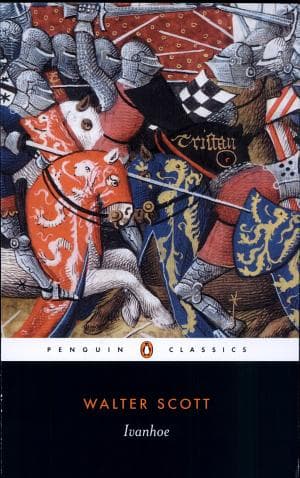
Walter Scott (2000)
Genre
Historical Fiction / Romance
Reading Time
12-15 hours
Key Themes
See below
Sign in to track this book
Amidst the clashing swords of Norman overlords and dispossessed Saxons, the banished knight Ivanhoe returns to a land of jousts and sieges, battling for his forbidden love and the rightful king against the treacherous Prince John.
The novel opens with Cedric the Saxon, a proud Saxon Thane, lamenting England's Norman subjugation. He hosts a feast at Rotherwood, attended by his ward Lady Rowena, his jester Wamba, and his swineherd Gurth. Travelers, including Prior Aymer and the Templar Brian de Bois-Guilbert, arrive seeking hospitality. They are joined by a mysterious pilgrim, who is Wilfred of Ivanhoe in disguise, returning from the Crusades. During the evening, the disguised Ivanhoe subtly challenges Bois-Guilbert's boasts and discreetly communicates with Rowena, whom Cedric intends for Athelstane of Coningsburgh to marry, hoping to restore a Saxon monarchy.
The travelers go to Ashby-de-la-Zouch for a grand tournament hosted by Prince John. The first day features a jousting competition. A mysterious knight, calling himself the 'Disinherited Knight,' enters, bearing a shield with an oak tree torn up by the roots. He defeats all challengers, including Brian de Bois-Guilbert, Front-de-Boeuf, and other Norman knights, to the delight of the Saxon spectators. Prince John, annoyed by the champion's anonymity and his victories, is further irritated by the crowd's favor. At the end of the day, the Disinherited Knight chooses Lady Rowena as the Queen of Love and Beauty, showing his unspoken devotion to her.
The second day of the Ashby tournament includes an archery contest, won by Locksley (who is Robin Hood) after he splits his opponent's arrow. The main event is a mêlée, a mock battle between two teams of knights. The Disinherited Knight's team is initially overwhelmed, but a mysterious Black Knight, of immense strength and skill, arrives to turn the tide. The Disinherited Knight, heavily involved in the fighting, is severely wounded by a blow to the head. After the mêlée, the Disinherited Knight is unhelmed and revealed to be Wilfred of Ivanhoe, much to the surprise of Prince John and the delight of Cedric and Rowena, despite their strained relationship.
Following his injury, Ivanhoe cannot travel. Isaac of York, a wealthy Jewish moneylender whom Ivanhoe had helped, offers to take Ivanhoe to his home for his daughter, Rebecca, a skilled healer, to tend him. Rebecca nurses Ivanhoe with great care, developing a deep, unspoken affection for him. Meanwhile, Brian de Bois-Guilbert, defeated and humiliated by Ivanhoe, becomes obsessed with Rebecca's beauty and spirit. He sees her as a prize and a way to further his own power and pleasure, foreshadowing dark events.
As Cedric, Rowena, Athelstane, Gurth, Wamba, Isaac, Rebecca, and the still-recovering Ivanhoe (traveling in a litter) journey from Ashby, a band of outlaws led by the ruthless Norman baron, Sir Reginald Front-de-Boeuf, and Brian de Bois-Guilbert ambushes them. The entire party is captured and taken to Front-de-Boeuf's stronghold, Torquilstone. The Black Knight, who had separated from the group, escapes the ambush. The stage is set for a siege, with the Saxon and Jewish captives imprisoned in the Norman fortress, facing dire threats.
Within Torquilstone, the captives face grim prospects. Front-de-Boeuf demands a ransom from Isaac, threatening torture if he refuses. De Bracy, another Norman knight, tries to force Rowena into marriage. Bois-Guilbert holds Rebecca captive, attempting to seduce or coerce her into becoming his mistress, but she fiercely resists, even threatening to throw herself from the castle battlements. Ivanhoe, still wounded, lies helpless in a distant chamber, only vaguely aware of the escalating peril. Cedric, enraged by the indignities, remains defiant, refusing to submit to his captors.
News of the captives reaches the Black Knight, who, along with Locksley and his band of outlaws (including Friar Tuck), mounts a daring rescue attempt. They besiege Torquilstone, engaging in a fierce battle with the Norman defenders. The Black Knight proves a formidable warrior, inspiring the attackers with his courage and strength. Gurth and Wamba, having escaped earlier, assist the besiegers from outside. Inside the castle, Ulrica, a Saxon woman who has lived a life of degradation under Front-de-Boeuf, sets the fortress ablaze, seeking vengeance for her family's destruction. The battle rages, with fire and sword consuming the stronghold.
During the chaotic siege, many captives escape. Cedric and Rowena are rescued, as are Isaac and Rebecca, though Bois-Guilbert forcibly carries Rebecca off as the castle collapses. Front-de-Boeuf is killed, and De Bracy is captured. In the confusion, Athelstane is severely wounded, and believed to have died, in an attempt to rescue Rowena. Ivanhoe, still weak, is carried to safety. The Black Knight, having played a central role in the victory, reveals his true identity to Cedric: he is King Richard the Lionheart, returned from captivity, much to Cedric's astonishment and grudging respect.
Bois-Guilbert, having escaped Torquilstone with Rebecca, takes her to the Preceptory of Templestowe. There, he tries to force his affections upon her once more, but she steadfastly refuses. To avoid scandal and protect himself from accusations of carrying off a Jewess, Bois-Guilbert orchestrates Rebecca's trial before the Grand Master of the Knights Templar, Lucas de Beaumanoir, on charges of witchcraft. De Beaumanoir, a rigid and zealous man, is easily convinced of her guilt, especially given her Jewish faith and healing abilities, which are interpreted as sorcery. Rebecca, facing certain death by fire, demands a trial by combat.
Rebecca's demand for a trial by combat means a champion must fight for her. Bois-Guilbert, despite his conflicted feelings, is appointed her accuser's champion. At the last possible moment, as the pyre is lit, Ivanhoe, still recovering from his wounds but driven by justice and his admiration for Rebecca, rides onto the lists as her champion. Though weak, he unseats Bois-Guilbert, who dies from exertion and internal conflict, rather than Ivanhoe's blow. Just then, King Richard, having rallied his supporters, arrives to reclaim his throne from Prince John. He pardons Locksley and his men and restores order.
Following the events, Athelstane, believed dead at Torquilstone, reappears, having merely been stunned and buried prematurely. His return resolves Cedric's ambition to unite the Saxon royal lines through his marriage to Rowena. Athelstane, having realized Rowena's true affection for Ivanhoe and deeply affected by his near-death experience, nobly renounces his claim to Rowena's hand and encourages her marriage to Ivanhoe. This act of Saxon nobility finally softens Cedric's heart, leading him to reconcile with his son and give his blessing to Ivanhoe and Rowena's union.
With Ivanhoe's name cleared and King Richard back on the throne, order is restored. Rebecca, deeply grateful to Ivanhoe for saving her life but understanding the societal barriers between them, visits Rowena to bid her farewell. She presents Rowena with jewels and expresses her heartfelt wishes for her happiness. Rebecca and Isaac of York decide to leave England, seeking a place where their people can live in greater peace and security, perhaps in Granada. Ivanhoe and Lady Rowena are finally married, and Ivanhoe, now reconciled with his father and enjoying the King's favor, lives a long and happy life, though he never forgets Rebecca's noble spirit.
The Protagonist
Ivanhoe begins as a disinherited, exiled knight seeking to reclaim his honor and love; he ultimately achieves both through his bravery and loyalty, reconciling with his father and marrying Rowena.
The Supporting
Rebecca endures persecution and nearly faces death, ultimately choosing to leave England to find a place of greater tolerance, showcasing her unwavering strength and self-respect.
The Supporting
Cedric, initially blinded by his Saxon pride and ambition, gradually softens and reconciles with his son, accepting the merging of Saxon and Norman influences for England's future.
The Supporting
Rowena, initially a passive object of others' desires, remains steadfast in her love for Ivanhoe, ultimately achieving her desired union.
The Supporting
Richard returns to England in disguise, observes the injustices, and eventually reveals his identity to reclaim his throne and restore order.
The Antagonist
Bois-Guilbert's initial arrogance and cruelty intensify into obsessive desire, leading him to commit heinous acts, culminating in his death during the trial by combat, a victim of his own conflicted passions.
The Supporting
Isaac endures persecution and threats, demonstrating resilience and paternal love, ultimately deciding to leave England for a more tolerant land.
The Antagonist
Prince John actively schemes to usurp his brother's throne, but his plans are thwarted by Richard's return, forcing him to submit to his rightful king.
The Supporting
Locksley consistently aids the cause of justice and the Saxons, proving his loyalty to King Richard, and is ultimately pardoned.
The novel explores chivalry's ideals against its often-corrupt reality. Ivanhoe and King Richard embody the best of chivalric ideals—honor, courage, loyalty, and protection of the weak. In contrast, characters like Bois-Guilbert and Front-de-Boeuf represent these ideals' perversion, using their knightly status for personal gain, lust, and cruelty. The tournament at Ashby, initially a display of knightly prowess, quickly becomes a stage for Prince John's political maneuvering and the Disinherited Knight's fight against Norman power. The Templars, supposedly a holy order, are shown to be grasping and hypocritical through Bois-Guilbert and De Beaumanoir, showing chivalry's decay.
“"Man dies, but glory lives!" (attributed to a knightly motto, reflecting the ideal of eternal renown through honorable deeds)”
Ivanhoe portrays the deep-seated religious and racial prejudice of medieval England, especially against Jews and Saxons. Isaac of York and Rebecca suffer constant humiliation, threats, and extortion because of their faith and ethnicity. Rebecca's trial for witchcraft, orchestrated by the zealous Grand Master, shows the lethal consequences of such bigotry, where 'healing' can become 'sorcery.' The conflict between Saxons and Normans, though often political, also has racial undertones, with Cedric's unwavering Saxon pride clashing against Norman dominance. The novel critiques these prejudices, especially through Rebecca's noble character and Ivanhoe's defense of her.
““The Jewess was beautiful, but the Templar was a Knight of the Temple.” (Narrator, highlighting the societal bias that favored a Christian knight over a Jewish woman, regardless of moral standing)”
The narrative highlights the struggle for justice in a kingdom with much lawlessness, particularly during King Richard's absence. Prince John's misrule and the unchecked power of tyrannical Norman barons like Front-de-Boeuf lead to widespread oppression. The common people, both Saxon and Norman, suffer under this regime. Figures like Locksley (Robin Hood) and his band of outlaws, operating outside the formal legal system, act as agents of popular justice, correcting wrongs when official channels fail. King Richard's return signifies the restoration of legitimate authority and the re-establishment of a just legal order, ending lawlessness and holding the corrupt accountable.
““There are no laws in England, but the sword and the strong hand.” (Wamba, reflecting the state of lawlessness under Prince John's rule)”
A central theme is the eventual reconciliation between the conquering Normans and the subjugated Saxons, leading to a unified English national identity. Cedric's initial refusal to accept Ivanhoe's love for Rowena, due to his desire to maintain a pure Saxon lineage, underscores the deep divisions. However, through shared adversity, the heroism of both Saxon (Ivanhoe) and Norman (Richard) figures, and ultimately Athelstane's renunciation of Rowena, the path is cleared for a merging of the two cultures. King Richard, a Norman king, proves to be a just ruler for all, and Ivanhoe, a Saxon knight, exemplifies the best of chivalry, suggesting that a new, stronger England can emerge from the blending of these distinct heritages.
““The time is come when the descendants of the victors and vanquished must be blended in one people.” (King Richard, recognizing the necessity of unity for England's future)”
Characters conceal their true identities to navigate treacherous political landscapes.
Disguise is a pervasive and crucial plot device in 'Ivanhoe'. Ivanhoe himself first appears as a humble pilgrim, then as the 'Disinherited Knight' at the tournament, allowing him to challenge his oppressors and prove his worth without revealing his banished status. King Richard similarly operates as the 'Black Knight' or 'Le Noir Faineant,' enabling him to observe his kingdom's state and rally support without immediately revealing his royal authority. These disguises create suspense, allow for dramatic reveals, and highlight the perilous environment where true identities must often be hidden for survival or strategic advantage.
A medieval legal procedure where disputes are settled by single combat, believed to be God's judgment.
Trial by combat serves as a climactic plot device, particularly in Rebecca's fate. Accused of witchcraft, Rebecca's only recourse is to demand a champion to fight on her behalf, believing that God will reveal the truth through the outcome of the duel. This device not only heightens the stakes for Rebecca but also provides a dramatic opportunity for Ivanhoe to demonstrate his unwavering chivalry and for Bois-Guilbert to face his internal conflict. It underscores the medieval belief in divine intervention and the brutal, yet often final, nature of justice in that era.
A romantic entanglement where one character's love for another is not reciprocated.
The unrequited love between Rebecca and Ivanhoe, set against Ivanhoe's devoted love for Rowena, is a powerful emotional engine. While Ivanhoe respects and admires Rebecca, his heart belongs to Rowena. Rebecca's silent, selfless love for Ivanhoe, her willingness to sacrifice for him, and her ultimate departure, add a layer of tragic romance and moral depth to the story. This device highlights themes of societal barriers, selflessness, and the pain of unspoken affection, allowing Rebecca to emerge as one of the novel's most noble and memorable characters, transcending the conventional happy ending.
An object or person that serves as a catalyst for the plot, but whose specific nature is less important than its role in driving the narrative.
Lady Rowena's hand in marriage functions as a MacGuffin, driving much of the early plot and the conflict between Cedric, Ivanhoe, and Athelstane. Her royal Saxon lineage makes her a key element in Cedric's plan to restore a Saxon monarchy, and her beauty makes her a prize for various suitors. While she is a character in her own right, her primary role in the plot is often as the object of desire and a symbol of Saxon heritage, motivating the actions of several male characters and shaping the political landscape of the story.
“For within the bounds of that forest, and sweeping through a great part of Yorkshire, there roamed at large a band of outlaws, whose exploits had long been the theme of popular wonder.”
— Introducing Robin Hood's band, early in the novel.
“There are some wounds which never heal, and leave a scar that throbs and aches in every change of weather.”
— Gurth reflecting on his servitude and past grievances.
“And the lists being now cleared of all but the champions, and the heralds having thrice proclaimed silence, the two knights, at the sound of the trumpets, set spurs to their horses.”
— Description of the start of a jousting match.
“The name of a Jew is anathema, and his habitation a mark for the spoiler.”
— Isaac of York lamenting the persecution of his people.
“He that does good, having the unlimited power to do evil, deserves praise not only for the good which he performs, but for the evil which he forbears.”
— Rebecca speaking about King Richard's potential for good.
“The love of woman is a wondrous thing, but it is not for a Jewess to dream of it from a Nazarene.”
— Rebecca's internal thoughts on her feelings for Ivanhoe.
“A bolt is soon shot, but a word is soon spoken.”
— Wamba, the jester, making a witty observation about words vs. actions.
“The lists are open, the trumpets have sounded, and the combatants are in the field!”
— A herald's announcement at the start of a joust.
“There is a tide in the affairs of men, Which, taken at the flood, leads on to fortune.”
— Quoted by Cedric, reflecting on the timing of events, though it's a Shakespearean quote.
“The poorest man may in his cottage bid defiance to all the forces of the Crown.”
— Said by Robin Hood, emphasizing the sanctity of one's home.
“Better to be a dog and bay the moon, than such a Roman.”
— Gurth expressing contempt for the Norman oppressors.
“It is not the cowl that makes the monk.”
— Wamba, disguised as a monk, making a point about appearances.
“Honour is like the eye, which cannot suffer the least impurity without damage.”
— Ivanhoe reflecting on the importance of reputation.
“There are few things so good that they cannot be improved by a little bad.”
— Friar Tuck offering a humorous and cynical observation.
Ready to see how well you understood this book? Take our interactive quiz with 10 questions.

Sir Walter Scott, 1st Baronet, was a Scottish historian, novelist, poet, and playwright. Many of his works remain classics of European and Scottish literature, notably the novels Ivanhoe (1819), Rob Roy (1817), Waverley (1814), Old Mortality (1816), The Heart of Mid-Lothian (1818), and The Bride of Lammermoor (1819), along with the narrative poems Marmion (1808) and The Lady of the Lake (1810). He had a major impact on European and American literature.







