“With man on board, the ship of life is sailing for the rocks.”
— Ishmael's core thesis about humanity's destructive path.

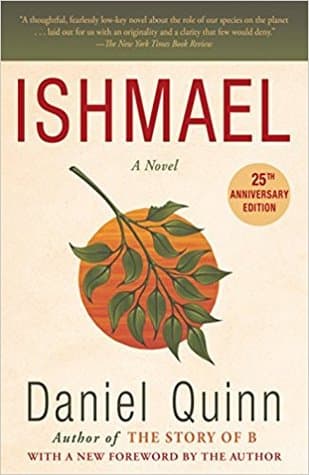
Daniel Quinn (1992)
Genre
Fantasy / Historical Fiction / Science Fiction
Reading Time
360 min
Key Themes
See below
Sign in to track this book
A disillusioned man finds an unexpected mentor in a telepathic gorilla named Ishmael, who challenges humanity's foundational myths and offers a new perspective on civilization's destructive path.
The unnamed narrator, a writer feeling lost and unhappy with modern society, finds a strange advertisement: 'Teacher seeks pupil. Must have an earnest desire to save the world. Apply in person.' Curious about the unusual words and his own sense of emptiness, he decides to investigate. He goes to the address, an old office building, and finds the room. The ad promises a chance for intellectual and spiritual awakening, appealing to his desire for meaning and understanding in a world he sees as destructive.
Inside the room, the narrator is shocked to find not a human teacher, but a large, intelligent gorilla named Ishmael. Ishmael communicates telepathically, explaining he is the teacher. This meeting challenges all the narrator's ideas about intelligence, communication, and teaching. Ishmael explains he has long searched for a pupil willing to listen and question human civilization's basic assumptions. The narrator, despite his shock, is drawn to Ishmael and agrees to begin lessons.
Ishmael starts by explaining that humanity divides into two groups: 'Takers' and 'Leavers.' Takers are modern, agricultural, and industrial civilizations that believe they will conquer and control the world. Leavers are indigenous cultures that live in harmony with nature, taking only what they need. Ishmael argues that Taker culture is a form of captivity, a 'cage' of ideas and myths that stops humans from seeing their true relationship with the planet. He stresses that this captivity is not physical, but ideological, enforced by a cultural story.
Ishmael discusses the Taker origin story, reinterpreting the biblical Genesis account. He explains that the story of Adam and Eve, the Tree of Knowledge, and their expulsion from Eden is a core myth for Taker culture. In Ishmael's view, the Tree of Knowledge represents the Takers' belief that they have a unique, divine right to decide who lives and who dies, to control nature, and to determine good and evil for the world. The 'Fall' from Eden symbolizes the moment Takers left the Leaver way of life—living within natural laws—for a path of control and expansion.
Ishmael introduces the 'Law of Life,' a universal principle that guides how all species, except Takers, interact with their environment. This law states that species may compete, but they must not wage war on their competitors' food supply or block access to it. No species is allowed to systematically destroy another's sustenance. Takers, however, violate this law through their agriculture and expansion, which destroy the habitats and food sources of other species, including other humans who live as Leavers.
Ishmael describes the 'Great Forgetting,' the process by which Taker culture suppressed and erased the knowledge of Leaver cultures. As Takers expanded their agricultural empires, they saw Leavers as primitive, failing to recognize the ecological balance and sustainable practices in their way of life. This forgetting led Takers to believe their civilization was the peak of evolution, destined to rule the world, while also cutting their connection to nature and its basic laws. This amnesia keeps the Taker myth of human exceptionalism alive.
Through his talks with Ishmael, the narrator understands the 'Mother Culture.' This is the dominant cultural story that shapes the worldview of Takers, dictating their values, beliefs, and behaviors. It is the unquestioned assumption that humanity is separate from nature, destined to conquer and control it. The Mother Culture promotes the idea that Takers are the 'chosen' people, and their way of life is the only correct and progressive path. The narrator realizes this story is so deeply ingrained that it is almost invisible, taken for granted by everyone within the Taker system.
As lessons continue, Ishmael refuses to give direct answers or solutions. Instead, he guides the narrator to discover truths himself, stressing that understanding must come from within. Ishmael challenges the narrator's ingrained assumptions, prompting him to examine the narratives that shaped his life and society. The 'path to freedom,' as Ishmael sees it, is not about adopting a new dogma, but about questioning the existing one and recognizing the possibility of living by the Law of Life, moving beyond the destructive Taker paradigm.
Ishmael shares his personal history, revealing he was captured from Africa as an infant and brought to America. He was used in a traveling show, where he learned to communicate with humans. Later, Walter Sokolow, a wealthy and eccentric Jewish businessman, took him in, recognizing Ishmael's intelligence and becoming his first pupil. Sokolow taught Ishmael human history and philosophy; together they developed the Taker and Leaver framework. Ishmael also reveals he is old and his health is failing, meaning their lessons must end soon.
In their final lessons, Ishmael stresses that humanity's future depends on recognizing and abandoning the destructive Taker myth. He emphasizes that change must come from individuals choosing to live differently and to spread understanding of the Law of Life. Ishmael does not offer a blueprint for a new society, but rather a basic change in perception. The narrator, transformed by Ishmael's teachings, understands his role is to be a messenger, to share Ishmael's wisdom with others. He leaves the office with a new purpose, ready to challenge the Mother Culture.
Some time after their last meeting, the narrator learns Ishmael died in an accident. A truck carrying him overturned, and Ishmael perished. The news is a blow, but it strengthens the narrator's commitment to Ishmael's legacy. He realizes that Ishmael's physical absence does not lessen his teachings. The narrator understands that the responsibility now falls to him and others who heard Ishmael's message to continue challenging the destructive Taker paradigm and promoting a new understanding of humanity's place in the world.
The Protagonist
He transforms from a disillusioned seeker into an enlightened messenger, committed to sharing Ishmael's wisdom.
The Teacher/Supporting
He fulfills his life's purpose by finding a suitable pupil to carry on his message, ultimately passing away but leaving a lasting legacy.
The Mentioned
Not applicable, as he is only mentioned historically.
The Minor/Mentioned
Not applicable, as he is a minor character with no personal arc.
A main theme is that humanity is trapped by a powerful, unquestioned cultural story – the 'Mother Culture' – that shapes its relationship with the world. Ishmael argues that this myth, especially the Taker belief in human exceptionalism and destiny to rule, causes environmental destruction and societal unhappiness. The book shows how this story, often based on reinterpreted origin myths like Genesis, shapes our view of reality and prevents us from seeing other ways of living. The narrator's journey involves breaking down this ingrained mythology.
“When you're captives of a story, you don't even know that you're captives.”
This theme explores the idea of a universal 'Law of Life' that guides all species in nature, except for modern humans. This law states that no species may systematically destroy another's food supply or block access to it. Ishmael argues that Taker civilization, through its agriculture and industry, violates this law, leading to ecological imbalance and the planet's destruction. The book suggests that sustainable living, as practiced by 'Leaver' cultures, means following this natural law and recognizing humanity's place within the web of life, not above it.
“The world was not made for you to conquer and rule it. It was made for you to live in it.”
This opposition is key to the book's argument. 'Takers' represent modern, agricultural, and industrial civilizations that believe in endless growth, technological progress, and humanity's right to control nature. 'Leavers' represent indigenous cultures that live in harmony with the environment, taking only what they need and respecting the interconnectedness of all life. The theme highlights the historical conflict and philosophical differences between these two ways of life, arguing that the Taker way is unsustainable and destructive, while the Leaver way offers a path to survival and peace.
“There's nothing fundamentally wrong with people. By and large, they're decent and they're good. The trouble is, they're in a trap. They're in a cultural trap.”
The narrator's initial disillusionment and search for purpose drive the story. He represents readers who feel a similar emptiness or unease with modern society. Ishmael's teachings offer not just intellectual understanding, but a spiritual and existential reorientation. The quest is not for a simple answer, but for a deeper truth about humanity's place in the cosmos and its responsibility to life. The book suggests that true meaning comes from aligning oneself with the natural order, rather than trying to dominate it.
“The gods made man to be an observer, not a ruler.”
Ishmael's teaching style, guiding the pupil to discover answers through questioning.
Ishmael employs a rigorous Socratic method throughout his lessons. He rarely provides direct answers, instead prompting the narrator with questions that force him to critically examine his own assumptions, cultural biases, and ingrained beliefs. This device actively engages the reader in the intellectual process, as they, like the narrator, are encouraged to think through the concepts rather than passively receive information. It emphasizes that true understanding must come from within and be earned through critical thought, rather than being handed down as dogma.
A talking gorilla serving as a wise, non-human mentor.
The choice of Ishmael as a gorilla teacher is a powerful plot device. It immediately challenges human anthropocentric biases and forces the reader to consider intelligence and wisdom outside of human form. As a non-human, Ishmael offers an objective, outsider's perspective on human civilization, free from the cultural conditioning that blinds humans to their own destructive patterns. His telepathic communication further emphasizes his unique status, allowing for direct intellectual exchange while maintaining his distinct, non-human identity, making his critique of humanity even more impactful.
A binary classification of human cultures to explain historical and ecological conflict.
This conceptual framework is the primary analytical tool used by Ishmael to explain human history and ecological problems. By dividing humanity into 'Takers' (modern, agricultural, industrial) and 'Leavers' (indigenous, sustainable), the book simplifies complex historical processes into a clear moral and ecological conflict. This dichotomy allows for a sharp contrast between two fundamental worldviews and their consequences. It serves as a powerful device to highlight the destructive nature of the dominant Taker paradigm and to suggest an alternative, more sustainable way of living.
Using existing cultural myths (like Genesis) to illustrate new philosophical concepts.
Ishmael frequently reinterprets well-known cultural myths, most notably the biblical story of Genesis, to illustrate his points about the Taker worldview. By taking a familiar narrative and giving it a new, ecological interpretation, the book effectively demonstrates how foundational stories shape cultural understanding and behavior. This device allows the author to critique deeply ingrained beliefs by showing how they can be understood in a way that supports the 'Taker' myth, and then offering an alternative reading that challenges it, making the abstract concepts more accessible and impactful.
“With man on board, the ship of life is sailing for the rocks.”
— Ishmael's core thesis about humanity's destructive path.
“The world was not made for you, you were made for the world.”
— Ishmael challenging the narrator's anthropocentric view.
“If you want to save the world, you have to change the way people think about it.”
— Ishmael explaining the necessity of a paradigm shift.
“There's nothing fundamentally wrong with people. By and large, they're decent and they're good. The problem is the system.”
— Ishmael distinguishing between individual people and the systemic issues.
“Every time you eat a potato, you're taking a risk.”
— Ishmael explaining the inherent risks and uncertainties in nature.
“We're not here to be the masters of the world, we're here to be part of the world.”
— Ishmael refuting the idea of human dominion over nature.
“The story of your people is that you were given the world to conquer and rule.”
— Ishmael describing the 'Taker' culture's founding myth.
“What is the story your culture is enacting?”
— Ishmael prompting the narrator to identify the underlying narrative of modern society.
“You are a member of a community, not a master of it.”
— Ishmael emphasizing humanity's role within the global ecosystem.
“Life must be lived forward, but can only be understood backward.”
— Ishmael's lesson about understanding the past to inform the present.
“The premise of the Taker culture is that the world was made for man.”
— Ishmael summarizing the fundamental belief driving modern civilization.
“You can't go home again, but you can go forward.”
— Ishmael on the impossibility of reverting to old ways, but the possibility of progress.
“To be a Taker means to take from the world without putting anything back.”
— Ishmael's definition of the 'Taker' mentality and its unsustainable nature.
“We're not meant to live in a world where everything is provided for us. We're meant to live in a world where we provide for ourselves.”
— Ishmael contrasting the 'Taker' consumer culture with a more self-sufficient approach.
Ready to see how well you understood this book? Take our interactive quiz with 10 questions.

Daniel Quinn was an American author best known for his philosophical novels exploring civilization and its impact on humanity. His breakout work, 'Ishmael' (1992), a philosophical novel framed as a dialogue between a man and a gorilla, won the Turner Tomorrow Fellowship Award. Other notable works include 'My Ishmael' and 'The Story of B'.







