“We are not slaves. We are children.”
— Iqbal Masih, a child laborer, asserts his humanity and rights in the carpet factory.

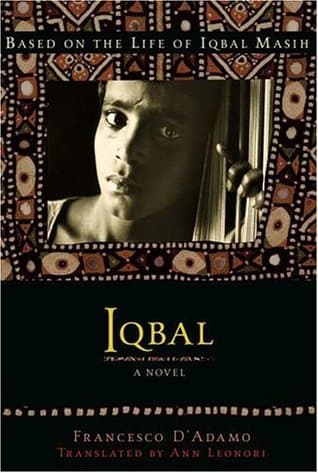
Francesco D'Adamo (2001)
Genre
Children's / Historical Fiction / Young Adult
Reading Time
120 min
Key Themes
See below
Sign in to track this book
In a grim carpet factory where childhoods are stolen, a courageous boy named Iqbal ignites a spark of rebellion among enslaved children, daring them to dream of freedom and fight for a life beyond their master's loom.
Fatima, a young girl with a hunchback, introduces herself and her life as a bonded laborer in Hussain Khan's carpet factory in Pakistan. She describes the harsh conditions: long hours, little food, and constant fear of the Master's punishments. The children are trapped, believing they must work off their families' debts, which never decrease. One day, a new boy, Iqbal Masih, arrives, bought from his desperate family for a small sum. Unlike the other children, Iqbal is immediately defiant, refusing to accept the injustice and questioning the Master's authority. This makes the other children both afraid and interested.
Iqbal’s rebellious spirit quickly shows. He ruins a carpet on purpose, a serious offense, to protest the conditions and the endless debt. For this act, Hussain Khan sends him to the 'Tomb' – a small, dark, suffocating cell used for punishment. Iqbal endures extreme discomfort and fear there but emerges unbroken. His time in the Tomb seems to strengthen his resolve to fight for their freedom. The other children, initially scared by his actions, begin to see hope and courage in his spirit, even if they do not fully understand it.
Driven by his desire for freedom, Iqbal makes his first escape attempt. He slips away from the factory and heads towards the city, hoping to find someone to help them. However, one of Hussain Khan's men quickly catches him and brings him back. His return results in a severe beating from Hussain Khan, meant to instill fear and stop any further rebellion among the children. Despite the brutal punishment, Iqbal’s spirit remains strong, and his determination to escape and expose their situation grows, inspiring fear and admiration among his fellow child laborers.
During a supervised outing to the mosque for Eid celebrations, Iqbal notices a newspaper. Unable to read, he asks an old man to read it to him. The man reads an article that says child labor is illegal and that organizations exist to free bonded children. This discovery gives Iqbal fierce hope. He realizes their enslavement is not only unfair but also against the law. He returns to the factory energized, sharing this information with the other children, who are both skeptical and cautiously hopeful about legal help.
With the knowledge from the newspaper, Iqbal makes a second, more determined escape. He reaches the city and finds the office of the Front Against Child Slavery, an organization run by Ehsan Khan. Iqbal bravely tells his story, detailing the conditions at Hussain Khan's factory and the children's illegal bondage. Ehsan Khan, impressed by Iqbal's courage, believes him and promises to help. This is a turning point, as Iqbal is no longer alone in his fight; he has found powerful allies committed to freeing him and his friends.
With Ehsan Khan and the Front Against Child Slavery, the police raid Hussain Khan's factory. The children, initially terrified, watch as Iqbal, now free, stands with the authorities. Hussain Khan is arrested, and the children are officially free from their bondage. The moment is overwhelming for them, as they have never known life outside the factory. Iqbal, though physically small, stands tall as their liberator, a sign of his courage and the power of fighting for justice. The children are taken to a shelter run by the Front.
At the shelter run by the Front Against Child Slavery, the children begin to experience a life they never imagined. They receive proper food, clean clothes, and medical care. Most importantly, they get to learn in a classroom, something none of them had ever done. Fatima describes the initial difficulties in adjusting to freedom and learning, but also the joy and hope that slowly appear. Iqbal, now a symbol of their freedom, continues to inspire them, though he is often busy working with Ehsan Khan, sharing his story with others.
Iqbal quickly becomes a strong voice against child labor. He travels with Ehsan Khan, speaking at conferences, giving interviews, and sharing his personal story of enslavement and liberation. He speaks with passion, captivating audiences with his simple message about the injustice of child bondage. His fame grows, and he becomes a global symbol for the fight against child slavery, especially in the carpet industry. The other children at the shelter, including Fatima, follow his progress with pride and a renewed sense of purpose, knowing their own freedom started his powerful advocacy.
As Iqbal's activism gains international attention, he also makes enemies of those who profit from child labor, particularly the powerful carpet mafia. Threats against his life begin to surface, causing concern among his supporters. Despite the danger, Iqbal remains committed to his cause. However, for his safety, he decides to return to his home village for a visit. This decision is met with mixed feelings – relief for his temporary absence from the public eye, but also unease about the risks he continues to take.
Tragically, while visiting his village, Iqbal Masih is murdered. The news shocks the shelter and his supporters worldwide. Fatima and the other children are devastated, trying to understand the loss of their hero. However, even in their grief, they realize that Iqbal's message and courage have not died with him. His sacrifice inspires them and many others to continue the fight against child labor. Fatima, especially, feels a renewed commitment to education and to sharing Iqbal's story, ensuring his legacy of freedom and justice lives on through their own lives and future actions.
The Protagonist
Iqbal transforms from a newly enslaved child who defies his master to a world-renowned activist, ultimately sacrificing his life for the cause of child liberation.
The Narrator and Supporting
Fatima moves from a state of resigned despair to one of hope and agency, inspired by Iqbal's courage to believe in a future free from bondage and committed to continuing his legacy.
The Antagonist
Hussain Khan begins as an unchallenged oppressor, but his reign of terror is ultimately brought down by Iqbal's activism, leading to his arrest.
The Supporting
Maria transitions from a skilled but silent laborer to an eager student, representing the potential for growth and education once freed.
The Supporting
Ehsan Khan remains a steadfast figure of justice, providing the means for Iqbal's liberation and subsequent activism, and continuing the fight even after Iqbal's death.
The Supporting
Karim evolves from a cynical, resigned child laborer to one who, despite his initial fears, embraces the hope and freedom brought by Iqbal.
The Supporting
Ghulam, a fearful child, finds liberation and a chance at a new life through Iqbal's bravery.
The Mentioned
Jumman remains a consistent enforcer of cruelty until the factory is raided and he is presumably apprehended or loses his position.
This theme explores the contrast between the children's brutal reality of bonded labor and the dream of liberation. The factory represents enslavement, where children are stripped of their rights, childhood, and future, bound by debts. Iqbal's arrival, fueled by his belief in freedom, inspires the other children, showing them that escape is possible. The story shows the psychological and physical toll of enslavement and the joy of achieving freedom, as seen when the children are freed and begin to learn and heal at the shelter.
““We were slaves, all of us, chained by invisible chains that were stronger than any iron.””
Iqbal shows courage and defiance in the face of oppression. From his first act of ruining a carpet to his repeated escapes and public speaking, Iqbal challenges Hussain Khan and the child labor system. His bravery inspires the other children, who initially live in fear, to slowly find their own courage. Fatima, the narrator, explains how Iqbal's defiance, even with severe punishment, never changes. This leads to their liberation and starts a global movement. The book suggests that even a small act of defiance can lead to change.
““Iqbal was like a small, fierce flame that refused to be put out.””
Education and knowledge are important, especially as a tool for liberation. The children in the factory are kept illiterate, a tactic to keep them ignorant of their rights and the outside world. Iqbal's discovery of the newspaper article, which says child labor is illegal, is a key moment; this knowledge empowers him to seek help. After their liberation, the chance for the children to attend school at the shelter is presented as a freedom, allowing them to reclaim their childhood and build a future. Maria's quick learning of reading and writing shows the potential that was suppressed.
““The words on the newspaper were like a key, unlocking a door I didn't even know existed.””
The story balances hope and despair. The children in Hussain Khan's factory live in despair, believing their debts are endless and escape is impossible. Iqbal's arrival introduces a fragile but persistent hope, challenging their hopelessness. His first escape, recapture, and brutal punishment temporarily bring them back to despair, but his spirit keeps hope alive. Their ultimate liberation and new life at the shelter show hope's triumph, even with Iqbal's tragic death, as his legacy inspires continued hope for a better future.
““Before Iqbal, there was no hope. Only the endless weaving and the endless debt.””
The novel advocates for social justice and the importance of activism. Iqbal's personal story becomes a broader fight against child labor, showing the systemic injustice that exploits vulnerable children. His journey from victim to activist shows how one person's courage can start a movement. The establishment of the Front Against Child Slavery and figures like Ehsan Khan emphasize the need for organized efforts and legal intervention to fight social problems. The book calls readers to action, reminding them of the ongoing struggle for human rights and the impact of collective advocacy.
““He wasn't just fighting for himself anymore. He was fighting for all of us, and for all the children still in chains.””
Provides an intimate, child's-eye view of the factory and Iqbal's impact.
The story is told entirely through the eyes of Fatima, one of the child laborers. This narrative choice immerses the reader directly into the harsh realities of the carpet factory and the children's psychological states. Fatima's perspective, marked by her physical disability and initial resignation, makes Iqbal's courage even more striking. Her internal thoughts and observations provide emotional depth, allowing readers to experience the fear, despair, and eventual hope alongside the children. It also keeps Iqbal somewhat enigmatic, seen through the admiring lens of a friend, emphasizing his heroic status among the children.
A symbol of punishment, fear, and Iqbal's unbreakable spirit.
The 'Tomb' is a small, dark, suffocating cell used by Hussain Khan to punish disobedient children. It functions as both a physical plot device for punishment and a powerful symbol. Initially, it represents the ultimate fear and control of the Master, a place designed to break a child's spirit. However, for Iqbal, it becomes a crucible. His emergence from the Tomb unbroken and even more determined transforms its symbolic meaning from one of despair to one of resilience and an unyielding will for freedom. It highlights the psychological torture of the system but also the strength of the human spirit.
A catalyst for Iqbal's understanding of the law and his path to freedom.
The discarded newspaper article, read to Iqbal by an old man, serves as a crucial plot device. It is the catalyst that transforms Iqbal's instinctive defiance into informed action. Before this, he knew his enslavement was wrong; afterward, he understood it was illegal and that there were people fighting against it. This piece of knowledge empowers him, providing a concrete path forward and demonstrating the power of information and literacy in combating injustice. It directly leads to his second, successful escape and finding the Front Against Child Slavery.
A symbol of freedom, hope, and the children's lost childhood.
While not explicitly detailed as a plot device in every chapter, the motif of kites and kite flying (a popular pastime in Pakistan) implicitly represents the children's lost childhood and the aspiration for freedom. Iqbal's eventual desire to fly a kite, or the children's observation of kites, symbolizes a yearning for open skies, play, and a life unburdened by labor. After their liberation, the ability to simply play and experience childhood joys, like flying a kite, becomes a tangible representation of the freedom Iqbal fought for, contrasting sharply with their previous confined existence.
“We are not slaves. We are children.”
— Iqbal Masih, a child laborer, asserts his humanity and rights in the carpet factory.
“A boy like me can change the world.”
— Iqbal inspires other child workers with his belief in their collective power.
“The debt is a lie. It will never be paid.”
— Iqbal exposes the false system of debt bondage used to trap children in labor.
“We must tell the world what is happening here.”
— Iqbal urges his fellow workers to speak out about their conditions.
“Freedom is not given. It is taken.”
— Iqbal reflects on the necessity of active struggle against oppression.
“Every knot we tie is a cry for help.”
— Describing the symbolic pain embedded in the carpets made by child laborers.
“They think we are nothing, but we are everything.”
— Iqbal counters the dehumanization of child workers with a declaration of worth.
“Our hands are small, but our dreams are big.”
— Highlighting the contrast between the children's physical labor and their aspirations.
“The world must hear our story.”
— Iqbal emphasizes the importance of sharing their experiences to incite change.
“We are not alone. There are others like us.”
— Iqbal comforts his peers by reminding them of a broader community of suffering children.
“Courage is not the absence of fear, but the will to go on.”
— Iqbal motivates others to persevere despite their fears in the factory.
“One voice can start a revolution.”
— Iqbal believes in the power of individual action to spark larger movements.
“Our lives are worth more than any carpet.”
— Iqbal challenges the economic value placed on their labor over their well-being.
“Hope is the thread that keeps us from unraveling.”
— A metaphorical reflection on how hope sustains the children in dire conditions.
Ready to see how well you understood this book? Take our interactive quiz with 10 questions.

Dan Gemeinhart
4.5

Kate O'Hearn
4.4

Jeanne Birdsall
4.4

Jen Wang
4.4

Wendelin Van Draanen
4.3

John Marsden
4.3

Chris Van Allsburg
4.3
Jennifer A. Nielsen
4.2