“He that troubleth his own house shall inherit the wind: and the fool shall be servant to the wise in heart.”
— Hornbeck quotes Proverbs 11:29, foreshadowing the emptiness of the town's victory.

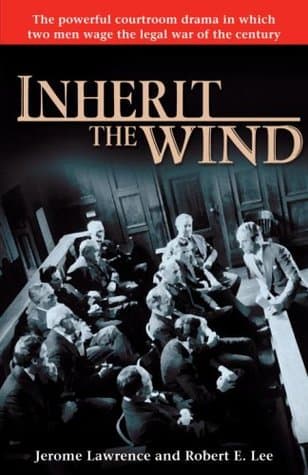
Jerome Lawrence (1955)
Genre
Historical Fiction
Reading Time
120 min
Key Themes
See below
Sign in to track this book
In a sweltering courtroom, America's intellectual freedom is on trial as two legal giants clash over a teacher's right to teach evolution, turning a small-town trial into a Roman circus of clashing beliefs.
The play opens in the small, devout town of Hillsboro, 'Heavenly Hillsboro,' where the community is abuzz with Bertram Cates's impending trial. Sarah Brady, Reverend Brown's daughter and Cates's fiancée, is distressed by the situation. Rachel, Cates's friend, tries to comfort her. The town prepares for the arrival of Matthew Harrison Brady, a renowned prosecutor and fundamentalist, who is coming to lead the prosecution against Cates. The atmosphere is tense, with the townspeople united in their condemnation of Cates and their fervent religious beliefs. Children practice a song, showing the town's conservative values and the pressure Cates faces.
Matthew Harrison Brady arrives in Hillsboro to a grand reception, greeted by cheering crowds, a band, and Reverend Brown, who hails him as a champion of their faith. Brady, a charismatic and imposing figure, delivers a rousing speech about defending biblical truth. Shortly after, E.K. Hornbeck, a cynical journalist from Baltimore, arrives, observing the scene with sardonic wit. He announces that the defense has secured Henry Drummond, a brilliant and controversial lawyer, to represent Cates. Drummond's arrival is met with suspicion and hostility, a stark contrast to Brady's reception, immediately establishing the ideological battle ahead.
Jury selection begins, with Drummond immediately facing an uphill battle. The potential jurors are all local Hillsboro residents, deeply religious and openly prejudiced against Cates and the idea of evolution. Drummond attempts to question their impartiality, but Judge Coffey, sympathetic to the prosecution, frequently overrules his objections. Drummond and Brady engage in their first direct confrontations, showing their contrasting legal styles and worldviews. Drummond argues for the right to think and question, while Brady emphasizes faith and tradition. The difficulty in finding an unbiased jury shows the pervasive influence of religious fundamentalism in Hillsboro.
Rachel is called to the stand by Brady, who manipulates her into revealing personal conversations with Cates, attempting to paint him as an irreligious and dangerous man. Rachel's testimony is agonizing for her, torn between her love for Cates and her fear of her father, Reverend Brown. Later, Reverend Brown delivers a fervent prayer meeting, condemning Cates and all who support him, even calling for God's wrath upon his own daughter, Rachel, for her wavering faith. This public denunciation disturbs Brady, who recognizes the dangerous extremism of Brown's rhetoric, despite sharing his religious convictions.
Drummond attempts to call expert witnesses—scientists and theologians—who could testify about the scientific basis of evolution and the compatibility of faith and reason. However, Judge Coffey consistently rules against allowing their testimony, deeming it irrelevant to the specific charge of violating the state law. The judge's rulings prevent Drummond from presenting a scientific defense, forcing him to shift his strategy. This highlights the limitations placed on intellectual freedom and the judicial system's bias against new ideas in Hillsboro, frustrating Drummond and emphasizing the uphill battle Cates faces.
In a bold and unexpected move, Drummond calls Matthew Harrison Brady to the witness stand as an expert on the Bible. This decision shocks the courtroom and even Brady himself. Drummond begins a meticulous cross-examination, questioning Brady about the literal interpretation of biblical stories, such as the creation account and Noah's Ark. Drummond uses logic and reason to expose inconsistencies and absurdities in a strictly literal interpretation of the Bible, challenging Brady's authority and the foundation of his beliefs. The intensity of the exchange grows, captivating the courtroom.
As Drummond presses his questions, particularly concerning the duration of a 'day' in Genesis and the concept of free will, Brady becomes increasingly agitated and defensive. His answers grow erratic, and he begins to shout, losing his usual calm demeanor and oratorical prowess. The crowd, initially supportive, starts to waver, witnessing their champion falter under Drummond's intellectual assault. Brady's authority crumbles as he struggles to reconcile literal biblical interpretation with logical inquiry, culminating in a public breakdown that shatters his image of infallibility and reveals the fragility of his convictions.
Despite Drummond's powerful cross-examination of Brady, the jury, having been denied access to scientific evidence, finds Bertram Cates guilty. However, the verdict comes with a surprisingly light sentence: a fine of only one hundred dollars. This lenient punishment, potentially influenced by the public spectacle and Brady's breakdown, is a symbolic victory for Drummond, as it undermines the prosecution's desire for a severe condemnation. The light sentence suggests a crack in the town's monolithic fundamentalism and a recognition, however slight, of the complexities involved.
After the verdict, Matthew Harrison Brady attempts to deliver a final, impassioned speech to the courtroom and the radio audience, but his voice is weak, and his words lack their former power. He tries to recite a biblical passage, but his energy is depleted, and he collapses, suffering a fatal stroke. His death marks a poignant end to his career and symbolizes the decline of an era of unchallenged fundamentalist authority. The once-mighty orator dies amidst the very people he sought to champion, leaving a void and a sense of disillusionment in Hillsboro.
In the aftermath of Brady's death, Drummond, Hornbeck, and Rachel gather in the quiet courtroom. Hornbeck, ever the cynic, mocks Brady's demise, but Drummond defends Brady's humanity, acknowledging his past greatness and the tragedy of his intellectual rigidity. Drummond picks up Brady's Bible and Darwin's 'Origin of Species,' weighing them in his hands, symbolizing the ongoing tension between faith and reason. Rachel, having found her voice and courage, decides to leave Hillsboro with Cates, empowered by the trial's events. The play concludes with Drummond walking out, carrying both books, signifying the necessity of balancing different forms of truth.
The Protagonist
Drummond maintains his core beliefs but demonstrates a surprising empathy for his opponent, Brady, recognizing the tragedy of his downfall.
The Antagonist
Brady's character arc is a tragic downfall, as his dogmatic beliefs are exposed as brittle under Drummond's cross-examination, leading to his public humiliation and death.
The Protagonist
Cates begins as a timid figure but gains strength and resolve through the trial, ultimately finding his voice and deciding to leave Hillsboro with Rachel.
The Supporting
Rachel evolves from a fearful, conflicted character into a woman who finds her own voice and chooses intellectual freedom over familial and societal pressure.
The Supporting
Hornbeck remains largely unchanged in his cynical worldview, but his interactions with Drummond reveal a hidden, almost wistful desire for meaning.
The Supporting
Reverend Brown's extremism is ultimately tempered by Brady's subtle disapproval, but he remains steadfast in his fundamentalist beliefs.
The Supporting
Judge Coffey remains consistent in his bias, serving as an obstacle to Drummond's defense and reflecting the local community's closed-mindedness.
This is the central theme, explored through the clash between Brady's biblical literalism and Drummond's advocacy for scientific inquiry and intellectual freedom. The trial itself is a microcosm of this larger societal debate. Brady believes in absolute, unchanging truth derived from the Bible, while Drummond champions the right to question, to doubt, and to evolve understanding. The play doesn't necessarily condemn faith but critiques blind, dogmatic adherence to it, especially when it stifles intellectual growth. The inability of the court to hear scientific evidence highlights the societal struggle to reconcile these two powerful forces.
“''An idea is a greater monument than a cathedral. And the advance of man's knowledge is a greater miracle than any sticks turned into snakes, or water into wine.''”
The play explores the importance of intellectual freedom—the right to think, to question, and to teach ideas that challenge established norms. Bertram Cates is on trial not just for teaching evolution, but for introducing a concept that contradicts Hillsboro's dominant religious dogma. Drummond's defense is about the fundamental right to free thought. The town's hostile reaction to Cates and Drummond, and the court's suppression of scientific testimony, illustrate the dangers of intellectual stagnation and the chilling effect of dogmatic control on education and society.
“''Is it possible that something is holy to the celebrated Mr. Brady that is not holy to the Lord?''”
The play portrays how easily a community can succumb to extremism and mob mentality, especially under the influence of charismatic leaders like Reverend Brown and Matthew Harrison Brady. The townspeople of Hillsboro, initially devout, quickly turn hostile and judgmental towards Cates and Drummond. Reverend Brown's fiery sermon, where he calls down damnation on his own daughter, exemplifies the destructive potential of unchecked religious fervor. Even Brady, despite his initial moderation, becomes swept up in the emotional intensity, leading to his public breakdown. The play warns against the suppression of individual thought by collective passion.
“''All glitter, no gold. He's a Barnum-and-Bailey booster. A Bible-beating, God-fearing, khaki-colored, old-fashioned, pure-American, unadulterated, hundred-percent, red-white-and-blue-dyed-in-the-wool, all-around patriot!''”
E.K. Hornbeck, the cynical journalist, serves as a lens through which the audience observes the trial and its impact. His dispatches and commentary show how events are framed and interpreted for a wider public, shaping national opinion. The presence of radio broadcasts also emphasizes the growing power of mass media to disseminate information and influence perceptions, turning a local trial into a national spectacle. Hornbeck's sharp observations often expose the performative aspects of the trial and the underlying motivations of the characters, underscoring the media's capacity to both inform and manipulate.
“''Ladies and gentlemen, I am a newspaperman. I am not a prophet. But I can tell you that the future of this country is in the hands of its children. And the future of its children is in the hands of its teachers.''”
Historical event serving as the play's direct inspiration and framework.
The actual 1925 Scopes Monkey Trial is the primary historical event upon which 'Inherit the Wind' is based. While fictionalized, the play uses the core elements—a teacher accused of teaching evolution, the clash between two legal giants (Clarence Darrow and William Jennings Bryan), and the intense public debate over science and religion—as its foundational structure. This device grounds the play in a significant moment in American history, giving it immediate relevance and resonance, and allowing it to explore timeless themes through a specific historical context.
The intense courtroom exchanges between Drummond and Brady.
The play heavily relies on the verbal combat and rhetorical prowess of Henry Drummond and Matthew Harrison Brady. Their courtroom exchanges are not merely legal arguments but dramatic duels of wit, logic, and oratorical skill. This device elevates the intellectual debate into high drama, captivating the audience and highlighting the contrasting ideologies. Brady's grand, emotional rhetoric clashes with Drummond's sharp, logical questioning, demonstrating how language and persuasion are used to sway opinion and defend vastly different worldviews. The power of their words drives the play's central conflict.
A cynical journalist's commentary providing critical distance.
E.K. Hornbeck serves as the primary outsider perspective, a cynical and detached observer who comments on the proceedings and the townspeople. His witty, often biting remarks function as a chorus, offering an intellectual critique of the small-town mentality and the fundamentalist fervor. This device provides comic relief while also reinforcing the play's themes of intellectual freedom and the dangers of ignorance. Hornbeck's presence allows the audience to view the events with a degree of critical distance, preventing the play from becoming overly sentimental or didactic.
Drummond weighing Darwin's 'Origin of Species' and the Bible.
At the play's conclusion, Henry Drummond picks up and weighs Darwin's 'Origin of Species' in one hand and the Bible in the other. This powerful visual symbolizes the central conflict of the play—the tension between scientific inquiry and religious faith. By holding both, Drummond suggests that neither is inherently superior or entirely dismissible, and that perhaps a balance or synthesis between the two is necessary for true understanding. It underscores the play's message that wisdom lies not in choosing one over the other, but in embracing the complexity of both forms of truth.
“He that troubleth his own house shall inherit the wind: and the fool shall be servant to the wise in heart.”
— Hornbeck quotes Proverbs 11:29, foreshadowing the emptiness of the town's victory.
“All motion is relative. Perhaps it is as well that a man cannot see himself as others see him.”
— Drummond reflects on perception and self-awareness during a quiet moment.
“The man who has the courage to think is a hero.”
— Hornbeck expresses his admiration for Cates's independent thought.
“An idea is a greater monument than a cathedral.”
— Drummond argues for the enduring power of ideas over physical structures.
“I understand what Bert's going through. It's the loneliest feeling in the world—to find yourself standing alone in the middle of a crowd, all pointing their fingers at you.”
— Rachel confides in Drummond about her empathy for Cates's isolation.
“Is it possible that something is holy to the celebrated man, that is not holy to the common man?”
— Brady questions the universality of religious belief and the sanctity of truth.
“Truth has meaning only in terms of men's perceptions. And there is no perfection in perception.”
— Drummond explains the subjective nature of truth and human understanding.
“Conform! Conform! Be like your brother, like your sister, like your father, like your mother! And like the Judge, like the jury—and like me!”
— Hornbeck mocks the town's pressure to conform to established norms.
“He that troubleth his own house shall inherit the wind.”
— The townspeople quote the Bible verse, unknowingly condemning their own actions.
“You see, Colonel, I have the right to think!”
— Cates asserts his right to independent thought against the prevailing dogma.
“A man's got a right to think. And my client has a right to think.”
— Drummond champions the fundamental right to intellectual freedom.
“I'm not trying to destroy anyone's belief in God, but to ask that everyone be allowed to think.”
— Cates clarifies his intentions, emphasizing intellectual freedom over religious destruction.
“The Bible is a book. A good book. But it's not the only book.”
— Drummond argues for the value of other sources of knowledge beyond religious texts.
“He who has a thing to sell and goes and whispers in an ass's ear, Is not so apt to get the buyer as he who doth trumpet forth his wares.”
— Hornbeck uses a cynical proverb to comment on the need for publicity and showmanship.
Ready to see how well you understood this book? Take our interactive quiz with 10 questions.

Biography coming soon.







