BookBrief
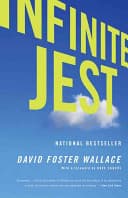
Infinite Jest cover
Archivist's Choice

Infinite Jest

David Foster Wallace (2006)

Genre

Literary Fiction / Philosophy

Reading Time

30-50 hours (highly variable)

Key Themes

See below

Track Your Reading

Sign in to track this book

In a future America where corporate sponsorship has taken over the calendar and entertainment is a weapon, the fractured lives of a junior tennis prodigy, his absent intellectual father, and a recovering addict converge in a sprawling, tragicomic exploration of addiction, depression, and the relentless pursuit of happiness.

Synopsis

In a dystopian near-future North America, where years are corporately sponsored and the U.S., Canada, and Mexico have merged into the Organization of North American Nations (O.N.A.N.), the story takes place in two main settings: the Enfield Tennis Academy (ETA) and Ennet House, a halfway house for substance abusers. At ETA, Hal Incandenza, an intelligent and introspective tennis prodigy, struggles with an increasing sense of anhedonia and an inability to communicate, as he deals with the legacy of his father, James O. Incandenza. James was a legendary avant-garde filmmaker and founder of ETA, who seemingly committed suicide. At Ennet House, Don Gately, a recovering addict and former professional thief, navigates daily struggles of sobriety and community, often experiencing disturbing dreams. The central conflict involves a mysterious and lethally entertaining film, "Infinite Jest" (also known as "The Entertainment"), made by James Incandenza. This film is so compelling that anyone who watches it loses all desire to do anything else, eventually dying in a state of blissful catatonia. Various groups are searching for a master copy of the film: the Quebecois separatist group, Les Assassins des Fauteuils Roulants (A.F.R.) — the Wheelchair Assassins — who plan to use it as a weapon against O.N.A.N., and agents from the Office of Unspecified Services (O.U.S.), an intelligence agency. The story weaves together the histories and inner lives of the Incandenza family, particularly Hal, his brother Orin (a professional football punter and serial seducer), and their mother, Avril (a domineering academic). Joelle Van Dyne, James Incandenza's former lover and a disfigured radio personality known as the Veiled Lady, also plays a role, as she is connected to the film's creation and its effects. The novel ends with unresolved revelations and mysterious events, including a search for the film's master cartridge, Hal's escalating psychological collapse, and Don Gately's near-death experience. The ultimate fate of the film and its impact is ambiguous, hinting at an unresolved struggle with addiction, entertainment, and meaning.
Reading time
30-50 hours (highly variable)
Difficulty
Hard
Pacing
Slow
Mood
Intellectual, Challenging, Darkly Humorous, Existential, Satirical, Melancholy
✓ Read this if...
You enjoy intellectually challenging, experimental fiction with a vast scope, intricate world-building, and a blend of dark humor, philosophy, and detailed character studies. Ideal for readers who appreciate a dense, non-linear narrative and are willing to commit to a lengthy, immersive reading experience.
✗ Skip this if...
You prefer straightforward plots, linear narratives, concise prose, or find extensive footnotes and digressions disruptive to your reading flow. Not for those seeking a quick, easy, or light read.

Plot Summary

The Year of the Depend Adult Undergarment and the Enfield Tennis Academy

The novel opens with Hal Incandenza, a prodigious but withdrawn tennis player, in a bizarre college admissions interview. His thoughts, detailed in extensive footnotes, are clear, but his spoken words are perceived as grunts and gibberish by the deans. This scene establishes Hal's internal struggles and the novel's non-linear, fragmented narrative style. At the same time, the reader is introduced to the near-future North American political landscape, specifically the Organization of North American Nations (O.N.A.N.), a geopolitical entity formed by the U.S., Canada, and Mexico. Much of the story takes place at the Enfield Tennis Academy (E.T.A.), founded by Hal's deceased father, James O. Incandenza, and directly adjacent to the Ennet House Drug and Alcohol Recovery House, where many of the novel's other characters reside.

Ennet House and Don Gately's Struggles

The narrative often shifts to Ennet House, a halfway house for recovering addicts. Here, characters like Don Gately, a former drug addict and current house manager, struggle with their sobriety and past demons. Gately, a large and contemplative man, often reflects on his own history of addiction, violence, and the path to recovery through the twelve steps. His sections provide a grounded, often bleak, but ultimately hopeful perspective on the human condition and the effort required to maintain sobriety. Other residents, each with their own unique and often tragic backstories, add to the complex picture of addiction and recovery.

The Incandenza Family Dynamics

The Incandenza family is at the story's center. James O. Incandenza, the deceased father, was a brilliant but troubled filmmaker and optics expert, whose suicide by microwave leaves a void. His widow, Avril Incandenza, is a highly intellectual and emotionally distant woman, possibly having an affair. Their children include Orin, a professional football punter who seduces mothers; Hal, the tennis prodigy struggling with anhedonia and an internal crisis; and Mario, a physically deformed but empathetic and artistic savant who films documentaries at E.T.A. Their interactions are strained, marked by intellectual superiority, emotional repression, and unresolved grief, all revolving around the enigma of James's life and death.

The Entertainment and the Search for It

A central mystery of the novel involves a film made by James O. Incandenza, titled 'Infinite Jest (The Entertainment)'. This film is rumored to be so entertaining that anyone who watches it loses all desire to do anything else, eventually leading to their death from neglect. Various groups are desperately seeking copies of this master cartridge. The Québécois Separatist terrorist group, Les Assassins des Fauteuils Rollents (A.F.R.), led by Pat Montesian, believes the film can liberate Quebec by incapacitating the O.N.A.N. populace. Their pursuit of the film drives much of the external plot, creating a sense of urgency and danger that intertwines with the more internal struggles of the E.T.A. students and Ennet House residents.

Joelle Van Dyne and the Veiled Lady

Joelle Van Dyne, known as 'The Prettiest Girl of All Time' and 'The Veiled Lady,' is a former lover of Orin Incandenza and a prominent figure in James O. Incandenza's films, including the deadly 'Entertainment.' She often wears a veil due to a self-inflicted acid burn, or perhaps a perceived disfigurement, and struggles with severe depression and addiction. Joelle is a resident at Ennet House, where she forms a complex, platonic bond with Don Gately. Her deep connection to James Incandenza and her knowledge of his artistic work, particularly 'The Entertainment,' make her an important, though often cryptic, source of information and a tragic symbol of the film's destructive power and James's own torment.

The A.F.R. and Their Schemes

Les Assassins des Fauteuils Rollents (A.F.R.), a group of wheelchair-bound Québécois Separatists, are actively pursuing 'The Entertainment.' They believe that distributing the film throughout O.N.A.N. will incapacitate the population, allowing Quebec to secede. Their methods involve espionage, torture, and manipulation. They are interested in Orin Incandenza, whom they kidnap and interrogate, believing he holds clues to the film's location. The A.F.R.'s narrative introduces elements of political satire and thriller, contrasting with the internal, psychological struggles of the other characters but ultimately converging as the search for the master cartridge becomes more desperate and violent.

Hal's Growing Apathy and Withdrawal

Throughout the narrative, Hal Incandenza's internal world becomes increasingly isolated. Despite his intellectual brilliance and tennis prowess, he experiences a profound sense of anhedonia – an inability to feel pleasure. His communication with others deteriorates, culminating in the opening scene where he is perceived as mute. This withdrawal is partly due to his excessive marijuana use, but also hints at a deeper, unresolved psychological crisis related to his father's legacy and the pressures of his environment. His narrative often details his obsessive thoughts about language, tennis, and the nature of consciousness, revealing an analytical mind trapped within a body that is failing to connect with the external world.

Don Gately's Near-Death Experience

Don Gately is severely wounded during a botched robbery at Ennet House, shot in the head by a drug dealer named DuPlessis. His recovery in the hospital is long and filled with vivid, hallucinatory experiences, often involving visitations from the ghost of James O. Incandenza. These sequences are philosophical, exploring themes of death, consciousness, and the nature of reality. Gately's struggle for survival, both physical and psychological, becomes a central focus, intertwining with the broader mysteries of the Incandenza family and 'The Entertainment.' His experience tests his sobriety and forces him to confront the weight of his past and future.

The Wraith of James Incandenza

The ghost of James O. Incandenza appears to several characters, most notably Don Gately during his hospital stay and possibly Hal. The wraith is a silent, somewhat disoriented figure, seemingly trying to communicate or guide those who encounter him. His appearances are often cryptic, leaving the characters to interpret his intentions. It is implied that James's ghost is attempting to lead someone to the master cartridge of 'The Entertainment,' perhaps to ensure its destruction or to reveal some hidden truth about his suicide and the film's purpose. This spectral presence adds a layer of mystery and grief, linking the past directly to the present struggles of the living.

The Eschaton Game

Eschaton is an elaborate and violent tennis-based game played by the students at E.T.A., simulating global thermonuclear war. Players represent different countries, launching tennis balls (missiles) at targets on a scaled-down map, with elaborate rules for missile interception and retaliation. The game, overseen by Mario Incandenza, is a chaotic and darkly humorous parody of Cold War-era geopolitics and the absurdities of strategic conflict. It reflects the novel's broader themes of competition, aggression, and the destructive nature of human interaction, serving as a symbolic representation of the larger political tensions within O.N.A.N. and the Incandenza family's own internal battles.

The Dig and the Missing Cartridge

As the novel progresses, the various threads converge on the suspicion that the master cartridge of 'The Entertainment' is buried somewhere on the grounds of the Enfield Tennis Academy, possibly near James Incandenza's grave. The A.F.R. intensifies its efforts to infiltrate the academy and uncover the film. At the same time, other unnamed parties, including agents of the Office of Unspecified Services (O.U.S.), are also searching for the film. The anticipation of the dig, and the potential discovery, creates tension, hinting at a climax that the novel ultimately defers, leaving the ultimate fate of the film and its impact ambiguous.

Hal's Internal Collapse and Don Gately's Dream

In the novel's final, non-linear sequences, Hal's internal collapse reaches a critical point, culminating in the opening interview scene where he is unable to communicate coherently. His anhedonia and withdrawal intensify, suggesting a mental break. At the same time, Don Gately, still recovering in the hospital, has a vivid, symbolic dream. In this dream, he is part of a group digging for something buried in the earth, possibly the master cartridge. The dream is ambiguous but suggests a collective effort to unearth a dangerous truth, and hints at the cyclical nature of addiction and recovery. The novel ends with Gately's dream, leaving many plotlines unresolved and the ultimate fate of 'The Entertainment' and the Incandenza family open to interpretation.

Principal Figures

Hal Incandenza

The Protagonist

Hal begins as a seemingly functional but internally detached prodigy and ends in a state of profound anhedonia and communicative paralysis, suggesting a mental breakdown.

Don Gately

The Protagonist

Gately progresses from a struggling, but committed, recovering addict to a man profoundly tested by violence and spiritual encounters, reaffirming his commitment to sobriety.

James O. Incandenza

The Antagonist/Catalyst

His arc is presented in reverse, with his genius, struggles, and ultimate demise revealed gradually through flashbacks, character memories, and his spectral appearances.

Avril Incandenza

The Supporting

She remains a largely static, formidable figure, her past and true feelings largely unrevealed, maintaining her dominant role throughout the narrative.

Orin Incandenza

The Supporting

Orin's journey takes him from a self-absorbed professional athlete to a victim of A.F.R. torture, forcing him to confront the consequences of his family's legacy.

Mario Incandenza

The Supporting

Mario remains a steadfast source of empathy and artistic expression, his character arc focusing on his quiet observations and the creation of beauty amidst chaos.

Joelle Van Dyne

The Supporting

Joelle's arc involves her struggle with addiction and self-worth, and her slow, painful process of healing and forming meaningful connections, particularly with Don Gately.

Remy Marathe

The Supporting

Marathe navigates his role as a double agent, grappling with the moral ambiguities of his mission and his personal allegiances, remaining a figure of internal conflict.

Hugh Steeply

The Supporting

Steeply's arc involves his relentless pursuit of 'The Entertainment' and his attempts to understand the motivations of the A.F.R. through his interactions with Marathe.

John 'No Relation' Wayne

The Supporting

Wayne remains a consistent, disciplined figure, his primary role being to embody the strict regimen of the tennis academy and his mysterious relationship with Avril.

Themes & Insights

Addiction and Recovery

The novel explores addiction in many forms, not just to drugs and alcohol, but also to entertainment, sex, and intellectual pursuits. Through the residents of Ennet House, especially Don Gately and Joelle Van Dyne, Wallace details the daily struggles, relapses, and small triumphs of recovery. The twelve-step program is presented with its practical efficacy and spiritual demands. The 'Entertainment' itself is the ultimate addiction, a metaphor for the human craving for escapism and pleasure, showing how easily any pursuit can become a destructive obsession.

''Everybody is identical in their secret unspoken longings.'

Don Gately (internal thought)

Entertainment and Escapism

Central to the narrative is 'The Entertainment,' a film so potent it robs viewers of all desire, leading to a catatonic state. This is a metaphor for the dangers of passive consumption and the human tendency to seek oblivion through distraction. The novel examines various forms of entertainment, from televised sports to experimental cinema, questioning their value and impact on the human mind. It also explores how entertainment can be a form of self-medication, a way to avoid confronting deeper emotional or existential issues, ultimately leading to a loss of agency and connection.

''The truth will set you free. But not until it is finished with you.'

James O. Incandenza (as quoted by a character)

Family Dysfunction and Legacy

The Incandenza family is a microcosm of dysfunction, driven by intellectual genius, emotional repression, and the overwhelming legacy of the deceased patriarch, James O. Incandenza. Each family member deals with James's suicide and his artistic work in different ways, leading to strained relationships, self-destructive behaviors, and unresolved grief. The novel looks at the dynamics of parental influence, sibling rivalry, and the burden of expectation, showing how a brilliant but troubled individual can cast a long shadow over their descendants, shaping their identities and destinies.

''The only thing that ever sat well with me was the thought that if there was a God, He'd be an all-forgiving, all-understanding kind of God. Not a God who punished you for being human.'

Don Gately (internal thought)

Identity and Self-Discovery

Many characters in *Infinite Jest* search for identity, whether it's Hal Incandenza struggling with his anhedonia and true desires, Don Gately redefining himself in sobriety, or Joelle Van Dyne dealing with her past and self-image. The novel questions how identity is shaped by family, addiction, societal pressures, and the narratives we construct for ourselves. Characters often present different personas or struggle with internal voices, showing the fragmented nature of the self in a hyper-stimulated world. The journey of self-discovery is presented as a difficult, often painful process, requiring honesty and a willingness to confront uncomfortable truths.

''It is not the man who has too little, but the man who craves more, that is poor.'

Narrator (paraphrasing Seneca)

Communication and Language

Language and communication are central themes, explored through Hal's intellectual prowess and eventual inability to speak coherently, the extensive footnotes that are a parallel narrative, and the philosophical dialogues between characters like Steeply and Marathe. The novel shows both the power and limitations of language to express inner experience, connect with others, and convey truth. Hal's struggle shows how internal clarity can be at odds with external expression, while the novel's dense, referential style itself reflects a fascination with the nuances and complexities of communication in a postmodern age.

''The truth is that the truth is a lie. The lie is that the lie is the truth.'

James O. Incandenza (from a film title)

Plot Devices & Literary Techniques

Non-Linear Narrative

Story told through fragmented flashbacks, flashforwards, and concurrent timelines.

The novel's plot does not follow a chronological order. Instead, it jumps between different time periods (e.g., Hal's future interview, the present-day events at E.T.A. and Ennet House, flashbacks to James Incandenza's life) and different character perspectives. This fragmentation mirrors the fractured mental states of the characters and the chaotic nature of the world, forcing the reader to piece together the overarching narrative and themes. The non-linearity contributes to the sense of mystery surrounding 'The Entertainment' and James's death, as clues are scattered throughout the text.

Extensive Footnotes and Endnotes

Detailed supplementary information, often forming parallel narratives.

Wallace employs hundreds of footnotes and endnotes, some of which are several pages long. These notes provide encyclopedic information, character backstories, philosophical digressions, technical details about tennis or film, and even entire mini-narratives. They serve multiple purposes: they deepen the world-building, offer insights into characters' internal monologues (especially Hal's), provide comic relief, and challenge the reader's linear reading experience, forcing them to engage with the text in a non-traditional, multi-layered way. The endnotes are particularly significant, often containing crucial plot details or character development.

The MacGuffin ('The Entertainment')

A mysterious, sought-after object that drives much of the external plot.

The master cartridge of James O. Incandenza's final film, 'Infinite Jest (The Entertainment),' functions as a classic MacGuffin. It is an object whose specific nature and content are less important than its role in motivating the actions of various characters and factions (the A.F.R., the O.U.S., the Incandenza family). Its rumored power to incapacitate viewers drives the external conflict and the search, even as the internal, psychological dramas of the characters unfold independently. The MacGuffin provides a tangible goal that connects disparate storylines, even if its ultimate fate remains ambiguous.

Stream of Consciousness

Narrative technique mimicking the unfiltered flow of a character's thoughts.

Particularly evident in Hal Incandenza's sections and Don Gately's internal monologues, this device allows the reader direct access to the characters' unfiltered thoughts, feelings, and perceptions. It often involves long, complex sentences, digressions, and a lack of conventional punctuation, reflecting the chaotic and associative nature of the human mind. This technique is crucial for conveying Hal's anhedonia and intellectual struggles, as well as Gately's battles with addiction and his philosophical reflections, immersing the reader deeply into their subjective experiences and internal worlds.

Satire and Parody

Humorous exaggeration and critique of societal norms and political structures.

Wallace uses satire and parody to critique various aspects of contemporary American society, including consumerism (e.g., the 'Subsidized Time' where years are named after corporate sponsors), politics (O.N.A.N. and the U.S. being 'concatenated'), and the entertainment industry. The game of Eschaton, for instance, is a dark parody of geopolitical conflict. These elements provide comic relief but also serve as a sharp commentary on cultural excesses, political absurdities, and the pervasive influence of advertising and media, grounding the novel's philosophical explorations in a recognizable, albeit exaggerated, reality.

Critical analysis

Notable Quotes

The so-called 'psychotically depressed' person who tries to kill herself doesn't do so out of quote 'hopelessness' or any abstract conviction that life's assets and debits do not square. And surely not because death seems suddenly appealing. The person in whom Its invisible agony reaches a certain unendurable level will kill herself the same way a trapped person will eventually jump from the window of a burning high-rise.

Describing the psychology of suicidal depression.

You will become way less concerned with what other people think of you when you realize how seldom they do.

A piece of advice on self-consciousness and social anxiety.

Everything I've ever let go of has claw marks on it.

Reflecting on attachment and letting go.

The truth will set you free. But not until it is finished with you.

A philosophical take on truth and personal growth.

It's weird to feel like you miss someone you're not even sure you know.

Expressing a sense of longing and uncertainty.

The U.S.A. was a nation of men, not laws, because the laws were men, and the men were laws.

Commentary on American society and governance.

One of the things that makes you aware of how fake and transitory your own life is is the fact that you can be watching a movie and be so absorbed in it that you forget you're watching a movie.

Discussing media consumption and reality.

The thing about people who are truly and malignantly crazy: their real genius is for making the people around them think they're the crazy ones.

Observations on mental illness and perception.

It's not the person who's the addict; it's the brain.

A perspective on addiction and neuroscience.

The world is full of people who are now more or less dead, but who don't know it yet.

A bleak reflection on modern existence.

The really important kind of freedom involves attention, and awareness, and discipline, and effort, and being able truly to care about other people and to sacrifice for them, over and over, in myriad petty little unsexy ways, every day.

Defining a deeper concept of freedom.

What passes for hip cynical transcendence of sentiment is really some kind of fear of being really human, since to be really human [...] is probably to be unavoidably sentimental and naïve and goo-prone and generally pathetic.

Critiquing cynicism and emotional detachment.

The older you get, the more you realize that the way you look is a lot about how you feel about yourself.

Reflections on aging and self-perception.

It is the peculiar nature of the world to go on spinning no matter what sort of heartbreak is happening.

Commenting on the indifference of the universe.

Quiz

Test Your Knowledge

Ready to see how well you understood this book? Take our interactive quiz with 10 questions.

10
Questions
~5
Minutes
?
Best Score

Key Questions (FAQ)

'Infinite Jest' is a sprawling, encyclopedic novel set in a near-future North America, primarily following the intertwined lives of residents at Ennet House Drug and Alcohol Recovery House and students at the Enfield Tennis Academy. The plot revolves around the search for a mysterious film cartridge titled 'Infinite Jest' that is so entertaining it renders viewers catatonic, exploring themes of addiction, entertainment, and the pursuit of meaning in a hyper-commercialized society.

About the author

David Foster Wallace

David Foster Wallace was an American novelist, short story writer, essayist, and university professor of English and creative writing. Wallace is widely known for his 1996 novel Infinite Jest, which Time magazine cited as one of the 100 best English-language novels from 1923 to 2005. His posthumous novel, The Pale King (2011), was a finalist for the Pulitzer Prize for Fiction in 2012. The Los Angeles Times's David Ulin called Wallace "one of the most influential and innovative writers of the last twenty years".