“Abandon all hope, ye who enter here.”
— Inscribed above the gates of Hell as Dante enters.

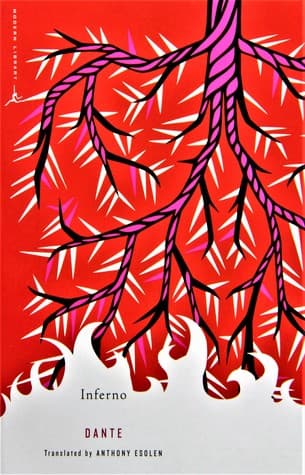
Dante Alighieri (2007)
Genre
Thriller / Romance
Reading Time
16 hr
Key Themes
See below
Sign in to track this book
Dante travels through Hell's circles with Virgil, learning about sin and damnation, and seeking redemption through understanding.
On the eve of Good Friday in 1300, Dante Alighieri is lost in a dark wood, which means his spiritual confusion and sin. He tries to go up a sunlit hill, meaning salvation, but three fierce beasts block him: a leopard (lust), a lion (pride), and a she-wolf (greed). Full of despair, Dante is about to give up when the ghost of the Roman poet Virgil appears. Virgil says Beatrice, Dante’s dead love, sent him to guide Dante through Hell and Purgatory to reach Paradise, a journey Dante cannot do alone. Dante, at first unsure but then relieved, agrees to follow Virgil into the underworld.
Dante and Virgil first go into the Vestibule of Hell, where the Neutrals – those who lived without praise or blame – endlessly chase a banner while wasps and flies sting them. Their tears and blood feed maggots. They then reach the River Acheron. The monster ferryman Charon at first refuses to take Dante, a living person, across. Virgil silences Charon by saying it is God's will. Dante faints from fear and wakes up on the other side, in Limbo, Hell's First Circle. Here live virtuous pagans and unbaptized infants. They have no physical pain but live with endless longing, without hope of knowing God. Dante meets great figures like Homer, Horace, Ovid, Lucan, and Aristotle, all in a noble castle.
Leaving Limbo, Dante and Virgil meet Minos, the demon judge who assigns each damned soul to its circle by coiling his tail. In the Second Circle, the Lustful are swept in a violent, dark whirlwind forever, showing their uncontrolled desires. Dante talks with Francesca da Rimini and Paolo Malatesta, who tell their sad love story, making Dante faint from pity. Next, they go to the Third Circle, where the Gluttonous lie in freezing, dirty slush, tormented by Cerberus, the three-headed dog, and hit by constant, icy rain. Dante talks with Ciacco, a glutton from Florence, who predicts political trouble in Florence.
In the Fourth Circle, the Greedy and the Wasteful endlessly push huge weights against each other, clashing and insulting each other, stuck in a useless fight over money. Dante sees some clergy among them. They then go to the Fifth Circle, the Styx, a muddy river where the Wrathful violently attack each other, while the Sullen lie under the mud, gurgling in despair. Phlegyas, the Styx ferryman, takes them across. As they get near the strong walls of the City of Dis, Lower Hell's capital, defiant fallen angels block them from entering, which troubles Virgil for a time and shows his human limits.
A heavenly messenger comes down, easily opening the gates of Dis for Dante and Virgil. Inside, they find the Sixth Circle, where Heretics are trapped in flaming tombs forever. Dante talks with Farinata degli Uberti, a Ghibelline leader, who discusses Florentine politics, and Cavalcante de' Cavalcanti, who asks about his son, Guido. They then go to the Seventh Circle, for the Violent. This circle has three rings: first, the Violent against Neighbors, in the Phlegethon, a river of boiling blood, guarded by centaurs; second, the Violent against Themselves (Suicides), who are gnarled trees, whose leaves Harpies eat; and third, the Violent against God, Nature, and Art, who suffer under fire rain on burning sand.
After the circles of violence, Dante and Virgil meet Geryon, a monster with an honest man's face, a serpent's body, and a scorpion's tail, meaning fraud. Geryon carries them down to the Eighth Circle, Malebolge, meaning 'Evil Ditches.' This large, stony area has ten trenches (bolgias), each punishing a type of ordinary fraud. They see Panderers and Seducers whipped by demons, Flatterers in excrement, Simoniacs (those who sold church offices) buried headfirst in rock with burning feet, and Sorcerers and False Prophets with their heads twisted backward.
Continuing through Malebolge, Dante and Virgil see more punishments for fraud. They meet Barrators (corrupt politicians) in boiling pitch, guarded by demons who hook them. Hypocrites walk slowly, weighed down by gilded lead cloaks. Thieves are tormented by snakes, turning into ash and then reforming, or merging with reptiles. Dante talks with Vanni Fucci, a Florentine thief, who makes an obscene gesture against God. Counsellors of Fraud, like Ulysses and Diomedes, are in individual flames. Finally, Sowers of Discord are mutilated forever by a demon with a sword, their bodies healing only to be cut again.
In Malebolge's tenth and last bolgia, Dante and Virgil see the Falsifiers, in four types: Alchemists, Impersonators, Counterfeiters, and False Witnesses, all with terrible diseases, thirst, and smell. They are tormented forever by sicknesses that match their deceptive acts. After going through all ten bolgias, the poets reach Malebolge's Central Pit, surrounded by tall Giants, standing from their navels down in the pit. These giants, including Nimrod, Ephialtes, and Antaeus, are bound or confused, showing brute treachery. Antaeus, unbound, lifts Dante and Virgil and gently lowers them into Hell's deepest and final circle.
Dante and Virgil are now in Cocytus, Hell's Ninth and final Circle, a large frozen lake where the Treacherous are encased in ice forever, varying in depth by their sin. This circle has four concentric rounds: Caina (treachery to kin), where souls are frozen to their necks; Antenora (treachery to country), where heads are above the ice, letting them gnaw on each other; Ptolomea (treachery to guests), where souls are frozen with only half their faces showing, their tears freezing their eyes shut; and finally, Judecca (treachery to lords and benefactors), where souls are entirely submerged and twisted in the ice, unable to move or speak. Dante meets figures like Ugolino della Gherardesca, who gnaws on his betrayer, Archbishop Ruggieri's head.
At Judecca's very center, and thus the universe's center, Dante sees Lucifer, the ultimate betrayer, frozen from the waist down in the ice. Lucifer is a grotesque, three-faced giant, with bat-like wings that make Cocytus's freezing wind. Each of his three mouths forever chews one of history's greatest betrayers: Judas Iscariot (who betrayed Christ), Brutus, and Cassius (who betrayed Caesar). Dante and Virgil climb down Lucifer’s hairy hide, passing the center of gravity. As they cross the exact midpoint, they climb upwards through a natural tunnel, having passed from Earth's Northern Hemisphere into the Southern. They emerge into dawn's light on the other side of the world, seeing the stars again, ready to begin climbing Mount Purgatory.
The Protagonist
From a lost and spiritually confused man, Dante gains profound insight into the nature of sin and divine justice, preparing him for Purgatory and Paradise.
The Supporting
Virgil fulfills his divine mission to guide Dante through Hell, preparing him for the spiritual guidance of Beatrice, before returning to Limbo.
The Mentioned
Beatrice orchestrates Dante's journey from Heaven, initiating his path to redemption.
The Antagonist
Lucifer is eternally fixed in his state of punishment, serving as a static symbol of ultimate sin.
The Supporting
Charon remains a fixed figure, fulfilling his duty as a ferryman of the damned.
The Supporting
Minos remains eternally fixed in his role as judge, dispatching souls to their designated torments.
The Supporting
Francesca remains eternally swept in the whirlwind of the lustful, recounting her story to those who ask.
The Supporting
Farinata remains eternally in his flaming tomb, forever concerned with earthly political matters.
The Supporting
Ugolino remains eternally fixed in his act of vengeful cannibalism, recounting his tragic fate.
The Supporting
Ulysses remains eternally trapped in a flame, recounting his final, fraudulent voyage.
A main theme of the Inferno is God's perfect justice, where every sin gets a fitting punishment (contrapasso). Dante shows how each torment in Hell matches the sin. For example, the lustful are swept by a whirlwind, like their passions in life (Canto V); the gluttonous lie in freezing filth, as they overindulged (Canto VI); and the treacherous are frozen in ice, showing their cold betrayal of love and trust (Canto XXXII-XXXIV). This theme assures readers that God's judgments are always just, even if scary.
“Justice moved my high maker; divine power made me, and highest wisdom, and primal love.”
Dante's Inferno lists sins, going from lesser sins of incontinence (lack of self-control) to more severe sins of violence, and then to the worst sins of fraud and treachery. The poem explores how evil grows, showing that sins of passion are less offensive than sins of bad intent. Fraud is worse than violence because it misuses human reason. Treachery, the worst misuse of love and trust, is at Hell's bottom, showing that the greatest evil is betraying what is most sacred. Dante's meetings with sinners show the reasons for their wrongs.
“All malice, which earns hatred in Heaven, has injustice as its end, and this end harms either by force or fraud.”
Virgil, representing human reason and classical philosophy, guides Dante through Hell, explaining its parts and people. But Virgil's limits are clear: he cannot enter Paradise because he lived before Christ and lacks divine grace. This shows that while reason helps understand sin and moral judgment, it is not enough for salvation and true spiritual insight. Dante's journey needs Beatrice's help, meaning divine revelation and grace, to go beyond reason and reach Heaven. This difference shows the poem's Christian theological basis.
“And if you wish to climb higher, a worthier spirit will guide you. With her I will leave you, when I depart.”
Dante uses the Inferno to criticize the political and social corruption of his time in Italy, especially Florence. He puts many real historical figures, including popes, politicians, and families, in Hell's circles. For example, he condemns simoniac popes (Canto XIX), corrupt Florentine politicians (Canto XXII), and feuding groups (Canto X). Through these meetings, Dante shows his anger at the moral decay and divisions in his society, portraying Hell as a mirror of earthly wrongs. His personal exile also drives much of his harsh comments.
“Ah, Florence, you may well be content with this digression, which touches you, thanks to the people who cause you such grief!”
Dante's journey into Hell is not just a tour of damnation; it is a journey of self-discovery and spiritual cleansing. By seeing the results of every sin, Dante faces his own potential for evil and understands morality better. His initial pity for some sinners slowly turns into righteous anger as he goes through the circles of worse sins, showing his moral growth. This journey is the necessary first step in his personal redemption, clearing his spiritual confusion and preparing him to go towards God.
“Through me you pass into the city of woe; through me you pass into eternal pain; through me you pass among the lost people.”
The principle of symbolic retribution in Hell.
Contrapasso is the central principle of divine justice in the Inferno, meaning 'suffer the opposite' or 'suffer in turn.' It dictates that each sinner's punishment in Hell is a direct, ironic, or symbolic reflection of their earthly sin. For example, the Lustful are eternally tossed in a whirlwind, mirroring their uncontrolled passions (Canto V); the Gluttonous lie in frozen slush, desiring but never finding satisfaction (Canto VI); the Soothsayers have their heads twisted backward, unable to see forward, because they tried to see too far into the future (Canto XX); and the Traitors are frozen in ice, symbolizing their cold-hearted betrayal (Canto XXXII-XXXIV). This device ensures that Hell is not merely arbitrary torture but a perfectly ordered and just system of divine retribution.
The use of characters and events to represent abstract ideas.
The entire Inferno is a grand allegory. Dante's journey is not just a literal trip through the underworld but also a symbolic representation of humanity's spiritual journey from sin to redemption. The dark wood symbolizes spiritual confusion and sin; the three beasts (leopard, lion, she-wolf) represent lust, pride, and avarice; Virgil embodies human reason; and Beatrice symbolizes divine grace and revelation. Each circle of Hell, each demon, and each sinner serves not only as a character or place but also as a symbolic representation of different aspects of sin, morality, and divine justice. This allows the poem to operate on multiple levels of meaning, offering both a gripping narrative and profound theological insights.
A literary device where a knowledgeable figure leads the protagonist.
The figure of Virgil as Dante's guide is a crucial plot device. His presence allows Dante (and by extension, the reader) to navigate the complex geography and moral structure of Hell. Virgil provides explanations of the sins, the punishments, and the historical or mythological context of the damned souls. He also serves as Dante's protector, intervening with demons and asserting divine authority when necessary. As a symbol of human reason, his guidance also establishes the philosophical and theological boundaries of what human intellect can achieve without divine grace, setting the stage for Beatrice's later role.
Dante narrates his own journey, directly addressing the reader.
The Inferno is told from a first-person perspective, with Dante Alighieri himself as the narrator and protagonist. This allows for a deeply personal and immediate experience of Hell. Dante frequently breaks the fourth wall, directly addressing the reader with warnings, exhortations, or expressions of his own feelings (e.g., 'O you who have sound intellects, look at the doctrine hidden beneath the veil of the strange verses!'). This authorial intrusion creates a sense of intimacy and urgency, drawing the reader into Dante's moral and emotional journey and reinforcing the didactic purpose of the poem.
The physical layout of Hell reflects its moral hierarchy.
The physical structure of Hell itself is a significant plot device, meticulously designed to reflect a moral hierarchy of sin. It is conceived as a funnel-shaped pit, descending in nine concentric circles, each narrower and deeper than the last. This downward spiral symbolizes the increasing gravity and distance from God of the sins punished within. The Vestibule for the indifferent, Limbo for the virtuous pagans, then circles for incontinence, violence, and finally fraud and treachery at the very bottom, culminating in Lucifer frozen at the Earth's center. This systematic geography reinforces the theme of divine justice and provides a clear, visual representation of Dante's theological understanding of sin.
“Abandon all hope, ye who enter here.”
— Inscribed above the gates of Hell as Dante enters.
“The path to paradise begins in hell.”
— Dante reflecting on the journey through Inferno to reach salvation.
“There is no greater sorrow than to recall happiness in times of misery.”
— Dante speaking with Francesca da Rimini in the circle of the lustful.
“Consider your origins: you were not made to live as brutes, but to follow virtue and knowledge.”
— Ulysses encouraging his crew to pursue knowledge beyond known limits.
“The darkest places in hell are reserved for those who maintain their neutrality in times of moral crisis.”
— Dante observing the punishment of the indifferent in the vestibule of Hell.
“Love, that excuses no one loved from loving, seized me so strongly with his charm that, as you see, it has not left me yet.”
— Francesca da Rimini explaining how love led to her damnation.
“Through me you go into the city of weeping; through me you go into eternal pain; through me you go among the lost people.”
— The inscription on the gates of Hell, describing its nature.
“The more a thing is perfect, the more it feels pleasure and pain.”
— Dante reflecting on the capacity for feeling in higher beings.
“He who sees a need and waits to be asked for help is as unkind as if he had refused it.”
— Dante criticizing those who ignore suffering around them.
“In the middle of the journey of our life, I found myself in a dark wood, for the straight way was lost.”
— The opening lines of the poem, describing Dante's spiritual crisis.
“The devil is not as black as he is painted.”
— Dante observing that evil often appears more monstrous than it is.
“O human race, born to fly upward, wherefore at a little wind dost thou so fall?”
— Dante lamenting human weakness and susceptibility to sin.
“The heavens call to you and wheel about you, displaying to you their eternal beauties, and still your eyes are fixed upon the ground.”
— Beatrice chastising Dante for being distracted by earthly concerns.
“There is a place in hell reserved for women who keep their beauty for themselves.”
— Dante commenting on the punishment of the vain in Hell.
Ready to see how well you understood this book? Take our interactive quiz with 10 questions.
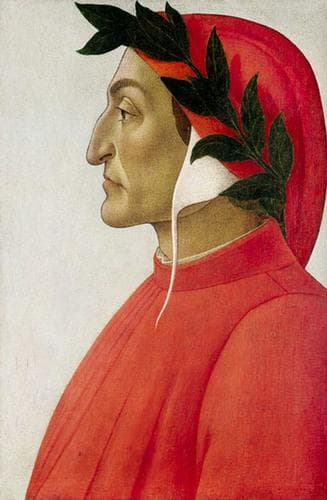
Dante Alighieri, most likely baptized Durante di Alighiero degli Alighieri and often referred to as Dante, was an Italian poet, writer and philosopher. His Divine Comedy, originally called Comedìa and later christened Divina by Giovanni Boccaccio, is widely considered one of the most important poems of the Middle Ages and the greatest literary work in the Italian language.







