“The past is a place, a country, and you can't go home again. Not ever.”
— Rob Ryan reflecting on his childhood trauma and the impossibility of returning to an innocent state.

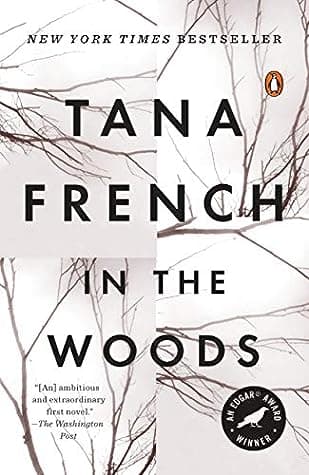
Tana French (2007)
Genre
Thriller / Mystery
Reading Time
9-10 hours
Key Themes
See below
Sign in to track this book
Twenty years after being the sole, amnesiac survivor of three children who vanished into the woods, a detective must confront his own shattered past when a new murder in the same woods reopens the chilling, unsolved mystery of his childhood.
In the summer of 1984, in the Dublin suburb of Knocknaree, twelve-year-old Adam Ryan and his two best friends, Peter and Jamie Machin, go into the local woods. When dusk falls, only Adam is found. He grips a tree trunk, his sneakers soaked with blood, and has no memory of what happened to Peter and Jamie, or to himself during the missing hours. The police investigation yields no clues to the disappearance of the Machin children. Adam is adopted by a new family, changing his name to Rob Ryan to escape his past. The incident becomes a local legend, an unsolved mystery that haunts the community.
Twenty years later, Rob Ryan is a detective with the Dublin Murder Squad. He keeps his past a secret, sharing it only with his partner and closest friend, Detective Cassie Maddox. Their professional and personal lives are intertwined. A new case emerges that shatters Rob's carefully constructed life: 12-year-old Katy Devlin is found murdered on an archaeological dig site in the same Knocknaree Woods where Rob's friends vanished. The site is close to the exact spot where Rob was found, drawing him back to his repressed trauma and the unresolved mystery of his childhood.
Despite the clear conflict of interest, Rob insists on taking the lead on the Katy Devlin case, concealing his true identity from his superiors, with Cassie's reluctant support. They move into a house in Knocknaree to immerse themselves in the investigation. Rob's return to the familiar, yet unsettling, landscape triggers fragmented memories and intense emotional responses. The local community, including Katy's parents, a university lecturer named O'Kelly, and other residents, are wary of the new detectives, especially as the shadow of the 1984 disappearances hangs over their present tragedy. Rob struggles to maintain his composure and objectivity.
Rob and Cassie look into Katy Devlin's life, discovering she was a talented ballet student with a complex social circle. They interview her parents, Margaret and Jonathan Devlin, and her older sister, Jessica, who seems resentful of Katy. Suspects emerge, including Katy's ballet teacher, a local recluse named Shane, and members of the archaeological team led by Dr. O'Kelly, who had been excavating near the murder site. The team also discovers that Katy was part of a secret club with other local children, complicating the investigation and revealing hidden tensions within the community.
As the investigation progresses, Rob's repressed memories begin to surface in vivid, disturbing flashes. He becomes erratic, obsessive, and prone to emotional outbursts, alienating potential witnesses and colleagues. His judgment is clouded by his personal connection to the woods and the past. Cassie, deeply concerned for Rob, tries to shield him and keep the case on track, but his behavior strains their professional partnership and deep friendship. She fears his obsession with the 1984 case is overshadowing the current murder, and that his secret will be exposed, ruining both their careers.
Further investigation into the Devlin family reveals a dysfunctional dynamic. Jessica, Katy's older sister, is intensely jealous of Katy's talent and attention. Jonathan Devlin, Katy's father, appears overly protective, while Margaret Devlin is withdrawn and seemingly detached. The detectives uncover evidence of a secret diary kept by Katy, which hints at conflicts within her family and perhaps a forbidden relationship or a secret she was keeping. These revelations suggest that Katy's life, despite its outward appearance of normalcy, was fraught with tension and hidden struggles, potentially leading to her tragic end.
Dr. O'Kelly, the lead archaeologist, introduces the theory of ancient human sacrifice rituals in the woods, proposing that the site holds historical and perhaps spiritual meaning. He discusses the concept of 'liminal spaces' and the woods as a place between worlds. Rob becomes fixated on this idea, seeing parallels to his own experience. The police discover that Katy had been helping O'Kelly with his research, spending time alone with him at the dig site. This raises suspicions about O'Kelly's involvement, especially as his academic ambitions and theories become intertwined with the murder investigation.
Rob's memories of 1984 become clearer, revealing a terrifying encounter in the woods. He recalls seeing Peter and Jamie with an older, menacing figure, and a sense of danger that caused him to dissociate. Meanwhile, the investigation into Katy's murder intensifies. Through interviews and collected evidence, it is revealed that Katy's death was a desperate act by her sister, Jessica, who felt overshadowed and unloved. Jessica, in a fit of rage and jealousy, pushed Katy, causing her to hit her head and die. The 'sacrifice' theory proves to be a red herring, though the woods retain their symbolic power.
With Katy's murder solved, Rob must face the full implications of his actions during the investigation. His superiors discover his true identity and his concealment of his past, leading to his immediate dismissal from the Dublin Murder Squad. The truth about Peter and Jamie's disappearance remains elusive, but Rob's journey has brought him closer to understanding his own trauma. The revelation of his identity also strains his relationship with Cassie, who feels betrayed by his lack of transparency and the professional risk he forced her to take.
Despite Rob's deep dive into the woods and his fragmented memories, the ultimate fate of Peter and Jamie Machin remains an enigma. The book concludes without a definitive answer to their disappearance in 1984. Rob's memories suggest a malevolent presence, but no concrete evidence or perpetrator is identified. This unresolved mystery highlights the enduring power of trauma and the limitations of memory, leaving Rob with a profound sense of loss and an understanding that some truths may forever remain buried in the woods, like the children themselves.
The Protagonist
From a seemingly stable detective with a hidden past, Rob descends into an obsessive, self-destructive quest for truth, ultimately losing his career but gaining a clearer, albeit painful, understanding of his trauma.
The Supporting
Cassie starts as Rob's unwavering support, but her trust is eroded by his self-destructive behavior and secrets, leading her to question their partnership and their future.
The Victim (central to the plot)
As a murder victim, her 'arc' is revealed posthumously, showing her transition from a seemingly innocent child to a complex figure with hidden struggles, whose death exposes the dark undercurrents of her family and community.
The Antagonist/Supporting
From a seemingly grieving sister, Jessica is unmasked as the perpetrator, her character arc revealing the destructive power of sibling rivalry and neglect.
The Supporting
Initially a prominent suspect, O'Kelly's role shifts from potential murderer to a symbolic figure whose theories reflect the novel's themes of ancient power and hidden truths.
The Supporting
Jonathan's character arc reveals the cracks in his family's facade, showing him as a father whose attempts at protection may have contributed to his daughters' struggles.
The Supporting
Margaret's arc reveals her as a woman stifled by her family's dysfunction and her own emotional repression, gradually hinting at the deep-seated issues within the Devlin household.
The Mentioned/Catalyst
Their 'arc' is entirely retrospective, their disappearance serving as the inciting incident for Rob's journey, and their unresolved fate highlighting the novel's themes of lost innocence and elusive truth.
The novel explores how memory is subjective, fragmented, and often unreliable, especially when dealing with trauma. Rob Ryan's inability to recall the events of 1984 is central to his character and the plot. His journey to solve Katy Devlin's murder becomes a parallel quest to unlock his own buried past, but even at the end, the full truth of the Machin children's disappearance remains elusive. The narrative constantly reminds the reader that what we remember, and what we choose to forget, shapes our reality, and that some truths may simply be beyond our grasp. This is evident in Rob's struggle with his dissociative amnesia and the conflicting accounts of the 1984 incident.
“The past is a living thing, and it can reach out and grab you when you least expect it.”
Trauma, particularly childhood trauma, is a pervasive theme, manifesting in Rob Ryan's entire adult life. His repressed memories of the 1984 incident dictate his career, his relationships, and his fragile mental state. The return to Knocknaree Woods triggers a severe emotional and psychological breakdown, showing how unresolved trauma can lie dormant for decades only to resurface with devastating force. The novel shows how trauma affects not just the individual but also ripples out to impact relationships and professional lives, as seen in Rob's deteriorating partnership with Cassie.
“Sometimes the past is a dark, heavy thing that swallows you whole.”
Rob Ryan's entire adult identity is a carefully constructed façade, built to distance himself from Adam Ryan, the traumatized boy found in the woods. He actively deceives his colleagues and even himself about his past, believing he can escape its shadow. This theme explores how we create and maintain our identities, and the psychological cost of living a lie. His self-deception about his true role in the Katy Devlin case, and his inability to separate himself from his past, ultimately leads to his downfall, forcing him to confront who he is, or who he has become.
“I was Adam Ryan. And Adam Ryan was dead. Or so I'd told myself for twenty years.”
Secrecy permeates the novel, from Rob's hidden past to the unspoken tensions within the Devlin family and the wider Knocknaree community. The constant act of concealing truths, whether personal or communal, leads to suspicion, distrust, and destructive consequences. Rob's secret identity jeopardizes his career and his relationship with Cassie. The Devlin family's efforts to maintain an image of normalcy, while harboring deep-seated resentments and neglect, directly contribute to Katy's murder. The novel suggests that secrets, no matter how well-guarded, inevitably fester and explode.
“Secrets are like wounds. They fester if you don't expose them to the air.”
The Knocknaree Woods itself is a central character and powerful symbol in the novel. It is simultaneously a place of childhood innocence and sinister darkness, a 'liminal space' where boundaries blur and the ordinary can become terrifying. The woods represent the unknown, the subconscious, and the repository of buried truths and forgotten traumas. Its unchanging presence over twenty years highlights the enduring nature of the past and its ability to reclaim those who try to escape it. The archaeological dig further emphasizes the layering of history and mystery within the landscape.
“The woods were still there, the same as they'd always been, holding their secrets tight.”
Rob Ryan's inability to recall his childhood trauma is the central mystery.
This device is crucial to the plot, as Rob Ryan's dissociative amnesia regarding the 1984 incident drives his character arc and the overarching mystery. His fragmented memories resurface throughout the investigation, providing tantalizing but unreliable clues. The amnesia creates suspense, as the reader, like Rob, is desperate to uncover the truth. It also serves to explore themes of trauma and the unreliability of memory, forcing Rob to confront the psychological impact of his past.
The story is told from Rob Ryan's subjective and increasingly unstable perspective.
Rob Ryan serves as the unreliable narrator, particularly as his mental state deteriorates. His personal connection to the case, his repressed trauma, and his emotional instability color his perceptions and interpretations of events. The reader experiences the investigation through his biased lens, making it difficult to discern objective truth from his subjective reality. This device enhances the psychological suspense and reinforces the theme of the elusiveness of truth, as the reader must constantly question Rob's judgment and sanity.
The current murder case mirrors and intertwines with a past unsolved mystery.
The novel cleverly uses parallel investigations, where the present-day murder of Katy Devlin directly mirrors and is deeply intertwined with the unsolved disappearance of Peter and Jamie Machin in 1984. This structural device creates a powerful sense of déjà vu and escalating tension. It allows Rob to investigate his own past while ostensibly solving a new case, creating a personal and professional conflict that drives the narrative. The parallels highlight the enduring nature of trauma and the idea that history can repeat itself.
Cassie Maddox acts as a rational counterpoint to Rob Ryan's emotional instability.
Cassie Maddox functions as a foil to Rob Ryan. While Rob is driven by emotion, haunted by his past, and increasingly erratic, Cassie is pragmatic, logical, and focused on procedure. She represents the objective, professional detective, contrasting with Rob's subjective and self-destructive approach. Her presence highlights Rob's descent, providing a measure of his unraveling and underscoring the dangers of his actions. Their strained relationship, born from this contrast, is central to the emotional core of the story.
“The past is a place, a country, and you can't go home again. Not ever.”
— Rob Ryan reflecting on his childhood trauma and the impossibility of returning to an innocent state.
“There are two things that can make you a legend: being dead, or being a rock star.”
— Cassie Maddox considering the nature of fame and how it's achieved.
“We are all of us, in the end, alone.”
— Rob Ryan's recurring existential dread and sense of isolation.
“The woods were always there, waiting. And the woods remember.”
— Rob Ryan's haunting memories of the Knocknaree woods and their role in his childhood disappearance.
“Some things, once you've seen them, you can't unsee.”
— Rob Ryan grappling with disturbing evidence and the lasting impact of his investigations.
“We were good at lies, Cassie and I. We understood them.”
— Rob Ryan reflecting on his and Cassie's shared ability to navigate deception, both personally and professionally.
“Every secret comes with a price.”
— The detectives uncovering layers of hidden truths within the Knocknaree community.
“Fear is a strange thing. It can make you do things you never thought you would.”
— Characters reacting to the escalating tension and danger in Knocknaree.
“Childhood is not a country, it's a house. And you can never go home again.”
— A variation of Rob's recurring theme about the irretrievable nature of his past.
“There’s a kind of peace in knowing you’re utterly fucked.”
— Rob Ryan's dark humor and resignation in the face of overwhelming personal and professional crisis.
“The truth is a mirror, and it's not always pretty.”
— The detectives confronting harsh realities and unpleasant revelations during their investigation.
“We build our lives on stories, and sometimes the stories are lies.”
— The unraveling of community narratives and personal facades in Knocknaree.
“The past isn't dead. It's not even past.”
— Rob Ryan's constant struggle with his unresolved childhood trauma impacting his present.
“It’s easier to live with a lie than to face the truth, sometimes.”
— A character's internal struggle with difficult revelations or maintaining a comforting illusion.
“Some cases get into your blood, and they don't let go.”
— Rob Ryan's personal connection to the Knocknaree case, mirroring his own past.
Ready to see how well you understood this book? Take our interactive quiz with 10 questions.

Biography coming soon.







