“Mickey in the Night Kitchen.”
— The opening line introducing the main character and setting.

Maurice Sendak (1889)
Genre
Fantasy / Children's
Reading Time
5 min
Key Themes
See below
Sign in to track this book
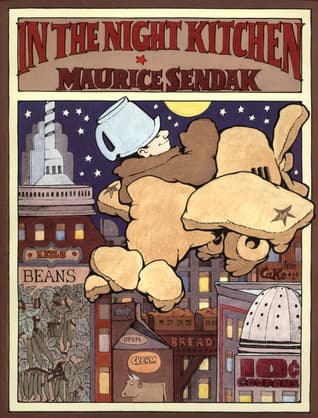
Young Mickey tumbles from his bed into a midnight kitchen where three bakers, oblivious to his presence, knead him into the morning cake, sparking an intoxicating, dreamlike escape.
The story opens with young Mickey in his bed, trying to sleep. He hears various noises at night — 'CRASH! BANG! WHANG!'. Annoyed, he tumbles out of bed and, as he falls, also tumbles out of his pajamas, landing naked in the dark. This sudden fall moves him from his bedroom into the Night Kitchen. He is curious and slightly bewildered, setting the stage for his dreamlike adventure.
After falling out of his clothes and bed, Mickey continues to fall through what looks like the night sky. He passes stars and the moon, falling quickly until he lands directly into a giant kitchen. This kitchen is busy and filled with huge appliances and ingredients. The change is smooth and surreal, showing the dreamlike quality of his journey. He is completely naked, a repeated detail that shows his vulnerability and innocence in this strange new world.
In the Night Kitchen, Mickey meets three enormous, identical bakers, all with mustaches and chef hats. They are busy making the morning cake. The bakers, who resemble Oliver Hardy, see Mickey and, mistaking him for milk, scoop him up. They plan to knead him into their dough, chanting 'Milk in the batter! Milk in the batter! We bake you and we bake you and we bake you to light!' Mickey is alarmed, realizing they intend to bake him alive. This introduces the main problem and immediate threat to Mickey.
The three bakers succeed in putting Mickey into their cake dough. He is kneaded and rolled, becoming part of the sticky mixture. This is a moment of great vulnerability for Mickey, as he is completely at the bakers' mercy. However, Mickey's quick thinking and resourcefulness appear. He manages to free himself from the dough, showing his ability to act even in this strange, threatening situation. His escape is a small victory, allowing him to regain some control over his situation.
After escaping the dough, Mickey uses his cleverness. He quickly shapes the remaining dough into an airplane. This act turns a potential weapon against him into a way to escape and gain power. The bakers, still unaware of his true identity and focused on their task, continue to bake. Mickey's ability to use his surroundings highlights his childlike imagination and problem-solving skills, turning a dangerous situation into an opportunity for adventure and freedom.
Mickey, now flying his dough airplane, soars through the large Night Kitchen. He flies past giant ovens, mixing bowls, and the unaware bakers. This scene is one of pure excitement and victory for Mickey. He is no longer a helpless ingredient but controls his own destiny, for a short time. His flight shows his escape from the bakers' control and his embrace of the fantastical possibilities of his dream world, showing his newfound freedom and joy.
As Mickey continues his flight, the three bakers finally realize that their 'milk' – Mickey – is missing. They discover their cake lacks the essential ingredient and is incomplete. Their initial confusion turns to frustration and a frantic search for the missing part. This provides a funny contrast to Mickey's joyful flight, highlighting their single-mindedness and the absurdity of their situation, while also showing how important Mickey's role is, even if accidental, in their baking process.
Understanding the bakers' problem and the need for milk to finish the morning cake, Mickey decides to provide it. He flies his dough plane up towards the giant milk bottle that makes up the kitchen's ceiling. With a powerful thrust, he breaks through the foil cap, causing milk to fall down, creating a 'Milky Way' that fills the cake batter. This act is a moment of generosity, as Mickey, having escaped danger, now ensures the success of the bakers' task.
With the milk now in the batter, the three bakers are very happy. They quickly finish mixing the dough and place the giant cake into the oven. The Night Kitchen is filled with the warmth and smell of baking. This scene means their nightly task is successfully completed, thanks to Mickey's help. The bakers' happiness contrasts with their earlier frustration, bringing a sense of resolution and satisfaction to their part of the story.
Having finished his role in the Night Kitchen, Mickey slides down from the sky, back through the night. He lands gently back in his own bed, slipping back into his pajamas as if he had never left. The sun is just beginning to rise, signaling the end of the night and his dream adventure. He is safe and sound, his journey complete, leaving the reader to think about the thin line between dreams and reality, and the strong imagination of a child.
The Protagonist
Mickey transforms from a passive victim into an active participant and hero, using his ingenuity to overcome challenges and even aid his former antagonists.
The Antagonist/Supporting
The bakers remain largely static, their primary function being to create the conflict and setting for Mickey's adventure, ultimately achieving their goal thanks to Mickey.
The entire story explores a child's dream world, where ordinary things (nighttime noises, a kitchen) become extraordinary. Mickey's journey shows how imagination helps children process experiences, overcome fears, and find their place in fantasy. The Night Kitchen itself is a dream, a place where reality's rules disappear, and a child can fly a dough airplane. This theme is central, suggesting that dreams are not just an escape but a key part of a child's mind.
“And the world was made of bread and milk and things.”
Mickey's nakedness throughout much of the story shows his vulnerability and innocence, especially as he falls into the Night Kitchen and is almost baked into a cake. This initial helplessness, however, quickly turns into strength. He uses his intelligence and creativity to escape the bakers, build a dough airplane, and become the hero who provides the missing ingredient. His journey shows a child's ability to overcome difficult situations and gain control, changing from a potential victim into a resourceful protagonist.
“I'm not milk and I'm not dough! I'm Mickey!”
Sendak skillfully turns common elements of a child's world – a kitchen, milk, bread, nighttime sounds – into objects of wonder and adventure. The Night Kitchen is a super-sized version of a familiar place, where ordinary ingredients become tools for flight or sources of danger. This theme encourages readers to see the magic in their surroundings, showing how a child's view can give everyday things special meaning and potential for adventure, making the familiar feel new and exciting.
“Then all the world was warm and sweet and smelled of cake.”
Mickey's adventure shows the resourcefulness and independence of children. He faces a difficult challenge alone, without adult help, and solves his problems using his own cleverness. He doesn't panic but thinks creatively, turning dough into a way to escape. His decision to help the bakers by providing the milk, despite their earlier attempts to bake him, further highlights his self-reliance and active nature, showing a child's ability to act and solve problems.
“And he made a plane. And he flew!”
The narrative operates on the fluid, non-linear, and often absurd rules of a dream.
The entire story unfolds as a dream, allowing for seamless transitions between reality and fantasy, and for events to occur without logical explanation. Mickey falls out of his clothes and bed directly into a giant kitchen in the sky. Bakers mistake him for milk, and he builds an airplane out of dough. This device creates a sense of wonder and unpredictability, immersing the reader in Mickey's subjective experience where anything is possible, mirroring the imaginative world of a child's subconscious.
Mickey's lack of clothing symbolizes his vulnerability and innocence.
Mickey is naked for the majority of his adventure in the Night Kitchen. This isn't merely for comedic effect; it serves as a powerful symbol of his childlike innocence, vulnerability, and primal state as he navigates a strange and potentially threatening world. It strips him of all external defenses, emphasizing his raw, unadulterated self as he faces the bakers and finds his own solutions, making his eventual empowerment feel even more significant.
Inanimate objects and concepts are given human-like qualities or significance.
While not strictly anthropomorphic characters, the kitchen itself and its ingredients take on a life of their own. The milk bottle becomes a sky-high structure, the dough is a malleable substance for escape, and even the 'Night Kitchen' acts as a character in its own right, a bustling, living entity. This device enhances the magical realism, transforming ordinary items into active participants in Mickey's adventure and making the setting feel vibrant and alive.
Mickey's physical journey through the Night Kitchen represents a psychological journey of growth.
Mickey's descent into the Night Kitchen and his subsequent flight and return are not just literal movements but also represent an internal transformation. He begins as a passive, vulnerable figure and, through his experiences, develops ingenuity, courage, and a sense of agency. The journey through the 'dark' and into a place of creation (the kitchen) can be seen as a metaphor for navigating fears and discovering inner strength, culminating in his confident return to his bed.
“Mickey in the Night Kitchen.”
— The opening line introducing the main character and setting.
“And the world was made of milk and bread.”
— Describing the fantastical landscape of the Night Kitchen.
“Up to the top, past the Milky Way, and right into the dough.”
— Mickey's journey as he is incorporated into the bakers' plans.
“I'm not the milk and I'm not the butter, I'm Mickey!”
— Mickey asserting his identity against the bakers' attempts to bake him.
“He fell out of his clothes and down he tumbled.”
— Mickey's initial descent into the Night Kitchen.
“They were three fat bakers and they looked exactly alike.”
— Describing the main antagonists, the bakers.
“We need milk! We need milk! Milk for the morning cake!”
— The bakers' urgent chant, driving the plot.
“And Mickey, naked, flew at the bakers.”
— Mickey's brave and defiant action against the bakers.
“He found a plane made of dough and flour.”
— Mickey constructing his escape vehicle.
“He flew up to the top, past the Milky Way.”
— Mickey's aerial journey to find the missing milk.
“He found the biggest bottle of milk in the sky.”
— Mickey successfully locating the giant milk bottle.
“Spilling and splashing and tumbling and crashing.”
— The chaotic action of Mickey pouring the milk into the bowl.
“And that's why we have cake every morning.”
— The concluding line, explaining the origin of morning cake.
“I'm not the butter, I'm Mickey!”
— Mickey's repeated declaration of self, slightly varied.
Ready to see how well you understood this book? Take our interactive quiz with 10 questions.
Biography coming soon.







