“The thing about remembering is that you don't forget.”
— Speaking about the persistence of memory, especially of traumatic events.

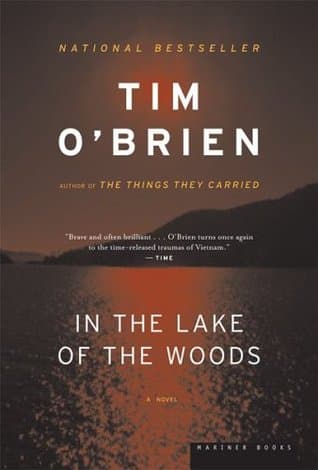
Tim O'Brien (1994)
Genre
Literary Fiction / Historical Fiction / Mystery
Reading Time
600 min
Key Themes
See below
Sign in to track this book
A Vietnam veteran, haunted by jungle horrors and political ruin, faces his wife's disappearance from their remote lakeside cabin, where dark currents from the past threaten to consume them.
John Wade loses the Minnesota Democratic primary for the U.S. Senate. This happens because of stories about the My Lai massacre and his hidden past as 'Sorcerer' in Vietnam. He and his wife, Kathy, go to a remote cabin on Lake of the Woods. John, a magician, hopes to fix their relationship and escape the media. Kathy is upset and withdrawn because of John's exposed secrets and his evasiveness. The lake's isolation, meant to be a safe place, instead makes their existing tensions worse, setting a grim mood for their stay.
Days into their retreat, Kathy Wade disappears from their cabin. John wakes to find her gone, along with their boat and the gas can, but no signs of a struggle. He reports her missing. This starts a search involving local police, including Sheriff Polson, and a private investigator, Tony Carbo. The lack of clear evidence and John's history of secrecy quickly make him the main suspect. The story then mixes the current investigation with parts of John's past, official papers, and speculative chapters. This creates an atmosphere of uncertainty and suspicion around Kathy's disappearance.
John Wade's political campaign for the U.S. Senate fails when a newspaper uncovers his true identity and his role in the My Lai massacre. His birth name was John "Sorcerer" Wade. He was a helicopter pilot during the Vietnam War and was at My Lai, but his records were sealed and his identity changed. This revelation ruins his public image and shows his lifelong pattern of lying, especially his efforts to hide his past from Kathy. This exposure leads to their retreat to Lake of the Woods and the events that follow. It shows how much his past affects his present life and relationships.
The story describes John Wade's childhood. He had a distant, alcoholic father and a loving, overprotective mother. From a young age, John became interested in magic. He used it to cope, to control his surroundings, and to escape reality. He learned tricks and developed a persona that hid his insecurities. This period shows his pattern of evasion and manipulation. It explains how magic became his main tool for dealing with the world, both personally and professionally, and sets the stage for his adult deceptions and the mystery around Kathy's disappearance.
Sheriff Polson leads the official search for Kathy. At first, he thinks she might have drowned by accident or run away. But as days pass and no trace of Kathy or the boat is found, suspicion falls more and more on John. Tony Carbo, a private investigator hired by Kathy's sister, starts his own, more aggressive investigation. He digs into John's past and interviews locals. The novel offers various theories through these investigations: Kathy's accidental death, her deliberate disappearance, or John's direct involvement. The conflicting evidence and John's unreliability make it impossible for the investigators—and the reader—to know what happened.
As the search for Kathy continues, John Wade's mental state worsens. He has vivid hallucinations, flashbacks to Vietnam, and increasing paranoia. He feels watched and judged. His carefully built life of illusion begins to fall apart. He struggles to tell reality from his distorted perceptions. He replays conversations with Kathy, looking for clues, and is tormented by guilt over his past lies. His inner turmoil is a main focus. It shows the psychological cost of his secrets and the ambiguity of his character, making readers question his sanity and guilt.
The story describes John Wade's time in Vietnam. He earned the nickname 'Sorcerer' because of his magic tricks and his ability to seemingly disappear and reappear. He was a helicopter pilot, often carrying bodies and seeing the horrors of war. The chapters explore the psychological effect of his experiences, including his presence at My Lai. His direct involvement in the massacre remains vague. The war deeply shaped his character, encouraging his detachment, his use of illusion, and his capacity for violence. All of these contribute to the mystery around Kathy's disappearance.
The cabin on Lake of the Woods was meant to be a safe place, but it becomes a psychological test for John Wade. Isolated, he must confront his past deceptions, his guilt over My Lai, and his failing marriage. The lake's silence and vastness reflect his inner emptiness and the unknowable nature of Kathy's fate. The cabin, filled with memories and Kathy's presence, becomes a stage where John performs his final, desperate acts of self-deception and delusion, blurring the lines between reality and his fractured mind.
Tim O'Brien often includes chapters titled 'How to Tell a True War Story' and 'Hypothesis.' He speaks directly to the reader and presents many theories about Kathy's disappearance, which often contradict each other. These sections explore possibilities like accidental drowning, Kathy deliberately running away, John murdering her, or even her surviving in the wilderness. This technique highlights the ambiguity of truth, the unreliability of memory, and the limits of human understanding. It forces readers to face their own biases and the subjective nature of storytelling.
Overwhelmed by the investigation, his guilt, and increasingly vivid hallucinations of Kathy, John Wade eventually leaves the cabin. He takes the remaining boat and goes deeper into the wilderness of Lake of the Woods. His escape becomes more and more tied to his worsening mental state. He imagines Kathy with him, comforting him, confirming his belief that she is still alive and has chosen to disappear. His journey becomes a descent into a private, self-made reality. There, magic and illusion offer a final, desperate refuge from the unbearable truths of his past and the uncertainty of Kathy's fate.
The novel ends without a clear answer to Kathy Wade's disappearance. Her body is never found, nor is the second boat. John Wade himself vanishes into Lake of the Woods; his ultimate fate also remains unclear. The various theories—murder, accidental death, deliberate disappearance—are all presented, but none are confirmed. This lasting mystery emphasizes the novel's main themes: the elusiveness of truth, the destructive power of secrets, and the lasting impact of war and personal deception. Readers are left with unsettling uncertainty, much like the characters in the story.
Beyond the immediate mystery, the novel explores the psychological and moral legacy of the Vietnam War, especially through John Wade's experiences at My Lai. His direct actions in the massacre are never fully confirmed, but his presence and the subsequent cover-up deeply shape his life, identity, and relationship with Kathy. The war is shown as a source of trauma, moral compromise, and a reason for John's lifelong pattern of deception. The My Lai incident is a symbolic wound, festering beneath his life and ultimately contributing to the tragic events at Lake of the Woods.
The Protagonist/Antagonist
John's arc is a tragic descent into delusion and self-destruction as his carefully constructed life unravels, forcing him to confront the unbearable truths of his past and the ambiguity of his present.
The Supporting/Central Mystery
Kathy's arc is one of silent suffering and ultimate, unresolved disappearance, leaving behind a profound void and an unanswerable question.
The Supporting
Polson's arc shows his increasing frustration as the case remains unsolved, highlighting the limits of conventional investigation when faced with a master deceiver and an ambiguous situation.
The Supporting
Carbo's arc is one of determined pursuit, showcasing his unwavering belief in John's guilt, even as definitive proof remains elusive.
The Supporting/Meta-Narrative
The narrator's arc is one of persistent questioning, guiding the reader through the complexities of truth and fiction without ever providing a definitive answer.
The Mentioned
Not applicable, as Calley is a historical reference rather than a developing character.
The Mentioned
Not applicable, as her role is limited to flashbacks, shaping John's early development.
The novel shows how truth is subjective, hard to grasp, and often hidden by memory, trauma, and lies. Through the many 'Hypothesis' chapters and conflicting accounts of Kathy's disappearance, O'Brien makes readers face the impossibility of knowing what 'actually' happened. John Wade's entire life rests on illusion, from his magic tricks to his made-up past, making him an unreliable narrator. The uncertainty around Kathy's fate, John's guilt, and even the details of My Lai highlights how objective truth can be lost in the fog of war, personal trauma, and the desire for self-preservation. The narrator's direct comments challenge readers to accept that reality can remain unresolved.
“How do you separate what happened from what seemed to happen? What's the difference between a story that's true and a story that's accurate?”
John Wade's life shows the damaging effect of secrets and lies. His hidden past in Vietnam, especially his involvement (or presence) at My Lai, and his attempts to change his identity and hide the truth, eventually destroy his political career and his marriage. His lifelong use of magic and illusion, at first a way to cope, becomes a pattern of deep dishonesty. This isolates him from Kathy and prevents true closeness. The exposure of his secrets leads to Kathy's disappearance, whether she fled, was murdered, or died by accident. The novel suggests that while secrets might offer temporary protection, their eventual discovery has devastating results, unraveling lives and relationships.
“He knew it was a terrible thing to hide a life. A terrible thing to be hidden from.”
The novel explores the lasting psychological and moral trauma of the Vietnam War, especially through John Wade's character. His experiences as 'Sorcerer' in Vietnam, seeing atrocities and being at My Lai, leave him deeply scarred. He has flashbacks, paranoia, and a detachment from reality, made worse by the investigation's pressure. The war is not just history but a wound that continues to shape his perceptions, his capacity for violence, and his inability to handle truth. The novel suggests that war's horrors can change people, creating a deep darkness that can appear years later in unexpected and destructive ways, blurring the lines between soldier and civilian, sanity and madness.
“He brought the war home, he brought it to bed, he brought it to the dinner table. He brought it to the campaign trail. It was in his blood.”
The relationship between John and Kathy Wade is a central emotional part of the novel. It is a deep, though flawed, love that John's constant deception ultimately undermines. Kathy loves John, but his secrets, evasiveness, and the public shame of his past being exposed slowly wear down that love. Her disappearance can be seen as the ultimate betrayal, either by John or by her own choice to escape a marriage built on lies. The novel explores how love, even strong love, cannot survive a foundation of chronic dishonesty, and how betrayal's pain can lead to desperate acts or tragic outcomes. Their bond, once a comfort, becomes a source of torment and unresolved grief.
“He loved her, yes, but he also loved the idea of her, the way she completed his illusions.”
John Wade's perspective is consistently clouded by his mental state, secrets, and magical thinking.
John Wade serves as a highly unreliable narrator. His lifelong practice of magic and illusion, his history of deception, his deteriorating mental state, and his desperate need to control perceptions mean that his version of events cannot be fully trusted. The reader is constantly forced to question his memories, his interpretations, and his direct accounts, especially regarding Kathy's disappearance. This unreliability is a core mechanism for generating the novel's central mystery and reinforces the theme of the elusiveness of truth, making the reader an active participant in discerning what might have happened.
The authorial voice directly addresses the reader, discussing the nature of storytelling and truth.
Tim O'Brien frequently breaks the fourth wall with chapters titled 'How to Tell a True War Story,' 'Hypothesis,' and 'Authorities Speak.' These sections feature an authorial voice that directly addresses the reader, discussing the challenges of recounting events, the subjective nature of memory, and the multiple possibilities surrounding Kathy's disappearance. This meta-narrative device serves to deconstruct the traditional novelistic expectation of a definitive truth. It highlights the constructed nature of stories and invites the reader to critically engage with the process of interpretation, underscoring the novel's central theme that some mysteries are inherently unsolvable.
The novel deliberately withholds a definitive resolution, offering several plausible but unconfirmed scenarios.
The most prominent plot device is the pervasive ambiguity surrounding Kathy Wade's disappearance and John Wade's ultimate fate. The novel presents various 'hypotheses' for what happened—accidental drowning, deliberate disappearance, or murder by John—but never confirms any of them. This deliberate lack of resolution forces the reader to confront the unknowable and challenges the conventional desire for closure. It mirrors the real-life experience of unsolved mysteries and the lasting psychological impact of uncertainty, reinforcing the novel's thematic exploration of truth's elusiveness and the enduring scars of war and deception.
Non-linear storytelling using past events, official reports, and fictional interviews.
The narrative structure is non-linear, interweaving present-day events at Lake of the Woods with extensive flashbacks to John Wade's childhood, his time in Vietnam, and his political career. Additionally, the novel includes fictional 'evidence' such as official reports, excerpts from books, and interview transcripts. This fragmented approach mirrors John's fractured psyche and the piecemeal way truth is often discovered (or obscured). It allows the author to gradually reveal John's complex past and motivations, while simultaneously highlighting the difficulty of forming a complete, coherent picture from disparate and often contradictory sources, contributing to the overall sense of mystery and unreliability.
“The thing about remembering is that you don't forget.”
— Speaking about the persistence of memory, especially of traumatic events.
“He would spend the rest of his life trying to remember, trying to forget.”
— Referring to John Wade's internal struggle with his past.
“How do you explain the unexplainable?”
— A recurring question regarding the mystery of Kathy's disappearance.
“Love is a process, not a state.”
— Reflecting on the nature of John and Kathy's relationship.
“War is like a fire—you can’t put it out, it just burns itself out.”
— John Wade's internal thoughts on the lasting impact of the Vietnam War.
“The truth, like a cat, will find its way home.”
— A hopeful but also ominous statement about the inevitability of truth.
“What matters is not what you know, but what you can prove.”
— Discussing the legal and public perception of John Wade's innocence or guilt.
“Sometimes you have to invent what you need to know.”
— Highlighting the human tendency to create narratives to fill gaps in knowledge.
“He was a magician, after all, and magicians trade in illusions.”
— Referring to John Wade's past profession and his ability to manipulate perception.
“The past is never dead. It's not even past.”
— A variation of Faulkner's famous line, applied to the inescapable grip of history.
“We're all just trying to make sense of things that don't make sense.”
— A general reflection on the human condition when faced with inexplicable events.
“There are things you can't outrun, no matter how fast you are.”
— John Wade's realization about his past catching up to him.
“A good story, in the end, is about what you leave out.”
— A meta-commentary on storytelling and the deliberate omissions in narratives.
“The heart has its reasons of which reason knows nothing.”
— Reflecting on the irrational aspects of human emotion and behavior.
“He understood that fear was a kind of magic, too, a spell that could transform the ordinary into the extraordinary.”
— John Wade's internal thoughts on the power of fear to alter perception and reality.
Ready to see how well you understood this book? Take our interactive quiz with 10 questions.

Tim or Timothy O'Brien may refer to:







